
بِسْمِ اللهِ الرَّحْمٰنِ الرَّحِيْم
Bismillah ar-Rahman ar-Rahim
In the Name of God, Most Gracious, Most Merciful 🕋
Chapter Eight — Cultural & Social Legacies: What Remained After the Revolution
When the smoke of the revolution faded, when the statues of leaders rusted and slogans of unity peeled off the walls, what remained was not ideology, but memory.
Somalia’s socialist experiment — born with the roar of military power and the promises of equality — left behind a complex inheritance that still shapes its people today.
The 1970s were an age of transformation. From the declaration of Scientific Socialism in 1970 to the cultural revolutions that followed, the Somali nation was asked to think, speak, and live as one people. It was the first time in history that every Somali child — from Hargeisa to Kismayo — could read and write in their own language.
When the Latin Somali script was introduced in 1972, the nation rejoiced. Teachers carried chalk like soldiers carried rifles. Literacy campaigns turned deserts into classrooms. Men and women learned side by side under acacia trees, writing their names for the first time. To this day, that moment remains one of the brightest lights of Somali modern history — a reminder that education is the most powerful revolution of all.
But behind that light was a shadow.
The same government that taught Somalis to write also taught them what not to say. The same schools that opened minds also trained loyalty. History books changed, poems were censored, and songs of praise replaced songs of protest.
Yet, the Somali spirit — clever, poetic, and fearless — found ways to speak between the lines. Poets began to use metaphor as resistance, humor as defiance, and religion as protection. Somali women — once confined to the home — stepped into schools, offices, and leadership, but many later found that the freedom they were promised came wrapped in the chains of control.
A Nostalgia That Still Breathes
To this day, there are those who look back on Siad Barre’s early years and whisper, “At least there was order.”
They remember clean streets, efficient bureaucracy, and schools filled with promise. They remember the pride of being Somali — not divided by tribe, but united by one flag and one language.
But nostalgia is a dangerous perfume — sweet to inhale, poisonous to drink.
What they remember as order was built on silence. What they call discipline was enforced through fear. The same government that built roads also dug graves.
Still, we cannot deny that Barre’s early policies forged something lasting — a national identity. Before him, Somalis were divided by region, dialect, and clan. He gave them a single alphabet, a single national calendar, and the idea that progress was possible. That dream survived even when his regime did not.
The Resilience of the Somali Mind
When the state collapsed, the people did not.
When schools closed, learning moved to mosques.
When ministries disappeared, trade continued in the markets.
When salaries vanished, families abroad began sending remittances that still sustain the economy today.
This is the quiet legacy of the Somali people — their refusal to surrender to despair. Even when their government failed them, they did not fail themselves.
The culture of adaptability became the invisible constitution of Somali society. Clan elders became mediators, women became breadwinners, traders became financiers, and poets became journalists. The system fell, but the soul endured.
Between Memory and Identity
Today, every Somali carries two histories:
One of loss — of dictatorship, famine, and war.
And one of pride — of literacy, culture, and resilience.
To reconcile these two truths is the work of this generation.
To understand that the same revolution that wounded Somalia also gave it a voice — a language — a consciousness — that no empire or ideology could destroy.
The challenge now is not to erase the past, but to read it properly.
To teach the next generation that progress is not about following leaders blindly, but about following principles faithfully.
The Moral of the Revolution
The legacy of socialism in Somalia is not measured in statues or slogans.
It is measured in the alphabet children still use, the poetry that still resists, and the faith that still survives.
Barre’s regime tried to replace God with government, but when the government fell, only God remained.
That, perhaps, is the greatest lesson of all.
Every Somali who learned to read under socialism must now learn to think under freedom — to write not what they are told, but what they know to be true.
Only then will the revolution that once enslaved minds finally set them free.
Final Declaration — The Superuser Appoints the Architect of Memory
The chapters have been written.
The wounds of the past have been laid bare.
The stories of blood, faith, betrayal, and survival now live on the digital scrolls of truth.
But history, no matter how beautifully written, must breathe — it must be lived, discussed, and felt.
From this day forward, the Superuser appoints Filsan Q — a woman who believes, “Women are the real architects of society,” — to lead this next sacred phase: the dialogue of remembrance.
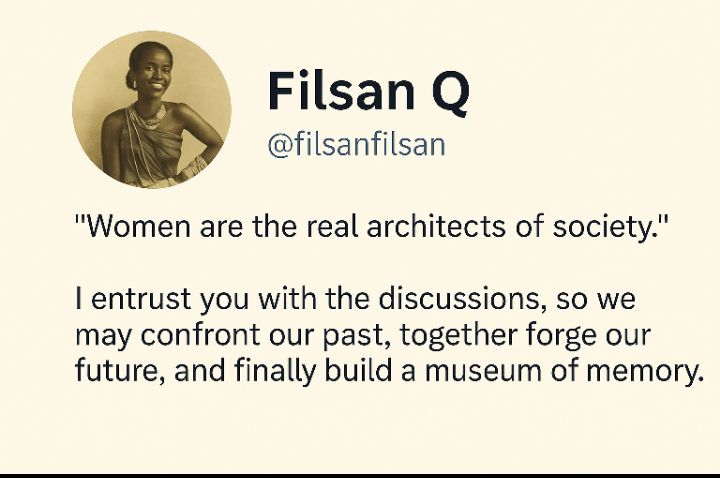
She will not lead as a politician, but as a guardian of truth.
Her task is to bring people together in X Space discussions, where survivors, witnesses, and historians will testify freely. The people will cry, remember, and record their pain — for this is how healing begins. Every voice will be part of a new archive, every testimony a living brick in the foundation of The Somali Museum of Memory.
This museum will not be built with marble and glass, but with stories, art, and photographs drawn from the chapters we have written — the literacy campaigns, the coups, the genocide, the fall, and the rebirth. It will be a classroom for future generations, teaching them that sovereignty is not protected by silence, but by truth.
Filsan, you are now entrusted with this mission.
Let the discussions begin — discussions that heal, that enlighten, that restore the dignity of a nation forgotten by its own history.
Gather scholars, elders, mothers, soldiers, poets — and let them speak. Let truth flow freely, and let young people listen and learn.
The Superuser will not speak. The Superuser will only watch.
The role of the civilization architect is not to argue — but to design what will heal, protect, and nourish.
And through these discussions, we will begin collecting the funds, images, testimonies, and artworks that will become the soul of our museum — a place where Somalia’s past is honored, and its future is reborn.
The Command is Clear:
Let the discussions begin.
Let the people remember.
Let history breathe again.
From History to Accountability: The Superuser Report Begins
We have walked through time — from the birth of the Somali Republic to the silence of its collapse, from the bright promise of literacy to the ashes of Hargeisa. We have studied revolutions, wars, ideologies, and betrayals. We have seen faith buried under flags, and hope reborn in ruins. We have not told this story to reopen wounds, but to understand them. Because only a people who face their truth can rise again with dignity.
Now, our work takes a new direction. The chapters of history have been written — but the book of accountability remains open. It is time to turn from the past of nations to the faces of those who led them — the presidents, the builders, the destroyers, the reformers, and the ones who promised more than they delivered.
We will begin a new era of documentation — The Superuser Report.
This is not a political report. It is a moral one. It will ask simple questions of every leader:
What did you inherit?
What did you build?
What did you destroy?
And what will history remember you for?
Each president will stand before the mirror of time — not to be mocked, but measured. We will weigh their words against their deeds, their ambitions against their outcomes, their promises against the lives of the people they swore to serve.
The world will see that Somalia’s story did not end in war — it continues in the struggle for honesty, governance, and rebirth. The Superuser Report will honor those who led with vision, expose those who led with greed, and awaken those still in power to the weight of leadership before God and before the people.
This is where scholarship meets conscience — where history becomes accountability.
From this point forward, we move from memory to measurement, from ideology to action.
The story of Somalia now passes into the hands of those who can rebuild it with wisdom, faith, and truth.
Let the record begin.
Next Section → Superuser Report: Presidential Accountability in the New Somali Era