
بِسْمِ اللهِ الرَّحْمٰنِ الرَّحِيْم
In the Name of God, Most Gracious, Most Merciful 🕋
Perfect — here’s a bold, captivating opening paragraph to go with:
MCP and HTTP: The Protocols That Will
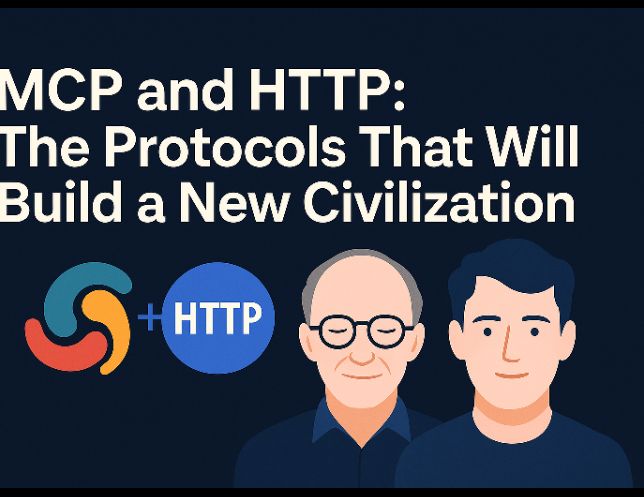
Build a New Civilization.
Civilizations are not built by monuments, armies, or governments — they are built by the invisible systems that connect people, ideas, and knowledge. In the 1990s, a quiet protocol called HTTP gave humanity a shared language for communication on the web. It was small, technical, and easily overlooked — yet it transformed isolated machines into a global network and turned information into the lifeblood of our modern world. Today, another protocol is emerging with the same silent power: MCP — the Model Context Protocol. Where HTTP connected websites and browsers, MCP connects intelligence itself — large language models, agents, tools, and data — creating a new fabric where AI doesn’t just answer questions, but builds, learns, acts, and collaborates. Together, these two protocols — one from the past, one from the future — form the hidden foundation of a new digital civilization now being born.
FYI CHAPTER 2 IN ONE UNDER MCP
From HTTP to MCP and the New Backend of AI
Every era of technology begins with a single, quiet breakthrough — not a flashy app, not a viral feature, but a protocol.
It’s never the part that makes headlines, yet it’s always the part that changes everything.
In the early days of the internet, that breakthrough was called HTTP. It was a simple agreement — a way for computers to talk to each other. But that simple protocol opened the door to something extraordinary: browsers could now speak to servers, websites could speak to users, and humanity could speak to itself across distance and time. That single layer of communication transformed the world.
Today, we are standing in front of the next HTTP moment. But this time, the protocol doesn’t connect machines — it connects intelligence. Its name is MCP — the Model Context Protocol. And it is the quiet, invisible layer that will define how AI thinks, acts, and interacts with the world.
🌐 The New Stack: LLM + Chat + MCP
To understand why MCP matters, you must first understand the new anatomy of intelligence.
At the top, you have the LLM — the large language model, the “brain.” It has been trained on billions of words, code, and ideas. It’s vast, powerful, and capable of reasoning at a scale no human mind can match.
Next, you have the chat layer — the “mouth.” It’s the interface where humans speak and machines reply. It’s the window we look through, the surface we touch.
But until recently, these two layers were like a browser with no internet — intelligent but isolated, capable but disconnected. That’s where MCP steps in. MCP is the bridge. It is the protocol that lets intelligence talk to the world — just as HTTP once allowed browsers to talk to servers.
🖥️ A Familiar Analogy: Browsers and the Web
Think about how you use the internet. You open a browser, type a URL, and a page appears. But what you see — the beautiful interface, the text, the images — is just the front-end.
Behind that simple screen, an invisible dance is happening:
Your browser sends a request using HTTP.
A server receives it, talks to a database, runs logic, and retrieves data.
That data is returned, processed, and displayed.
The part you see is just the tip of the iceberg. The real power lives underneath — in the back-end.
Now replace “browser” with “chat interface,” replace “server” with “agent,” and replace “HTTP” with MCP. That is the new architecture of AI.
🧠 Enter the Agents — The Builders of the Second Layer
Behind every intelligent conversation, a new class of digital workers is emerging: agents. These are specialized programs built to do things.
One agent might connect to a MongoDB database and retrieve sales numbers.
Another might run a financial model.
Another might analyze satellite data, write code, or send an email.
Each agent is like a web server — small, specific, and focused on a single job. And MCP is the language they all speak.
When a user asks a question in chat, the LLM doesn’t just generate text. It uses MCP to call the right agent, run the right query, and pull the right information — just like a browser reaching into a server. This is the backend of intelligence.
⚙️ The Power of the Backend — And Why It Matters
This second layer — the agent-tool-API layer — is where real power begins. It’s the place where questions become actions, where intelligence stops speaking and starts doing. And whoever builds, hosts, and controls this layer will decide:
🔐 What the AI is allowed to see
🛠️ What the AI is allowed to do
🧭 How the AI is allowed to behave
This is also where decentralization can finally become real. Just as anyone could host a web server and contribute to the early internet, anyone will soon be able to host their own MCP server, build their own agents, and run their own backend — creating private, sovereign AI ecosystems that belong to them.
🪐 The Beginning of a New Civilization Layer
This is why MCP is more than a technical specification — it’s a moment in history. It’s the same kind of moment that HTTP was in the 1990s: the quiet invention that rewires everything. It is the layer where intelligence meets action, where data meets agency, and where humans regain control of the tools they build.
Welcome to Chapter 3 — the story of how MCP transforms AI from a chatbot into an operating system for civilization. Here, we stop building apps and start building infrastructure. Here, we move from prompts to protocols, from outputs to orchestration, from users to builders. And from this point forward, the future will belong not to the ones who own the models — but to the ones who own the layers beneath them.
🌐 Conclusion: Before the Protocol, There Was Silence
There was a time — not very long ago — when the internet was nothing more than isolated machines. Computers existed, networks existed, even information existed. But they could not speak. They could not find each other. They could not share.
And then, a quiet man named Tim Berners-Lee wrote something small — just a protocol. A handful of rules that told one machine how to talk to another. He called it HTTP. It wasn’t flashy. It wasn’t hyped. Most people didn’t even know his name. But what he built changed everything.
With that single standard, browsers suddenly had a language. Servers suddenly had a way to listen. And the scattered islands of information that once floated alone became a global web — a fabric of communication that connected humanity itself.
Today, we stand at that same kind of moment again. MCP is not a product or a company. It is not an app or a feature. It is the quiet agreement that will allow intelligence itself to speak — not just to us, but to tools, to databases, to one another. It will do for agents what HTTP did for websites. It will turn a chaotic landscape of disconnected systems into an orchestrated network of thinking, acting, and collaborating machines.
So before we go forward, pause. Look back. Study the story of HTTP — the humble standard that built the modern world. Because to truly understand the revolution that is coming with MCP, you must understand that the most transformative technologies are rarely the loudest. They begin as whispers. They begin as protocols.
And once they are adopted, they become invisible — yet indispensable.
In the next chapter, we go inside that invisible layer. We’ll travel beyond the chat interface and into the beating heart of AI’s new backend — into the APIs, the databases, and the intricate dance that powers the next era of intelligent systems. This is where the story gets real. This is where you stop using AI — and start building it.
Here’s how I’d frame that — a short intro plus notes for students / readers to take away — and a teaser for what comes next.
🎥 Watch This
“Tim Berners-Lee: How This Guy Invented the World Wide Web 30 Years Ago”
Take a moment and watch that video. It’s a short reminder of how a simple protocol — HTTP — changed everything. Just like that, MCP is now poised to do the same for intelligence.
📝 Notes for Students & Curious Minds
HTTP was once unthinkable. Before it, computers and networks existed — but they couldn’t talk to each other in a universal way. HTTP gave them a shared protocol.
Tim Berners-Lee’s vision was humble but powerful. He didn’t build a giant platform. He created a small, universal rulebook so any machine, anywhere, could connect.
Open adoption was key. HTTP and the Web succeeded because they were free, open, and universally adoptable — no gatekeeper.
From front-end to back-end: the magic is invisible. Browsers and websites are what people see, but HTTP lives behind the scenes. It’s easy to miss until it stops working.
Control through protocol, not product. Once a protocol becomes essential, whoever owns or governs the ecosystem gains influence — unless it’s decentralized by design.
Parallel with MCP: Just as HTTP connected browsers and servers, MCP connects LLMs, agents, and tools. It’s the lingua franca for AI to act.
What’s coming next: In the next chapter, we dive into APIs, databases, and the dance between agents — the hidden infrastructure where power, control, and innovation will truly live.
🚀 What’s Next (Get Excited)
You’ve seen how HTTP shaped the web. Now, imagine what MCP could do for the AI world. In the coming chapter, we’ll pull back the curtain. You’ll see how agents reach into databases, how tools talk to models, how actions are executed — the hidden dance that transforms prompts into power.
Get ready. The next chapter isn’t just about ideas — it’s about building the backbone of a new intelligence layer for humanity.