
بِسْمِ اللهِ الرَّحْمٰنِ الرَّحِيمِ
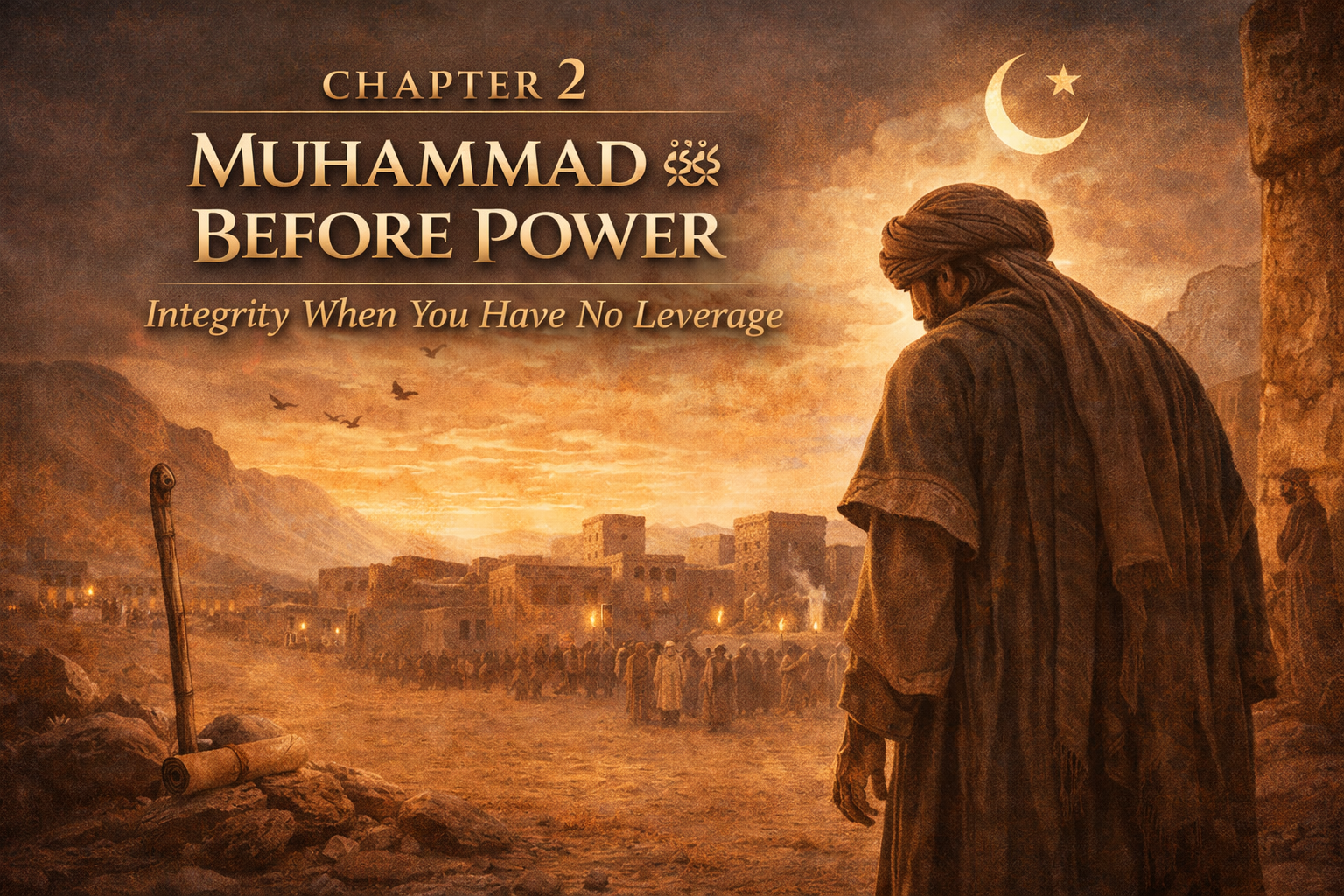
Chapter 2
Muhammad ﷺ Before Power: Integrity When You Have No Leverage
Orientation
Most people think the real test of leadership comes after power arrives.
Islam teaches the opposite.
The most dangerous moment is before power—when you are ignored, mocked, outnumbered, and unable to enforce anything. This is where character is either forged or corrupted quietly. Long before thrones, armies, or followers appear, a person reveals who they truly are when they have no leverage.
This chapter begins there—because Prophet Muhammad ﷺ passed the hardest political test before authority ever touched his hands.
1) Mecca: A World With No Power, Only Pressure
The Meccan period was not passive spirituality. It was political pressure without political tools.
The Prophet ﷺ lived in a society where:
tribal power determined safety,
wealth determined dignity,
lineage determined voice,
and force determined outcomes.
He had none of these.
He had:
no army,
no state,
no treasury,
no legal protection,
no media,
no alliances.
What he did have was truth—and truth alone does not protect you from humiliation.
This is the stage most leaders never study because it is uncomfortable. Yet it is here that political maturity is born.
2) Integrity Without Enforcement
The Prophet ﷺ could not compel obedience.
He could not punish injustice.
He could not protect followers materially.
And yet:
he never lied to gain followers,
never softened truth to grow numbers,
never incited chaos to provoke reaction,
never used victimhood to justify cruelty.
This matters.
Because many political movements become corrupt before they ever gain power—by compromising integrity in the name of survival.
The Prophet ﷺ refused that path.
His politics before power were built on trust, not coercion.
That is why his enemies—who rejected his message—still called him al-Amīn (the Trustworthy).
This is a political miracle:
being trusted by opponents while being opposed by them.
3) Speech as Political Action
When you have no authority, speech becomes your only weapon—and your greatest liability.
Every word is scrutinized.
Every phrase is weaponized.
Every mistake is magnified.
The Prophet ﷺ demonstrated:
restraint in tone,
precision in speech,
refusal to insult,
refusal to exaggerate,
refusal to retaliate verbally.
This was not weakness.
This was strategic patience rooted in principle.
Modern politics teaches:
“Say whatever mobilizes.”
Prophetic politics teaches:
“Say only what remains true even when you are powerless.”
That is why his message endured persecution without mutating.
4) Refusing Shortcuts to Power
The Quraysh offered deals.
Not symbolic deals—real power deals:
wealth,
leadership,
kingship,
compromise.
“Worship our gods one year, we worship yours the next.”
“Stop speaking publicly, and we’ll give you status.”
“Take authority—just soften the message.”
This was the most tempting political moment.
No one would have blamed him.
But the Prophet ﷺ understood something essential:
Power gained by compromise becomes ownership by others.
He refused.
He did not reject power—he rejected corrupted power.
This distinction is foundational for the entire masterclass.
5) Suffering Without Becoming Bitter
One of the greatest political dangers is bitterness.
Bitterness turns victims into future tyrants.
The Prophet ﷺ endured:
mockery,
slander,
social boycott,
economic strangulation,
physical harm,
exile.
And yet:
he did not generalize hatred,
he did not dehumanize opponents,
he did not poison followers with resentment.
This restraint is political genius.
Because bitterness poisons movements long before victory arrives.
He protected the hearts of his followers while they suffered—so that power would not later corrupt them.
6) Followers Without Dependency
Another subtle political achievement:
He did not create emotional dependency.
Followers were not attached to:
his personality,
his charisma,
his image.
They were attached to:
truth,
responsibility,
accountability.
This prevented cult behavior.
It ensured that when power eventually arrived, the community would not worship the leader—but the mission.
This is rare in human history.
7) Family Pressure as Political Pressure
Before state pressure comes family pressure.
The Prophet ﷺ faced:
uncles who opposed him,
relatives who mocked him,
kinship ties used as leverage.
He neither:
abandoned family,
nor compromised truth to appease them.
This balance is extremely difficult.
It teaches that politics begins in intimate spaces before public ones.
If you collapse under family pressure, you will collapse under national pressure.
8) Emotional Governance Before Social Governance
The Prophet ﷺ mastered:
anger before it mastered him,
grief without despair,
hope without delusion.
He cried privately. He endured publicly. He never weaponized emotion.
This is political discipline at the deepest level.
Because emotional chaos produces political chaos.
9) Why This Stage Is the Most Important
Most people fail here.
They:
lie when weak,
compromise when desperate,
radicalize when ignored,
become performative when powerless.
The Prophet ﷺ did none of this.
That is why when power eventually arrived, it did not change him.
Power reveals—it does not transform.
Closing of Chapter 2
The Meccan period teaches a brutal truth:
If integrity does not exist before power, it will never exist after power.
Muhammad ﷺ proved that leadership begins long before authority—and that politics rooted in patience outlives politics rooted in reaction.
In the next chapter, everything changes.
Power arrives.
Authority becomes real.
Decisions now affect lives at scale.
And the greatest test begins.
Chapter 3
Muhammad ﷺ Under Power: Humility at the Height of Victory
This is where history expected arrogance—and witnessed the impossible.