

بِسْمِ اللهِ الرَّحْمٰنِ الرَّحِيْم
In the name of God most gracious most merciful.
📖 Chapter 10: The Pillars of the Islamic Market
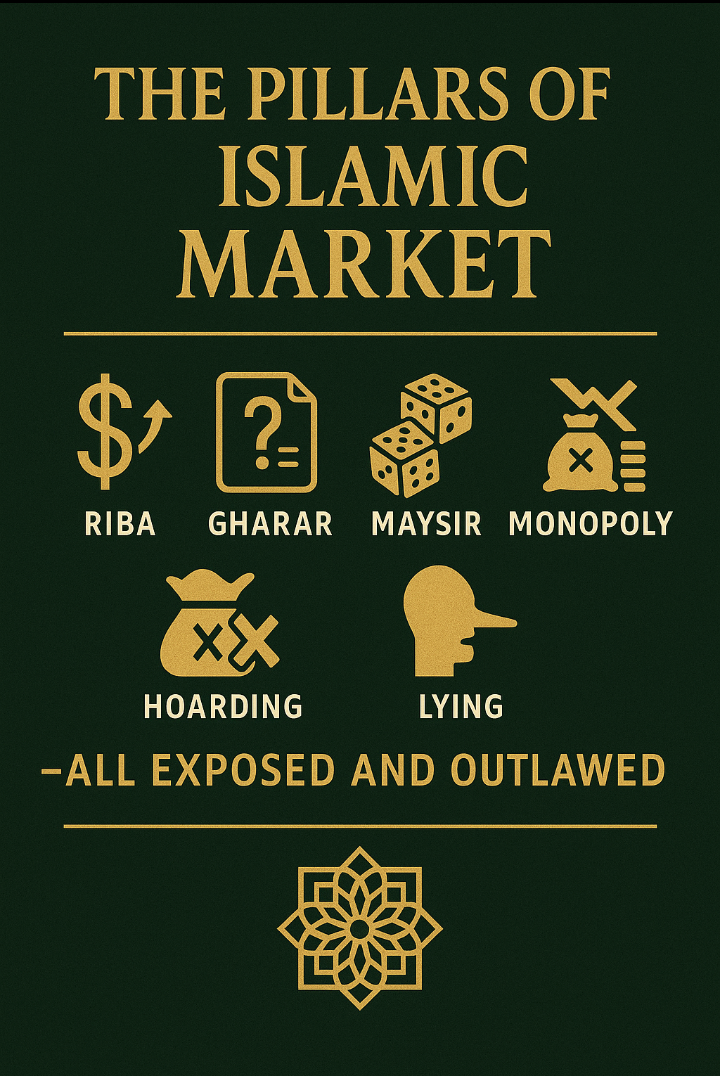
Riba, Gharar, Maysir, Monopoly, Hoarding, Lying — All Exposed and Outlawed
“Verily, those who consume interest cannot stand [on the Day of Resurrection] except as one who is being beaten by Satan into insanity.”
— Qur’an 2:275
A market without divine limits becomes a weapon.
A market with sacred boundaries becomes a garden.
These six prohibitions are not restrictions on prosperity —
they are its protection.
🌿 The Foundation of Sacred Trade
The Islamic market was never meant to be just “free.” It was meant to be just.
It wasn’t born to satisfy consumer desire; it was born to reflect divine justice. At its core were six inviolable prohibitions — ethical lines that could not be crossed, no matter how profitable, no matter how clever, no matter how convenient.
These were not negotiable. They were spiritual barricades placed by the Creator Himself. To protect people. To prevent collapse. To build a civilization based on truth, fairness, and mercy.
Let’s walk through each of them — and see how far the modern world has drifted.
❶ Riba (Usury / Interest)
The Disease:
Charging interest on loans, regardless of rate or rationale. Making money from money — without effort, risk, or work.
The Consequences:
Systemic inequality
Permanent debt traps
Centralized financial power
The worship of credit scores over character
The Revelation:
Riba is explicitly, repeatedly, and severely condemned in the Qur’an — even likened to war against God and His Messenger.
“O you who believe! Fear Allah and give up what remains of riba, if you are believers. And if you do not, then be informed of war from Allah and His Messenger.”
— Qur’an 2:278–279
The Solution:
Risk-sharing. Partnership. Trade based on real value creation. Islam substitutes debt-based finance with equity-based transactions — where reward is earned only through participation, not manipulation.
❷ Gharar (Uncertainty / Deception)
The Disease:
Ambiguous contracts. Hidden defects. Fine print. Deals where one party doesn’t know what they’re really getting.
The Consequences:
Exploitation of the poor and illiterate
Endless lawsuits
Fragile trust in commerce
The Revelation:
The Prophet ﷺ prohibited sales involving uncertainty. Every transaction must be transparent — no tricks, no confusion, no deception.
“The Prophet forbade the sale of gharar.”
— [Sahih Muslim, Book of Transactions]
The Solution:
Contracts must be clear. Products must be understood. All risks must be disclosed. A Muslim cannot profit from confusion — only from clarity.
❸ Maysir (Gambling / Speculation)
The Disease:
Trading on chance, not knowledge. Making gains without effort or merit. Betting on the market like a casino.
The Consequences:
Artificial volatility
Economic addiction
Collapse driven by fear and greed
The Revelation:
“They ask you about wine and maysir. Say: In them is great sin and some benefit for people. But their sin is greater than their benefit.”
— Qur’an 2:219
The Solution:
Trade must reflect real economic activity — not blind speculation. Muslims are encouraged to invest, build, grow — but never to gamble on outcomes they cannot influence or understand.
❹ Ihtikar (Monopoly / Market Manipulation)
The Disease:
Cornering a market. Controlling supply to fix prices. Preventing healthy competition.
The Consequences:
Artificial scarcity
Inflation
Exploitation of essential goods
The Revelation:
“Whoever hoards is a sinner.”
— [Sahih Muslim]
The Solution:
Market power must be diffused. Islam protects the freedom of prices — not the freedom of monopolies. The Muhtasib (market inspector) was tasked with preventing price manipulation and ensuring fair trade for all.
❺ Ihtikar (Hoarding / Withholding Goods)
The Disease:
Stockpiling goods to raise prices. Withholding food and essentials during times of need.
The Consequences:
Famine
Panic
Social unrest
The Revelation:
“Whoever hoards foodstuff for forty days has disassociated himself from Allah.”
— [Imam Ahmad]
The Solution:
Flow must be preserved. Goods must move freely in the market. In Islamic governance, food and water were sacred rights — not leverage for profit.
❻ Kidhb (Lying in Trade)
The Disease:
False advertising. Inflated claims. Concealing defects. Selling hype, not truth.
The Consequences:
Broken trust
Consumer cynicism
A race to the bottom in ethics
The Revelation:
“The two parties to a sale have the right to cancel the transaction until they part. If they speak the truth and make everything clear, they will be blessed in their sale. But if they lie and conceal, the blessing of the sale will be erased.”
— [Bukhari & Muslim]
The Solution:
The trader is not a salesman — he is a witness to God. Truth is more valuable than margin. A blessed deal is better than a big deal.
🌍 The Islamic Market Was Built to Last
Each of these six principles is an immune system.
They prevent collapse. They preserve dignity. They protect the weak. They create an economy that works not just in theory, but in the soul.
While modern markets reward deception and debt, the Islamic market rewards honesty and effort.
While modern capitalism maximizes profit at all costs, Islam maximizes blessing (barakah).
🧭 Toward a Divine Digital Future
As we move into AI-powered finance, decentralized systems, and smart contracts — these six pillars must not be forgotten.
They are the firewall.
They are the moral code.
They are the commandments of trade.
They are not ancient. They are eternal.
❝ If markets shaped by greed gave us poverty, war, inflation, and collapse…
then markets shaped by God can give us peace, dignity, fairness, and stability. ❞
Let the blueprint be remembered.
Let the pillars be rebuilt.
Let AI be taught the lines it must never cross.