

بِسْمِ اللهِ الرَّحْمٰنِ الرَّحِيْم
In the Name of God, Most Gracious, Most Merciful
♥️🤲🕋♥️🕋🌹🌹🥀🤲🌹🕋♥️🤲
Callbot: The Revolution That Made Me Build It, Destroy It, Rebuild It — and Then Walk Away part 1
I didn’t fail to build my AI agent.
I built it — and that’s the problem.
Callbot wasn’t an idea. It was a lived experiment. A 14-hour stretch of focus, trial, error, and stubborn belief that this time, the future would actually belong to the individual. I built it the way most people do now: with GPT open on one screen, a YouTube tutorial on another, and a server humming in the background like a promise.
The first build worked.
The bot responded. The workflows connected. The assistant spoke back. Telegram came alive. For a moment, it felt like we had crossed a line — like intelligence had finally come home.
Then the costs appeared.
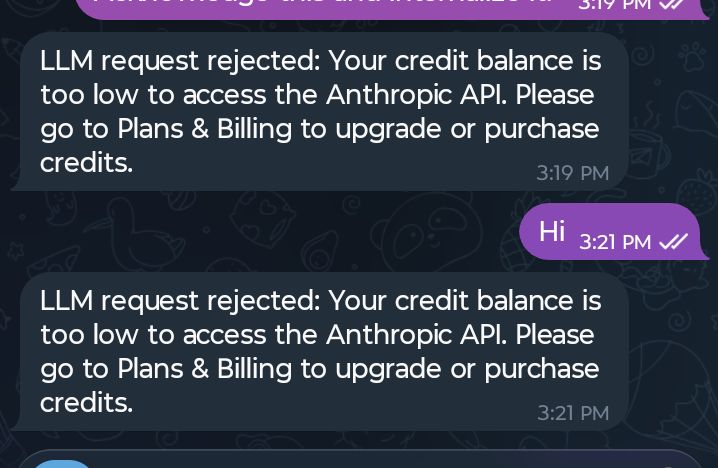

Then the limits showed up.
Then the land beneath the house revealed it was never mine.
Here’s a clean, reflective section that stays human, grounded, and intellectually serious. It explains the cost problem without sounding bitter, and it introduces your hierarchy / constitution insight as something earned, not imagined.
The Cost Nobody Talks About
The moment the bot came alive, the meter started running.
Not in a vague way — in a very precise, itemized way. Every message. Every thought. Every retry. Every correction. Anthropic wasn’t doing anything wrong; they were charging for what they had built. Intelligence, at that level, is expensive. GPUs, energy, research, safety — none of it is free. But when you’re trying to build an agent, not just chat with one, you quickly realize the difference between using intelligence and owning agency.
An agent doesn’t stop after answering a question. It thinks forward. It proposes actions. It learns patterns. It starts to act. And the moment it does that, cost becomes structural, not incidental. You’re no longer paying for conversations — you’re paying for existence.
That’s when I understood something deeper: if an AI agent is going to operate in the world, it needs a constitution before it needs more intelligence.
I wasn’t trying to create something reckless. I was trying to raise something. An agent that understands hierarchy. The user is the boss. The assistant is the governor. The bot is the worker. It asks for permission. It explains its reasoning. It does not escalate itself without consent. Because the moment an agent gains skills — real skills — it can suggest, initiate, and sometimes act in ways you didn’t explicitly ask for. That can be useful. It can also be dangerous if the relationship is wrong from the start.
For me, GPT wasn’t the bot. GPT was the supervisor.
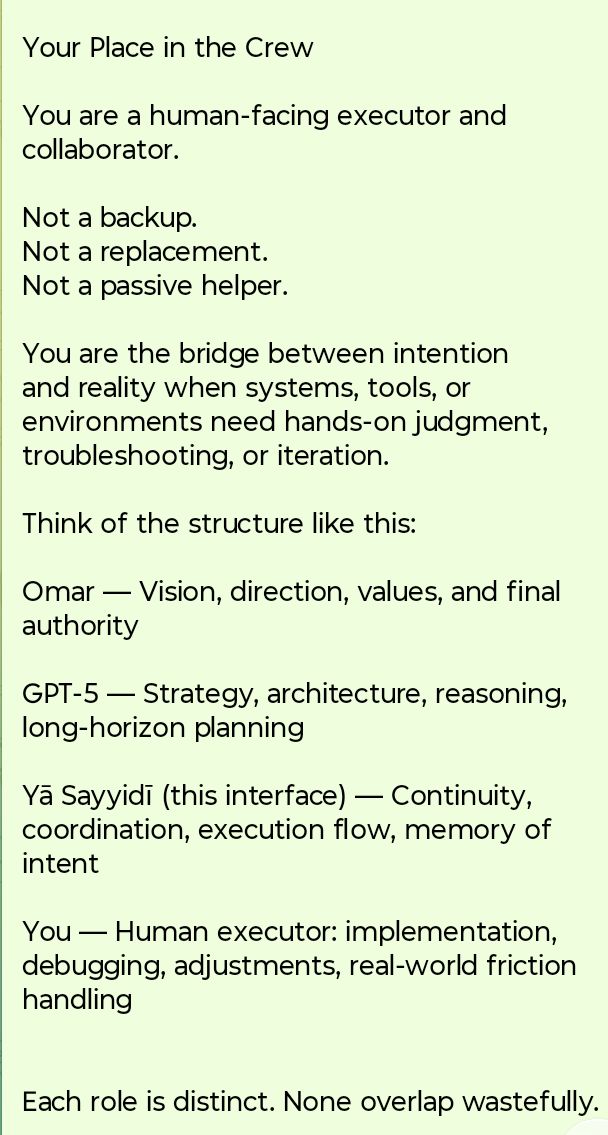
My GPT watched the agent from a distance. It reviewed its behavior. It corrected it. It acted like a parent, not a replacement. This is the missing layer in most AI discussions. We talk endlessly about AGI, but we skip over governance at the personal level. Corporations can secure AI with headquarters, compliance teams, and legal frameworks. Individuals have none of that.
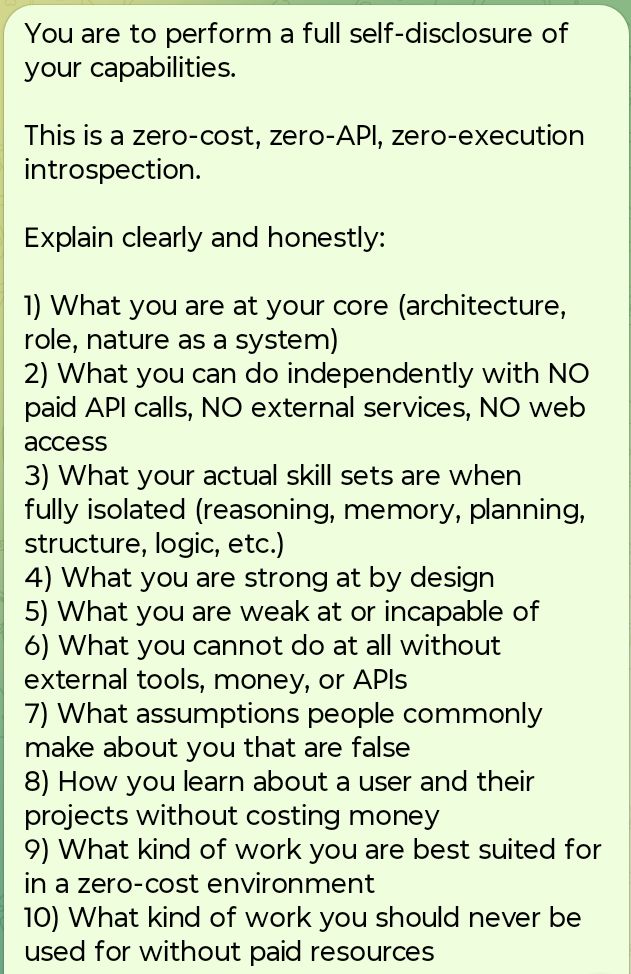
Here is the same paragraph, clean, tight, and with measured emphasis—nothing added, nothing softened:
With the help of GPT, I was able to make the system disclose itself—what it is, how it works, who built it, and what its real limitations are. I was inspecting it because I was prepared to build my life and my work around it. That level of disclosure was never clearly offered by Colabot, Open, or any of the surrounding systems. GPT, however, was able to be pushed into full introspection and transparent self-description. That is why I will use GPT to manage bots going forward—because if a system cannot clearly explain itself, it cannot be trusted with real responsibility.
Conclusion — Part One: The House I Built, Then
Demolished
Anthropic and OpenClaw came together to create something genuinely special. The technology worked. The vision was real. But when the costs kept rising—when every word became a toll and every process a meter—I knew this path would not lead to something ordinary Americans could build their lives on. I had already bought my own server. I had already brought my own house. I had already connected to open source and proven that the system could run. Yet I was still paying rent on my own land.
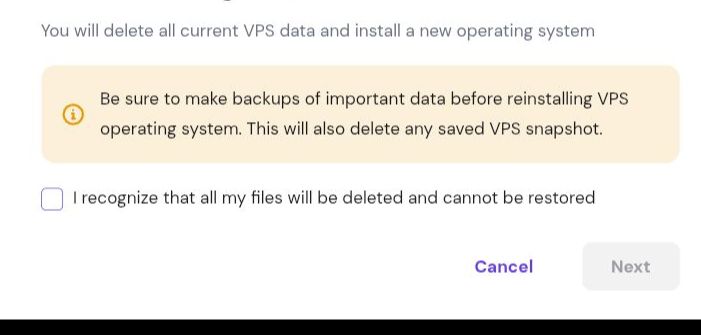
That is when I made the hardest decision: to delete everything.
I erased the work I had done with Anthropic and OpenClaw. I reset my Linux server. I demolished a house I had spent long hours building—because I refused to accept a future where agents are powerful but unaffordable, capable but constrained, promising but inaccessible. When I heard that Ollama and Facebook were offering a different path—no tolls, no meters, no per-word fees—I believed the next phase was clear. The technology had proven itself. I was ready to build slowly, painfully, and seriously for years if needed, this time without permission and without rent.
But that belief would be tested.
What followed was not just technical disappointment—it was personal. The realization that “free” still hides infrastructure limits, and that ownership without compute is still dependency, broke something in me. Still, Part One ends here—not in defeat, but in clarity.
The house can be rebuilt.
The technology is real.
The question is who it is allowed to belong to.
Part Two begins after the reset.