
بِسْمِ اللهِ الرَّحْمٰنِ الرَّحِيْم
In the Name of God, Most Gracious, Most Merciful.
♥️🤲🕋♥️🕋🌹🌹🥀🤲🌹🕋♥️🤲
CALIFORNIA BALLOT ELECTIONS, GOVERNOR’S NOMINEE REPORT CARD, AND DECISION-MAKING FOR MUSLIMS
I received my California ballot today as an American voter.
And it reminded me of something uncomfortable:
I AM BUSY. MOST PEOPLE ARE BUSY.
Even though I have promised myself many times that I would read more about politics, study every office, understand every candidate, and follow every election carefully, life gets in the way.
Then the ballot arrives.
It is filled with names, offices, judges, boards, districts, propositions, and legal language, and suddenly I am expected to make decisions about people who may control billions of dollars, appoint judges, influence schools, regulate businesses, administer healthcare, enforce laws, and shape the lives of millions of Californians.
Instead of treating that as a failure of the voter, I want to turn the ballot into an opportunity.
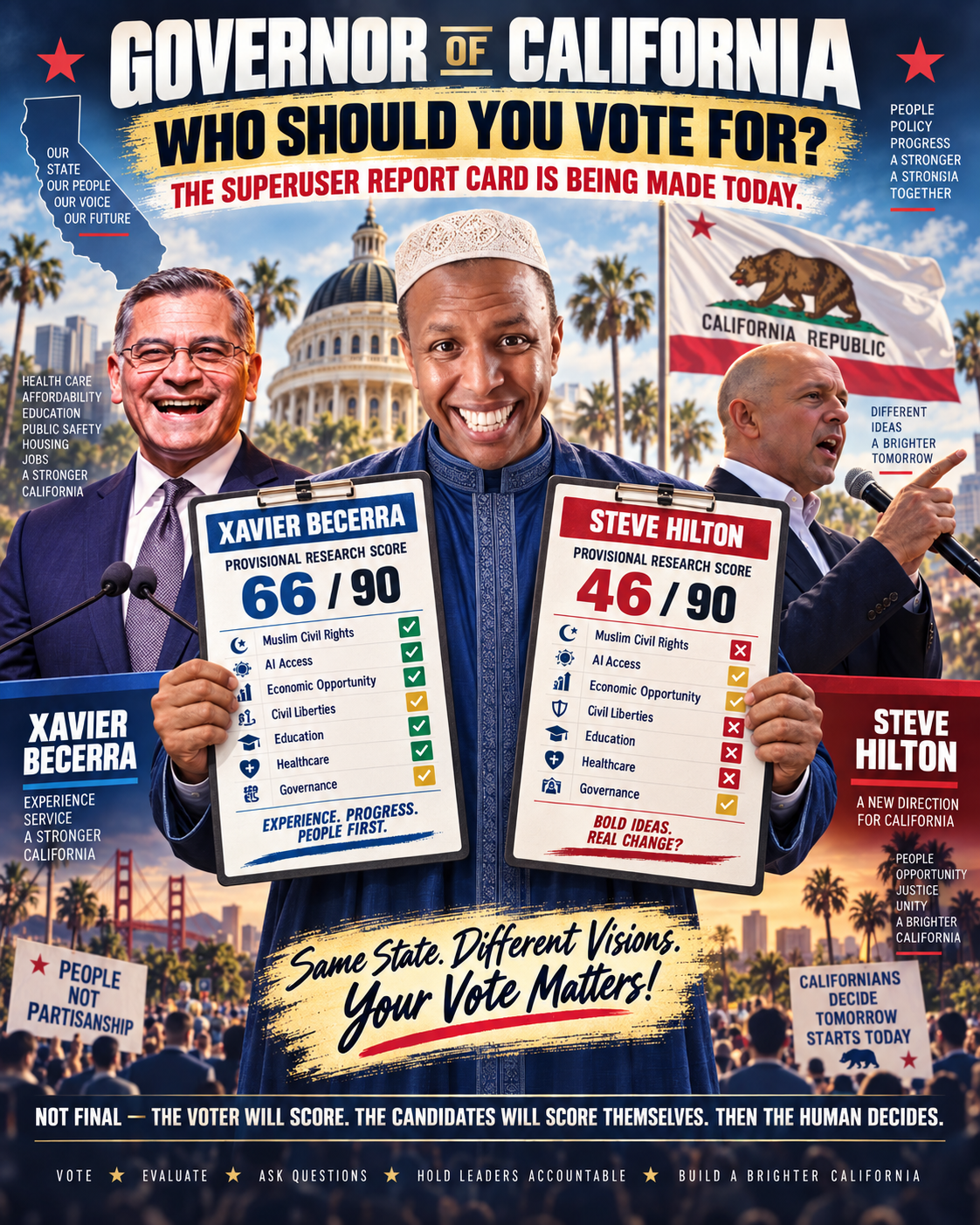
THE SUPERUSER VOTING REPORT CARD
I am going to build a Superuser Voting Report Card System — a simpler way for ordinary voters to understand what an office actually does, who is asking for that power, what each candidate has actually done, and how that record relates to the issues that matter to the person holding the ballot.
I am beginning with the Governor of California.
And because I am particularly concerned with the interests, dignity, civil rights, and future of Muslims, the first report card will examine:
Muslim civil rights. Religious liberty. Islamophobia. Palestine and political expression. AI access. Economic opportunity. Healthcare. Education. Civil liberties. Privacy. Surveillance. And the actual powers of the Governor.
This report card is especially intended for Muslims in California, but it is not meant to tell Muslims that they must think alike or vote alike.
EVERY VOTER SHOULD BE ABLE TO SCORE THE CANDIDATE FOR THEMSELVES.
My own provisional score will appear beside a blank voter score.
And there will be something else.
THE CANDIDATE GETS A SCORECARD TOO.
If a candidate believes the research is incomplete, inaccurate, or unfair, the candidate should have an opportunity to submit evidence, explain the record, challenge the findings, and score himself.
That gives us three different scores:
1. THE SUPERUSER PROVISIONAL SCORE
Based on publicly available research and subject to change.
2. THE VOTER SCORE
Left blank so every Californian reading the report can make their own judgment.
3. THE CANDIDATE SELF-SCORE
Left blank so the candidate can respond to the evidence and tell the public what score he believes he deserves.
My final decision will therefore not be immediate.
And it certainly will not be final simply because an AI produced a report.
I hope to give both candidates an opportunity for a brief conversation — either in person or by telephone.
If they choose to participate, I will listen.
If they provide evidence that changes the report, the report should change.
I then intend to explain my final decision publicly through a video and through my work on OmarArizona.com and, hopefully, theUSHousePlan.com.
BUT BEFORE I SCORE ANYBODY, I HAD A BASIC QUESTION
WHY ARE THERE ONLY TWO PEOPLE ON MY BALLOT?
My ballot shows:
Steve Hilton — Republican Party preference
Xavier Becerra — Democratic Party preference
My first reaction was simple:
WHERE DID EVERYBODY ELSE GO?
Did these two people pay some special fee?
Were they selected by the Republican and Democratic parties?
Were other candidates blocked?
Why are these two people special?
The answer is something every California voter should understand.
CALIFORNIA USES A TOP-TWO PRIMARY SYSTEM
California uses what is called the Top Two Candidates Open Primary system for voter-nominated offices such as Governor.
In the June 2, 2026 primary election, qualified candidates for Governor appeared in one contest regardless of political party.
California voters could choose among those candidates.
Then only the two candidates receiving the highest number of votes statewide advanced to the November general election.
That is why my November ballot contains only:
Steve Hilton
and
Xavier Becerra
They were not simply handed two privileged positions.
THEY SURVIVED THE PRIMARY.
And there is another important detail.
THEY ARE NOT TECHNICALLY PARTY NOMINEES
California calls these positions:
VOTER-NOMINATED OFFICES
That means the voters, rather than the political parties themselves, determine which two candidates advance.
The Republican or Democratic designation printed beside a candidate tells voters that person's party preference.
It does not mean the party formally nominated that candidate under the traditional party-primary system.
That is why the ballot says:
VOTER-NOMINATED OFFICES
The voters did the nominating.
AND THIS IS WHERE THE STORY GETS MUCH BIGGER
THERE WERE NOT TWO PEOPLE RUNNING FOR GOVERNOR.
THERE WERE DOZENS.
California's 2026 primary materials listed a huge field of people seeking the governorship before the election was narrowed to two.
Among the recognizable names were:
Katie Porter — Democratic
Tom Steyer — Democratic
Eric Swalwell — Democratic
Antonio Villaraigosa — Democratic
Tony Thurmond — Democratic
Betty Yee — Democratic
Matt Mahan — Democratic
Chad Bianco — Republican
along with Steve Hilton, Xavier Becerra, and many other candidates from different political backgrounds.
That means the November ballot only shows us the final chapter.
It does not show us the entire political process that came before it.
THE FIELD OF DOZENS BECAME A FIELD OF TWO.
California certified the June primary results in July.
Millions of Californians participated.
And when those votes were counted, Hilton and Becerra finished in the positions that allowed them to advance to November.
The other candidates were not necessarily removed because they were unqualified.
They simply did not finish in the top two.
CAN I JUST WRITE SOMEBODY ELSE IN FOR GOVERNOR?
This was another question I had.
Could I simply say:
I don't want Hilton.
I don't want Becerra.
Give me somebody else.
For this voter-nominated office, generally, that opportunity belonged to the primary election.
California permits write-in participation during the primary process under its election rules, but a candidate still has to advance through the top-two system.
A completely new candidate cannot normally appear in November and bypass the primary after the voters have already selected the two finalists.
That means if someone preferred:
Katie Porter
Chad Bianco
Tom Steyer
Antonio Villaraigosa
Betty Yee
Tony Thurmond
or another gubernatorial candidate, the crucial election for advancing that person was the June primary.
By November, the field has already been narrowed.
THAT IS AN IMPORTANT CIVIC LESSON
When someone receives a November ballot and sees only two people, it is very easy to assume:
These were the only two choices.
They were not.
The real election process started months earlier.
And that raises another important question:
HOW MANY PEOPLE EVEN KNEW THAT?
How many people received the primary ballot and understood that this was the election where dozens of candidates would be reduced to two?
How many people researched those candidates?
How many people understood what Governor actually does?
How many people were simply too busy?
That is exactly why I believe this report-card system is necessary.
THE FIRST SUPERUSER REPORT CARD
So my question is no longer simply:
STEVE HILTON OR XAVIER BECERRA?
The real questions are much larger.
How did these two people reach the final ballot?
What does the Governor of California actually control?
What have these two men done when they have been given power or influence before?
How have they treated Muslims and religious minorities?
What is their record on Islamophobia?
What have they said about Palestine and Gaza?
How do they view civil liberties, protest, privacy, surveillance, policing, and government power?
What will they do about artificial intelligence?
Will advanced AI become another tool available only to giant corporations and wealthy people, or will ordinary Californians have access to it?
What will they do about housing, healthcare, education, taxes, small businesses, and economic opportunity?
And perhaps most importantly:
WHICH OF THEIR PROMISES CAN A GOVERNOR ACTUALLY DELIVER?
Political campaigns can promise almost anything.
The report card must separate:
WHAT A GOVERNOR CAN DO ALONE
from
WHAT REQUIRES THE LEGISLATURE
from
WHAT REQUIRES THE VOTERS
from
WHAT BELONGS TO LOCAL GOVERNMENT
from
WHAT BELONGS TO THE FEDERAL GOVERNMENT.
That is how we stop campaign slogans from becoming substitutes for understanding.
THE THREE-SCORE SYSTEM
Every candidate report card will contain:
1. SUPERUSER PROVISIONAL SCORE
Based on publicly available evidence.
This score can change when new evidence appears.
2. VOTER SCORE
_____ / 90
This belongs to you.
Read the evidence.
Disagree with me.
Give the candidate a higher score.
Give the candidate a lower score.
Explain why.
3. CANDIDATE SELF-SCORE
_____ / 90
This belongs to the candidate.
If the candidate believes something is missing:
Show us.
If something is inaccurate:
Correct it.
If the candidate has helped Muslims and we did not find the evidence:
Give us the evidence.
If the candidate has an AI policy we missed:
Send it.
If the candidate believes he deserves a 10 instead of a 4:
Explain why.
THE DECISION IS NOT FINAL
The research score is not the vote.
The AI is not the voter.
The political party is not the voter.
The campaign advertisement is not the voter.
THE HUMAN BEING HOLDING THE BALLOT IS THE VOTER.
My own final decision will come after the research, after the scorecard, and after both candidates have been given an opportunity to respond.
If they are willing, I hope to speak with both candidates.
Then I will explain publicly why I made the choice I made.
THIS IS THE SUPERUSER VOTE
By the time we finish this California ballot, perhaps the voter will no longer simply be a person who fills in bubbles.
The voter will understand the institution.
The voter will understand the office.
The voter will understand the people asking for power.
The voter will understand what those people have actually done.
And the voter will have a record showing exactly why the vote was cast.