

بِسْمِ اللهِ الرَّحْمٰنِ الرَّحِيْم
In the Name of God, Most Gracious, Most Merciful
♥️🤲🕋♥️🕋🌹🌹🥀🤲🌹🕋♥️🤲
Bob Taylor and the Invisible Architecture of Breakthroughs
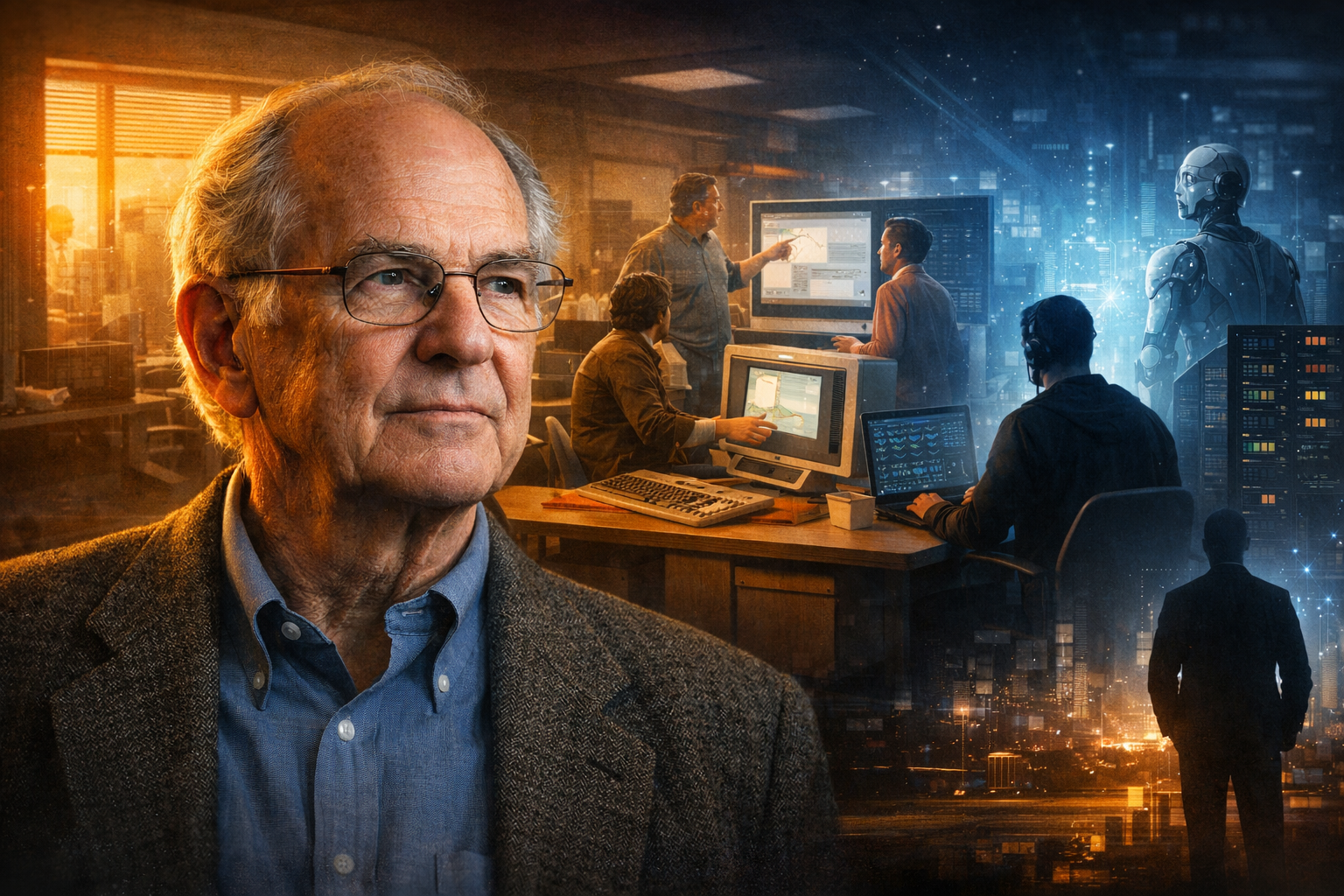
And why Anthropic’s momentum raises a serious, intelligent question
There are moments in technological history where progress does not feel chaotic or accidental. It feels designed. Quiet. Steady. Almost inevitable. When that happens, it is rarely because of a single genius writing code in isolation. It is because someone, somewhere, built an environment where truth could surface without fear, where people could speak freely, disagree cleanly, and work without being crushed by ego, bureaucracy, or short-term games.
That person, in one of the most consequential chapters of modern computing, was Bob Taylor.
Bob Taylor: The Man Who Built the Room
Bob Taylor did not invent the mouse.
He did not personally design the graphical user interface.
He did not write Ethernet with his own hands.
Yet without him, none of those things would have arrived when they did—or in the form that changed the world.
As the director of the Computer Science Laboratory at Xerox PARC, Bob Taylor did something far rarer than invention: he curated an environment.
He brought together people who thought differently. Philosophers and engineers. Dreamers and implementers. He protected them from corporate noise. He minimized hierarchy. He discouraged bullying, credit-grabbing, and internal politics. He believed, very simply, that innovation happens when smart people are allowed to talk to one another honestly.
What came out of that environment was not incremental progress. It was the foundation of modern personal computing.
Windows.
Icons.
The mouse.
Ethernet.
Object-oriented programming.
WYSIWYG text editing.
Steve Jobs famously walked into PARC in 1979 and immediately recognized what Xerox management could not: the future was already there. It wasn’t the technology alone that stunned him—it was the coherence of the vision. Someone had made thinking visible.
Bob Taylor once said, in essence, that he saw computers as tools for communication, not calculation. That idea alone reshaped the trajectory of technology. But again, his real contribution was not the idea—it was the conditions under which ideas could survive long enough to become real.
The Pattern: When Progress Doesn’t Feel Accidental
Fast-forward to today.
When you watch certain organizations, you can feel the difference between frantic output and disciplined momentum. One ships features. The other ships direction.
This is where the Superuser’s curiosity naturally turns toward Anthropic.
Because what we’re seeing there does not look random.
Anthropic’s Momentum: A Checklist, Not a Vibe
Over a relatively short period, Anthropic has delivered a steady sequence of meaningful advances—not just in models, but in structure:
Capability & Model Evolution
The Claude 3 family established a clear, intentional model lineup rather than a single monolith.
Claude 3.5 Sonnet pushed performance forward while maintaining speed and cost discipline.
Extended reasoning (“thinking budgets”) introduced explicit control over cognitive depth—an architectural choice, not a marketing one.
Computer use moved Claude from passive assistant to active operator, signaling a serious step toward agency.
Platform & Infrastructure
The Model Context Protocol (MCP) was released as an open standard, allowing AI systems to connect cleanly to real tools and real data.
MCP wasn’t just announced—it was adopted, extended, stress-tested, patched, and improved in public.
Tool-level integrations shifted Claude from “answering questions” to working inside workflows.
Governance & Discipline
The Long-Term Benefit Trust embedded long-range incentives into the company’s structure.
A formal AI constitution was published—not as PR, but as an operational document.
Economic impact analysis (the Anthropic Economic Index) attempted to measure real-world usage instead of relying on narratives.
This is not what chaos looks like.
This is not what “move fast and break things” looks like.
This is what an environment that is functioning looks like.
The CEO Question — and the Deeper One
Yes, Dario Amodei, Anthropic’s CEO, clearly fits part of the Bob Taylor pattern:
Deep technical grounding.
Public seriousness about AI risk.
Willingness to speak plainly about long-term consequences.
A focus on systems, not just products.
But Bob Taylor himself was never the loudest voice. He wasn’t the brand. He wasn’t the headline.
So the real question—the intelligent question—is not whether Anthropic has a capable CEO.
The question is:
Who is building the room?
Because sustained productivity of this kind does not come from one person. It comes from a network of people who recruit carefully, protect researchers, resolve conflict quietly, and maintain standards without fear or theatrics.
Somewhere inside Anthropic are people doing the Bob Taylor work:
Creating psychological safety.
Preventing internal games.
Letting truth beat hierarchy.
Making collaboration cheaper than ego.
They may not be visible. That’s the point.
Why This Matters Now
History teaches a hard lesson: institutions that lose their Bob Taylors lose their future, even if they keep their talent.
Bell Labs faded when structure overtook curiosity.
Xerox failed when it stopped understanding what it had.
Innovation dies not from lack of intelligence, but from poisoned environments.
If Anthropic continues on this path, it won’t be because of hype or capital alone. It will be because someone—or several someones—are consciously protecting the conditions under which real work can happen.
Closing Thought
Bob Taylor showed the world that the highest form of leadership is not command, but cultivation.
When progress rolls out calmly, continuously, and coherently, it’s a signal. Not of luck. Not of genius.
But of architecture.
And the Superuser, naturally, wants to know:
Who is today’s Bob Taylor—and are we paying close enough attention to protect them?
Watch "Alan Kay Episode of "Education in the Digital Age" [1998]" on YouTube