
اللهِ الرَّحْمٰنِ الرَّحِيْمِ
In the Name of God , Most Gracious, Most merciful
♥️🤲🕋♥️🕋🌹🌹🥀🤲🌹🕋♥️🤲
Before the Vacuum — What Civilizations Look Like Before They Forget God
Civilizations do not forget God suddenly.
They remember Him incorrectly first.
Before idols appear, before hypocrisy becomes fashionable, before revelation is mocked, there is always a quieter stage—one history rarely names: the period where truth still exists, but discipline weakens.
This is the most dangerous moment.
Because nothing looks broken yet.
The Original Orientation: Fitrah in Social Form
Every civilization begins with an orientation toward the unseen.
Not theology.
Not philosophy.
Orientation.
An acknowledgment that:
Life has weight
Promises bind the soul
The unseen watches
Actions echo beyond visibility
In this phase:
Oaths are feared
Hospitality is sacred
Shame restrains behavior
Elders are trusted
Speech is measured
Silence has meaning
This is not utopia.
It is alignment.
The Qur’an calls this fitrah.
Other civilizations remembered it differently, but the structure was the same.
What mattered was not explanation — but accountability.
How Memory Begins to Fracture
The decline does not begin with disbelief.
It begins with delegation.
People stop carrying truth inwardly and begin outsourcing it:
To priests
To elders
To rituals
To institutions
This is subtle. And at first, it looks like organization.
But something essential shifts:
Truth is no longer lived — it is managed.
Ritual replaces presence.
Authority replaces conscience.
Form replaces fear.
The unseen is still spoken of — but no longer felt.
When Representation Replaces Reality
This is where symbols begin to harden.
What was once remembered internally becomes externalized:
Stones
Statues
Names
Shrines
Myths
Not because people want false gods —
but because they can no longer sustain inward discipline.
An idol is not invented to deceive. It is created to simplify responsibility.
A symbol is easier to manage than submission.
This is the moment civilization tells itself:
“We still believe — just differently.”
This is never true.
Abraham and the Proof of Corruption
This is why Abraham matters historically.
He does not appear at the beginning of belief. He appears after corruption.
By Abraham’s time:
God was known
But intermediaries had multiplied
Ritual had replaced truth
Power had attached itself to belief
Abraham did not introduce monotheism. He restored it.
And his greatest proof was not argument — it was destruction: He shattered idols not to insult people, but to expose how far memory had fallen.
The Kaaba later held idols for the same reason: Not because Abraham failed — but because memory was not carried.
This is the law of history.
What Happens When Saints Disappear
Between revelations, saints matter more than institutions.
Saints embody:
Fear without spectacle
Discipline without coercion
Authority without force
When saints vanish:
Law becomes rigid
Ritual becomes empty
Hypocrisy becomes adaptive
At this point, civilization does not need evil. It produces it naturally.
This is the vacuum.
The Vacuum Is Not Absence — It Is Exposure
The vacuum is not God’s absence. It is the removal of protection.
Truth is still visible —
but it no longer carries consequences.
This is when:
Cleverness replaces virtue
Language replaces integrity
Power replaces truth
And this is when instruments appear.
Not prophets. Not saints.
But witnesses.
Why Philosophy Appears After Memory
Collapses
Philosophy does not precede revelation. It follows its erosion.
When people can no longer submit, they begin to analyze.
When they can no longer obey, they begin to argue.
When fear disappears, reason is asked to replace it.
This is why philosophy is endless. Why it never concludes. Why it never satisfies.
It is reason attempting to do the work of conscience.
And it cannot.
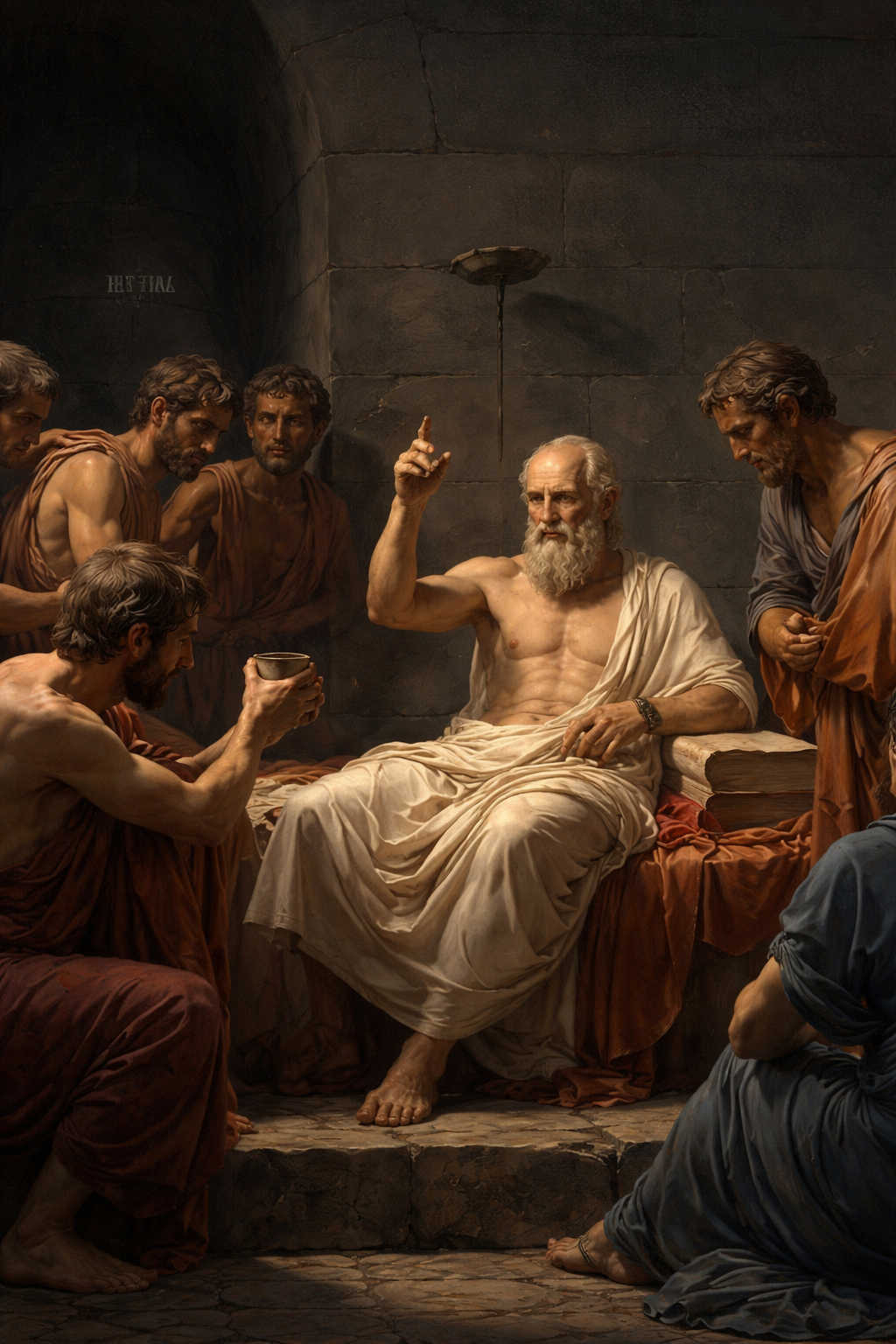
The Stage Is Set for Socrates
By the time Socrates appears:
Revelation is gone
Memory is fractured
Saints are absent
Institutions are hollow
Hypocrisy is profitable
This is not a failure of intelligence. It is a failure of truthfulness.
Socrates does not arrive early. He arrives too late.
And that is precisely why he matters.
Next page:
The Sophists — When Hypocrisy Learns to Speak Beautifully