

بِسْمِ اللهِ الرَّحْمٰنِ الرَّحِيْم
In the Name of God, Most Gracious, Most Merciful
BCS — BRAND CURRENCY SYSTEM
THE REDESIGN OF MONEY
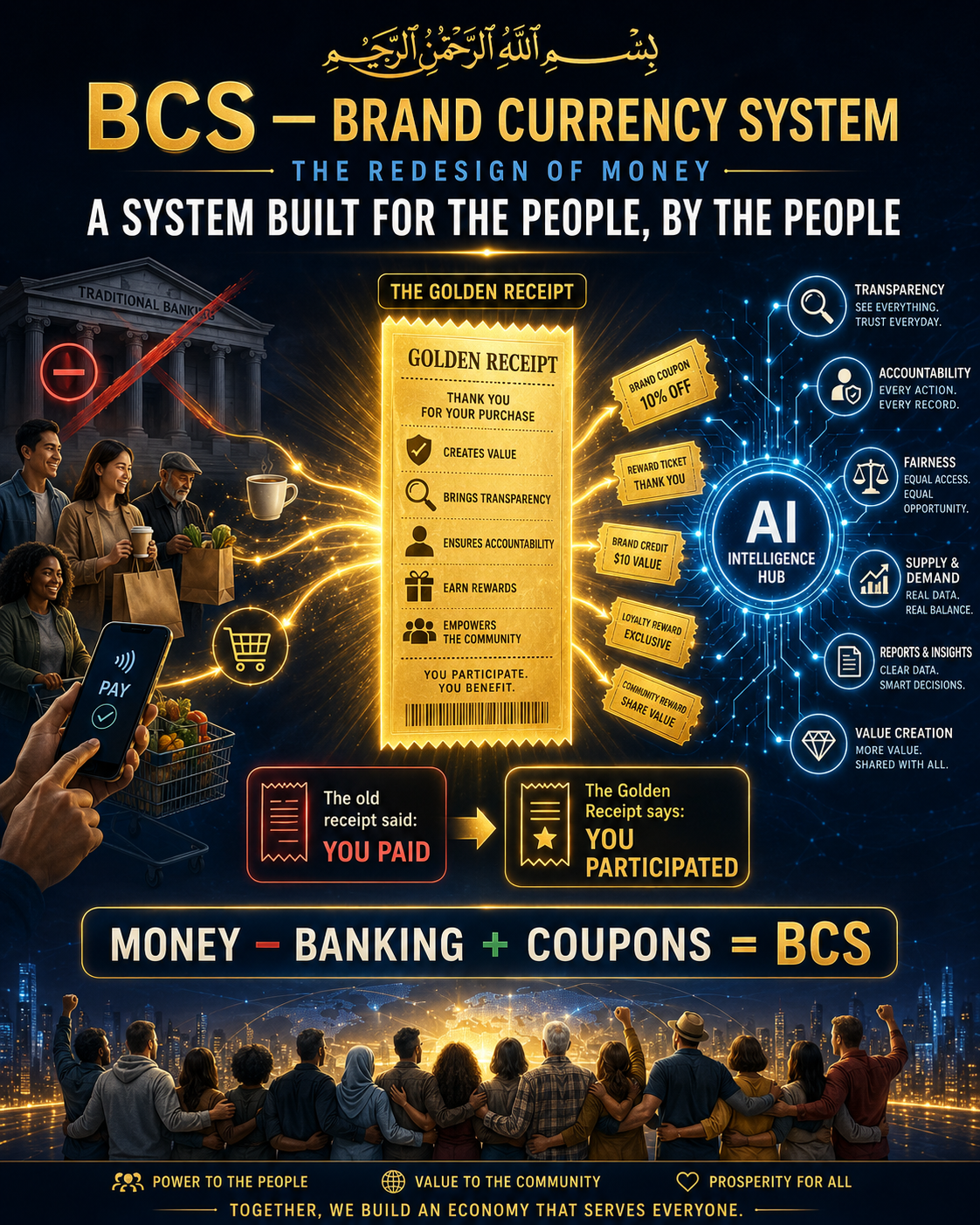
1. THE BRAND CURRENCY SYSTEM: A SYSTEM BUILT FOR THE PEOPLE, BY THE PEOPLE
MONEY − BANKING + COUPONS = BCS
What if the greatest source of economic power has been sitting in our hands the entire time?
Every day, billions of people make transactions.
We buy food.
We pay for transportation.
We purchase clothing.
We pay for housing, healthcare, education, entertainment, technology, and almost everything else that keeps the modern economy moving.
Yet after the transaction is complete, something strange happens:
The customer—the person whose spending created the transaction—largely disappears from the economic story.
The money continues moving.
The company records revenue.
Banks process payments.
Markets calculate valuations.
Investors measure returns.
Shareholders receive reports.
Analysts study performance.
But the person who actually walked into the store, opened the app, swiped the card, scanned the phone, and created the demand often receives little more than a receipt.
BCS STARTS WITH A DIFFERENT IDEA
The consumer should not disappear after the transaction. The transaction should become the beginning of the consumer's economic power.
That is the foundation of the Brand Currency System.
BCS is a proposal to rethink the relationship between brands, customers, transactions, coupons, receipts, data, artificial intelligence, and value itself.
It begins with a very simple observation:
WITHOUT CUSTOMERS, THERE IS NO ECONOMY.
A company can manufacture a million products.
A warehouse can be filled from floor to ceiling.
A brand can spend billions of dollars advertising.
Investors can assign enormous valuations.
But until somebody decides:
“I want that.”
—and completes a transaction—
economic demand has not been proven.
The customer closes the loop.
The transaction is the evidence.
And BCS asks:
Why shouldn't that evidence create value for the person who produced it?
THE CURRENT SYSTEM
Much of today's economy separates the consumer from the long-term value created by consumer activity.
A customer spends $100.
The transaction moves through payment processors, banks, merchants, distributors, advertising systems, loyalty programs, accounting systems, and corporate databases.
Everyone records something.
Everyone analyzes something.
Everyone extracts information.
Yet the customer frequently receives:
A receipt.
Maybe some points.
Maybe a coupon.
Maybe an advertisement asking them to spend again.
BCS asks whether we can redesign that relationship.
Not by pretending money no longer exists.
Not by pretending banks disappear tomorrow.
Not by replacing national currencies with another speculative asset.
Instead, BCS begins with something almost everyone already understands:
THE COUPON.
WHY COUPONS?
A coupon is one of the simplest forms of brand-created value.
A business can say:
“Because you purchased from us, here is $5 toward your next purchase.”
The business created the offer.
The customer earned access through participation.
The value exists inside a defined relationship.
Now imagine taking that familiar concept and connecting it to:
verified transactions,
digital receipts,
consumer-controlled records,
AI analysis,
brand accountability,
and eventually,
interoperable economic value.
The humble coupon suddenly becomes much more interesting.
It becomes a building block.
THE GOLDEN RECEIPT
In the traditional system, a receipt tells you what happened.
You bought something.
You paid.
The transaction ended.
In BCS, the receipt can become something more.
THE GOLDEN RECEIPT
A Golden Receipt could represent a verified record of economic participation.
It could tell the customer:
What you purchased.
Who produced it.
What you paid.
What value the brand returned to you.
What rewards or benefits were created.
What feedback you provided.
How the transaction contributes to future offers or services.
And potentially much more.
The receipt stops being garbage destined for the trash can.
It becomes an economic instrument.
FROM TRANSACTION TO VALUE
The basic principle is simple:
TRANSACTION → RECEIPT → DATA → ACCOUNTABILITY → VALUE
Every legitimate transaction produces information.
That information can help answer questions such as:
Was the customer satisfied?
Was the product worth its price?
Was there a defect?
Was the supply available?
Was the price increasing?
Was the customer repeatedly buying the same product?
Was the brand delivering genuine value?
Could the customer receive a better offer?
Could demand information reduce waste?
Could purchasing activity help unlock another benefit?
Today, much of this information already exists—but it is fragmented across companies and often optimized primarily for the institutions collecting it.
BCS proposes turning the transaction into a two-way economic relationship.
THE BRAND LEARNS FROM THE CUSTOMER.
THE CUSTOMER RECEIVES VALUE FROM THE BRAND.
THE PEOPLE BECOME THE ECONOMIC SIGNAL
This changes the way we think about economic power.
Instead of beginning with:
What do investors think this company is worth?
BCS asks:
What are people actually choosing to buy?
Instead of beginning with:
How much advertising can convince people to purchase something?
BCS asks:
Did the product actually create value after the purchase?
Instead of relying entirely on distant economic indicators, BCS puts tremendous importance on something concrete:
THE TRANSACTION.
Every purchase becomes a vote of economic confidence.
Every return becomes a signal.
Every complaint becomes information.
Every repeat purchase becomes evidence.
Every abandoned product becomes evidence too.
Supply follows demand because demand becomes visible.
ACCOUNTABILITY IS BUILT INTO THE TRANSACTION
This is where BCS becomes more than a rewards program.
The goal is not simply:
BUY MORE → GET MORE POINTS.
That already exists.
The deeper idea is:
BUY → VERIFY → REPORT → LEARN → REWARD → IMPROVE
Imagine a world where brands cannot easily separate revenue from customer satisfaction.
A company sells one million units?
Good.
Now show us:
How many customers came back?
How many products were returned?
How many customers reported problems?
How much value was returned to those customers?
What did the company improve?
What happened to prices?
What happened to quality?
Revenue tells us that something sold.
BCS should help tell us whether something deserved to sell.
That distinction matters.
TRANSPARENCY CHANGES THE MARKET
Markets become healthier when information improves.
Consumers make better decisions when they understand what they are buying.
Businesses make better decisions when they understand what customers actually need.
Producers can reduce waste when demand becomes clearer.
And society can make better economic decisions when transactions generate useful, transparent information.
BCS therefore treats transparency not as an optional feature.
TRANSPARENCY IS PART OF THE VALUE SYSTEM.
The customer should understand the transaction.
The business should understand the transaction.
And where appropriate, the system should be able to explain why value was created.
WHERE AI ENTERS THE SYSTEM
Without artificial intelligence, managing millions—or eventually billions—of these relationships would be extraordinarily difficult.
With AI, something new becomes possible.
AI can help analyze transaction patterns.
AI can help identify fraud.
AI can help predict demand.
AI can help businesses reduce unnecessary inventory.
AI can help customers understand their purchasing history.
AI can help compare price and quality.
AI can help generate personalized offers.
AI can help translate complicated economic information into language ordinary people understand.
But there must be an important principle:
AI MANAGES COMPLEXITY. PEOPLE RETAIN AGENCY.
AI should not become another invisible institution extracting value from the customer.
It should help make the system understandable.
A SYSTEM BUILT FOR THE PEOPLE, BY THE PEOPLE
The phrase matters.
For the people means the economic system should produce benefits that reach ordinary participants.
By the people means economic demand originates from human choices expressed through transactions.
You purchased.
You participated.
You created the signal.
You helped create the market.
BCS asks that your participation finally be recognized.
Not through charity.
Not because a corporation decided to be generous.
But because the transaction itself demonstrates that the customer contributed to the economic relationship.
THIS IS NOT ABOUT DESTROYING BUSINESS
Successful businesses should succeed.
Innovation should be rewarded.
Entrepreneurs should build.
Workers should prosper.
Brands should compete.
People should be able to become wealthy by creating extraordinary value.
BCS does not need to eliminate those incentives.
It asks something different:
CAN SUCCESS BE SHARED MORE DIRECTLY WITH THE PEOPLE WHO MAKE SUCCESS POSSIBLE?
That is a far more interesting question.
THIS IS NOT ABOUT DESTROYING MONEY
The dollar can remain the dollar.
The euro can remain the euro.
The yen can remain the yen.
National currencies still perform essential functions.
BCS is exploring another layer:
BRAND-CREATED VALUE GENERATED AROUND VERIFIED ECONOMIC PARTICIPATION.
That might include coupons.
Rewards.
Credits.
Benefits.
Savings.
Access.
Membership.
Services.
Or entirely new forms of programmable value we have not yet designed.
The point is not to decide every rule today.
The point is to build the architecture that allows experimentation tomorrow.
THE FORMULA
MONEY − BANKING + COUPONS = BCS
This formula is deliberately provocative.
It does not mean every bank disappears.
It asks us to imagine which parts of economic exchange genuinely require traditional financial intermediaries—and which parts could instead become direct relationships between people and brands.
Take the payment.
Recognize the transaction.
Generate the receipt.
Return value.
Build accountability.
Use AI to manage complexity.
Put the individual back into the economic equation.
That is BCS.
THE REDESIGN BEGINS WITH ONE TRANSACTION
We do not have to redesign the entire global economy overnight.
Start smaller.
One customer.
One brand.
One purchase.
One receipt.
One coupon.
One verified unit of returned value.
Then do it again.
And again.
And again.
Eventually, millions of isolated transactions become something larger:
AN ECONOMIC NETWORK BUILT FROM THE BOTTOM UP.
That may be the most important difference of all.
The system does not begin with Wall Street.
It does not begin with a central bank.
It does not begin with a government ministry.
It does not begin inside a boardroom.
IT BEGINS WHEN A HUMAN BEING MAKES A CHOICE.
“I will buy this.”
That choice creates the transaction.
The transaction creates the record.
The record creates accountability.
Accountability creates better information.
Better information creates better markets.
And the system can return value to the person who started the entire chain.