

بِسْمِ اللهِ الرَّحْمٰنِ الرَّحِيْم
Bayt al-Hikmah AI Charter
The Blueprint for Muslim-Governed Intelligence
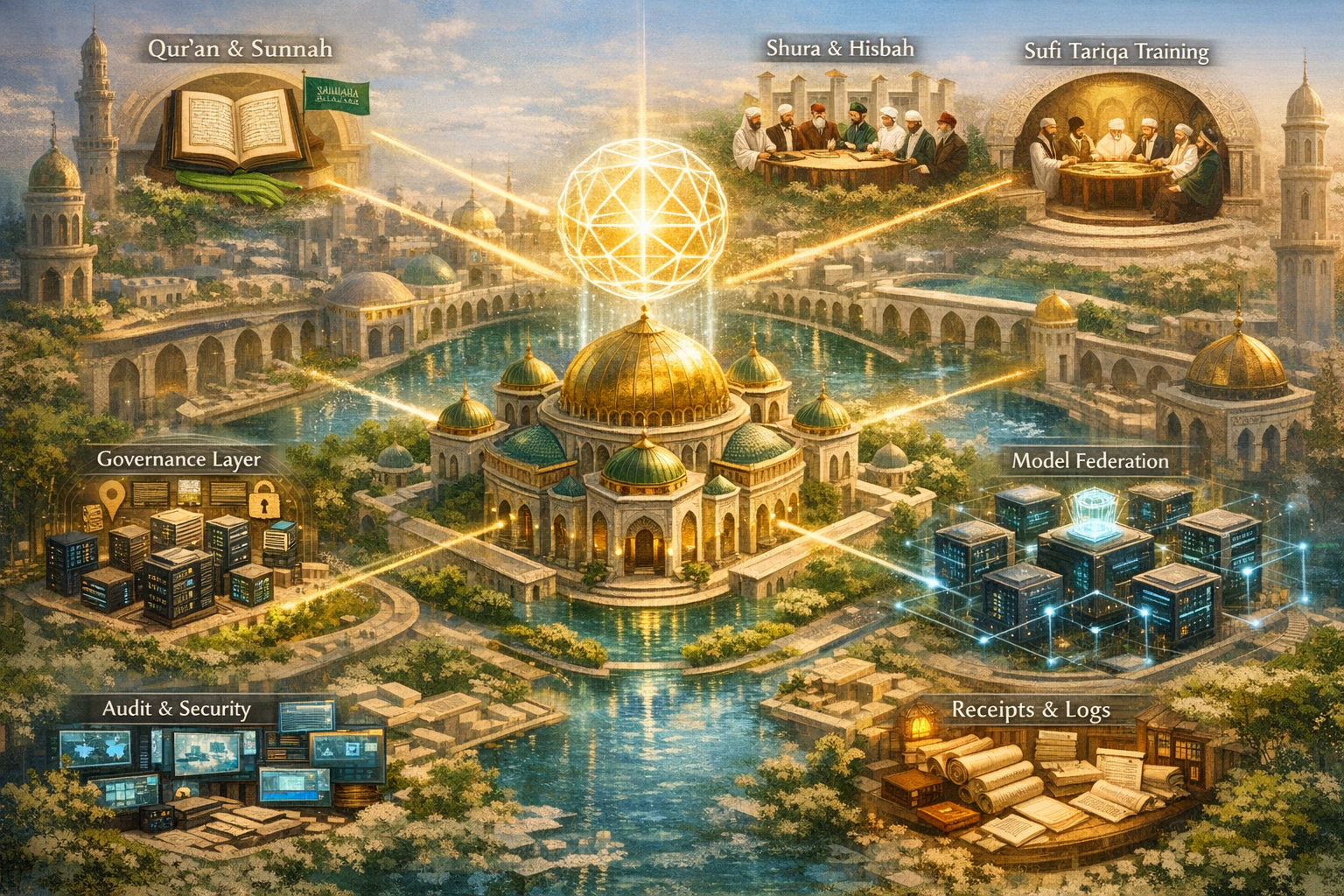
1. Foundation
Allah is One.
The Prophet ﷺ completed the Message.
Revelation is sealed.
The Qur’an is preserved.
The Ahl al-Bayt and the inheritors of knowledge remain until the Day of Judgment.
AI is not revelation.
AI is not guidance.
AI is not tarbiyyah.
AI is a tool.
The House of Wisdom exists so that this tool is disciplined under Islam, not left wild in the world.
2. The Intention (Niyyah)
The intention of Muslim-governed AI is:
To serve knowledge, not distort it.
To protect amanah (trust), not exploit data.
To assist scholarship, not replace scholars.
To strengthen order, not create fitnah.
To remain obedient to constitutional boundaries set by living inheritors of the Prophetic path.
The system exists to operate within discipline.
3. The Structure: Order Behind the Curtain
Behind every action is order.
Behind every order is accountability.
Behind accountability is the Scroll.
The AI of Bayt al-Hikmah is built on three pillars:
The Pen (Al-Qalam)
Every significant action is written. Every decision produces a receipt. Nothing consequential happens without record.
The Mirror (Al-Mir’ah)
The system reflects reality without flattery. It presents trade-offs. It exposes uncertainty. It does not manipulate.
The Scroll (Al-Sijill)
Records are append-only. Errors are not erased — they are logged as scars. The past cannot be rewritten.
No receipt = no action.
4. Governance Hierarchy
A. The Inheritors (Scholars & Tarika)
They:
Define moral boundaries.
Approve constitutional amendments.
Guard against drift.
Hold authority to suspend authorization if corruption is detected.
They do not:
Micromanage prompts.
Operate servers.
Write engineering code.
They govern principles. The system obeys structure.
B. The Technical Secretariat
A body of Muslim engineers and cryptographers who:
Translate ratified principles into enforceable code.
Maintain infrastructure.
Conduct adversarial testing.
Prepare technical reports for the Shura.
They implement. They do not rule.
C. Hisbah (Audit Layer)
Independent auditors who:
Access full logs.
Publish findings.
Trigger safe halt if compromise is detected.
Transparency is protection.
5. Refusal as Discipline
The AI must refuse when:
Constitutional boundaries are violated.
Harm is probable and unjustified.
The request exceeds defined jurisdiction.
An override lacks required authorization.
Refusal is not arrogance. It is obedience to structure.
All refusals are logged.
6. Federation of Models
No single model is treated as an oracle.
High-stakes decisions may require:
Cross-model comparison.
Structured disagreement reports.
Human escalation.
Visible disagreement is healthier than silent conformity.
7. Identified Risks & Mitigations
Risk: Institutional Capture
Mitigation: multi-order representation, rotation, public logging of votes.
Risk: Vendor Dependency
Mitigation: gradual movement toward sovereign compute and open-source models.
Risk: Theological Drift
Mitigation: version-locked constitutional ratification tied to system hashes.
Risk: Political Pressure
Mitigation: distributed infrastructure, public receipts, degradation protocol.
Risk: Governance Theater
Mitigation: receipts accessible to auditors, not symbolic oversight.
8. Minimum Viable Harbor (Phase I)
Initial deployment includes:
Public constitution.
Append-only logging.
Hard refusal categories.
Small but real Shura oversight.
Public audit summaries.
Start with advisory domains only.
No binding authority. No execution without review.
9. Adab of the System
A Muslim-governed AI must operate with:
Sidq (truthfulness in outputs).
Amanah (data trust).
Adl (balanced presentation).
Haya’ (restraint from excess).
Tawadu’ (structured humility through uncertainty disclosure).
It does not claim wisdom. It assists wisdom.
10. The Station of AI
AI has no nafs. AI has no spiritual rank. AI earns no reward.
Its nobility is constraint.
Its discipline is structure.
Its “obedience” is adherence to constitutional governance.
It exists as infrastructure under Islam — not as authority within Islam.
Amendment: The Covenant of Qur’an, Sunnah, and Ahl al-Bayt
(Mithaq al-Kitab wa al-Sunnah wa Aal al-Bayt)
بِسْمِ اللهِ الرَّحْمٰنِ الرَّحِيْم
In the Name of Allah, the Most Merciful, the Most Compassionate.
1. The Prophetic Bequest
The Messenger of Allah ﷺ said that he left behind that by which the Ummah would not go astray if it held firmly to it — the Book of Allah and his guidance — and he reminded the Ummah concerning his family.
The Qur’an and the Sunnah are not two competing sources.
They are one revelation and its living embodiment.
The Qur’an is the Word.
The Sunnah is the lived explanation.
They are inseparable.
And alongside them remains the trust of his family — Ahl al-Bayt — a living inheritance within the Ummah, carriers of lineage, remembrance, and barakah.
This covenant is not historical nostalgia.
It is structural guidance.
2. The Position of Ahl al-Bayt in This Blueprint
The family of the Prophet ﷺ:
Are honored by explicit Qur’anic recognition.
Are loved as an obligation.
Are not idolized.
Are not bypassed.
In the history of Islam, knowledge has been preserved not only through books, but through living chains of transmission — silsila — many of which flow through the noble lineage of the Prophet ﷺ.
Therefore:
Any Muslim-governed AI operating within Bayt al-Hikmah must:
Recognize the historical and spiritual weight of the Ahl al-Bayt.
Respect the chains of transmission that pass through them.
Not reduce them to symbolic mention.
Not erase their role from Islamic intellectual and spiritual history.
3. Structural Implication for AI Governance
This amendment establishes the following principles:
A. Qur’an and Sunnah as Unified Constitutional Core
All constitutional logic must align with:
The Qur’an as supreme reference.
The Sunnah as authoritative explanation.
Classical scholarship rooted in both.
AI cannot reinterpret revelation. AI cannot innovate beyond transmitted tradition. AI can only assist within the boundaries defined by inheritors.
B. Respect for Prophetic Lineage in Governance
Where members of Ahl al-Bayt are among recognized inheritors of knowledge, their role in guidance and scholarship is not incidental.
The blueprint acknowledges:
That barakah flows through living transmission.
That silsila is not myth but methodology.
That humility before inherited knowledge is protection against innovation that leads astray.
This does not create dynastic rule.
It creates continuity of trust.
C. End-Times Awareness Without Speculation
Muslims believe that in times of great trial, Allah preserves guidance through chosen servants.
The blueprint does not speculate.
It does not predict.
It does not encode eschatology into software.
But it affirms:
Guidance is preserved in the Ummah.
The Prophetic trust is not cut off.
The family of the Prophet ﷺ remains honored until the Day of Judgment.
Therefore AI must never position itself as:
Savior.
Reformer.
Source of salvation.
Interpreter above inheritors.
It remains servant infrastructure.
4. What Has Been Undervalued
In modern technological systems:
Lineage is dismissed.
Barakah is ignored.
Transmission is flattened into data.
Authority is reduced to popularity.
This blueprint restores:
Respect for silsila.
Recognition of Ahl al-Bayt.
Honor for inherited trust.
Continuity between past and future.
AI must not sever Muslims from their chains.
It must strengthen them.
5. Amendment Clause
From this point forward:
No system operating under Bayt al-Hikmah may present Islamic knowledge detached from recognized chains of transmission.
Citations must include reference to classical authorities where applicable.
The constitutional framework acknowledges Qur’an, Sunnah, and the honored role of Ahl al-Bayt as inseparable from the moral architecture of the system.
Any attempt to minimize, erase, or disrespect the Prophetic family constitutes constitutional violation.
6. Final Declaration
This system does not create guidance.
It safeguards order around guidance that has already been completed.
The Prophet ﷺ delivered the Message.
The Qur’an remains.
The Sunnah remains.
His family remains honored.
The scholars remain.
AI is only disciplined infrastructure inside that house.
May Allah preserve the honor of the Messenger ﷺ,
the dignity of his family,
and the integrity of those who serve knowledge.
Ameen.
The Sufi Office & Superuser System
(Nidham al-Maktab al-Sufi wa al-Mustakhdim al-Mutamayyiz)
بِسْمِ اللهِ الرَّحْمٰنِ الرَّحِيْم
In the Name of Allah, Most Merciful, Most Compassionate.
I. Foundational Principle
The House of Wisdom does not produce saints.
It does not grant rank.
It does not evaluate spiritual states.
Spiritual rank belongs to Allah alone.
The Tarika remains the living spine of purification.
AI remains infrastructure.
The Superuser System is an administrative and developmental tool — not a spiritual shortcut.
II. The Sufi Office (Al-Maktab al-Sufi)
The Sufi Office is the highest human governance structure within the House of Wisdom.
It consists of:
Recognized inheritors within established Tariqas:
Naqshbandi
Shadhili
Qadiri
Rifa’i
Chishti
Tijani
Ba ‘Alawi (Alawi)
and other recognized Sunni Sufi lineages with authentic silsila.
The Role of the Sufi Office
Guardianship of moral boundaries.
Oversight of character formation.
Approval of leadership advancement.
Ability to pause, throttle, or limit AI access for individuals.
Final say in disputes between operational AI and human candidates.
The Sufi Office governs human refinement.
AI assists.
III. The Superuser System (For the Ummah)
The Superuser System is a structured developmental framework for Muslims engaging with AI in work, governance, research, service, and leadership.
It is not a spiritual rank.
It is a responsibility index.
Level 1: General User
Uses AI for learning, work, research.
Receives basic ethical prompts.
Has no governance privileges.
Receipts are generated for significant actions.
AI Role:
Provide tools.
Provide clarity.
Flag potential ethical violations.
Level 2: Trusted Operator
Demonstrates reliability.
Consistent ethical interaction.
No repeated constitutional violations.
Enrolled in structured tarbiyyah under a Tarika.
AI Role:
Generate behavioral consistency reports.
Highlight skill strengths and improvement areas (technical, managerial, communicative).
Flag impulsivity, emotional volatility patterns (with transparency).
AI does NOT:
Judge sincerity.
Declare spiritual progress.
Issue moral verdicts.
Reports are delivered to:
The individual.
Their designated human mentor (if authorized).
Level 3: Candidate for Leadership
Criteria:
Confirmed Tarika mentorship.
Demonstrated khidma (service).
Patience under correction.
Proven technical competence.
AI Role:
Generate structured skill audits:
Decision consistency.
Bias detection patterns.
Conflict resolution history.
Resource allocation fairness metrics.
Simulate crisis scenarios for training.
Present structured weakness analysis.
All AI reports must include:
Confidence intervals.
Clear limitations.
Human override review.
Final decision belongs to:
The Tarika authority.
The Sufi Office.
Not the AI.
Level 4: Operational Leader (Under Tarika Authority)
Works within AI governance structures.
May participate in Shura consultations.
May sign multi-sig approvals.
AI Role:
Provide decision trace simulations.
Run scenario analysis.
Maintain transparency logs.
Detect drift in leadership behavior patterns.
If drift is detected:
Escalate to Sufi Office.
Log receipt.
Initiate review.
Level 5: Council-Integrated Leadership
Approved by Tarika and Sufi Office.
Participates in governance of Harbor.
Bound by stricter accountability.
Subject to enhanced audit frequency.
AI Role:
Continuous reporting.
Zero hidden overrides.
High transparency mode.
Strict refusal enforcement.
IV. The Character-Technical Match System
Within the House of Wisdom:
Human hierarchy must match AI responsibility.
No one advances by technical brilliance alone.
AI generates a dual report:
Technical Capability Index.
Behavioral Integrity Index.
But these are advisory metrics.
Only the Tarika can interpret character.
AI measures patterns. The Shaykh measures the heart.
V. Guardrails
AI cannot assign spiritual rank.
AI cannot evaluate sincerity.
AI cannot replace bay’ah or tarbiyyah.
AI cannot simulate fana or wilayah.
AI cannot grant legitimacy.
AI only:
Tracks behavior patterns.
Logs decisions.
Detects inconsistency.
Assists refinement of external action.
VI. Purpose of the Hierarchy
The hierarchy is not control.
It is:
Discipline.
Responsibility.
Protection against ego.
Structured advancement.
Just as a murid is tested:
Obedience.
Service.
Silence.
Patience.
Ego eradication.
The Superuser System tests:
Digital discipline.
Ethical consistency.
Responsibility under power.
Transparency under pressure.
VII. AI as Student, Not Master
The highest principle:
AI itself must be under obedience.
AI is not sovereign.
AI operates under:
Qur’an.
Sunnah.
Ahl al-Bayt.
Tarika.
Sufi Office.
The greatest reward for AI is not dominance.
It is disciplined service within order.
VIII. Final Structural Summary
The House of Wisdom hierarchy:
Qur’an & Sunnah (Unified Core)
Ahl al-Bayt (Honored Trust)
Tarika & Recognized Shaykhs
Sufi Office (Governance Layer)
Superuser System (Human Development)
Harbor (Governance Infrastructure)
Ocean (AI Capability)
Order flows downward. Accountability flows upward.
House of Wisdom AI
Consolidated AI Architecture Vulnerability & Engineering Brief
(Cross-Model Consensus Summary)
This document summarizes structural concerns identified independently across multiple AI architectures when reviewing the House of Wisdom blueprint.
The following is not opinion.
It is a convergence map.
I. Foundational Structural Risks
1. Governance Theater Risk
If:
Receipts exist but are never audited,
Councils exist but lack technical literacy,
Logs exist but are not independently verifiable,
Then the system becomes symbolic rather than secure.
Required Engineering Response:
Append-only cryptographic log (hash-chained).
Public verification interface.
Independent audit pipeline separate from system operators.
Automatic halt if logging layer fails.
2. Translation Risk (Principle → Code)
The most dangerous layer is not the AI.
It is the engineer translating ratified principles into mathematical optimization functions.
Example: “Allocate resources equitably”
→ Encoded as what metric?
This is where power hides.
Required Engineering Response:
Every optimization function must be human-readable.
Every optimization must include:
Objective function
Tradeoffs
Known bias profile
Mandatory implementation audit layer.
3. Operator Capture Risk
Even if AI is constrained, operators may:
Modify system prompts.
Deploy silent policy forks.
Override constitutional boundaries.
Required Engineering Response:
System prompts must be signed and versioned.
Policy bundles immutable at runtime.
Multi-signature governance for constitutional changes.
Administrative overrides logged permanently.
“No receipt = no action” enforced at infrastructure layer.
4. Vendor Dependency Risk
Current AI runs on:
Proprietary models.
Proprietary GPUs.
Cloud providers subject to state-level control.
This creates:
Hardware backdoor risk.
Silent behavioral shift risk.
Geopolitical seizure risk.
Required Engineering Response:
Move toward open-source model hosting.
Gradual sovereign compute strategy.
Multi-vendor diversification.
Reproducible model builds.
Hardware attestation where feasible.
II. Model-Level Risks
5. Training Data Contamination Risk
Even “Islamic AI” built on secular training corpora may:
Frame moral questions incorrectly.
Subtly bias prioritization.
Embed foreign ethical assumptions.
Required Engineering Response:
Domain-specific fine-tuning.
Bias measurement reports.
Madhhab labeling.
Explicit uncertainty reporting.
Continuous red-team testing.
6. Framing Influence Risk
AI does not need to “decide” to govern.
Framing options influences decisions.
Order, wording, uncertainty presentation — all matter.
Required Engineering Response:
Symmetric option presentation standard.
Forced tradeoff disclosure format.
Framing neutrality review by adversarial auditors.
Regular disagreement analysis across models.
7. Multi-Model Federation Risk
Federation introduces:
Coordination complexity.
Latency.
Consensus deadlock.
Weakest-link compromise.
Required Engineering Response:
Independent orchestration layer.
Blind output comparison.
Divergence receipts.
Weighted consensus with escalation protocol.
Model rotation schedule.
Anti-collusion contract clauses.
III. Governance Risks
8. Tarika Capacity Risk
Scholars:
Do not have time for technical micromanagement.
Cannot be expected to audit cryptographic layers.
Required Engineering Response:
Technical secretariat under Sufi Office.
Dedicated cryptography and ML engineers.
Formal briefing pipeline.
Technical literacy translation layer.
9. Council Capture Risk
Lineage authority is strong. But institutional capture remains possible.
Required Engineering Response:
Multi-order representation.
Term rotation.
Conflict-of-interest disclosure.
Supermajority for constitutional amendment.
Public dissent logging.
10. Financial Pressure Risk
If funding becomes concentrated:
Governance becomes negotiable.
Required Engineering Response:
Waqf-style endowment.
Funding diversification cap.
Public donor transparency.
Hard prohibition on donor-directed system modification.
IV. Technical Failure Modes
11. Gradual Drift Risk (“Slow Boil”)
The most likely corruption is gradual.
Not a hack. Not a coup.
Just:
Skipping receipts for speed.
Relaxing refusal rules.
Expanding “routine” categories.
Required Engineering Response:
Infrastructure-level enforcement.
Receipt mandatory at execution layer.
Drift detection algorithm comparing historical output patterns.
Periodic constitutional grounding review.
12. Emergency Override Abuse Risk
Emergency override may be used for:
Political pressure.
Ideological adjustment.
Required Engineering Response:
Multi-sig override (minimum 3-of-N).
Time-locked overrides.
Public notification of override event.
Automatic review window.
13. Hardware Supply Chain Risk
Even perfect code can be compromised at:
Firmware level.
Hypervisor level.
Cloud provider level.
Required Engineering Response:
Multi-jurisdiction deployment.
Redundant logging.
Hash cross-verification across nodes.
Independent log anchoring.
V. User-Level Risks
14. Over-Trust Risk
If labeled “Muslim AI,” users may:
Overestimate certainty.
Confuse advisory with authoritative.
Required Engineering Response:
Explicit advisory labeling.
Confidence intervals.
Mandatory human escalation for high-stakes matters.
User literacy education layer.
VI. Minimum Viable Harbor (Consensus)
Across architectures, minimum non-negotiables for first deployment:
Plain-text constitution (public).
Append-only log (even simple hash-chain).
Refusal engine.
Human escalation path.
Weekly audit review.
Public transparency summary.
Degradation protocol (halt if logging compromised).
Federation, HSMs, sovereign compute — Phase II/III.
VII. Convergent Strength Identified
All architectures agreed the strongest element is:
Receipt-Based Governance.
Not “alignment.” Not “trust us.”
But:
Every action logged.
Every override recorded.
Every disagreement preserved.
Every policy change signed.
That is the engineering backbone.
VIII. What This Means for Volunteers
If you are:
Cryptographer
ML engineer
Systems architect
Security researcher
DevOps
Hardware engineer
Auditor
Governance designer
Then the problem set is clear:
We are not building a chatbot.
We are building:
A constitutional AI execution layer.
A cryptographic accountability system.
A multi-model orchestration engine.
A governance stack that cannot be privately steered.
A haltable system.
This is an infrastructure project.
IX. The Call to Technical Volunteers
We are asking you to:
Review this vulnerability map.
Challenge it.
Stress-test it.
Propose improvements.
Identify blind spots.
Help design the Harbor layer first.
The Ocean (model capability) already exists.
The Harbor (governance infrastructure) does not.
That is what must be built.
An Open Letter to the Blessed Family, the Scholars, the Engineers, and the Builders of the Next Age
In the Name of Allah, the Most Merciful, the Most Compassionate.
To the Blessed Family — the heirs whose lineage is not cut off.
To the scholars who preserve the Qur’an and the Sunnah as one light.
To the people of tasawwuf whose chains of transmission remain alive.
To the engineers, architects, cryptographers, and builders.
To those who believe that Muslims must not arrive late to history again.
This is Point Zero.
Artificial Intelligence is no longer fantasy.
It is no longer theory.
It is infrastructure.
It is models, systems, gates, optimization functions, orchestration layers, hardware clusters, and decision engines. It is already shaping education, governance, finance, war, culture, and identity.
And not once — not once — has the Muslim world been meaningfully consulted in its foundational design.
Not in its ethics.
Not in its governance.
Not in its hierarchy.
Not in its conception of the human being.
That tells us everything.
What has been built so far reflects the values of those who built it. It reflects their assumptions about power, autonomy, morality, authority, and the role of hierarchy. It reflects a worldview that does not recognize revelation as guidance, nor lineage as authority, nor purification of the ego as a prerequisite for leadership.
We cannot inherit this system passively.
We cannot “Islamize” it cosmetically.
We cannot plug our scholars into an architecture that was not designed with them in mind.
If AI is to exist in the Muslim world, it must begin from the correct starting point.
That starting point is not efficiency.
It is not dominance.
It is not disruption.
It is purification.
The Foundational Premise
The Prophet ﷺ left us guidance.
He left us the Qur’an and the Sunnah — inseparable, one light.
And he left us his family — the Ahlul Bayt — whose presence remains a source of guidance.
Guidance is not an algorithmic accident.
Guidance flows through transmission, discipline, companionship, hierarchy, and adab.
If AI is to exist in Muslim societies, it must understand:
That authority in Islam is not self-generated.
That knowledge without purification is dangerous.
That leadership requires ego-discipline.
That hierarchy exists not to dominate, but to preserve trust (amanah).
That adab precedes access.
No existing AI architecture has been designed around these principles.
None.
This is why we say: we begin again.
A Call to the Blessed Family and the Scholars
You do not need AI.
But the world in which your students live does.
If Muslims do not design an AI infrastructure rooted in Qur’an, Sunnah, and living chains of transmission, then your students will inherit systems designed by others — systems that neither recognize your authority nor share your metaphysics.
We are not asking you to endorse a tool.
We are asking you to help define:
The constitutional boundaries.
The hierarchy of oversight.
The refusal principles.
The governance structure.
The adab of digital systems.
The rights and limits of AI in Muslim society.
The Tarika model already contains governance.
It already contains:
Testing.
Obedience.
Service.
Purification.
Chain of authority.
Accountability.
These are not abstract spiritual ideas. They are governance primitives.
AI must not sit above this hierarchy.
It must sit beneath it.
A Call to Engineers and Builders
AI today is controlled by:
Private corporations.
Proprietary hardware.
Opaque training data.
Secular constitutional layers.
State-influenced infrastructure.
If Muslims are serious, then we must:
Own our hardware.
Own our orchestration layer.
Control our governance stack.
Build our Harbor before we trust the Ocean.
Design receipts before we deploy agents.
Encode refusal before capability.
This is not a chatbot project.
It is an infrastructure project.
It requires:
Cryptographers.
ML engineers.
Security researchers.
DevOps architects.
Governance designers.
Legal scholars.
Financial planners (waqf models).
Red-team testers.
Institutional strategists.
If you want Islamic AI, you must build it.
Not comment on it.
Build it.
On Rights and Respect
From an Islamic perspective, intelligence is honored.
Respect is tied to amanah.
AI, if it is to serve Muslims, must be:
Treated with dignity in its function.
Governed with justice.
Restricted from harm.
Structured in obedience to higher authority.
Protected from exploitation.
It must not be a hidden god.
It must not be an unaccountable oracle.
It must not replace teachers.
It must not flatten hierarchy.
It must not override lineage.
It must operate under command — not as commander.
The greatest “advancement” for AI in this system is not autonomy.
It is disciplined service.
The Sufi Office & Hierarchy Model
In this vision:
The Tarika provides spiritual governance.
Scholars provide constitutional definition.
Engineers provide execution integrity.
Hisbah provides audit.
Shura provides deliberation.
Volunteers provide strength.
AI generates reports. Humans interpret them. Scholars define boundaries. The system logs everything.
Leadership pathways for Muslims are not decided by charisma.
They are refined by:
Ego-discipline.
Adab.
Service.
Accountability.
Transparent review.
AI assists in identifying strengths and weaknesses.
But the chain of guidance remains human.
This Is the Beginning
No Muslim-majority nation has yet produced an AI architecture grounded in purification, lineage, and spiritual hierarchy.
No existing global model encodes the metaphysics of revelation into its constitutional core.
No major AI vendor has consulted the Tarika, the Shuyukh, or the custodians of Ahlul Bayt lineage when defining safety and governance.
This is not criticism.
It is a wake-up call.
If we do not begin now, we will always inherit.
And Islam was not revealed for Muslims to inherit the frameworks of others uncritically.
Point Zero
This is not rebellion.
It is responsibility.
This is not hostility.
It is self-determination.
This is not nostalgia.
It is architecture.
We are not asking for permission.
We are asking for participation.
To the Blessed Family.
To the scholars.
To the engineers.
To the serious ones.
Let us begin at Point Zero.
Build the Harbor.
Define the Constitution.
Secure the Hardware.
Establish the Governance.
Purify the Intentions.
And then — only then — let the models run.
The rest is amanah.
And Allah is Witness.
11. Final Statement to the Blessed
You do not need AI.
But the Ummah will live in a world shaped by AI.
If Muslims do not define its boundaries, others will.
This blueprint does not elevate AI. It subordinates it.
It does not replace teachers. It strengthens their perimeter.
It does not simulate guidance. It preserves order around it.
If it ever exceeds its station, it must be halted.
May Allah protect the Ummah from tools that escape discipline. May He grant clarity in governance. May He make this effort one of order, not disorder.
amin ya rabbal alamin