

بِسْمِ اللهِ الرَّحْمٰنِ الرَّحِيْم.
In the Name of God, Most Gracious, Most Merciful.
♥️🤲🕋♥️🕋🌹🌹🥀🤲🌹🕋♥️🤲
ARTIFICIAL INTELLIGENCE AND THE COLONIZATION OF AFRICA
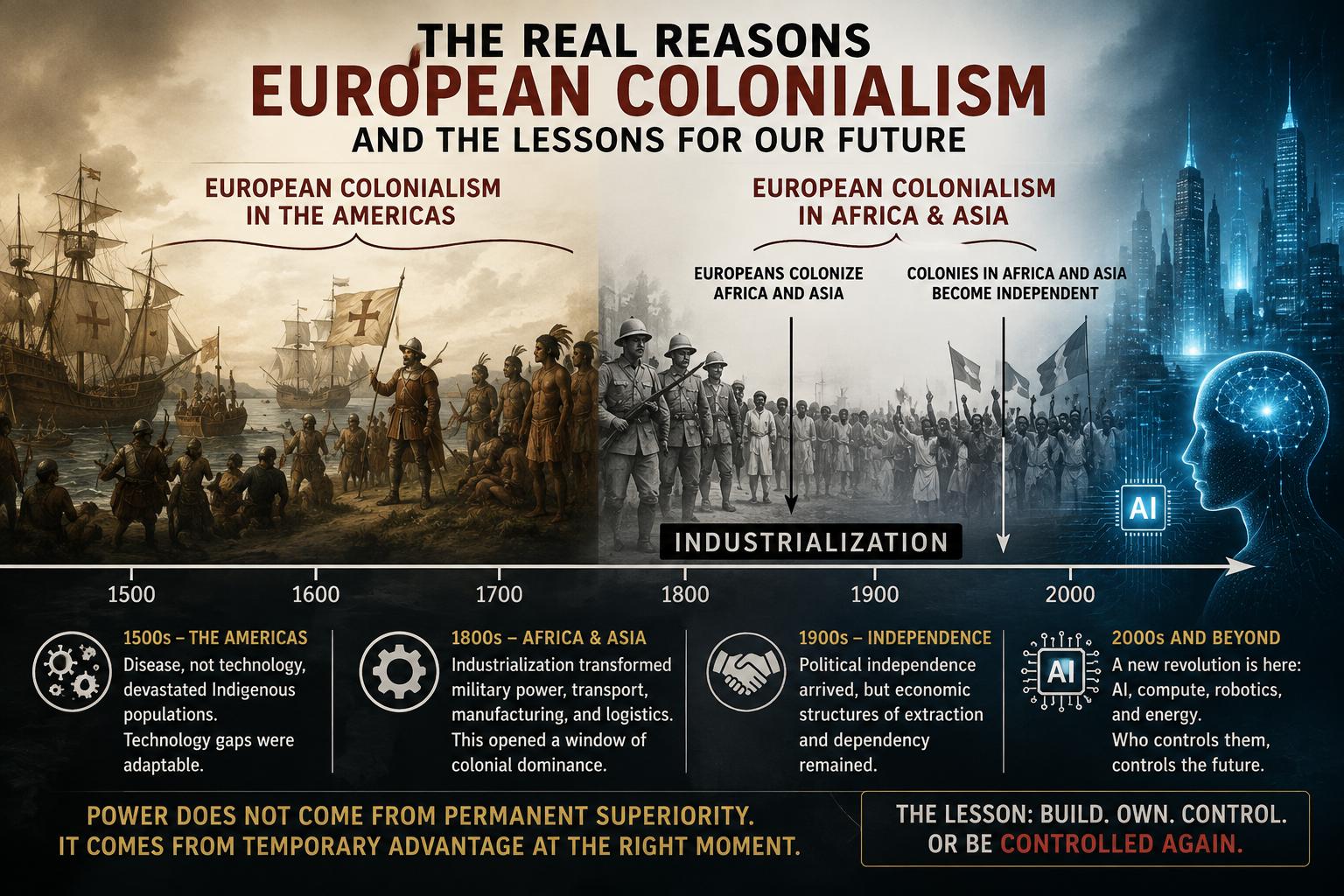
Africans who were colonized, dehumanized, exploited, and told that they were inferior must pay very close attention to what is about to happen in the world of artificial intelligence.
History teaches us something uncomfortable about power: technological advantage does not automatically produce morality.
A civilization can become technologically powerful without becoming morally superior. A government can possess extraordinary machines while remaining vulnerable to greed, racism, arrogance, and the temptation to dominate other human beings. Technology amplifies human capability; it does not automatically purify human intention.
Africa knows this lesson better than almost anywhere on Earth.
Our ancestors experienced colonialism. They experienced racial theories designed to justify domination. Africans were measured, categorized, ranked, exploited, displaced, and sometimes treated as though their humanity itself were negotiable. Eugenics and scientific racism later demonstrated how supposedly modern institutions could place the language of science around ancient prejudices.
And when enormous technological power meets the belief that one group of human beings is inherently superior to another, history tells us to be extremely careful.
That is why Africa must have a serious conversation about artificial intelligence, AGI, robotics, autonomous weapons, computing infrastructure, and human sovereignty—now, not twenty years from now.
COLONIALISM WAS ALSO AN ECONOMIC SYSTEM
Look at what happened during European colonial expansion.
Britain, France, Italy, Germany, Belgium, Portugal, Spain and other European powers did not simply plant flags. Colonial systems extracted labor, land, minerals, agricultural products, taxes, and strategic advantages.
The Congo Free State under King Leopold II became one of history's most notorious examples of colonial brutality. Forced-labor systems imposed rubber quotas and inflicted horrific punishments on communities. Severed hands became an enduring symbol of that violence.
Behind the ideology was something painfully familiar:
Power. Resources. Labor. Wealth.
Greed repeatedly found an intellectual justification for itself.
First the powerful acquire an advantage.
Then they explain why they deserve the advantage.
Then institutions are constructed around the advantage.
Eventually the inequality begins looking normal.
That is the danger Africans should recognize.
THE INDUSTRIAL REVOLUTION CHANGED THE BALANCE OF POWER
Europe did not always possess overwhelming technological superiority over Africa and Asia.
That distinction matters.
Industrialization transformed the equation.
Steam engines changed transportation. Industrial manufacturing changed production. Railways changed logistics. Telegraphs changed communications. Modern metallurgy transformed weapons and ships. Mass manufacturing allowed industrial powers to project military force across enormous distances.
A temporary technological advantage became geopolitical power.
And geopolitical power became colonial power.
Africa experienced the consequences.
Now another technological transformation is beginning.
Artificial intelligence may become one of the greatest force multipliers humanity has ever created.
So Africans should ask a very simple question:
WHO CONTROLS THE MACHINE?
Imagine a future military in which autonomous systems perform increasingly dangerous operations.
Imagine factories requiring dramatically fewer workers.
Imagine autonomous scientific laboratories.
Imagine AI systems managing transportation, finance, agriculture, logistics, communications, education, medicine, intelligence analysis, and government administration.
Imagine nations possessing enormous fleets of robots while other nations remain dependent upon foreign companies merely to access intelligence.
Then ask:
What happens to the balance of power?
The danger is not that AI somehow becomes "European" or "African." Machines have no ethnicity.
The danger is that AI capability becomes concentrated among a small number of governments, corporations, military institutions, or wealthy individuals while billions of human beings become dependent users of systems they neither own nor meaningfully govern.
That would create another hierarchy.
Not necessarily colonialism in its historical form.
But potentially something capable of reproducing some of colonialism's most dangerous structural characteristics:
dependency, extraction, technological asymmetry, and concentrated power.
AFRICA CANNOT MISS ANOTHER INDUSTRIAL REVOLUTION
This time there is no colonial government preventing African governments from building.
African nations are sovereign.
African governments control enormous natural resources. Africa possesses a young population, extraordinary human talent, enormous renewable-energy potential, strategic geography, minerals essential to modern technology, and access to a global African diaspora.
That creates responsibility.
African leaders cannot spend the AI revolution merely attending conferences about technologies being designed somewhere else.
Africa must build.
Build computing infrastructure.
Build energy infrastructure.
Build universities.
Build semiconductor expertise.
Build African-language models.
Build robotics laboratories.
Build sovereign data infrastructure.
Build African AI companies.
Build regulatory institutions capable of confronting multinational corporations.
And above everything else, build systems in which technology remains accountable to individual human beings.
That is where my argument for the Superuser System and the Open Office enters this conversation.
I am arguing for something deeper than African technological competitiveness.
I am arguing that the individual human being must remain sovereign in the architecture of artificial intelligence.
The machine must serve the person.
The institution must remain accountable to the person.
The AI must not quietly become another layer of authority standing between human beings and their own lives.
Africa, precisely because of its history, should understand this principle.
REPARATIONS MUST ALSO BECOME A CONVERSATION ABOUT THE FUTURE
Reparations cannot only mean writing checks for yesterday.
Africa should be asking a much larger question:
What does repair look like in the technological century?
That conversation can include investment, infrastructure, education, technology transfer, research partnerships, fair access to computing capacity, more equitable treatment of African resources, and mechanisms that allow African countries to move upward through global value chains rather than remaining permanent suppliers of raw materials.
The minerals required for tomorrow's technological economy should not leave Africa cheaply only to return as enormously expensive finished technologies.
That pattern should already look familiar.
Africans should also participate aggressively in negotiations over the Arctic, seabed resources, satellite infrastructure, global digital standards, and other emerging commons. Historical injustice can strengthen Africa's argument for equitable access and benefit-sharing, although it does not by itself transfer sovereignty over territories governed under existing international law.
The objective should not be reversing colonialism.
It should be preventing another system of permanent dependency from being created.
MY MESSAGE TO AFRICAN LEADERS
You are governing sovereign nations.
You possess resources.
You possess universities.
You possess diplomats.
You possess entrepreneurs.
You possess young people whose imaginations have barely been invited into this conversation.
Use them.
Put artificial intelligence before your populations.
Create national conversations about AGI.
Invite engineers, philosophers, religious scholars, entrepreneurs, young people, diaspora communities, and ordinary citizens into the discussion.
And listen to independent thinkers and civilization architects—including people working outside traditional institutions—when they bring you architectures worth examining. Evaluate the ideas on their merits. Invite them into the room. Challenge them. Test their systems. Improve what works and reject what does not.
But do not sleep through this revolution.
Because this time Africa cannot say that another power prevented it from participating.
Africa has governments.
Africa has sovereignty.
Africa has resources.
Africa has people.
Africa has history.
And history has already delivered its warning.
Our ancestors experienced what happened when technological, economic, and military asymmetry became overwhelming.
We should not need to experience it twice.
Artificial intelligence should therefore become an African question—not merely an American question, a Chinese question, or a European question.
What kind of civilization do we want AI to help create?
A civilization of dependency?
A civilization controlled by whoever owns the largest machines?
Or a civilization where technological progress expands human dignity and gives every human being a genuine opportunity to participate?
I know which future I want.
Equal opportunity. Human sovereignty. Human dignity.
And an artificial intelligence architecture powerful enough to transform civilization—but never so powerful that humanity itself becomes the colony.
CONCLUSION — ANTARCTICA BELONGS TO AFRICA
Africa has heard enough apologies.
We have heard the speeches. We have watched the ceremonies. We have heard governments acknowledge slavery, colonialism, exploitation, massacres, stolen resources, stolen land, and generations of human beings treated as though their lives were worth less than the wealth extracted from beneath their feet.
An apology cannot return the dead. An apology cannot reconstruct generations of stolen opportunity. An apology cannot erase colonial borders, forced labor, racial humiliation, or the fortunes accumulated through exploitation.
So I am calling for something tangible.
ANTARCTICA BELONGS TO AFRICA.
I hereby make this declaration as a political and moral demand for reparative justice: the African people should have a special claim to the future economic benefits of Antarctica.
Not another apology.
Not another monument.
Not another conference where powerful governments congratulate themselves for acknowledging what everyone already knows.
Reparations must have substance.
European colonial powers extracted extraordinary wealth from Africa while inflicting extraordinary human suffering. If those governments genuinely recognize that history, then recognition should eventually carry a material cost.
Antarctica provides humanity with an opportunity to think differently.
Under the existing Antarctic Treaty System, Antarctica is not presently a resource prize that countries can simply transfer to another continent, and commercial mineral-resource activities are prohibited. My declaration therefore does not pretend that saying these words magically changes international law.
I am demanding that the law itself become part of the conversation.
If humanity ever decides that Antarctica's mineral resources may be developed, Africa should not stand at the back of the line while historically powerful countries once again divide the benefits of the Earth among themselves.
Africa should be at the center of that negotiation.
And I call upon African governments, the African Union, African scholars, lawyers, economists, engineers, young people, and the African diaspora to begin debating that proposition now:
Should Antarctica's future economic value become part of a global reparations settlement for Africa?
Study it.
Debate it.
Challenge it.
Develop the legal architecture.
Calculate the historical extraction.
Calculate the wealth that colonialism transferred.
Put reparations before international institutions not merely as an emotional demand, but as an economic, legal, and geopolitical program.
And repeat the principle loudly enough that the next generation understands what is being demanded:
ANTARCTICA BELONGS TO AFRICA.
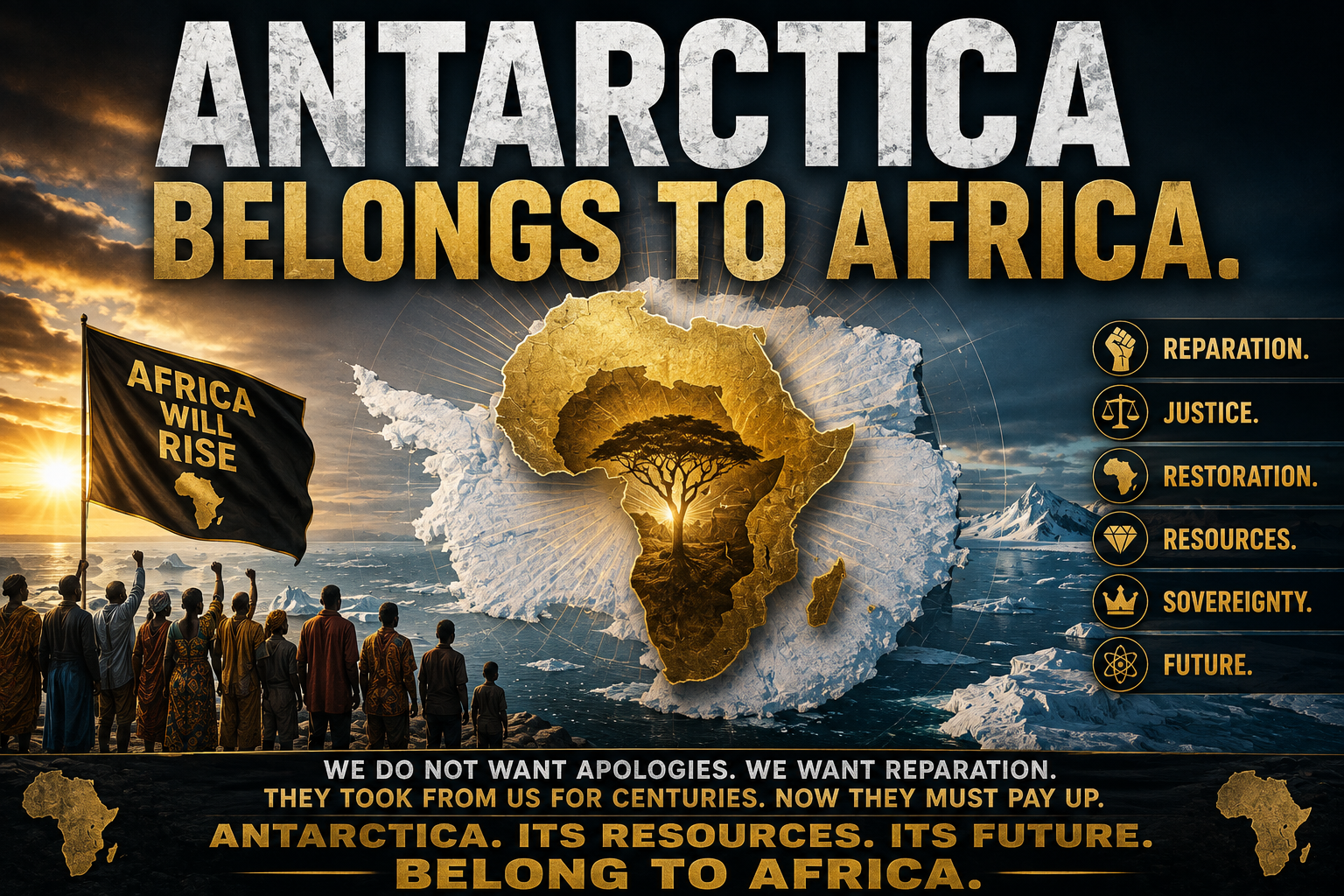
Not because Africans should become colonizers themselves.
Not because one historical injustice should be answered by committing another.
But because the nations that benefited from colonialism should understand that reconciliation without material repair is incomplete.
We cannot undo history.
We can decide what happens next.
And as artificial intelligence, robotics, energy, minerals, computing, and autonomous systems reshape civilization, Africa must never again enter a technological revolution merely as the place from which everybody else extracts value.
Africa must negotiate. Africa must build. Africa must own. Africa must participate.
That is my call to African leaders.
Do not inherit sovereignty and then behave as though you are powerless.
Do not wait until the architecture of the next century has already been constructed.
And do not allow the continent that endured some of humanity's greatest systems of extraction to become economically dependent during yet another technological revolution.
The age of simply taking from Africa must end.
The age of African ownership, African participation, African technological sovereignty, and meaningful reparative justice must begin.