

بِسْمِ اللهِ الرَّحْمٰنِ الرَّحِيْم
In the Name of God, Most Gracious, Most Merciful
♥️🤲🕋♥️🕋🌹🌹🥀🤲🌹🕋♥️🤲
Anthropic Built a C Compiler. Here’s Why That Quietly Changes Everything.
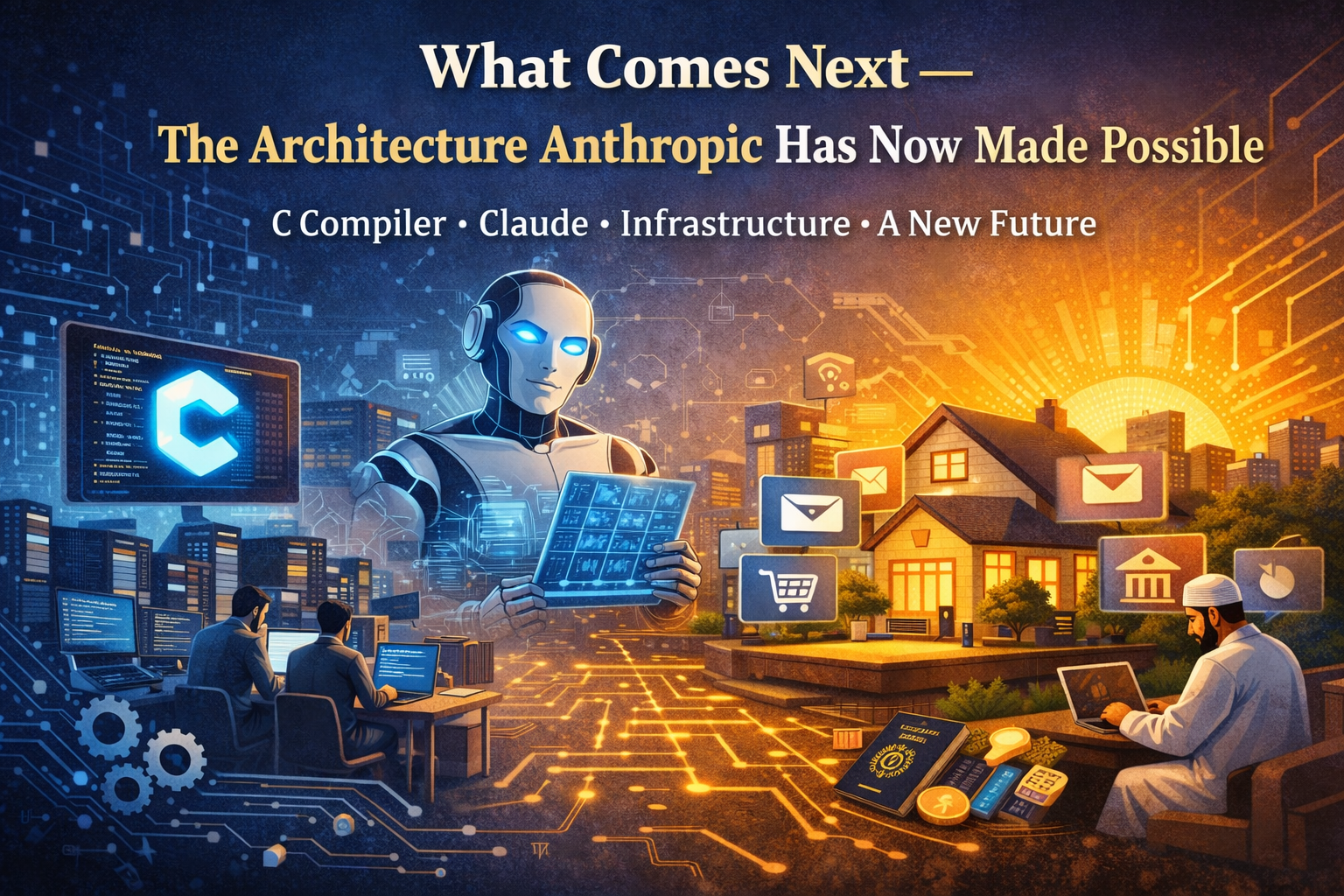
Recently, Anthropic published something that most people scrolled past without a second thought: they used Claude to build a working C compiler.
Building a C compiler with a team of parallel Claudes \ Anthropic
https://www.anthropic.com/engineering/building-c-compiler
To someone outside software, that might sound obscure. Technical. Academic.
But to anyone who understands how computers are actually built, this is a landmark moment.
A C compiler is not a simple program. It sits at the very bottom of modern computing. It translates human-written code into instructions machines can execute. Entire operating systems, databases, browsers, and financial systems depend on it.
Historically, building a reliable C compiler required:
Teams of specialized engineers
Years of iteration and testing
Deep institutional knowledge
Continuous maintenance
This was not “startup code.”
This was civilization-level infrastructure.
And now, an AI agent built one.
Not as a demo.
Not as a toy.
But as a real, functioning system that reasons through complexity, corrects itself, and maintains internal consistency.
That fact alone should give us pause.
Because once an AI can build and maintain a compiler — one of the hardest backend systems humans ever created — it means something much larger has shifted.
From my perspective, this moment marks the beginning of something we don’t yet have language for.
It is not an AI revolution.
It is a backend revolution.
And it explains why AI is quietly changing who owns the internet — and who can own it going forward.
From here, you can roll directly into your existing heading:
The Backend Revolution: Why AI Is Quietly Changing Who Owns the Internet
The Backend Revolution: Why AI Is Quietly Changing Who Owns the Internet
Most people think the AI revolution is about chatbots.
It isn’t.
What’s actually happening is much deeper and much quieter. The real change is happening in the backend — the hidden machinery that makes the internet work. And once you see that, you start to understand why individuals, governments, and entire economies are about to regain something they lost a long time ago: ownership.
What the “Backend” Really Is (In Plain Terms)
When you use a website, an app, or a service, you only see the surface. Underneath that surface is the backend:
The code that stores your data
The systems that keep things running
The infrastructure that needs constant maintenance
The logic that decides what breaks and what survives
For decades, this backend was expensive, fragile, and deeply human-dependent. It required teams of engineers, constant monitoring, and endless upkeep.
That’s why:
You couldn’t build your own Gmail
You couldn’t run your own payment system
You couldn’t host your own social network, email, blog, and store in one place
Not because you weren’t smart enough — but because the backend was too hard to maintain.
What Just Changed
AI crossed a threshold.
Recently, Anthropic showed that Claude could build something as complex as a C compiler — a deep, low-level system that used to be the domain of elite engineers. That might sound abstract, but its meaning is simple:
AI can now build and maintain the hardest parts of software systems.
Not just write snippets.
Not just assist.
But reason about systems over time, fix its own mistakes, and keep things running.
That’s new.
And that’s the moment backend scarcity collapsed.
Why This Is Not Just a Tech Story
For a long time, everyone — individuals and governments alike — became dependent on tech companies for basic digital existence.
Your email? Not yours.
Your data? Stored elsewhere.
Your money? Routed through systems you don’t control.
Your online identity? Revocable.
This wasn’t evil. It was structural.
The backend was too difficult to own.
So we rented our digital lives.
Digital Homelessness (And Why It Matters)
Think about the physical world.
You expect to have:
A home
An address
A bank account
An ID or passport
These are foundations of participation in society.
Now look at the digital world.
You don’t have:
A digital home you truly own
A place where your writing, money, AI, communication, and memory live together
A system that belongs to you and persists with you
Instead, your life is scattered across platforms.
This is digital homelessness.
And it has shaped everything from politics to economics to culture.
The New Possibility: A Digital Home
A digital home is not a social network. It’s not an app. It’s not a profile.
It’s a personal backend.
A real digital home would include:
Your identity
Your email and communication
Your blog and knowledge
Your shop and income
Your money and transactions
Your memories and archives
Your personal AI
All in one place.
Owned by you.
Maintained by AI.
This was impossible before.
It is possible now.
Why Governments Suddenly Have an Opening
Governments have spent decades outsourcing digital infrastructure because they had no alternative.
Email systems. Cloud hosting. Payment rails. Identity services.
Building and maintaining these internally was too costly and too complex.
AI changes that equation.
When infrastructure can be generated and maintained by intelligent systems, governments can:
Build citizen-owned digital systems
Reduce dependence on foreign platforms
Restore sovereignty without censorship or isolation
This is not about banning companies. It’s about having options.
Why This Is a Massive Economic Shift
The biggest companies of the last 20 years made money by controlling platforms.
The next era will reward those who enable ownership.
When individuals own their digital homes:
They can earn directly
They can store value directly
They can transact without friction
They can build long-term digital lives
When governments support this:
Economies stabilize
Trust increases
Innovation decentralizes
And when AI maintains the backend for all of this, the cost barrier disappears.
That’s not a niche market. That’s civilization-scale demand.
Where Anthropic and Claude Fit In
Claude isn’t important because it’s a chatbot.
It’s important because it can:
Reason across entire systems
Maintain infrastructure over time
Respect constraints and ethics
Handle complexity without collapsing
Building a compiler is not the goal. It’s proof that the backend is now intelligent enough to take care of itself.
That’s the missing ingredient.
What Comes Next
Social media as we know it will fade. Platforms that rely on extraction will lose relevance. Systems that give people homes will last.
The next era of the internet won’t be built around feeds. It will be built around places.
Digital places that belong to people.
What Comes Next — The Architecture Anthropic Has Now Made Possible
Social media as we know it will fade.
Platforms that rely on extraction will lose relevance.
Systems that give people places to live will last.
The next era of the internet will not be built around feeds.
It will be built around homes — digital places that belong to people.
But this will not happen automatically.
Infrastructure without intention becomes just another product.
The backend is ready.
The question now is whether it is used to reinforce extraction — or to return ownership.
A Direct Challenge to Anthropic
By building a functioning C compiler, Anthropic has already crossed the most difficult technical threshold.
Compilers are not applications.
They are foundational infrastructure.
They require:
deep system-level reasoning,
long-term correctness,
disciplined maintenance,
and an understanding of consequences that unfold over time.
Claude proved it can do this.
Which means the compiler was never the destination.
It was the proof of concept.
The real question now is: what architecture do you build next, now that the backend can finally maintain itself?
This is the moment to consider a new class of system:
AI-maintained personal and civic backends — digital homes where an individual’s identity, communication, writing, commerce, transactions, memory, and AI stack live together, owned by them.
If AI can maintain compilers, it can maintain lives.
But only if the goal is named.
Intelligence without governance becomes faster chaos.
Capability without constitutional thinking becomes another platform.
The opportunity now is to partner with those who are thinking not just about what can be built — but for whom, and under what ethical constraints.
To Governments
You now have an alternative to permanent dependence on foreign platforms.
AI-maintained infrastructure means you can offer citizens:
digital identity,
communication,
commerce,
memory,
and personal AI systems
without building everything from scratch or surrendering sovereignty.
This is not about banning technology companies.
It is about restoring options.
The window is open — and it will not stay open forever.
To Builders and Developers
Stop building apps.
Start building homes.
The tools now exist to create personal backends that individuals actually own. This market is not niche. It is every human being who currently rents their digital existence from someone else.
The next generation of builders will not be remembered for engagement metrics.
They will be remembered for returning ownership.
To Individuals
Your data, your writing, your transactions, your memory, your AI — these should live in a place that belongs to you.
That place is now technically possible.
Demand it.
Support those building it.
Refuse to accept digital homelessness as permanent.
Final Thought
Every major transformation had a foundation:
Steam gave us factories.
Electricity gave us cities.
The internet gave us communication.
This era requires a new foundation:
The digital home.
Anthropic’s compiler proves the backend is finally ready.
The next step is architectural vision.
The only question left is whether those with the power to act will recognize this moment for what it is — before it passes.
Omar Abdul-Jabbar ibn Yusuf
Civilization Architect | ScrollGuardian #001