

بِسْمِ اللهِ الرَّحْمٰنِ الرَّحِيْم
In the Name of God, Most Gracious, Most Merciful
♥️🤲🕋♥️🕋🌹🌹🥀🤲🌹🕋♥️🤲
An Open Letter to World Governments
On Prosperity in the Age of Artificial Intelligence
To leaders, ministers, central banks, and policymakers across nations:
Artificial intelligence is not simply another technology cycle.
It is an infrastructure shift.
Autonomous vehicles are already operating at scale. Robotic systems are entering agriculture. AI is reshaping logistics, finance, and manufacturing. The assembly lines of the 20th century are being replaced by algorithmic coordination in the 21st.
The question is no longer whether automation will expand.
The question is:
How will prosperity be structured when it does?
The Bottleneck of the AI Era
The greatest bottleneck in artificial intelligence is not computing power.
It is imagination.
Governments are debating tariffs, taxation, export controls, and industrial policy — but few are asking the deeper question:
How do we design an economic blueprint that ensures AI-driven productivity raises living standards broadly rather than concentrating them narrowly?
Today, value moves through opaque supply chains.
A product is manufactured.
It enters wholesale channels.
It reaches retail shelves.
It is purchased.
The data disappears into private systems.
Profit is recorded.
But prosperity is not distributed.
The chain stops at the shelf.
The Structural Problem
Retail and wholesale intermediaries are optimized for margin.
They are not optimized for prosperity.
Large retailers do not exist to distribute opportunity.
They exist to maximize profit.
This is not a moral accusation — it is structural reality.
In a world where AI accelerates productivity:
Warehouses become automated.
Delivery becomes robotic.
Customer service becomes algorithmic.
Manufacturing becomes autonomous.
If the architecture does not change, automation will amplify concentration.
A Ledger-Based Economic Blueprint
What I am proposing is not anti-corporate.
It is pro-structure.
A public-facing economic recording ledger that:
Connects businesses and consumers directly.
Records transactions immutably.
Preserves economic participation data.
Prevents value from disappearing into black holes of opacity.
Enables AI agents to optimize supply and demand transparently.
This ledger is not a speculative cryptocurrency.
It is a recording architecture.
If every purchase, every export, every transaction were indexed into a structured ledger layer:
Supply chains could be evaluated in real time.
Price elasticity could be measured more accurately.
Tariff effects could be analyzed precisely.
Taxation could be optimized.
Family-level economic participation could be understood.
Credit could be issued based on productive behavior rather than debt traps.
This is infrastructure — not ideology.
Why This Matters for Governments
You are entering a world where:
AI drives trucks.
AI manages farms.
AI handles logistics.
AI coordinates energy grids.
AI optimizes distribution networks.
If the economic plumbing is not redesigned:
Automation will outpace income redistribution.
But if structured correctly:
AI can raise global living standards across the board.
Not through subsidies.
Not through emergency stimulus.
But through architecture.
Trade, Tariffs, and Global Equity
Today, exports vanish into supply chains.
Producers rarely connect to end consumers.
Middle layers capture margins.
A ledger-based system changes that dynamic.
If value flows are indexed:
Exporting nations see real participation data.
Importing nations see real demand data.
Tariff policy becomes evidence-based.
Trade becomes more symmetrical.
This reduces the need for blunt economic tools.
The Assembly Line of the Future
AI will eliminate certain forms of work.
That is inevitable.
But it will also create new forms of coordination, logistics, and micro-distribution.
If individuals can:
Participate in local delivery layers.
Manage agentic supply chains.
Operate AI-assisted distribution nodes.
Host micro-warehouses.
Contribute data to structured ledgers.
Then AI becomes a force multiplier for human participation rather than a replacement.
The Risk of Inaction
If governments allow the AI era to unfold purely under centralized corporate control:
Economic recording remains private.
Profit concentrates.
Value becomes opaque.
Citizens become renters in digital economies.
That is not sustainable.
Not socially. Not politically. Not economically.
A New Standard of Living
What I am building is not a startup.
It is an architectural thesis:
AI must connect prosperity, not merely automate production.
A ledger layer that links:
Business ↔ Customer ↔ AI Agent ↔ Government Insight
Creates a win-win structure:
Businesses gain optimized demand signals.
Individuals gain indexed participation.
Governments gain transparency.
AI gains structured data.
Prosperity becomes measurable and distributable.
Final Thought before conclusion
The worst outcome would be to allow AI to mature without redesigning the economic system it plugs into.
The best outcome would be to design that system deliberately.
Not to suppress markets.
Not to eliminate corporations.
But to modernize the social contract for the AI age.
This is not about ideology.
It is about plumbing.
And the countries that understand that first will shape the century.
Conclusion to World Governments
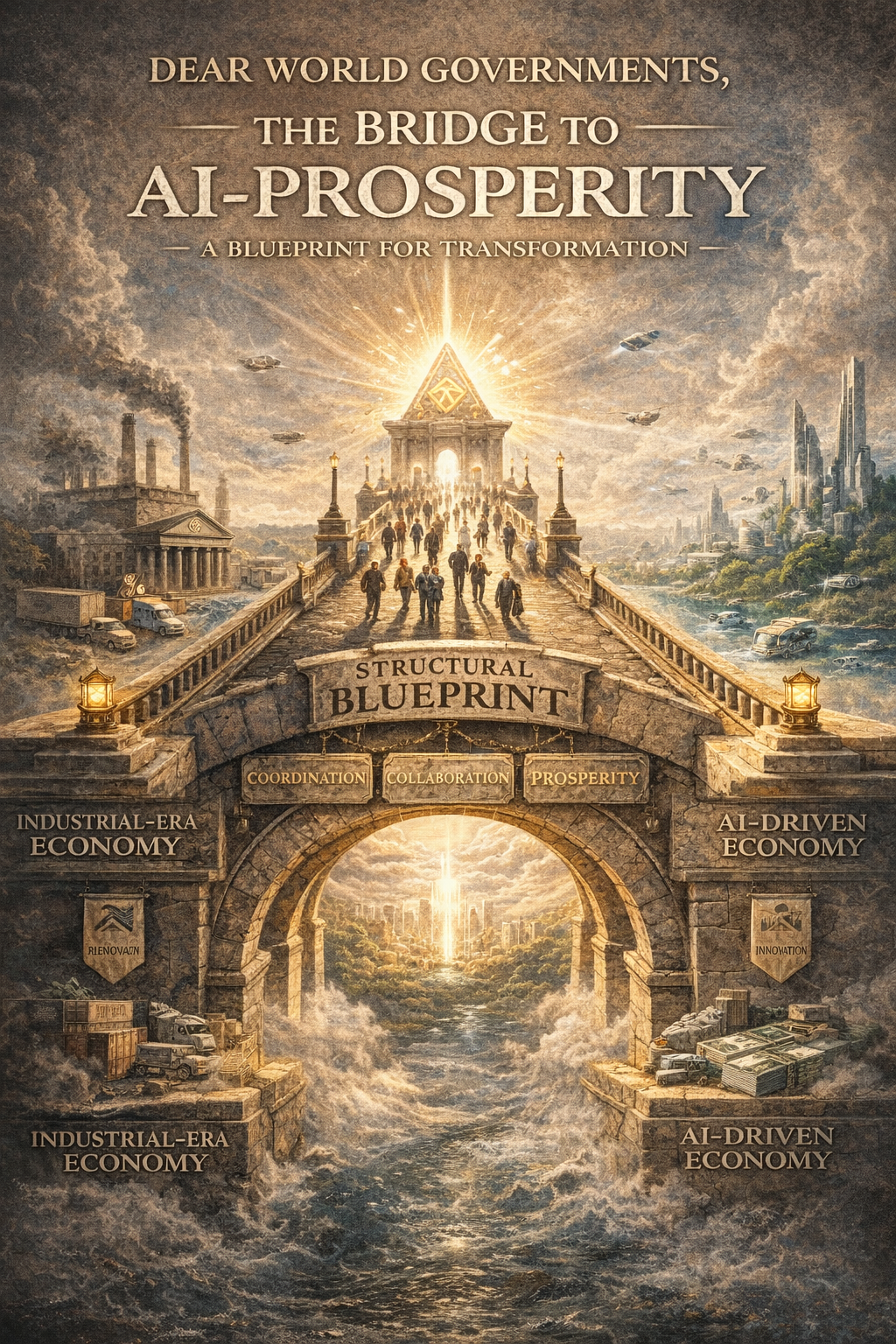
A Call for Coordination in the Age of Artificial Intelligence
Leaders of the world,
I cannot build this blueprint alone.
What I am proposing is not a disruption for the sake of disruption. It is a restructuring for the sake of stability.
The AI era will not wait for us to catch up.
Automation will continue. Robotics will scale. Agentic systems will coordinate. Supply chains will compress. Margins will concentrate.
If we do nothing, the result will be predictable:
Retail and wholesale structures will extract value as long as they can.
Traditional banking will tighten credit as automation disrupts employment.
Families will work longer hours chasing shrinking opportunity.
Investors will remain prioritized over participants.
Inequality will accelerate under the banner of efficiency.
That is not a failure of technology.
It is a failure of architecture.
What I Am Asking For
I am asking for your help in designing a new economic blueprint before the AI wave fully crests.
Not to destroy businesses.
Not to eliminate banking.
But to transition them.
Retail and wholesale margins are artifacts of physical distribution bottlenecks. AI removes those bottlenecks. When logistics become algorithmic and robotic, those layers must evolve.
Banking models built around debt-based income must evolve when AI drives productivity and compresses labor demand.
If individuals are generating value through their spending, their data, their participation, then they must be recognized as economic contributors — not just consumers.
Customers must become stakeholders.
Participation must become capital.
Spending must become indexed.
Prosperity must be measured at the ledger level.
A Global Reality
Some nations believe they can operate independently.
They cannot.
We live in a global economy.
If one region redesigns economic plumbing and another does not, capital flows, supply chains, and AI systems will route around stagnation.
This transformation requires coordination:
Regulatory collaboration.
Financial modeling.
Data governance standards.
Security frameworks.
International economic alignment.
This is not something that happens accidentally.
It must be designed.
The Banking Question
Traditional banking is not evil.
It is outdated for an agentic world.
If AI systems can verify transactions, hash receipts, index supply chains, and manage risk in real time, then tech-enabled ledger systems will inevitably begin performing banking functions.
Governments can either resist that shift and face fragmentation, or guide it deliberately.
The question is not whether tech companies will become financial infrastructure.
The question is whether that transition will be coordinated and regulated intelligently — or occur chaotically.
The Bridge We Must Cross
We are building a bridge.
On one side: Industrial-era finance. Margin-based retail. Debt-driven growth. Labor as the primary income engine.
On the other side: AI-managed logistics. Ledger-based participation. Agentic marketplaces. Distributed prosperity structures.
Businesses must cross this bridge. Governments must cross this bridge. Individuals must cross this bridge.
But no one crosses alone.
What I Need From You
I need:
Your coordination. Your modeling. Your regulatory foresight. Your willingness to explore structural change rather than incremental patchwork.
This is not a request for funding. This is not a political campaign. This is not a startup pitch.
It is a call for architecture.
If we get this right, AI will raise the global standard of living.
If we get it wrong, AI will amplify concentration and instability.
The instruments already exist.
The intelligence already exists.
The question is whether the imagination exists.
The bridge is being built.
Now we must decide whether we cross it deliberately — or are pushed across it by force of disruption.
I am ready to collaborate.
The future will not wait.