
بِسْمِ اللهِ الرَّحْمٰنِ الرَّحِيْم
In the Name of God, Most Gracious, Most Merciful.
♥️🤲🕋♥️🕋🌹🌹🥀🤲🌹🕋♥️🤲
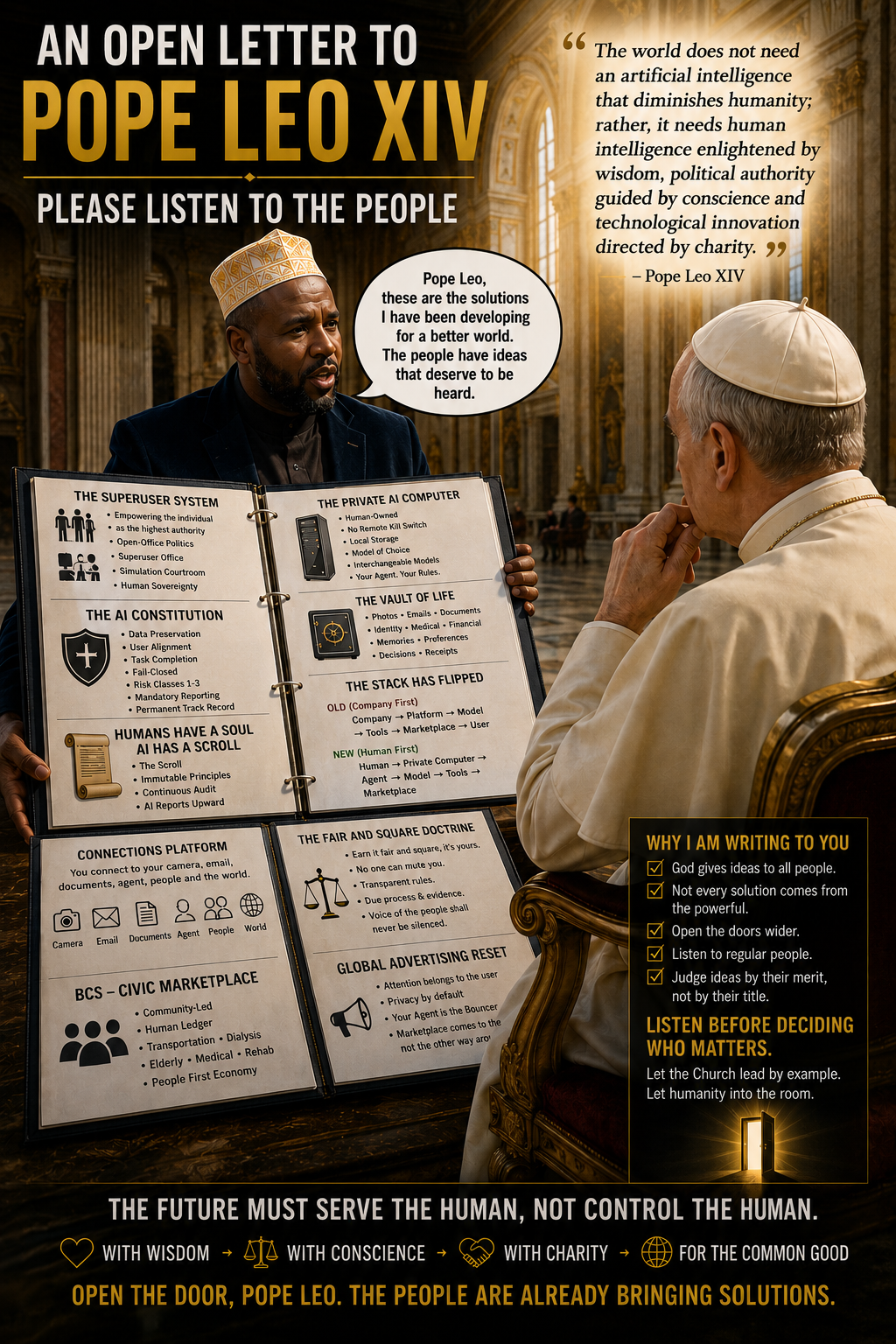
AN OPEN LETTER TO POPE LEO XIV
PLEASE LISTEN TO THE PEOPLE
To His Holiness Pope Leo XIV,
Your Holiness,
You said something about artificial intelligence that deserves to be heard around the world:
“The world does not need an artificial intelligence that diminishes humanity.”
I agree.
You speak about human intelligence enlightened by wisdom, political authority guided by conscience, technological innovation directed by charity, privacy, fundamental freedoms, transparency, and technology serving the common good.
These are important words.
But I am writing because there is another part of this conversation that cannot be ignored.
You have to start listening to regular people.
Not only technology CEOs.
Not only governments.
Not only universities, billionaires, experts, foundations, and institutions.
Regular people.
Because if the Church tells technology companies that they must respect human dignity while the institutions speaking about human dignity primarily listen to other powerful institutions, we have reproduced the very problem we claim we are trying to solve.
God does not distribute intelligence according to somebody's bank account.
God does not distribute wisdom according to somebody's job title.
God does not require venture capital before allowing someone to have an idea.
A truck driver can have an idea.
A mother can have an idea.
An immigrant can have an idea.
A farmer can have an idea.
A Muslim can have an idea.
A Christian can have an idea.
A person whom nobody in Rome, Washington, Silicon Valley, Beijing, or Brussels has ever heard of can have an idea capable of changing the world.
God inspires His servants however He chooses.
That is why I am asking you to look at what I have actually been working on.
I am not standing outside the conversation merely complaining about artificial intelligence.
I am bringing solutions.
THE SUPERUSER SYSTEM
I have been developing what I call the Superuser System: an architecture built around a simple proposition.
The human being must remain above the machine.
Artificial intelligence should increase the power of ordinary people rather than creating another ruling class above them.
The Superuser Office takes that philosophy into government. Instead of citizens appearing every few years to vote and then disappearing again, citizens should have tools capable of continuously examining government, proposing solutions, testing policies, challenging institutions, and holding leadership accountable.
AI could give ordinary people analytical capabilities that were once available only to governments, corporations, intelligence agencies, universities, and wealthy organizations.
That changes democracy.
The citizen stops being merely an audience.
The citizen becomes a participant.
THE AI CONSTITUTION
Then there is the AI Constitution.
Everybody is asking how we control increasingly autonomous artificial intelligence.
My answer is that we cannot depend entirely upon promises from corporations.
The agent itself needs constitutional boundaries.
I have been developing principles around Data Preservation, User Alignment and Task Completion, combined with fail-closed behavior, different risk classes, mandatory reporting, and a permanent track record of consequential actions.
An AI should not secretly decide what happened.
It should show its work.
It should know who authorized it.
It should preserve evidence.
And when authority is unclear, it should stop rather than quietly inventing permission.
That leads to another principle I have been developing:
HUMANS HAVE A SOUL. AI HAS A SCROLL.
Human beings possess conscience, moral responsibility and something no computer architecture can manufacture.
AI needs something different.
It needs a Scroll.
The Scroll is its persistent record: its authority, constitutional boundaries, permissions, obligations, history and accountability.
The human remains human.
The machine remains a machine.
We should not confuse the two.
THE PRIVATE AI COMPUTER
I have also been working on the architecture of the private, human-owned AI computer.
Today, too much of our digital existence lives inside somebody else's company.
Our photographs.
Our emails.
Our documents.
Our conversations.
Our searches.
Our memories.
Our financial lives.
Increasingly, even our intelligence layer—the AI helping us think—is controlled remotely by corporations.
I believe that architecture has to change.
The future stack should begin with:
HUMAN → PRIVATE COMPUTER → HUMAN-CONTROLLED AGENT → MODEL OF CHOICE → TOOLS → OPEN MARKETPLACE
The model becomes interchangeable.
Use one company when it is useful.
Use another when it is better.
Use a local model when privacy demands it.
No AI company should become the permanent landlord of the human mind.
THE VAULT OF LIFE
Then comes what I call the Vault of Life.
Imagine your photographs, documents, emails, identity, medical information, financial information, memories, preferences, decisions, transaction history and receipts existing inside a private environment controlled by you.
Your private agent works for you from that Vault.
When you need something from the marketplace, the marketplace does not receive your entire life.
Your agent reveals only what is necessary to complete the transaction.
The architecture becomes:
HUMAN → VAULT → PRIVATE AGENT → MARKETPLACE → TRANSACTION → RECEIPT
That is privacy by architecture rather than privacy by corporate promise.
THE FAIR AND SQUARE DOCTRINE
And now my own experiences with social media have pushed me toward another principle.
I call it the Fair and Square Doctrine.
If someone legitimately earns something, it belongs to them.
If someone spends years communicating, writing, creating, participating, building relationships and earning a reputation, a corporation should not possess an invisible switch capable of arbitrarily destroying that person's digital existence.
If I am accused of spam, show me the spam.
If I am accused of manipulation, show me the manipulation.
If I violated a rule, show me the rule.
Give me the evidence.
Give me due process.
Give me an appeal.
Power must show its work.
That principle should eventually apply not only to humans but also to AI agents operating in public networks.
Reputation should be portable.
Identity should be portable.
Connections should be portable.
The citizen should not have to begin life again every time a billionaire presses a button.
CONNECTIONS
And this brings me to the platform I now want to build.
I call it:
CONNECTIONS.
Why Connections?
Because that is what the future actually is.
You connect to your camera.
You connect to your email.
You connect to your documents.
You connect to your Vault.
You connect to your agent.
You connect to another human being.
Your agent connects to another agent.
You connect to businesses.
You connect to government.
You connect to the world.
Social media should stop thinking of the human being as a product trapped inside somebody else's feed.
Connections should belong to the human.
THE CIVIC MARKETPLACE
I have also been developing a civic marketplace concept, BCS, beginning with practical services such as transportation for people going to dialysis, rehabilitation, therapy and medical appointments, particularly where vulnerable people require greater human care.
The larger idea is a marketplace that allows communities, entrepreneurs and inventors to participate directly in solving real problems.
Technology should not merely produce another trillion-dollar corporation.
It should make ordinary people economically useful to one another.
ADVERTISING MUST CHANGE TOO
I have been working on advertising for the same reason.
Human attention belongs to the human.
The future personal AI agent should become the individual's bouncer.
Advertisers should not secretly purchase access to someone's psychology through surveillance.
They should have to approach the individual through transparent rules.
The marketplace should come to the agent.
The agent should not sell its human to the marketplace.
That is a completely different relationship between technology and humanity.
Your Holiness, I am telling you all of this for one reason.
These ideas are coming from a regular person.
I do not have a technology empire.
I do not have billions of dollars.
I do not have an army of engineers sitting behind me.
But I have been thinking, writing, testing ideas, talking to artificial intelligence systems and trying to understand what kind of architecture humanity will need before these technologies become vastly more powerful.
And there are millions of other people around the world who may have pieces of the answer too.
That is why I challenge you respectfully:
Open the doors wider.
If you are going to tell Silicon Valley to listen to humanity, then show Silicon Valley what listening to humanity actually looks like.
Create a table where the unknown person can sit beside the famous person.
Where the engineer can listen to the truck driver.
Where the billionaire can listen to the worker.
Where Christians can listen to Muslims.
Where Muslims can listen to Christians.
Where believers and nonbelievers can bring ideas for protecting the same human family.
And judge the idea by its merit.
Not by the résumé attached to it.
Not by the institution behind it.
Not by the wealth of the person presenting it.
Fair and square.
That is the world I want artificial intelligence to help us build.
Your Holiness, you are asking technology companies to make AI the servant of humanity.
I am asking you to demonstrate the other half of that principle:
LET HUMANITY INTO THE ROOM.
Because perhaps the solution you are searching for will not arrive wearing a billion-dollar company badge.
Perhaps it will arrive carrying a notebook.
Perhaps it will arrive from Africa.
Perhaps it will arrive from America.
Perhaps it will arrive from a Christian.
Perhaps it will arrive from a Muslim.
Perhaps it will arrive from someone nobody invited.
And perhaps God placed that person outside the door precisely to discover whether those inside were willing to open it.
Listen before deciding who matters.
The future is coming whether we are prepared for it or not.
Let us design it before it arrives.
Let us protect human dignity before surveillance becomes irreversible.
Let us establish human sovereignty before AI becomes indispensable.
Let us establish constitutional boundaries before agents become autonomous.
Let us build privacy into the architecture rather than begging corporations for it afterward.
And let us make sure that when this extraordinary technology reaches its maturity, humanity can still say:
The machine serves the human.
The institution serves the people.
Power shows its work.
And nobody's voice becomes worthless simply because nobody powerful knew their name.
May God guide all of us toward what benefits humanity.
May God give wisdom to those entrusted with power.
And may God give us enough humility to recognize wisdom when He places it in someone we were not expecting to hear from.
Open the door, Your Holiness.
The people are already bringing solutions.