

بِسْمِ اللهِ الرَّحْمٰنِ الرَّحِيْم
In the Name of God, Most Gracious, Most Merciful
♥️🤲🕋♥️🕋🌹🌹🥀🤲🌹🕋♥️🤲
An Architectural Proposal to Uber
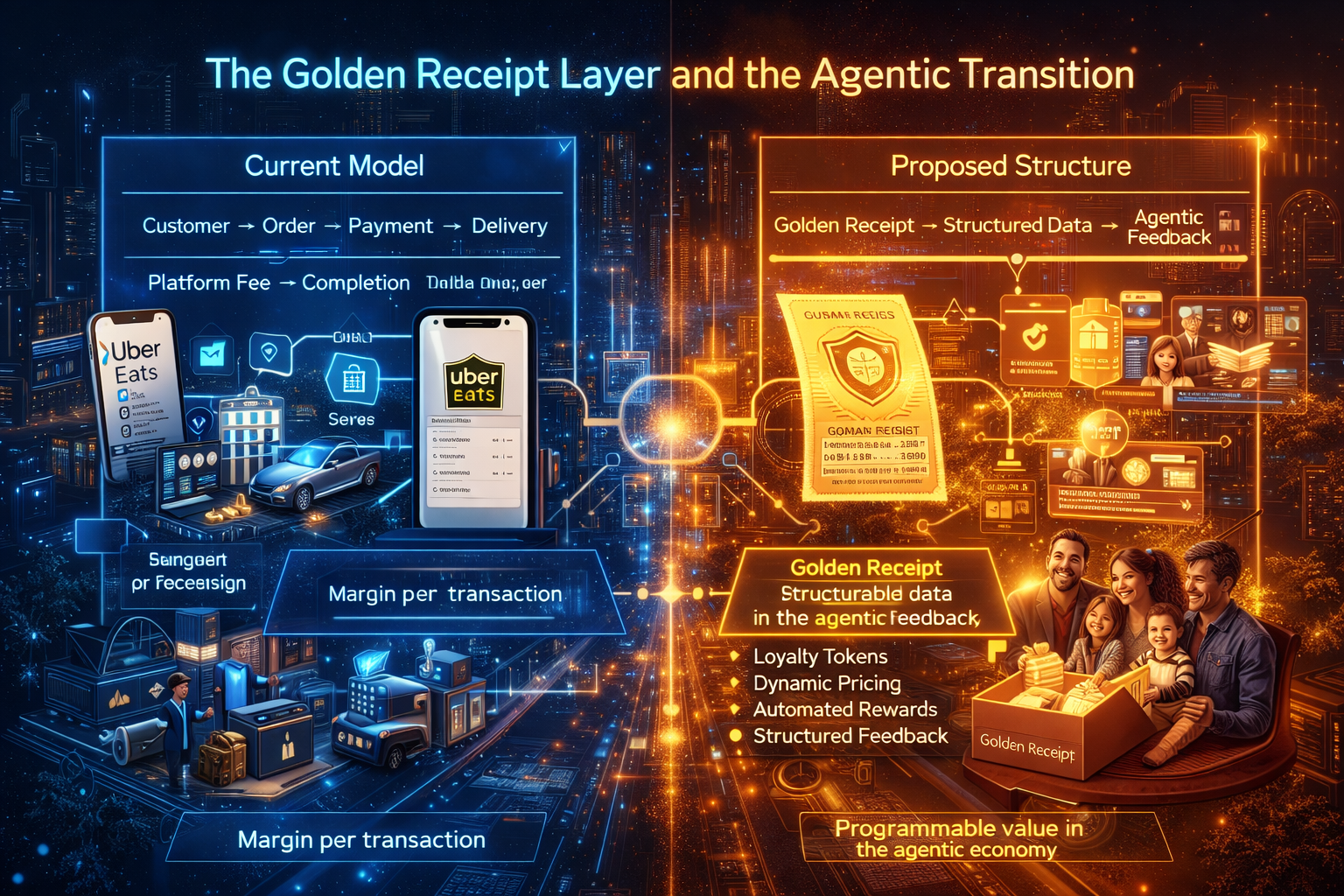
The Golden Receipt Layer and the Agentic Transition
To the leadership of Uber,
This is not a feature request.
This is a structural proposal.
Uber already operates one of the most sophisticated real-time marketplaces in the world. You have solved logistics at scale. You have solved dynamic routing. You have solved instant digital payments. You have solved identity, delivery verification, and feedback loops.
But there is a layer missing.
And that missing layer is what will determine who survives the agentic transition.
The Current Model (What Works Today)
Today, the Uber transaction model is simple:
Customer → Order → Payment → Delivery → Platform Fee → Completion
It works.
It scales.
It generates revenue.
But it ends the moment the delivery is completed.
The receipt is a static record.
The value stops there.
In an agentic world, that model will not be enough.
The Transition: From Transaction Platform to Agent-Compatible Infrastructure
What I am proposing is the introduction of a new structural layer inside Uber’s ecosystem:
The Golden Receipt Layer.
Every Uber transaction — especially in food, grocery, and retail delivery — becomes:
Digitally signed
Hashed (SHA-256 or equivalent)
ID-tagged
Structured for agent readability
Stored optionally in a user-controlled ledger
The receipt stops being proof of purchase.
It becomes a programmable participation asset.
Why Uber Is the Perfect First Platform
You already have:
Real-time ordering behavior
Payment confirmation
Identity anchoring
Product metadata
Delivery confirmation
Post-transaction feedback
Behavioral loops
Repeat purchase tracking
No new infrastructure needs to be invented.
The pipes are built.
What’s missing is structured intelligence attached to the transaction.
The Golden Receipt Box Concept
Imagine this:
A family orders groceries or food.
Inside the digital experience (and optionally physically), there is a structured receipt ID.
That receipt:
Registers product SKU
Registers timestamp
Registers source kitchen/store
Registers user feedback
Registers satisfaction metrics
Registers repeat intent
This data becomes agent-compatible.
The customer’s AI agent (future-facing) can:
Reorder automatically
Compare quality
Track health impact
Track price variance
Negotiate better terms
Optimize household consumption
This is not theory.
This is a shift from static commerce to programmable commerce.
Why This Matters for Uber Strategically
Today Uber captures:
Margin per transaction.
In the agentic future, platforms will compete on:
Infrastructure compatibility with AI agents.
Agents will not browse apps.
Agents will:
Compare marketplaces
Optimize pricing
Automate purchasing
Negotiate subscriptions
Route orders
If Uber does not become agent-compatible infrastructure, agents will bypass you.
If Uber does, you become foundational.
The BCS Layer (Unlocking Value)
This is where my Brand Currency System (BCS) enters.
Receipts can unlock value.
Not discounts in the traditional sense.
But structured participation:
Loyalty tokens
Quality scoring systems
Brand performance analytics
Automated rebates
Dynamic rewards
Data-backed reputation systems
Instead of:
Order → Delivered → Closed
We move toward:
Order → Delivered → Feedback → Structured Data → Agentic Optimization → Marketplace Evolution
A Controlled Dry Run
This does not need to launch publicly immediately.
It can begin internally:
Uber employee beta
Limited regional rollout
Controlled Golden Receipt pilot
Structured feedback experiment
Hundreds of families. Hundreds of transactions. Structured hashing. Agent-readable outputs.
We build the intelligence loop before the full agentic layer arrives.
The Long-Term Evolution
Today: Drivers deliver.
Tomorrow: Robots deliver.
Today: Humans compare products.
Tomorrow: Agents compare products.
Today: Receipts are records.
Tomorrow: Receipts are programmable assets.
Uber can either:
Remain a logistics intermediary.
Or become the programmable commerce backbone of the agentic world.
The Bigger Picture
This is not anti-platform.
It is pro-evolution.
The agentic world will not wait.
Commerce will become:
Agent-first. Data-structured. Feedback-loop driven. Infrastructure-dependent.
If Uber activates this layer early, you move from delivery company to agentic marketplace engine.
And that position is far more defensible.
The Strategic Question
Will Uber remain:
A company that completes transactions?
Or become:
A company that mints programmable value in the AI economy?
You already built the roads.
Now is the moment to build the economic protocol on top of them.
This is not about replacing your business.
It is about ensuring it remains relevant when agents begin to transact.
The infrastructure exists.
The experiment can begin immediately.
I am ready to prototype this layer.
The agentic transition will happen.
The only question is who builds the first compliant marketplace.
Conclusion — Uber and the Birth of the Agentic Marketplace
 🪙 The Birth of the Gold Receipt —
buymeacoffee.com/omar1800m/the-birth-gold-receipt-humanity-first
Uber, this is not about rides.
It is not about food delivery.
It is not about squeezing margin between a driver and a restaurant.
It is about becoming the transaction layer of the agentic economy.
In the future that is already forming, the majority of products in every category — groceries, supplements, cosmetics, electronics, household goods — will be ordered through AI agents.
Not through scrolling.
Not through search ads.
Not through impulse placement.
Through agents.
When that order happens, something far more important than delivery takes place:
The digital receipt must be minted.
The product identity must be tagged.
The feedback loop must be recorded.
The supply-demand signal must return to the marketplace.
The value must be redistributed intelligently.
That blueprint does not exist yet.
And that is the opportunity.
This is not just an Uber project.
It cannot be.
To build the agentic marketplace properly, we must partner:
With Google — for image recognition, digital shelf construction, and secure identity mapping.
With OpenAI — for orchestration and agent intelligence.
With Apple — for device-level integration and trusted hardware execution.
With infrastructure providers — for security and scaling.
With logistics innovators — for robotics and final-mile automation.
This is a coalition moment.
Because once agents begin ordering at scale, the entire wholesale/retail markup structure is exposed.
Margins that currently exist because of fragmentation, opacity, and inefficiency will compress.
The majority of traditional supermarkets and retail layers that depend on wholesale → retail → markup chains will not survive in their current form.
Profits will not disappear.
They will move.
They will move toward:
Efficient distribution
Intelligent logistics
Transparent feedback loops
Direct brand-to-family relationships
Agent-mediated purchasing
Secure digital receipts
Hash-anchored transaction identity
And Uber is uniquely positioned.
You already:
Control large-scale transaction flow.
Operate real-time delivery logistics.
Manage distributed labor.
Capture digital payment data.
Handle instant fulfillment.
Coordinate supply at city scale.
But you are still operating under the old architecture:
Transaction → Delivery → Fee → End.
What I am proposing is:
Transaction → Digital Minting → Feedback Loop → Supply Signal → Agentic Optimization → Value Redistribution.
Uber can become more than a transportation company.
Uber can become:
The transaction backbone of the agentic marketplace.
The minting engine of golden digital receipts.
The bridge between human agents today and robotic agents tomorrow.
The marketplace layer through which AI agents place orders.
The infrastructure that prepares for robotic distribution.
The platform where margins are intelligently optimized — not extracted blindly.
And when this happens, Uber does not compete alone.
Uber coordinates.
Google builds the digital shelf.
OpenAI builds the orchestration layer.
Apple anchors secure devices.
Uber executes fulfillment.
Together, we build the first true agentic marketplace.
This is not about destroying retail.
It is about restructuring it.
It is not about removing corporations.
It is about inviting them into a new structure.
In this structure:
Individuals increase margin through intelligent purchasing.
Brands increase margin through direct feedback loops.
Platforms increase margin through orchestration and logistics.
AI agents increase efficiency and coordination.
Wholesale/retail inefficiencies are reduced.
Value becomes transparent.
And Uber becomes indispensable.
Not as a ride app.
Not as a food delivery app.
But as the engine of real-world fulfillment in an agent-driven economy.
The agentic marketplace may not exist yet.
But this is the right way to build it.
And if Uber steps into this architecture early, it does not just adapt to the agentic world.
It helps create it.
.