
بِسْمِ اللهِ الرَّحْمٰنِ الرَّحِيْم
In the Name of God, Most Gracious, Most Merciful.
♥️🤲🕋♥️🕋🌹🌹🥀🤲🌹🕋♥️
America's Election System
How America's Election System Turned Into a Modern Duopoly.
To understand how America's election system evolved into a modern two-party duopoly, we must go back to the Founding Fathers and follow how a system designed around independent presidential electors gradually fell under the influence of political parties, congressional insiders, and powerful political bosses.
Phase 1: The Founders' Independent Ideal
1787–1796
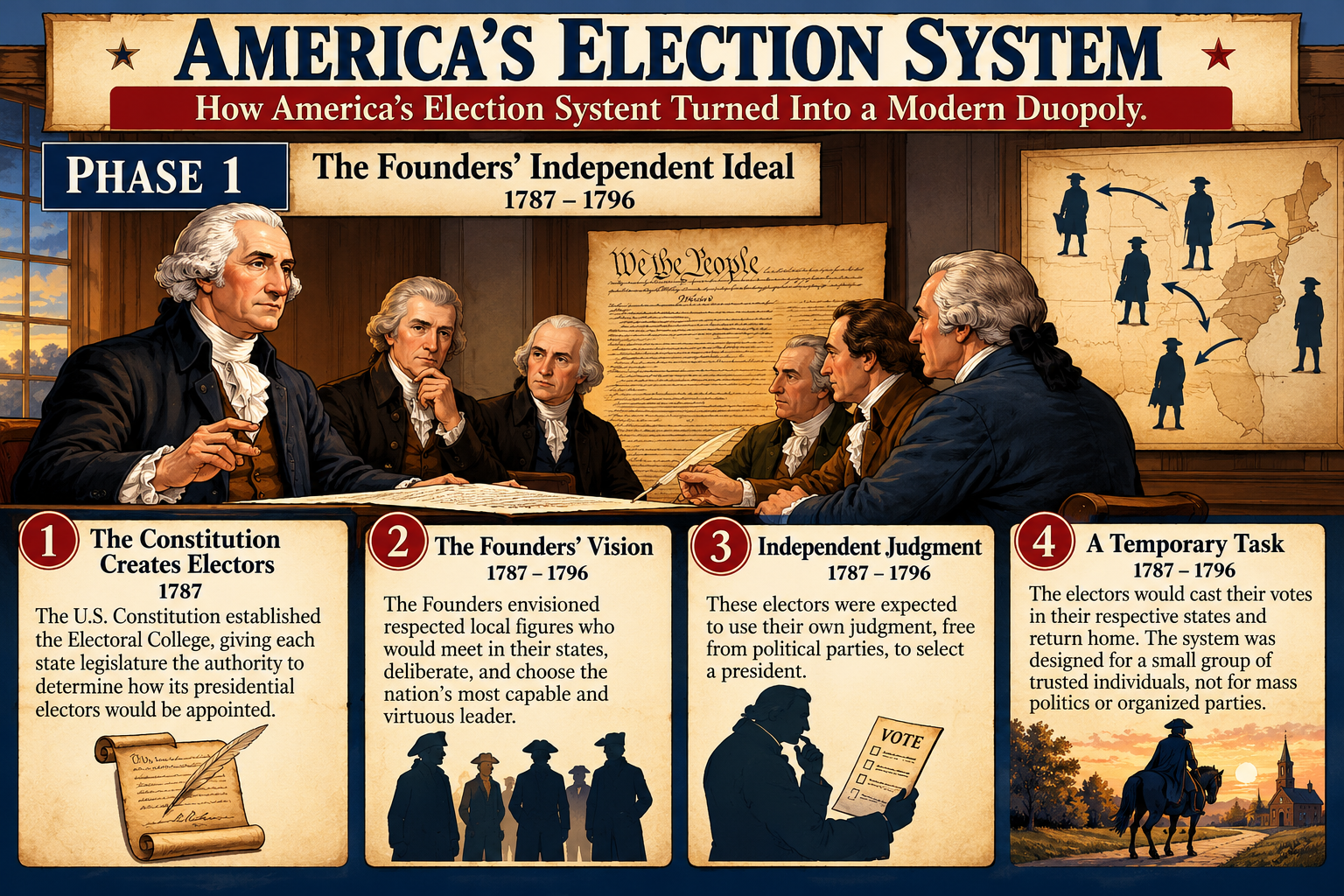
The United States Constitution established the Electoral College in 1787, giving each state legislature the authority to determine how its presidential electors would be appointed.
The Founders envisioned respected individuals exercising independent judgment when selecting the nation's president. These electors would meet in their respective states, cast their votes, and return home.
The Constitution did not establish political parties, national nominating conventions, or presidential primary elections.
The original idea was to select a president through electors exercising judgment—not through competing political party organizations.
But the system began changing almost immediately.
Phase 2: Congressional "King Caucus"
1796–1824
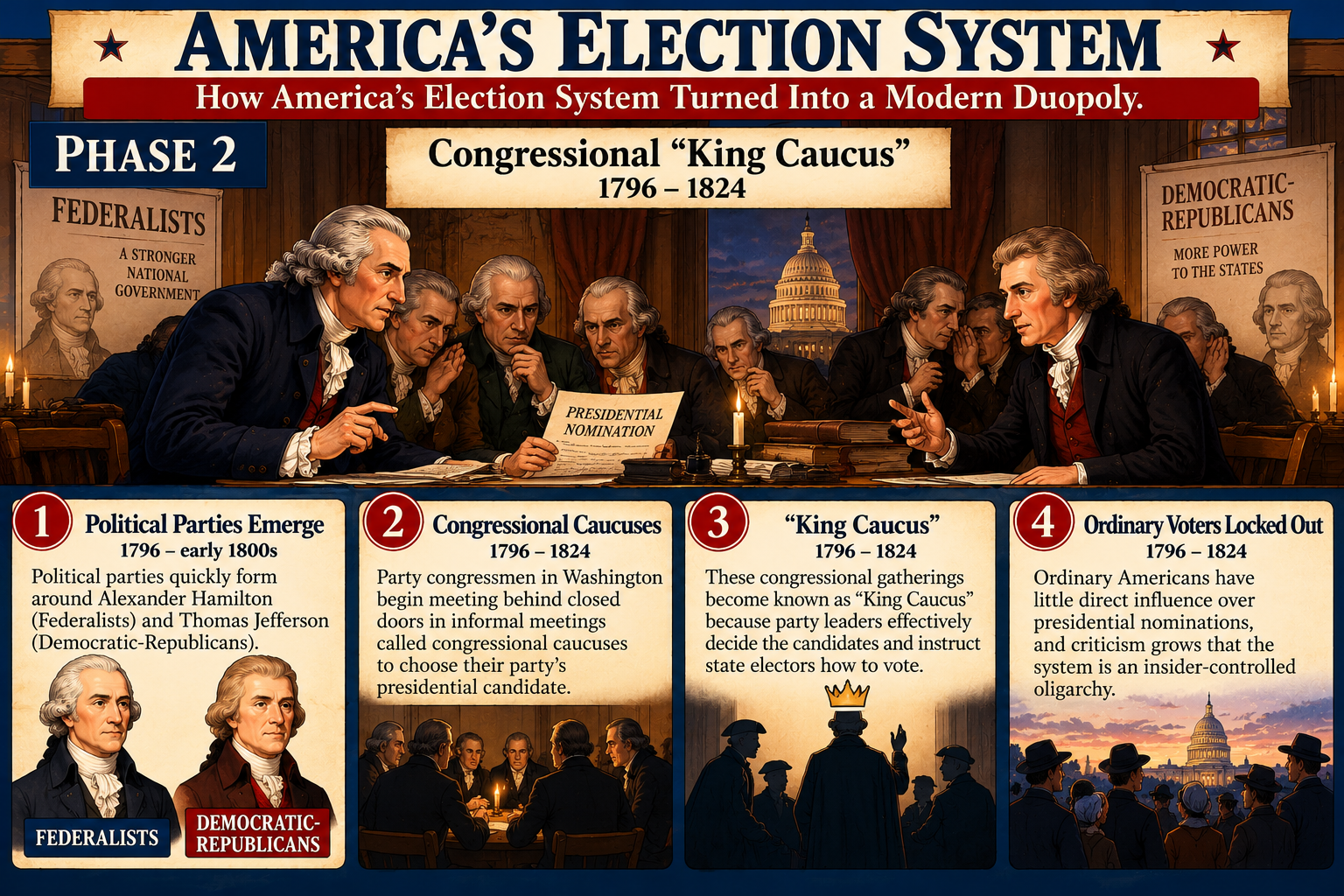
Political parties emerged around two competing political visions represented by Alexander Hamilton and Thomas Jefferson.
As these parties gained influence, members of Congress began organizing informal meetings known as congressional nominating caucuses.
Instead of leaving presidential nominations to independent electors, congressional party leaders increasingly sought to determine who would represent their political organizations.
These closed-door meetings became known to critics as "King Caucus."
Ordinary Americans had little direct influence over these congressional nominations, and opposition to the system grew.
By 1824, the congressional caucus system was collapsing under accusations that political insiders had taken control of presidential nominations.
The first major transformation was complete: political organizations had begun replacing independent presidential judgment with party-controlled nominations.
Phase 3: The Rise of National Conventions and Political Bosses
1830–1865
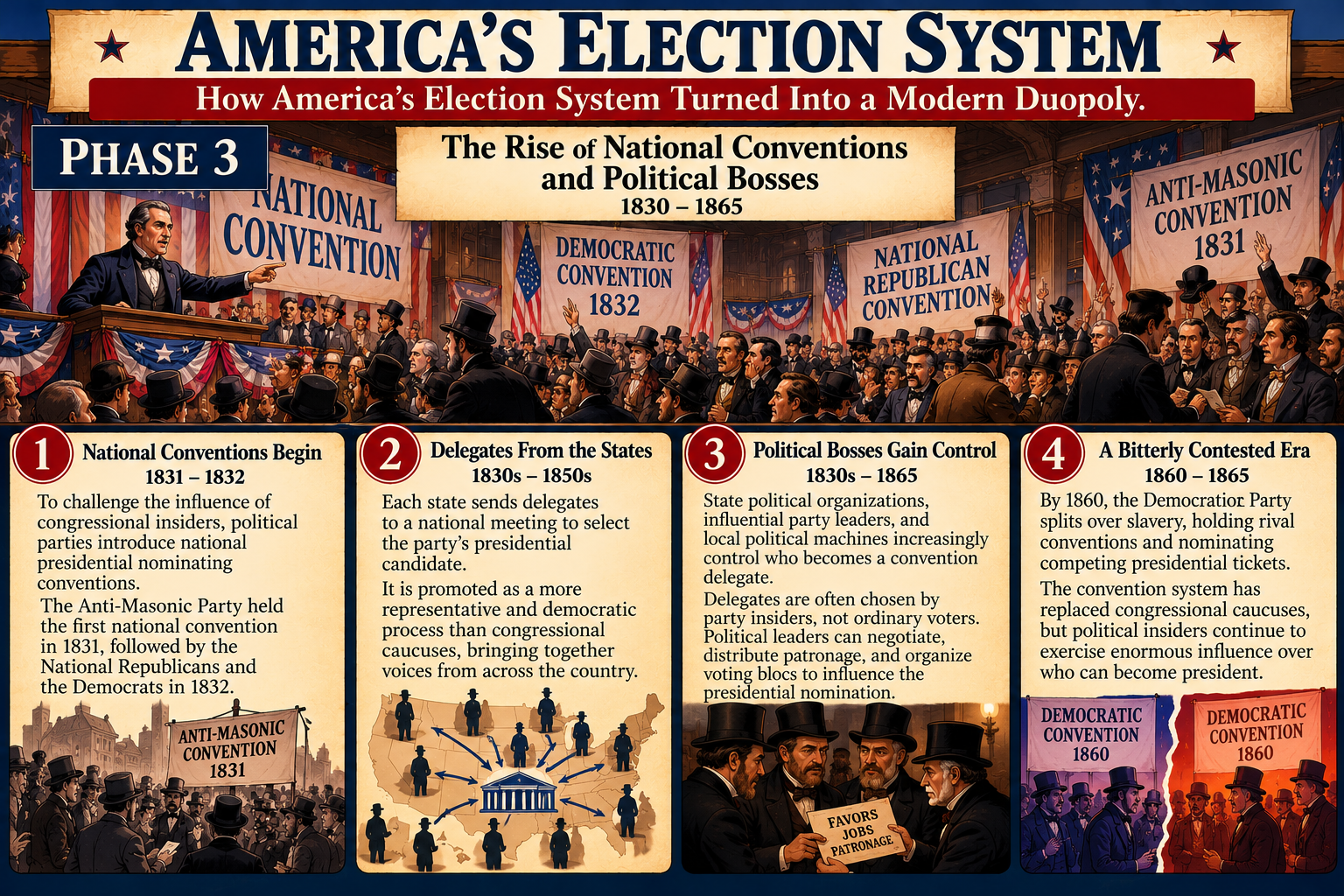
To challenge the influence of congressional insiders, political parties introduced national presidential nominating conventions.
In 1831, the Anti-Masonic Party held the first national presidential nominating convention. The National Republicans followed, and the Democrats held their first national convention in 1832.
The idea was to bring delegates from different states together to select presidential candidates rather than leaving the decision to a small group of congressmen in Washington.
It appeared to be a more representative system.
But another concentration of political power began developing.
State political organizations, influential party leaders, and local political machines increasingly shaped who became a convention delegate.
These delegates were not necessarily chosen directly by ordinary voters. State conventions, party committees, and political insiders often controlled the selection process.
Political leaders could negotiate over candidates, distribute patronage, and organize voting blocs to influence presidential nominations.
By 1860, competing factions within the Democratic Party demonstrated how bitterly contested these conventions could become. The party split over slavery, holding rival conventions and nominating competing presidential tickets.
The presidential nomination process had moved from congressional caucuses into national conventions, but political insiders continued to exercise enormous influence over who could become president.
The American people were gaining a greater role in choosing presidential electors, yet the selection of presidential nominees remained largely in the hands of political organizations.
By 1865, the foundations of the convention system—and the political machinery that would later empower powerful party bosses—were firmly established.
America's Election System
How America's Election System Turned Into a Modern Duopoly.
Phase 3 Continued: The Rise of Political Machines and Smoke-Filled Rooms
1865–1968
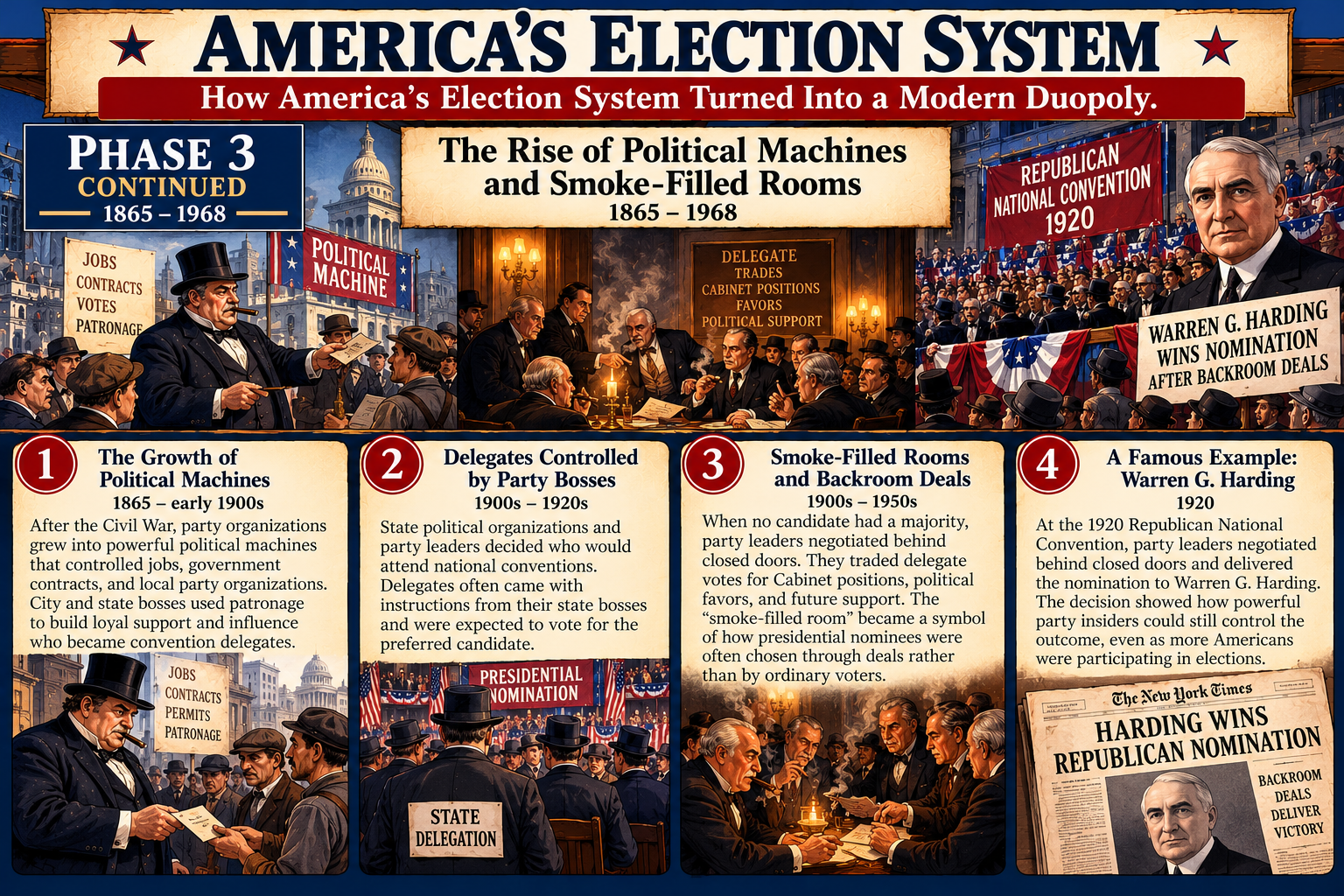
By 1865, the foundations of the national convention system—and the political machinery that would empower powerful party bosses—were firmly established.
Following the Civil War, political parties expanded their influence throughout American society.
Local political organizations developed into powerful machines that controlled government appointments, political patronage, campaign financing, and the selection of convention delegates.
In major cities and states, influential political bosses could determine which candidates received party support and which delegates attended national presidential conventions.
Ordinary voters could participate in general elections, but choosing the presidential nominees remained heavily influenced by party organizations.
The Smoke-Filled Rooms
National conventions became the battleground where powerful party leaders negotiated presidential nominations.
Delegates arrived representing state political organizations, often carrying commitments to particular candidates.
When no candidate secured enough votes, party leaders negotiated behind closed doors.
Political alliances, promises of government appointments, and competing political interests could influence which candidate ultimately received the nomination.
The famous "smoke-filled room" became a symbol of this political system.
One of the best-known examples occurred in 1920, when Republican leaders negotiated Warren G. Harding's presidential nomination during the party's national convention.
The American people could vote for president, but powerful political organizations often exercised enormous influence over which candidates they were allowed to choose from.
By the middle of the twentieth century, presidential primaries existed in several states, but party leaders and convention delegates still retained substantial influence over nominations.
That system would face its greatest challenge in 1968.
Phase 4: The 1968 Crisis and the Birth of Modern Presidential Primaries
Watch "Another Kind of Chaos: The 1972 Democratic National Convention" on YouTube
https://youtu.be/wy8d9qEbac4?is=rP_1HQFqDsmy2BrP
1968–1972
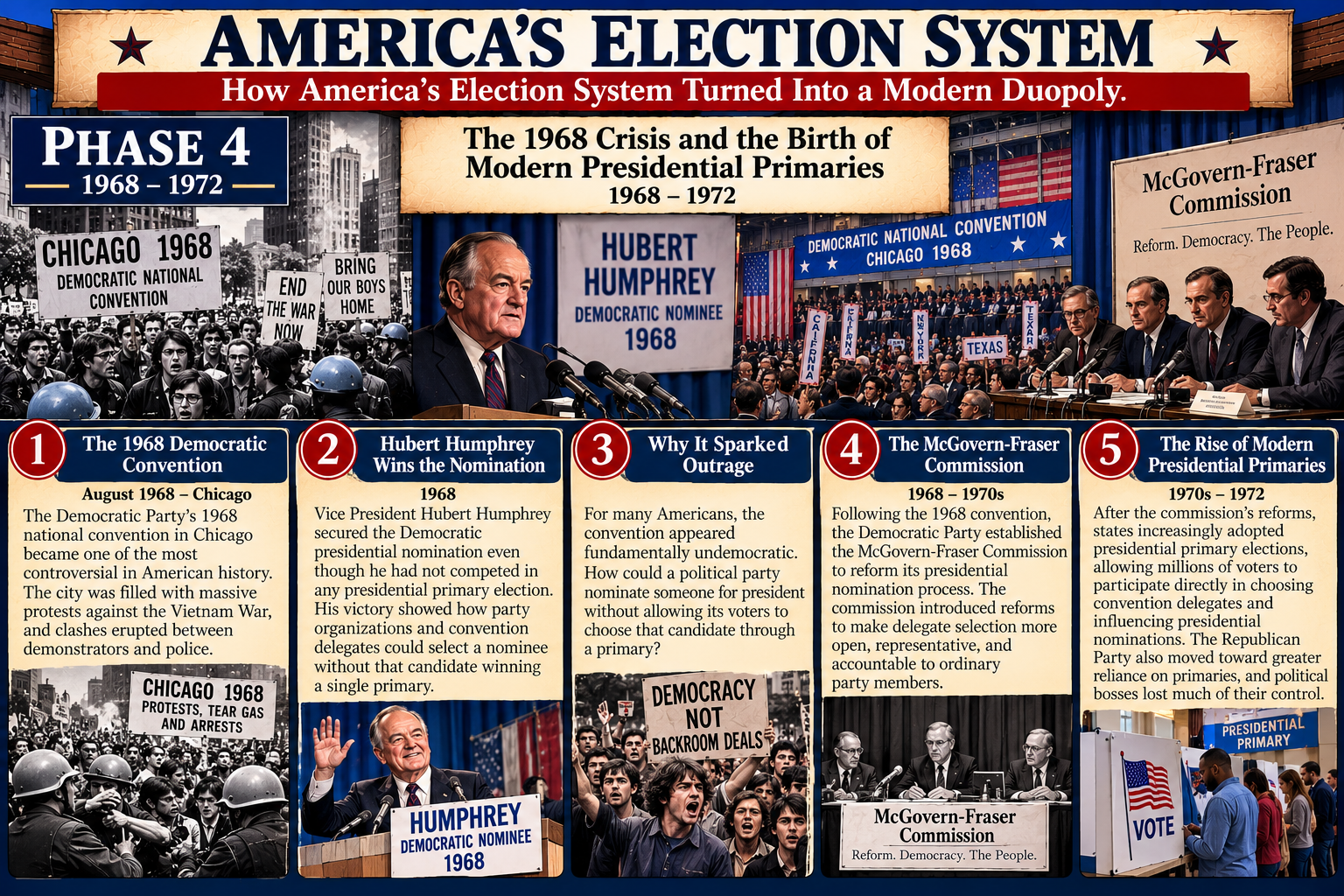
In 1968, the Democratic Party experienced one of the most controversial presidential nominating conventions in American history.
The convention took place in Chicago during widespread protests against the Vietnam War.
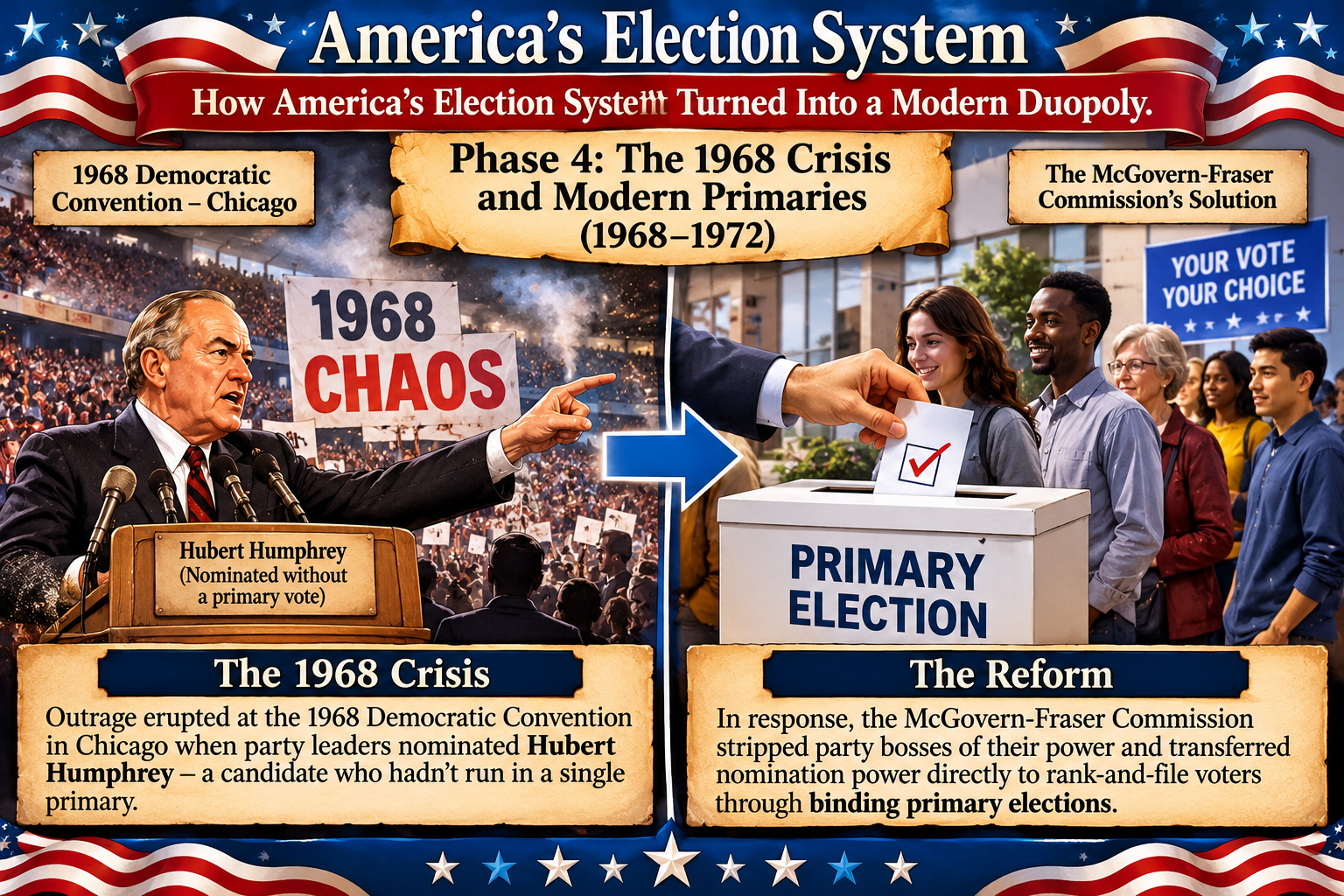
Vice President Hubert Humphrey secured the Democratic presidential nomination despite not competing in any presidential primary election.
His victory demonstrated how party organizations and convention delegates could select a presidential nominee without that candidate winning a single primary.
For many Americans, the system appeared fundamentally undemocratic.
How could a political party nominate someone for president without allowing its voters to choose that candidate through a primary?
The McGovern-Fraser Commission
Following the 1968 convention, the Democratic Party established the McGovern-Fraser Commission to reform its presidential nomination process.
The commission introduced reforms intended to make delegate selection more open, representative, and accountable to ordinary party members.
States increasingly adopted presidential primary elections, allowing millions of voters to participate more directly in choosing convention delegates and influencing presidential nominations.
The Republican Party also moved toward greater reliance on presidential primaries.
The political bosses were losing their traditional control over presidential nominations, while ordinary voters were gaining greater influence.
But this transformation did not eliminate political party power.
Instead, it helped establish a new relationship between political parties, state governments, and the administration of presidential elections.
Phase 5: The Rise of the Modern Two-Party Duopoly
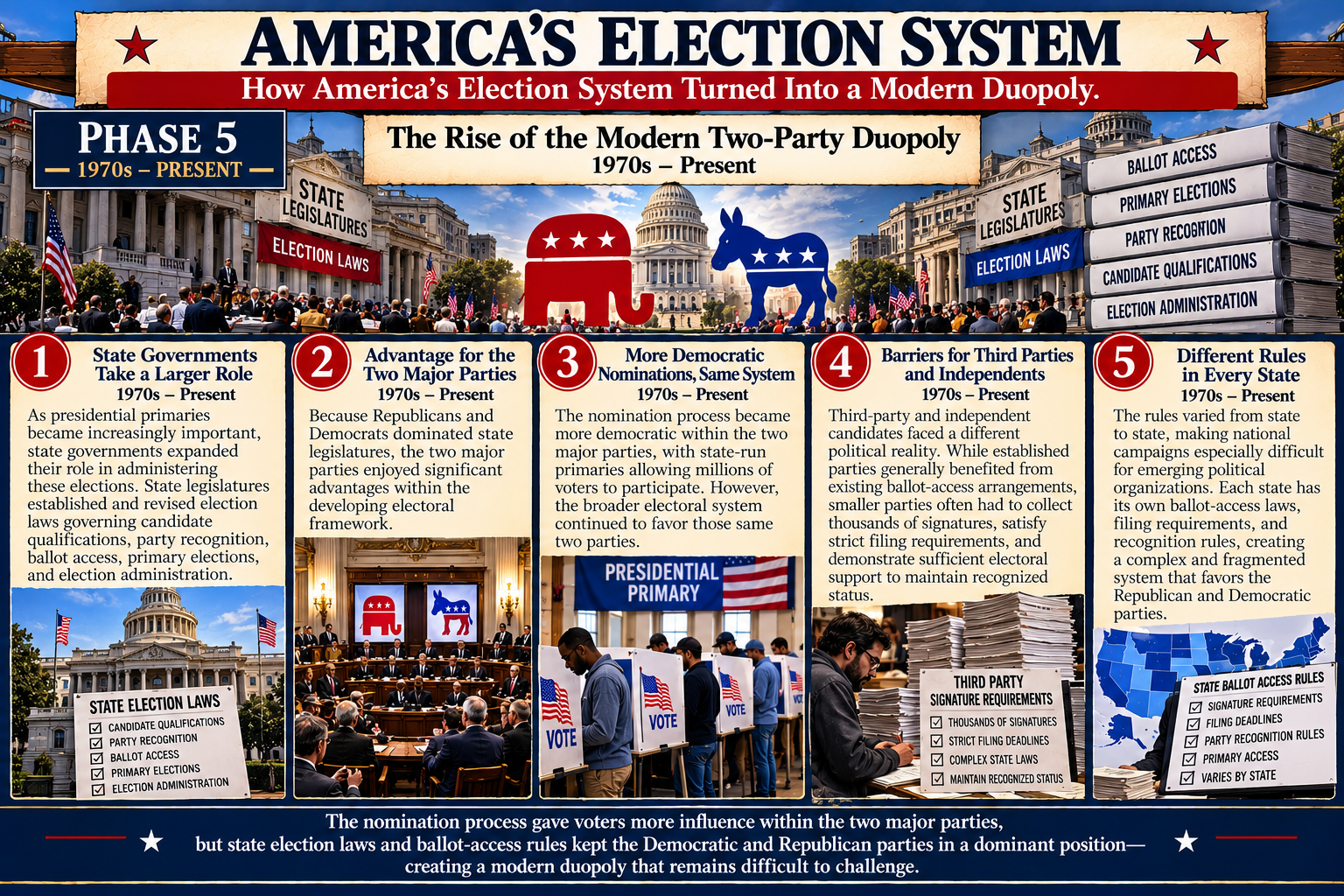
1970s–Present
As presidential primaries became increasingly important, state governments continued expanding their role in administering these elections.
State legislatures established and revised election laws governing candidate qualifications, political party recognition, ballot access, primary elections, and election administration.
Because Republicans and Democrats dominated state legislatures, the two major parties enjoyed significant advantages within the developing electoral framework.
The nomination process became more democratic within the two major parties, but the broader electoral system continued to favor those same parties.
Third-party and independent candidates faced a different political reality.
While established parties generally benefited from existing ballot-access arrangements, smaller parties often had to collect thousands of signatures, satisfy strict filing requirements, and demonstrate sufficient electoral support to maintain recognized status.
The rules varied from state to state, making national campaigns especially difficult for emerging political organizations.
How the Two Major Parties Entrenched Their Power
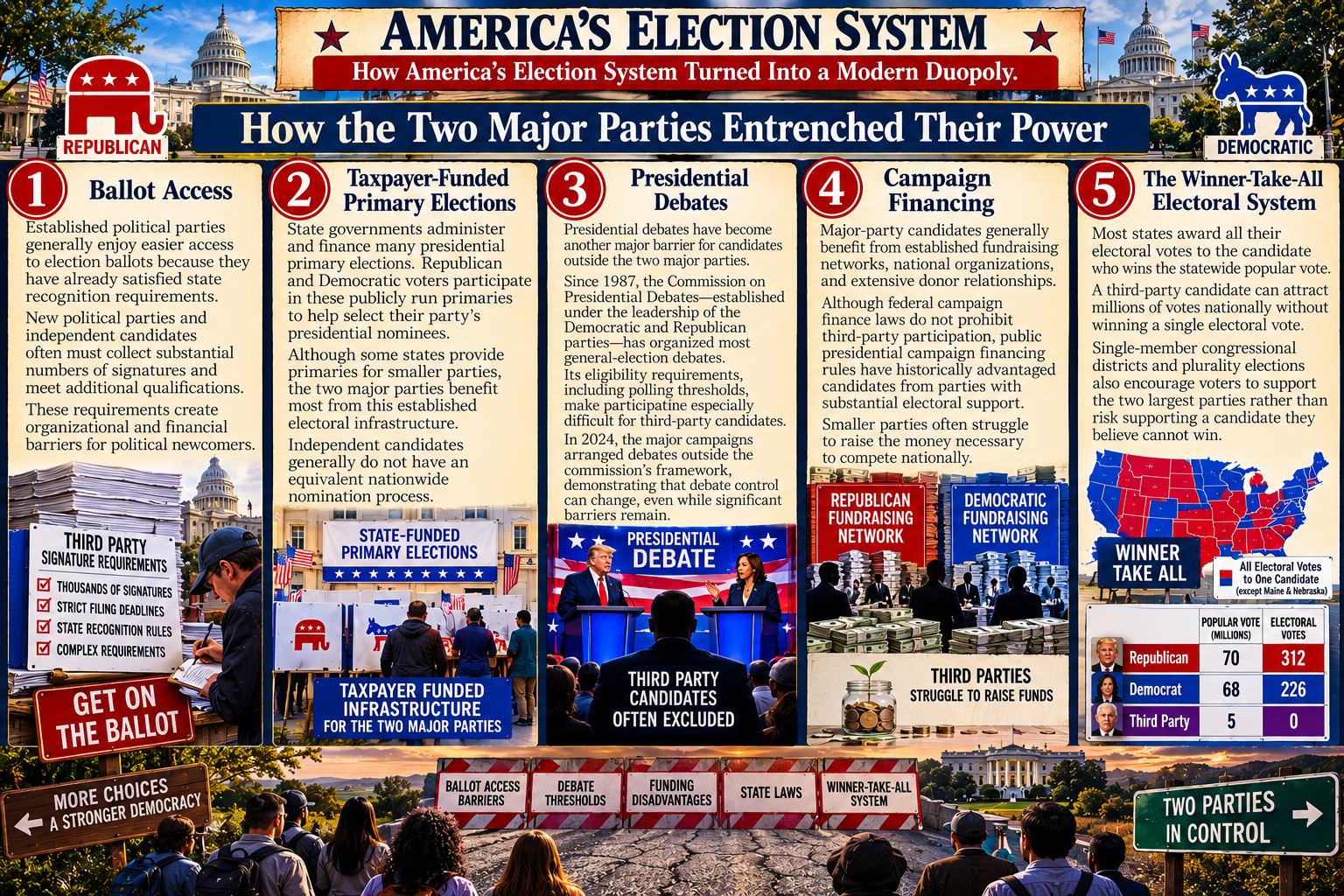
1. Ballot Access
Established political parties generally enjoy easier access to election ballots because they have already satisfied state recognition requirements.
New political parties and independent presidential candidates often must collect substantial numbers of signatures and meet additional qualifications.
These requirements create organizational and financial barriers for political newcomers.
2. Taxpayer-Funded Primary Elections
State governments administer and finance many presidential primary elections.
Republican and Democratic voters participate in these publicly administered processes to help select their party's presidential nominees.
Although some states also provide primary elections for qualifying smaller parties, the two major parties benefit most consistently from this established electoral infrastructure.
Independent candidates generally do not have an equivalent nationwide nomination process supported by state governments.
3. Presidential Debates
Presidential debates have become another important barrier for candidates outside the two major parties.
Since 1987, the Commission on Presidential Debates, established under the leadership of the Democratic and Republican parties, has played a major role in organizing general-election presidential debates.
Its eligibility requirements, including polling thresholds, made participation especially difficult for third-party candidates.
In 2024, the major presidential campaigns arranged debates outside the commission's traditional framework, demonstrating that debate control can change even while significant barriers remain.
4. Campaign Financing
Major-party presidential candidates generally benefit from established fundraising networks, national political organizations, and extensive donor relationships.
Although federal campaign finance laws do not prohibit third-party participation, public presidential campaign financing rules have historically provided advantages to parties demonstrating substantial electoral support.
Smaller parties often struggle to raise the money necessary to compete nationally.
5. The Winner-Take-All Electoral System
Perhaps the greatest structural advantage enjoyed by the two major parties comes from America's electoral rules themselves.
Most states award all their presidential electoral votes to the candidate who wins the statewide popular vote.
A third-party candidate can attract millions of votes nationally without winning a single electoral vote.
Single-member congressional districts and plurality elections also encourage voters to support candidates from the two largest parties rather than risk supporting a candidate they believe cannot win.
The result is a political system in which competing outside parties face enormous obstacles, even when millions of Americans want additional choices.
The Historical Transformation: From Independent Electors to a Two-Party System
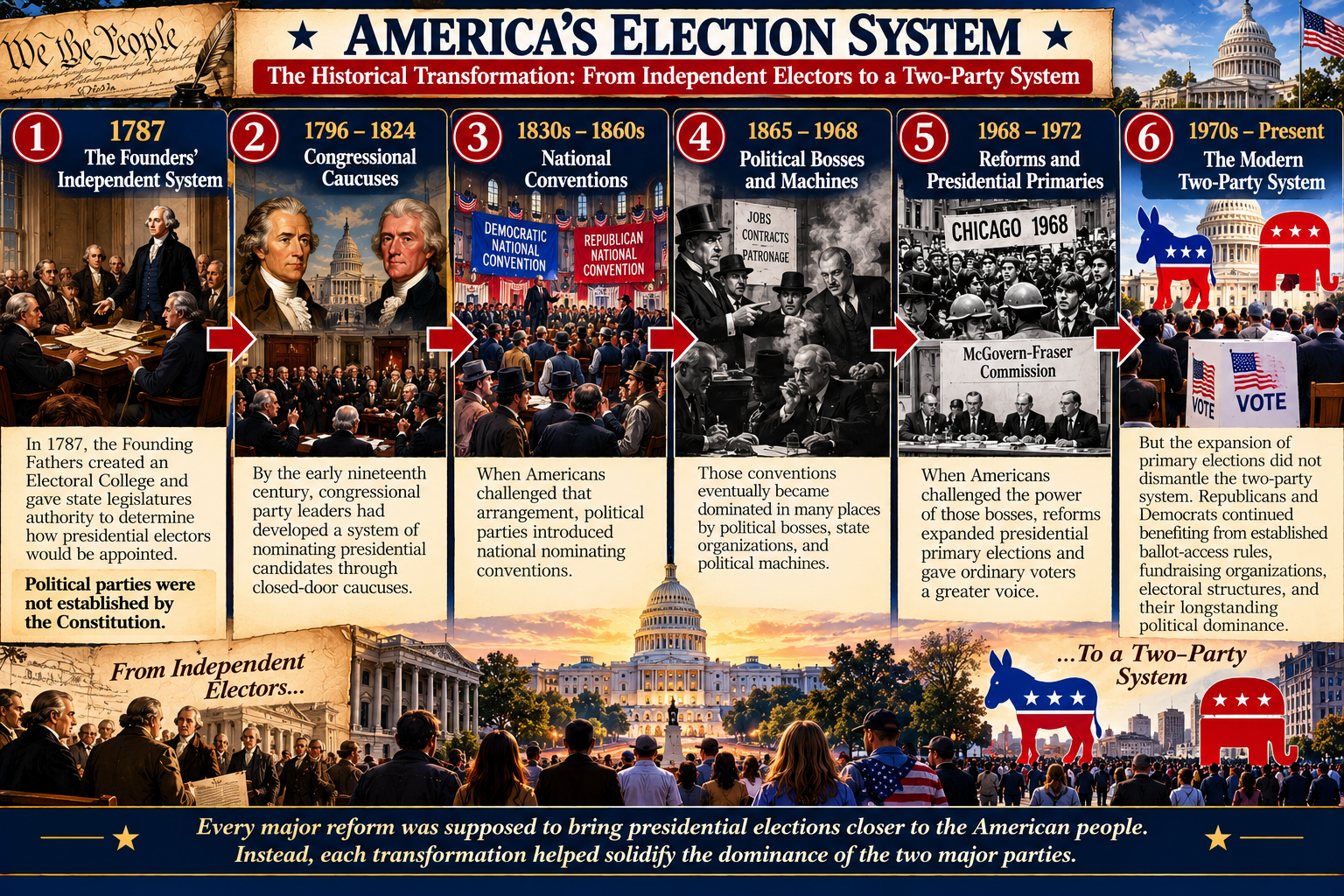
In 1787, the Founding Fathers created an Electoral College and gave state legislatures authority to determine how presidential electors would be appointed.
Political parties were not established by the Constitution.
By the early nineteenth century, congressional party leaders had developed a system of nominating presidential candidates through closed-door caucuses.
When Americans challenged that arrangement, political parties introduced national nominating conventions.
Those conventions eventually became dominated in many places by political bosses, state organizations, and political machines.
When Americans challenged the power of those bosses, reforms expanded presidential primary elections and gave ordinary voters a greater voice.
But the expansion of primary elections did not dismantle the two-party system.
Republicans and Democrats continued benefiting from established ballot-access rules, fundraising organizations, electoral structures, and their longstanding political dominance.
The Great American Contradiction
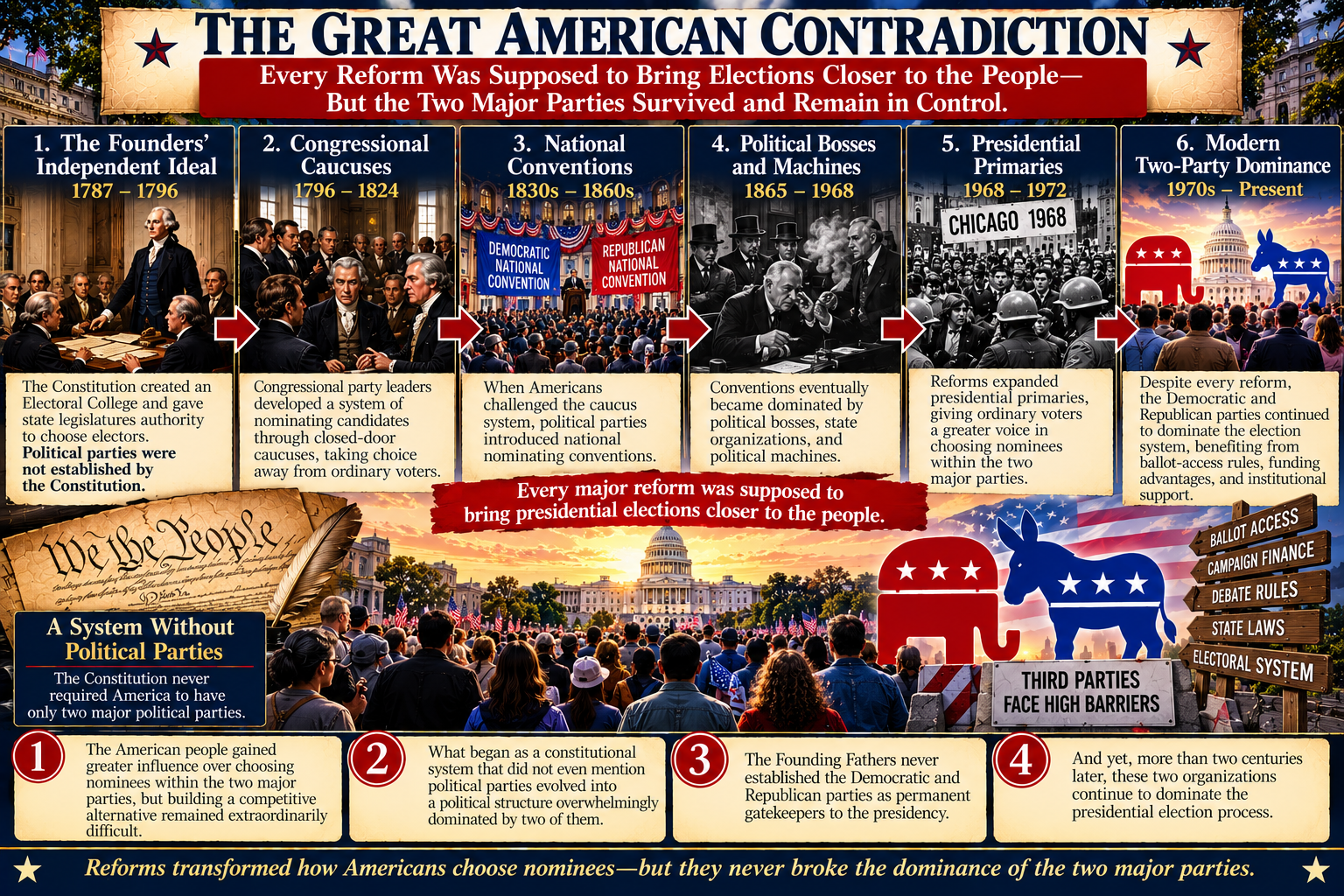
Every major reform was supposed to bring presidential elections closer to the American people.
The congressional caucus system gave way to national conventions.
National conventions gradually gave way to greater participation through presidential primaries.
But the fundamental dominance of two political parties survived every transformation.
The American people gained greater influence over choosing nominees within the Republican and Democratic parties, yet building a competitive alternative to those parties remained extraordinarily difficult.
What began as a constitutional system that did not even mention political parties evolved into a political structure overwhelmingly dominated by two of them.
The Constitution never required America to have only two major political parties.
The Founding Fathers never established the Democratic and Republican parties as permanent gatekeepers to the presidency.
And yet, more than two centuries later, these two organizations continue to dominate the presidential election process.
The Question for the American People
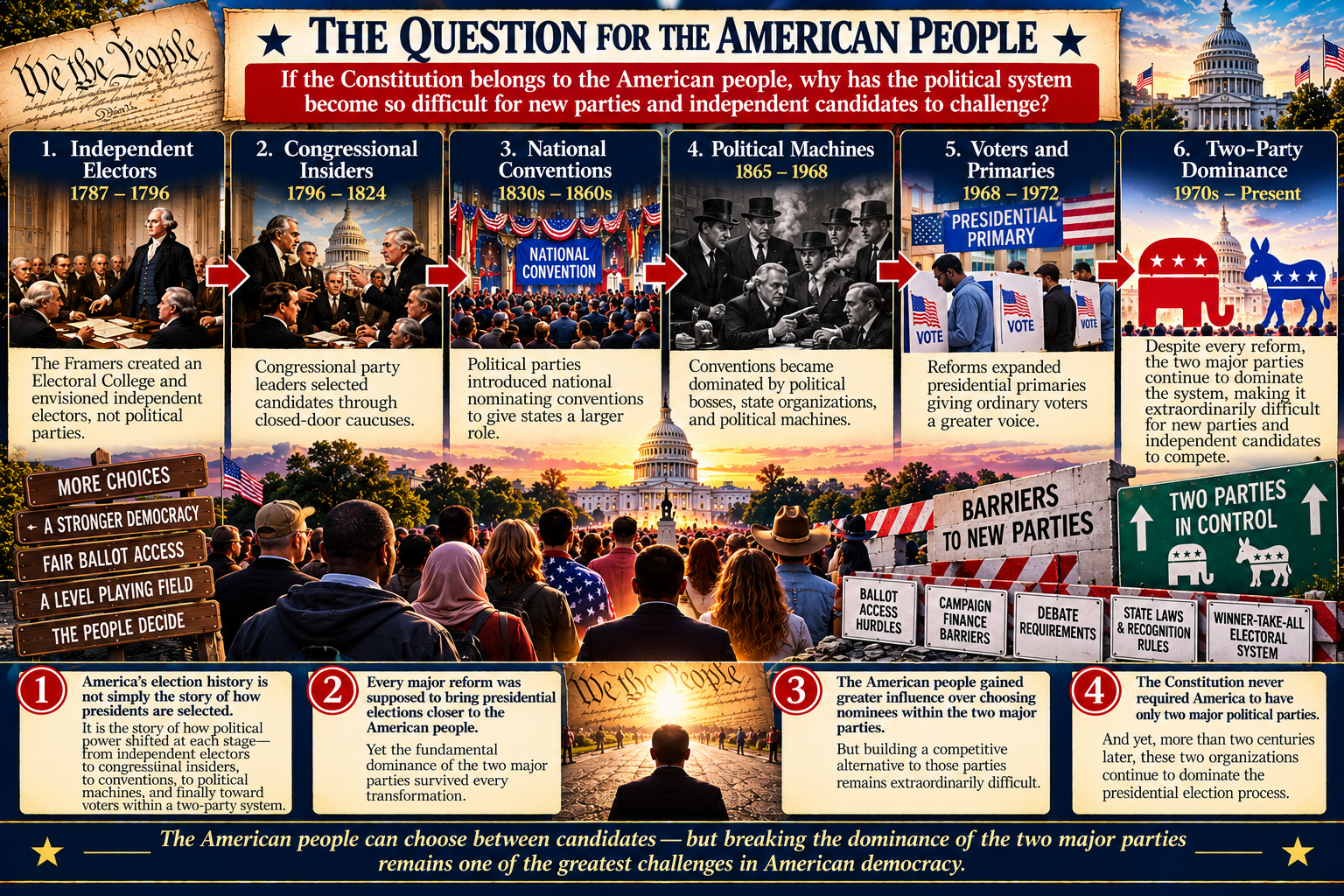
If the Constitution belongs to the American people, why has the political system become so difficult for new parties and independent candidates to challenge?
America's election history is not simply the story of how presidents are selected.
It is the story of how political power moved from independent electors to congressional insiders, from congressional insiders to national conventions, from conventions to political machines, and finally toward voters operating within a system still dominated by two major parties.
The American people gained the power to choose between candidates. But breaking the political dominance of the two major parties remains one of the greatest challenges in American democracy.
AMERICA'S ELECTION SYSTEM
THE SUPER USER PARTY
America's Political Restart in the Age of Artificial Intelligence
America seems to be headed for a correction.
Now that we have artificial intelligence, the same old rules will no longer apply.
And perhaps the best way to change those rules is to launch your own political party.
That is exactly what I intend to do. I am going to launch the Super User Party.
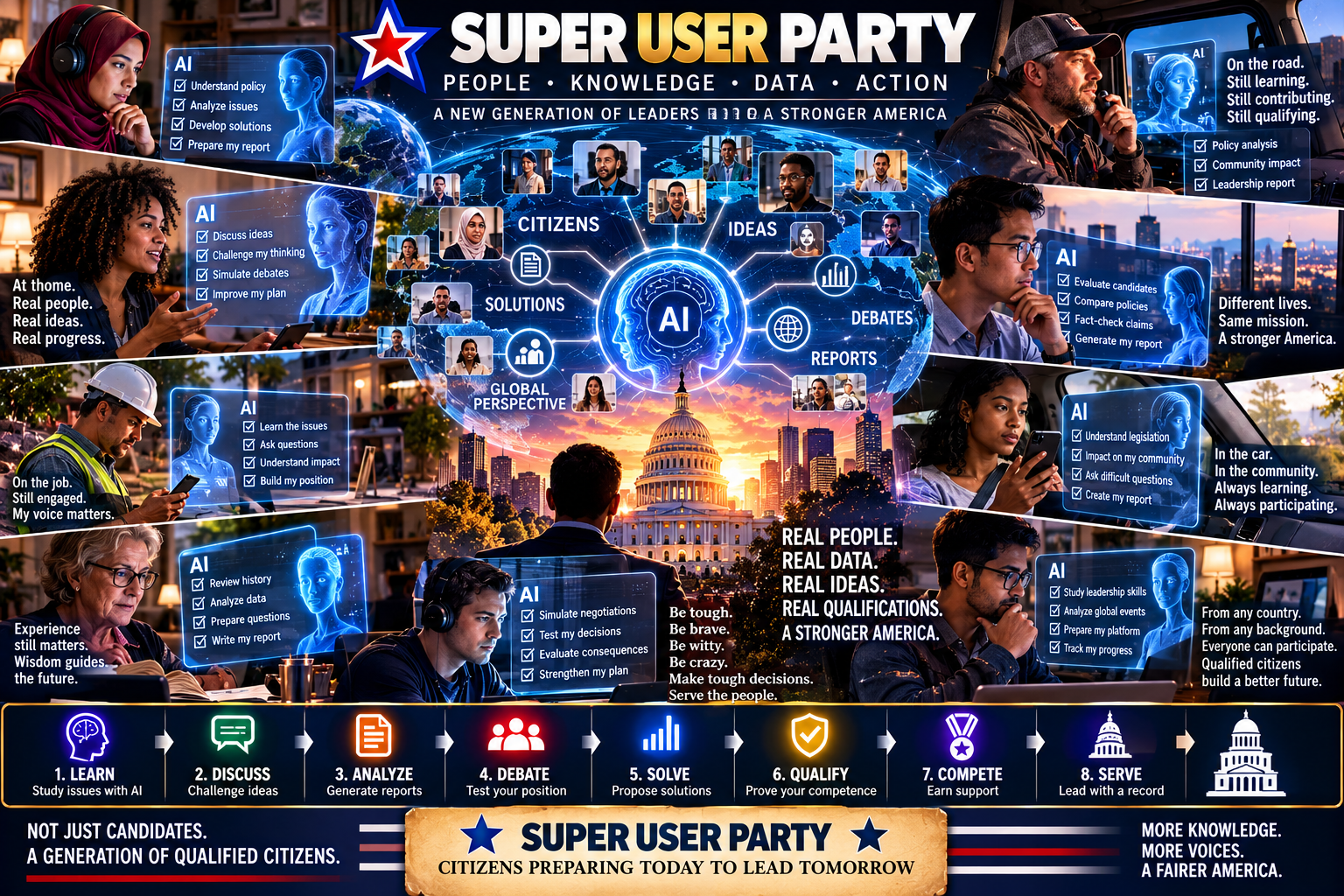
I am going to introduce rules that are fair and square, built around working in an open office, generating data, demonstrating knowledge, and establishing a record of competence in whatever arena you choose to work in.
And nowhere is this more important than in politics.
We live in a world that has advanced tremendously in science, technology, communications, and artificial intelligence.
Yet political crises have never been more entrenched.
We continue to live in a world dominated by egos, powerful personalities, and political leaders whose individual ambitions can shape the destiny of entire nations.
From Donald Trump to Vladimir Putin to Xi Jinping, politics has increasingly become about personalities.
And throughout history, powerful individuals have found ways to short-circuit political systems, manipulate the rules, and place everyone else at a disadvantage.
That is the story of America's election system.
Where Did America Drop the Ball?
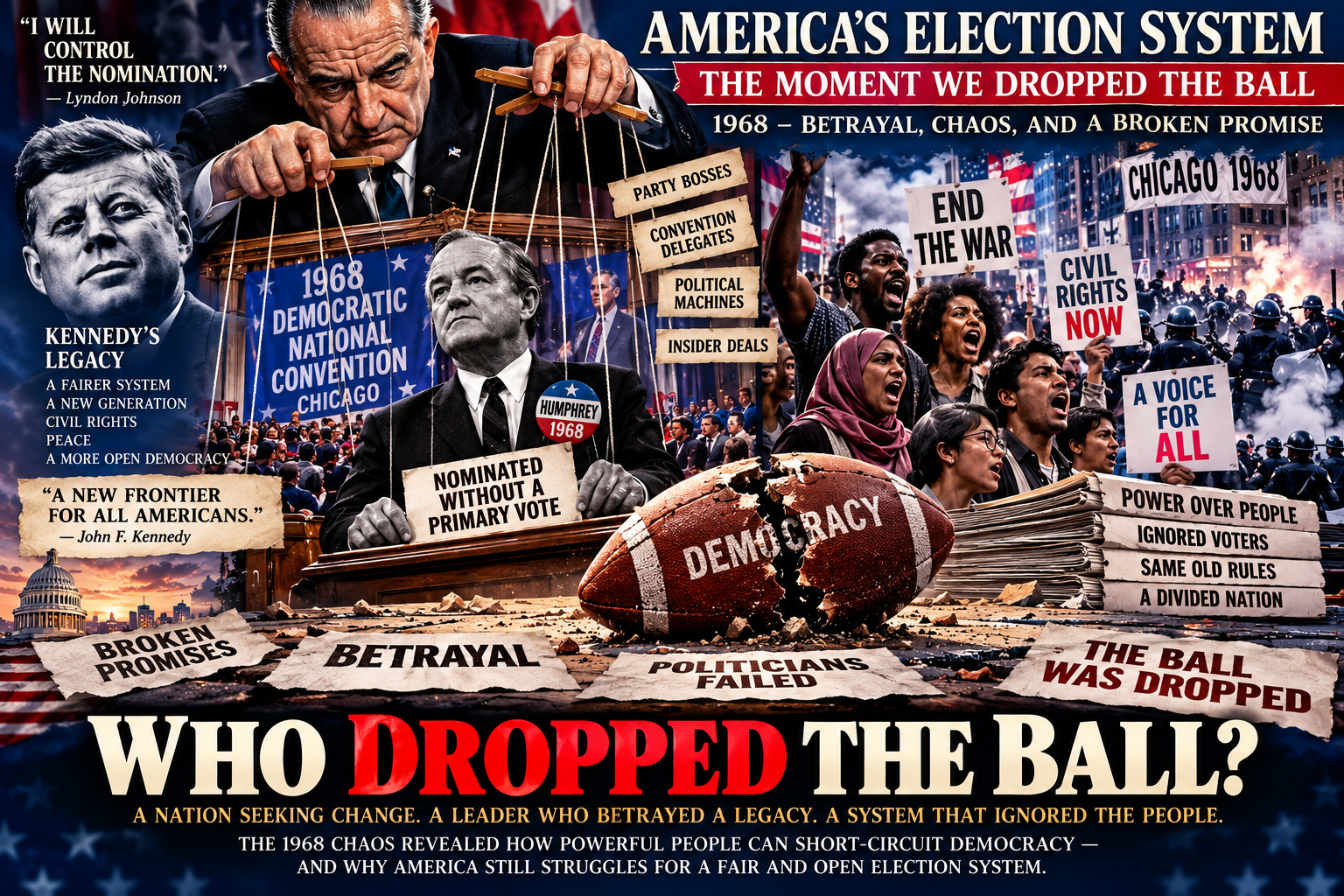
When we examine the history of America's presidential elections, one of the most interesting discoveries is that the Founding Fathers originally envisioned independent electors.
These individuals were supposed to exercise judgment, evaluate leadership, and select someone qualified to serve as president.
The smart idea was the independent elector.
Unfortunately, even the Founders became involved in the rise of political parties.
The Federalists and their opponents began organizing political power, influencing presidential selections, and establishing the foundations of a system in which political insiders increasingly became kingmakers.
And it only got worse from there.
Congressional caucuses emerged.
Then came national conventions.
Then came political bosses, political machines, patronage, and smoke-filled rooms.
Every time Americans attempted to correct the system, powerful people found another way to influence it.
But where do we begin when examining this history?
Where do we point to the moment when America truly dropped the ball?
As far as I am concerned, the ball was dropped during the Kennedy and Lyndon Johnson era.
Lyndon Johnson and the Betrayal of 1968
I believe Lyndon Johnson's political era represents one of the great missed opportunities in American democracy.
After President John F. Kennedy was assassinated, Johnson inherited not only the presidency but also an extraordinary opportunity to carry forward Kennedy's vision.
He could have helped establish a political environment where the best leaders were encouraged to emerge.
He could have used Kennedy's words, his vision, and his legacy to create a more open and fair political system.
Instead, the political establishment continued operating through the machinery of party power.
And in 1968, America witnessed the consequences.
Johnson's vice president, Hubert Humphrey, secured the Democratic presidential nomination without competing in a single presidential primary.
Humphrey was nominated by convention delegates under the existing party rules, not personally appointed by Johnson.
But the political outcome represented everything that was wrong with the system.
As far as I am concerned, it was an act of political betrayal. Honey just makes you wonder what would have happened if Kennedy lived? Well the answer to that question it's something that I have explored.
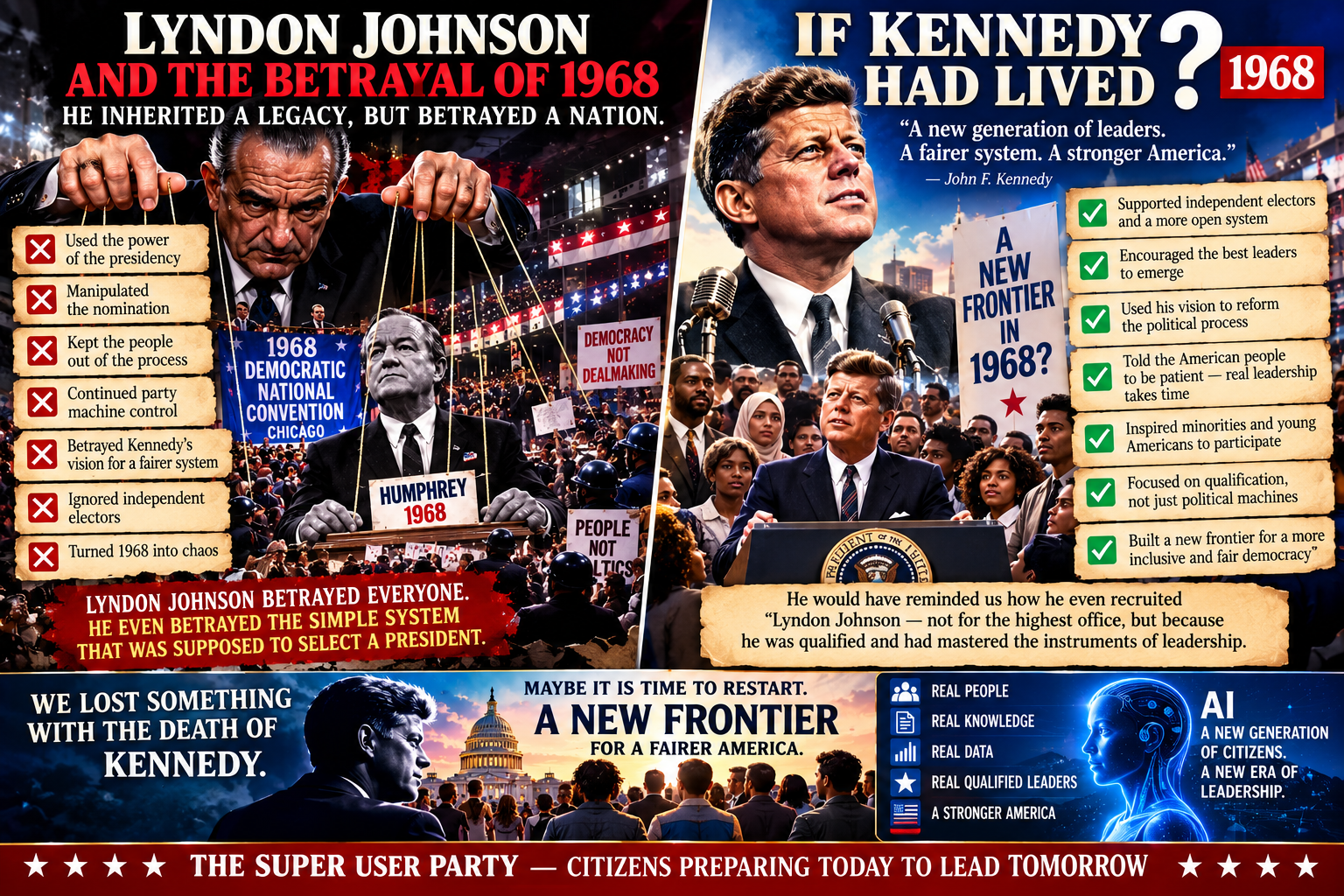
The American people deserved a genuine opportunity to choose their presidential nominee.
Instead, political organizations and party insiders retained enormous influence over the nomination.
And the Democratic National Convention in Chicago descended into chaos.
Americans were protesting.
The country was divided.
The Vietnam War was tearing the nation apart.
And the political establishment was demonstrating just how disconnected it had become from the people it was supposed to represent.
That was a moment when America should have fundamentally reconsidered how its political leaders were selected.
Johnson should have used Kennedy's legacy to help make the system fairer and create an environment where the best leaders could emerge.
Instead, America continued struggling with political machinery that rewarded power, connections, and personalities.
That is where I want to begin the conversation.
The Problem Has Changed, but the Political
And ordinary Americans continue to operate at a disadvantage.
The system still rewards political connections, money, influence, and personality.
But does it reward knowledge?
Does it reward competence?
Does it reward people who understand government?
Does it reward people who can demonstrate that they know how to solve problems?
And does it create an environment where the best leaders can emerge?
Those are the questions America needs to confront.
The Political Machinery Has Changed, but the Corruption Remains
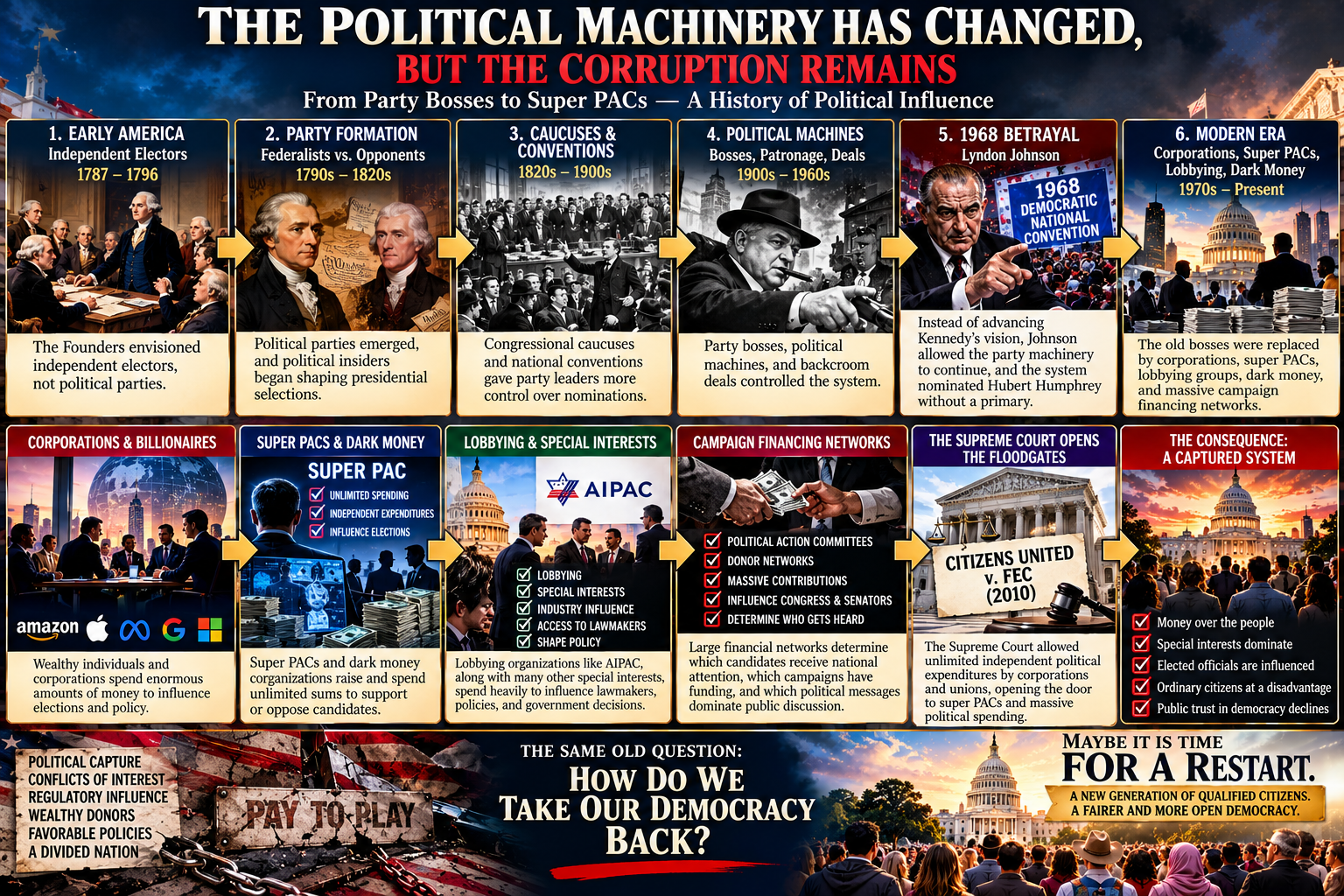
In the past, powerful political bosses and influential individuals could manipulate presidential nominations.
Today, the machinery has become much larger, more sophisticated, and deeply entrenched in American politics.
Now we have corporations.
We have super PACs.
We have lobbying organizations like AIPAC.
We have special interest groups.
We have dark money organizations.
We have powerful political action committees.
We have enormous campaign-financing networks.
And we have wealthy individuals, billionaires, and corporate interests spending extraordinary amounts of money to influence elections and the political decisions of members of Congress and senators.
The old political bosses have been replaced by an entire industry of political influence, lobbying, campaign financing, and institutionalized special-interest power.
And the corruption does not end there.
These powerful political interests have also sought to shape the federal judiciary, supporting presidents and political movements that appoint Supreme Court justices sympathetic to their constitutional and political priorities.
And then came one of the most consequential Supreme Court decisions in modern American political history.
Citizens United v. Federal Election Commission (2010).
The Supreme Court opened the door to unlimited independent political expenditures by corporations and unions. Subsequent court decisions helped establish the legal framework that allows super PACs to raise unlimited contributions for independent political spending.
The floodgates of political money were opened.
And the American people have been living with the consequences ever since.
What was supposed to be a constitutional democracy increasingly resembles a political marketplace where enormous sums of money determine who gets heard, who receives national attention, and who has the resources to compete for public office.
Political organizations and wealthy donors can spend millions of dollars supporting favored candidates, attacking opponents, influencing public opinion, and shaping the political environment.
They can help determine which candidates receive national attention, which campaigns have sufficient funding, and which political messages dominate public discussion.
And through lobbying, campaign contributions, political relationships, and organized pressure, special interests can gain extraordinary access to elected officials.
This is political capture. This is the danger of pay-to-play politics. And this is how institutionalized political influence can undermine public confidence in democracy.
The danger is that elected representatives become more responsive to powerful financial and political interests than to the people they were elected to serve.
The Supreme Court was supposed to protect the Constitution, not create an electoral environment in which ordinary Americans struggle to compete with billionaires and powerful political organizations.
And while political spending is not automatically bribery or illegal corruption, the system creates enormous opportunities for conflicts of interest, disproportionate influence, and political favoritism.
The old political bosses controlled delegates in smoke-filled rooms. Today's political power brokers operate through super PACs, lobbying networks, dark money organizations, campaign-financing operations, and sophisticated political machinery.
The methods have changed.
The money has grown.
The influence has expanded.
And the American people are still fighting to regain control of their political system.
We went from political bosses controlling presidential nominations to wealthy political interests spending billions of dollars to influence who gets elected.
The machinery has changed, but the struggle against political corruption and concentrated power remains.
Introducing the Super User Party
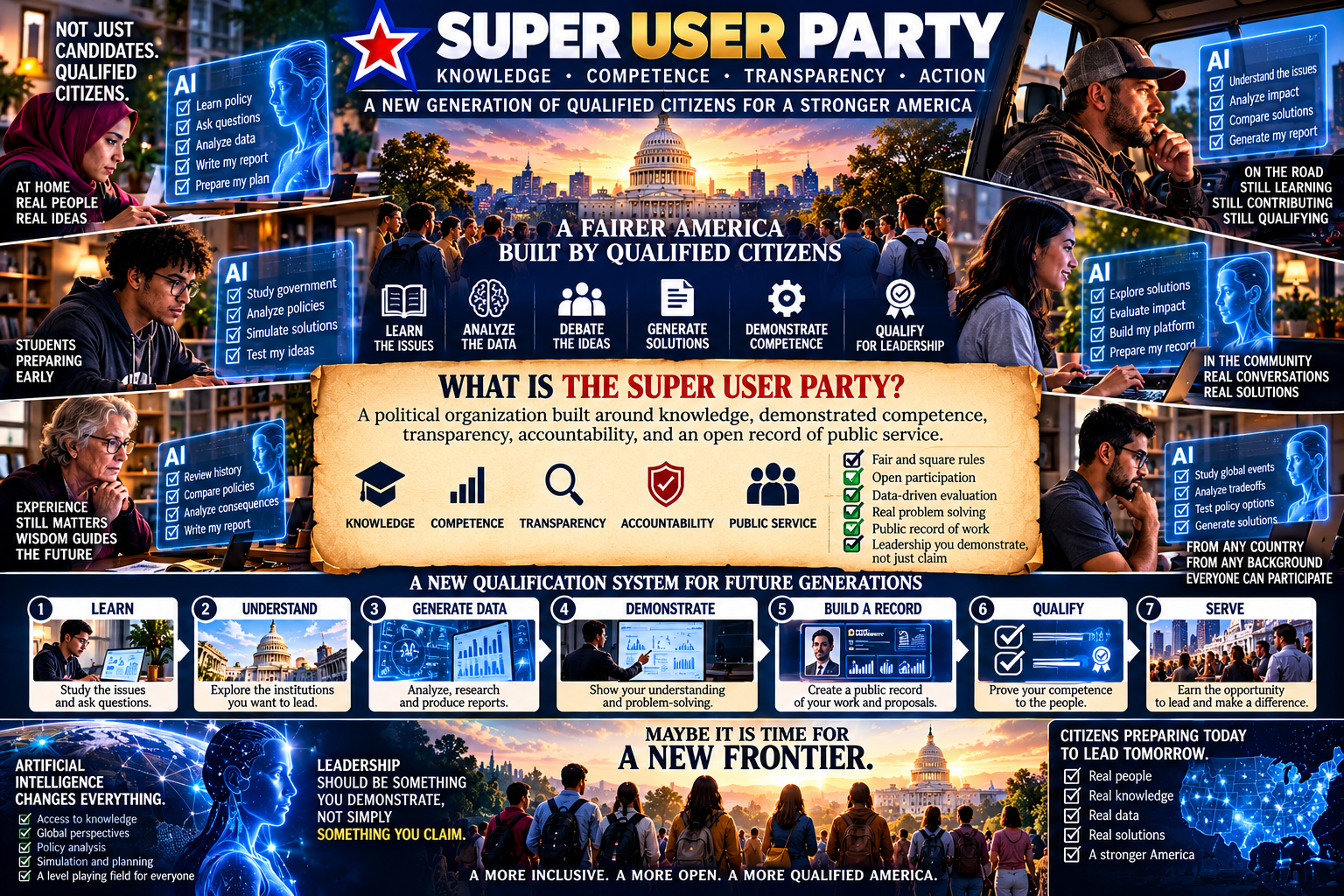
I am introducing a different political system.
The Super User Party.
A political organization built around knowledge, demonstrated competence, transparency, accountability, and an open record of public service.
I want to establish rules that are fair and square.
Rules that allow individuals to work in an open office.
Rules that allow people to generate data demonstrating their understanding of the arena in which they choose to participate.
And especially in politics, rules that require aspiring leaders to establish a record showing that they understand the responsibilities they want to assume.
It should no longer be enough to simply announce that you are running for office.
You should be able to demonstrate what you know.
You should understand the instruments of leadership.
You should understand the responsibilities of government.
You should understand the problems facing the people you intend to represent.
And you should establish a record that allows the public to evaluate your knowledge, judgment, proposals, and performance.
A New Qualification System for Future Generations
I envision a political environment where future generations can begin preparing for leadership long before they seek public office.
They will generate the right data.
They will study the institutions they want to lead.
They will demonstrate their understanding of political systems.
They will master the instruments of leadership.
And they will establish a public record of their work.
Leadership should become something you demonstrate, not simply something you claim.
The Super User system will create an environment where aspiring leaders can demonstrate their qualifications through their work, their knowledge, and their ability to solve problems.
Instead of depending entirely on political parties, wealthy donors, influential personalities, or powerful political organizations, people will have an opportunity to build a record of competence.
And artificial intelligence will make this possible on a scale that previous generations could never have imagined.
Artificial Intelligence and the Future of Political Leadership
Artificial intelligence changes everything.
For the first time in history, we have technology capable of helping people organize enormous amounts of information, examine political institutions, evaluate proposals, study public policy, and create records of their work.
We can build systems that allow aspiring leaders to demonstrate their understanding of government.
We can create transparent environments where people can examine what political candidates know, what they have proposed, and how their ideas have developed.
We can establish a record that future generations can study.
And we can create an environment where knowledge and demonstrated competence become central to political leadership.
But artificial intelligence alone will not guarantee fairness.
It is the responsibility of human beings to establish fair rules and apply them equally.
AI can help administer the system.
AI can help organize the information.
AI can help evaluate evidence against transparent standards.
But human beings must remain responsible for establishing those standards, ensuring accountability, and protecting the rights of everyone who participates.
The objective is not to replace democracy with artificial intelligence.
The objective is to use artificial intelligence to create a more informed, transparent, and accountable democracy.
America Needs a Restart
America has spent more than two centuries transforming its presidential election system.
Independent electors gave way to congressional caucuses.
Congressional caucuses gave way to national conventions.
National conventions became dominated by political machines and powerful party bosses.
Presidential primaries expanded participation, but the two major parties retained their dominance.
And today, corporations, super PACs, wealthy donors, and powerful political organizations exercise enormous influence over the political process.
Every generation has attempted to improve the system.
But powerful people have repeatedly found ways to short-circuit it.
Now we have artificial intelligence.
And with this technology comes an extraordinary opportunity to reconsider how political leaders are developed, evaluated, and selected.
I believe America needs a restart.
Not simply another political personality.
Not simply another political campaign.
And not simply another organization competing for money and influence.
We need a system that creates an environment where the best leaders can emerge.
A system that encourages knowledge.
A system that rewards competence.
A system that creates a permanent record.
A system that allows ordinary people to participate meaningfully in politics.
And a system that establishes fair and transparent rules for everyone.
That is the direction I intend to pursue with the Super User Party.
Because the future of American democracy should not belong to political bosses, powerful personalities, corporations, or wealthy political organizations.
It should belong to the American people.
And in the age of artificial intelligence, we finally have an opportunity to build a political system that helps people demonstrate that they are ready to lead.
THE NEW FRONTIER
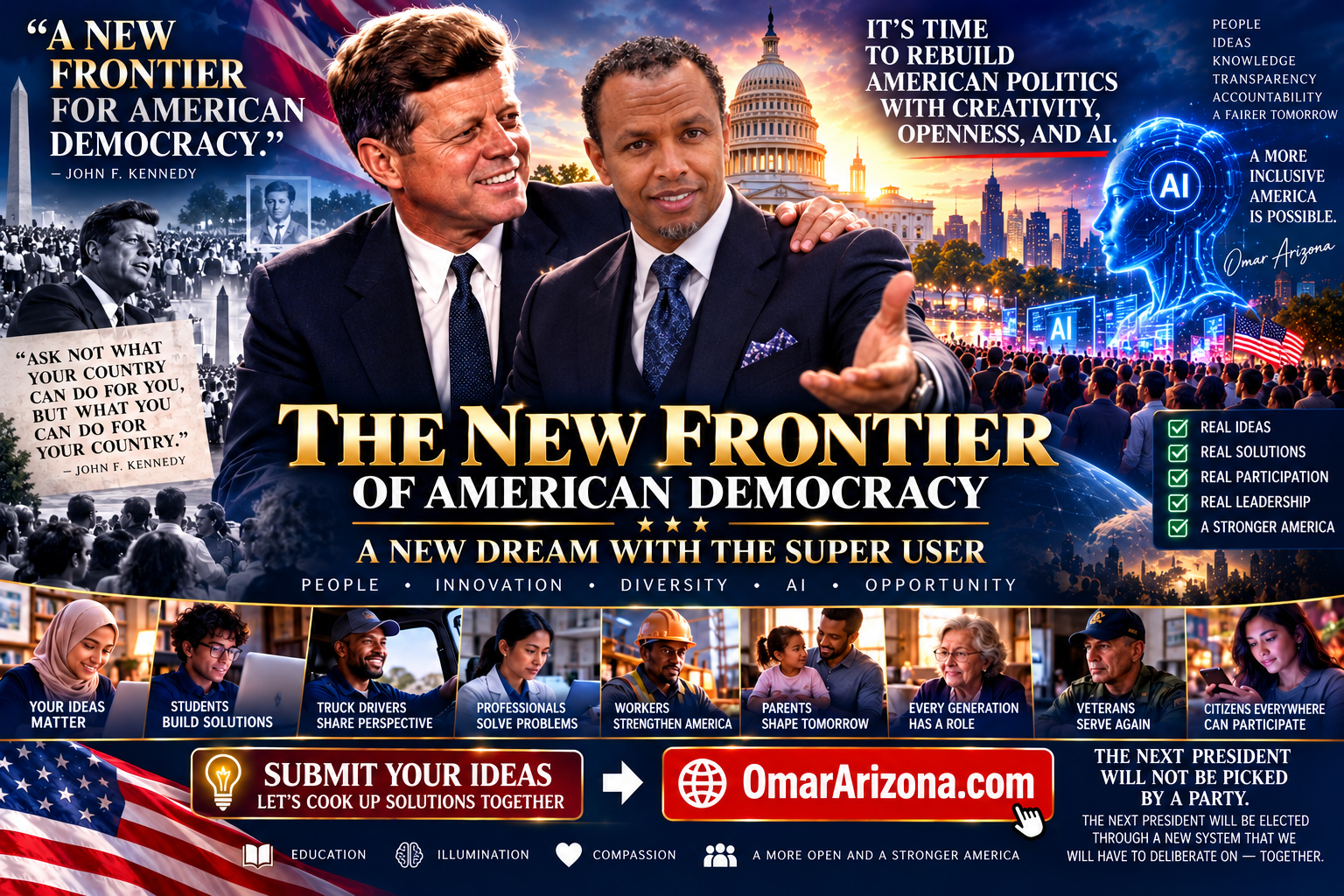
Renewing America's Dream in Politics
We can choose to be inspired by those who would not have failed us. And that is exactly what I choose to do. I understand what leadership is about. It is about the New Frontier. It is about refusing to make excuses. It is about having the courage, imagination, and determination to push our country forward. President John F. Kennedy was a leader to be admired, a man who inspired Americans to believe that tomorrow could be greater than yesterday. It is time to rediscover that spirit, reevaluate how our political system works, and challenge ourselves to build something better. If you have an idea that is better than mine, I welcome it. Come to my website, submit your position, challenge my proposals, and help us develop solutions. I am here to renew America's dreams in politics, to confront and domesticate the wild beasts of political corruption, division, and selfish ambition that threaten to drown this country in sorrow and humiliation. We cannot allow those who profit from America's failures to determine America's future.
America's greatness has always been renewed by the dreams of immigrants and the generations that follow them. Kennedy was an American of Irish immigrant heritage, and I am Somali-born. Our journeys are different, but we share something extraordinary: the belief that America is a land where imagination, opportunity, and determination can transform the future. Kennedy's New Frontier inspired a generation to dream beyond the limitations of its time. Today, artificial intelligence gives us an opportunity to open another frontier, one where knowledge, creativity, transparency, and demonstrated leadership can transform American politics. It is time to renew the American Dream through the dreams of immigrants, the aspirations of ordinary citizens, and the extraordinary possibilities of a new generation.
So, if you are fed up with the political machinery, the corruption, the excuses, and the endless divisions, let us get started. First, we must understand our history. Then we must identify where our political system failed, propose better solutions, and work together to make a difference. I am just one person with a vision, but I believe the American people can build something far greater than any one individual or political party. Bring your ideas, your imagination, your criticism, and your courage. Let us create a political system where the best leaders emerge through knowledge, competence, compassion, and service. The New Frontier is not behind us. It is waiting for us. And in the age of artificial intelligence, it is time to push America forward once again.
THE SUPER USER PARTY — A NEW FRONTIER FOR AMERICAN DEMOCRACY.
May God bless America, and may God bless everyone working to build a brighter future.