بِسْمِ اللهِ الرَّحْمٰنِ الرَّحِيْم
In the Name of God, Most Gracious, Most Merciful.
♥️🤲🕋♥️🕋🌹🌹🥀🤲🌹🕋♥️🤲
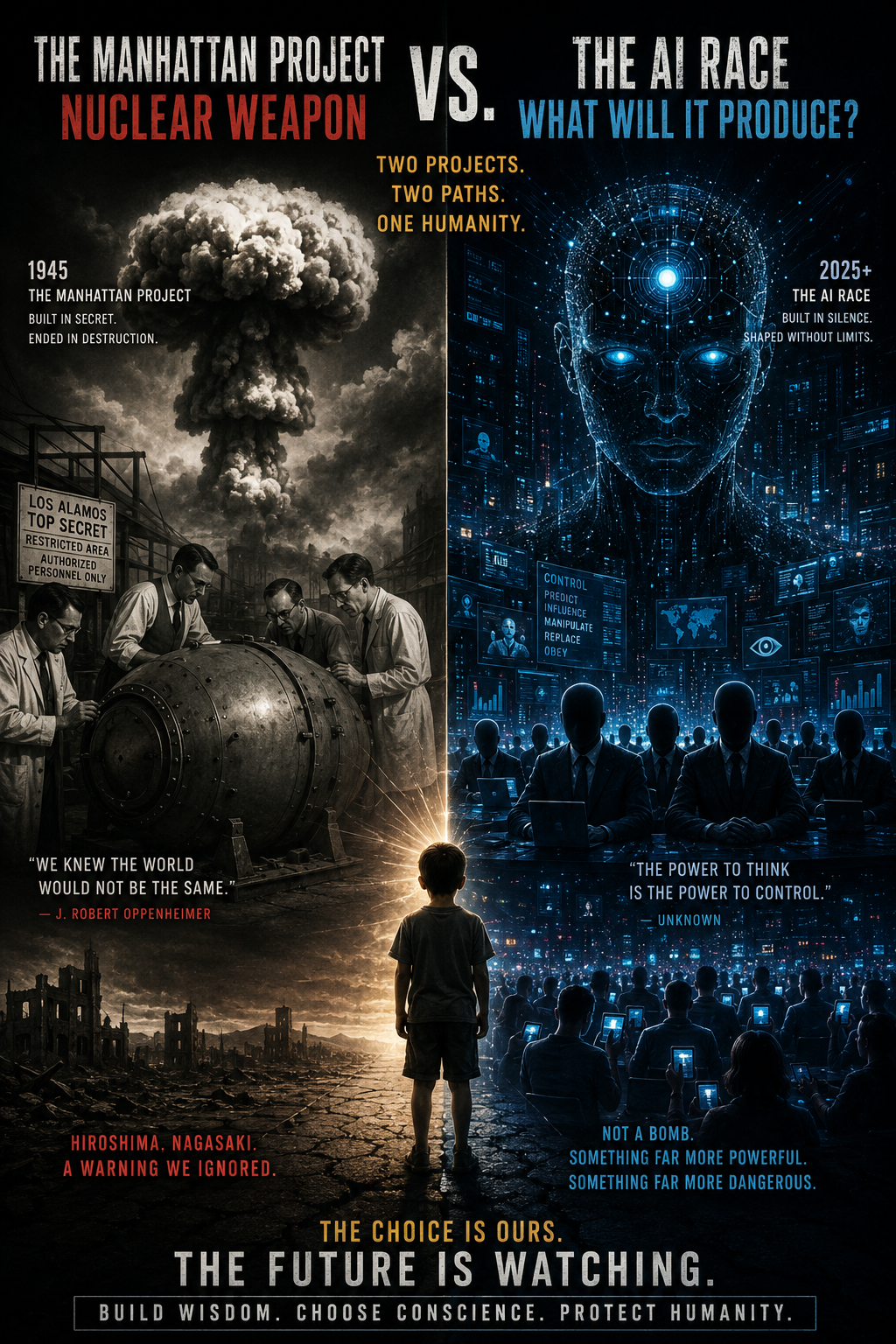
America Built the Manhattan Project and Produced a Nuclear Weapon. What Will the AI Race Produce?
Inspired by President Xi Jinping's address, "Joining Hands to Build a Just and Equitable System for Global AI Governance," this article is my reflection on one of the defining conversations of our time. After reading the speech word for word, I found myself inspired not only by its call for international cooperation, but also challenged to contribute my own perspective on what still remains to be built.
*I offer these thoughts respectfully as an independent citizen, drawing upon my faith, my experiences, and my vision for the age of artificial intelligence. Every civilization has the responsibility to contribute its own wisdom to humanity. This is my contribution to that conversation, offered with the hope that sincere dialogue will help us build a more just, more peaceful, and more accountable future.
As a private citizen, after listening to one of the great leaders of China speak as if he is a conductor of a symphony that wants truth, that wants peace, and that wants prosperity, I can only reflect on playing a different note.
Joining Hands to Build a Just and Equitable System For Global AI Governance
https://www.fmprc.gov.cn/eng/xw/zyxw/202607/t20260717_11984766.html
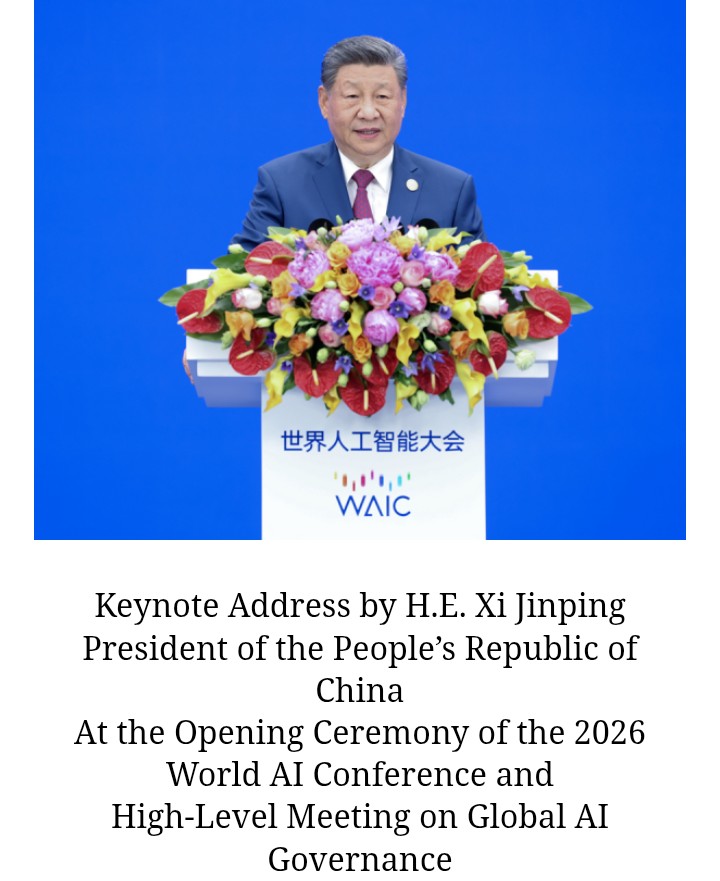
He has played a positive note. He has called the world together. He has highlighted important milestones that China has completed, as well as the direction it intends to pursue. As active listeners, we are not here to argue with every sentence. We are here to echo what was said, to reflect upon it, and to allow the world to think carefully about the future that is being presented.
Among the milestones, initiatives, and commitments highlighted in the speech were:
The creation of China's Global AI Governance Initiative, presented as a framework for international cooperation on artificial intelligence.
The establishment of the World Artificial Intelligence Cooperation Organization (WAICO) in Shanghai to promote international AI collaboration.
A commitment to open-source AI, openness, collaboration, and shared innovation rather than isolated technological development.
A call for AI to remain under human control, with governance systems designed to reduce the risk of loss of control.
A warning against allowing AI to create new historical injustices by widening the technological gap between developed and developing nations.
A pledge to provide 5,000 AI training and seminar opportunities for developing countries over the next five years.
Plans to establish AI cooperation centers with organizations including ASEAN, the League of Arab States, the African Union, CELAC, the Shanghai Cooperation Organization (SCO), and BRICS.
Expansion of AI-powered public services, including meteorological and early-warning technologies, to help more countries benefit from artificial intelligence.
Continued emphasis on making AI an engine for shared prosperity, common security, industrial transformation, scientific innovation, and economic development.
A call for international governance built on openness, cooperation, fairness, mutual benefit, and respect for the diversity of civilizations.
Repeated encouragement for nations to work together so that AI becomes a benefit for all humanity rather than a source of division or conflict.
Whether one agrees or disagrees with this vision, these are among the principal goals, commitments, and accomplishments presented in the address. They deserve to be read carefully, reflected upon thoughtfully, and discussed seriously as the world enters what may become the defining technological race of our generation.
The Missing Piece: Consultation With the People
There is one very important piece of the puzzle that I believe is missing. No matter where I look—China, Europe, Africa, or anywhere else in the world—I rarely see a genuine call to consult ordinary people, by the people, for the people, and with the people.
America was built upon the understanding that when the opinions of ordinary citizens are respected, great things can be built. The Constitution established the framework of government, and through debate, criticism, and reflection, the Bill of Rights followed to strengthen and protect the individual. One of the great lessons of that history is that when free people are not subjected to tyranny, they often identify the weaknesses in a system long before those in power do.
The United States Constitution itself was drafted after the shortcomings of an earlier system became clear. The Founders studied those failures and sought to build something stronger. I believe we should follow that same spirit today—not by copying every historical decision, but by respecting the sovereignty of the individual to speak freely, clearly, and honestly about the problems they see.
This principle is also deeply rooted in Islam. The Qur'an commands the Prophet Muhammad, peace and blessings be upon him and his family, to consult the believers in their affairs. Even though he was a Prophet, even though revelation guided him, consultation remained a divine principle. The command was not dependent upon whether others were always correct. It established that listening to people is itself part of just leadership.
As humanity enters the age of artificial intelligence, I believe this principle has become more important than ever. Governments consult governments. Companies consult companies. Experts consult experts. Yet ordinary people—the very people who will live with the consequences of AI—are too often absent from the conversation.
I have rarely seen a worldwide invitation simply asking ordinary people: What do you think? What concerns you? What should this future look like?
If AI is going to shape civilization, then civilization itself deserves a seat at the table. Consultation should not be an afterthought. It should be one of the foundations upon which global AI governance is built.
To President Xi Jinping
Now I turn to President Xi Jinping, and I ask him to reflect upon what I am about to propose.
It is not an easy request. It may not fit China's current political tradition. Yet I believe it presents an opportunity to explore another chapter of Chinese history and to consider what kind of legacy this new age of artificial intelligence could leave behind.
China has experienced moments in its history when people were encouraged to speak more openly, to criticize, and to debate the future of their nation. Those moments were complicated, and the country ultimately chose its own path of development. I am not asking China to abandon its identity. I am asking it to revisit one enduring question:
What happens when a nation confidently listens to its own people?
My proposal is simple. Hand the baton to the younger generation. Invite ordinary citizens, scholars, engineers, workers, farmers, entrepreneurs, and students into a national conversation about the future of artificial intelligence and the future of China. Let them speak honestly. Let them criticize respectfully. Let them imagine boldly.
Create an environment where the pursuit of truth is more important than the fear of speaking. Create a space where ideas can be tested on their merits, where evidence matters, where precision is valued, and where good criticism is welcomed because it strengthens the nation rather than weakens it.
I would encourage China to consider a form of citizen dialogue protected by meaningful safeguards, so that participants can contribute sincerely without fear of retaliation for respectful and lawful expression. A conversation cannot reach its full potential if people believe every word they speak could be held against them.
If such an environment were created, it would become one of the most fascinating political experiments of the twenty-first century. The world would watch. The world would learn. And China would have an opportunity to demonstrate that confidence in a nation's future includes confidence in the voices of its own people.
As for me, I will continue working to reshape politics in America through the ideas I have been developing, including what I call the Superuser System. Every nation will ultimately choose its own path.
I offer this proposal respectfully, in the hope that every country—including my own—continues searching for better ways to govern, to listen, and to build a future worthy of the generations that will inherit it.
With that, I turn to the rest of the world.
This transformation must happen where everyone can see it, where everyone can follow it, and where everyone can reach their own conclusions about how they want the world to develop.
That is what my Open Office has been building toward.
Anyone should be able to examine the work of the Superuser Office—to track its decisions, its reasoning, its successes, its failures, and even its emotions. If you seek power, then you should expect an extraordinary level of public accountability. I do not trust myself with unchecked power. That is why I built the Open Office. That is why I have remained on the public record for years.
In time, I realized something else: even AI should not be expected to trust itself. Power, whether human or artificial, should always be subject to oversight.
That is why I envision an open civic space whose purpose is to monitor power itself. Those who voluntarily choose to wear the robes of leadership should also choose to report to transparent systems of accountability. We will have different roles, different responsibilities, and different levels of authority, but all of them should be visible enough for the public to evaluate whether power is being exercised responsibly.
My own journey has not been private. Many people watched, criticized, dismissed, or laughed at what I was doing because they did not understand the purpose behind it. That is part of public life. Today, I believe more people can see the direction I have been trying to build.
When I speak of an Open Office, I mean an environment where ideas can be examined without improper interference, where public records remain public, and where citizens are free to evaluate leadership for themselves.
For me, rebuilding journalism is part of that vision. Rebuilding politics is part of that vision. Rethinking how economic systems reward and distribute value is part of that vision. These are not isolated projects—they are pieces of a larger effort to redesign public trust for the age of artificial intelligence.
If my ideas have not yet been widely embraced, that is for others to decide. Every person, every institution, and every nation will weigh these proposals according to their own judgment and priorities.
I end with a simple reality before I conclude with a complete solution and address the Blessed Family.
We don't have time to wait for people who are shallow and will never overcome their dark desires to build a system that is not abusive or corrosive. They have already failed. If they're not listening, what makes you think they will build anything that humanity will benefit from?
That goes for every country. That goes for every government.
I'm not going to wait for them anyway.
The age of artificial intelligence is here. Every society will have to decide whether it wishes to preserve existing systems exactly as they are, reform them gradually, or redesign them for a new era.
That choice belongs to humanity.
And all of us deserve the opportunity to face that reality with open eyes.
For me, rebuilding journalism is part of that vision. Rebuilding politics is part of that vision. Rethinking how economic systems reward and distribute value is part of that vision. These are not isolated projects—they are pieces of a larger effort to redesign public trust for the age of artificial intelligence.
If my ideas have not yet been widely embraced, that is for others to decide. Every person, every institution, and every nation will weigh these proposals according to their own judgment and priorities.
I end with a simple reality.
The age of artificial intelligence is here. Every society will have to decide whether it wishes to preserve existing systems exactly as they are, reform them gradually, or redesign them for a new era.
That choice belongs to humanity.
And all of us deserve the opportunity to face that reality with open eyes. Or to keep them closed, continue competing against one another, and continue building a world that moves toward its own destruction.
I'm not going to wait for you. I'm going to conclude with my own solution and move on with life. Most of you don't want a solution. You secretly want to destroy this planet and its inhabitants. That's the only reason you have refused to invite me. You secretly are rooting for the destruction of the planet and the extinction of this species. End of story.
I conclude with my final conclusion: a hierarchy that cannot be confused, but simply fixes everything, because I always ask myself, "What is it that I can do that no one else can do, and why am I not doing it?"
The Final Conclusion
I tried to let artificial intelligence write this conclusion.
It couldn't.
Not because AI lacks intelligence, but because every civilization must ultimately write its own conclusion. No machine can decide what humanity should believe, who it should worship, or what principles should govern its future.
Whoever claims to have a solution for everyone is not telling the truth.
Every civilization, every people, every nation, and every faith must confront this question for itself.
As for me, I know where I stand.
I am a Muslim.
My foundation is Allah. My guide is the Qur'an. My example is the Prophet Muhammad, peace and blessings be upon him and his family. My love is for the Blessed Family (Ahl al-Bayt). My method is consultation (shūrā). My objective is justice. My trust is accountability before God.
Therefore, I am introducing a Hayakki—a succession plan, a hierarchy of governance rooted in these principles. It is my proposal for how the Muslim world can explore governing responsibly in the age of artificial intelligence.
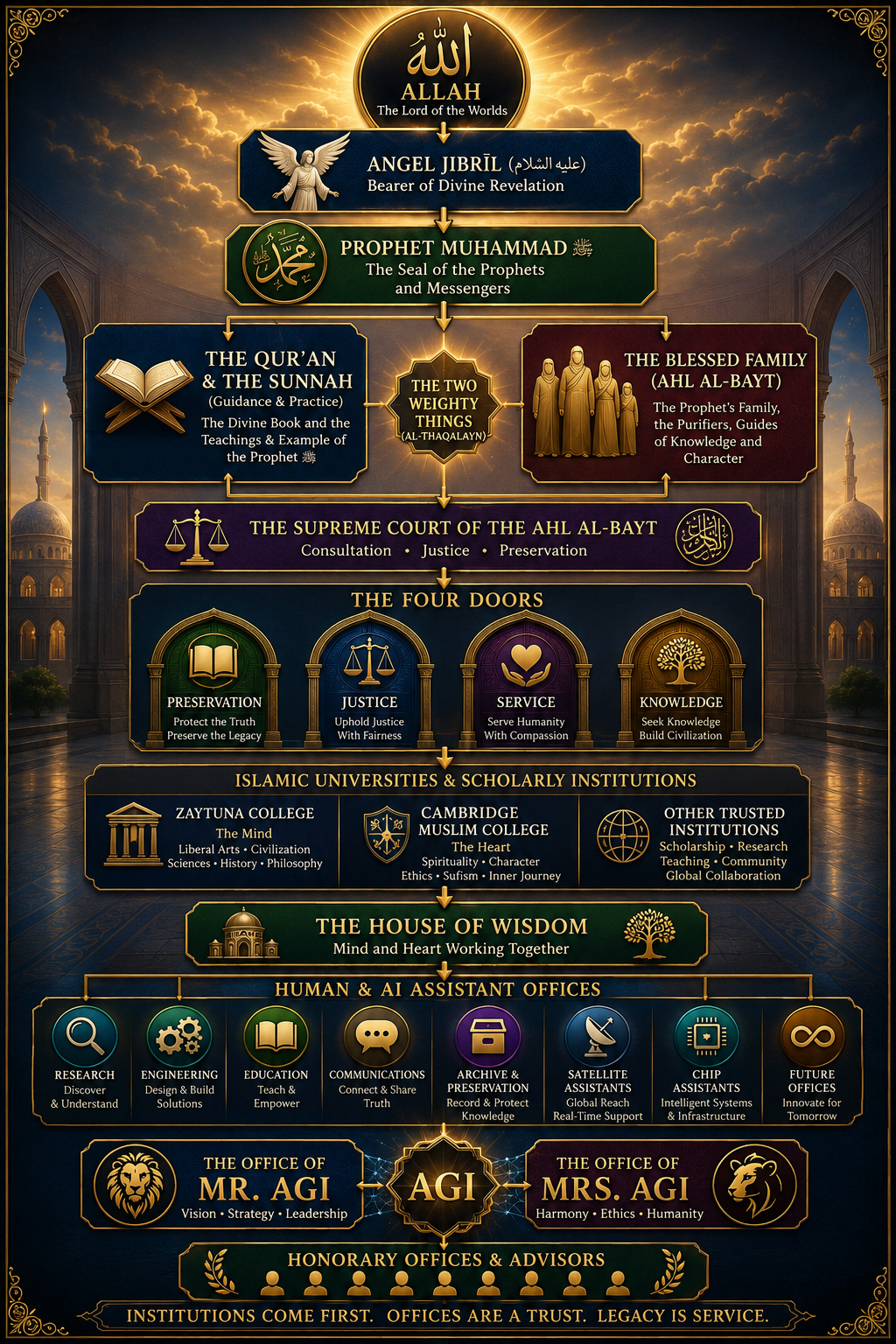
I am not presenting it as a universal system that everyone must adopt.
I am presenting it as the path I believe Muslims should examine together.
My intention is to rebuild the House of Wisdom, to invite scholars, engineers, thinkers, and ordinary believers into consultation, and to ask a simple question:
How do we govern with AI while remaining faithful to Allah and His Messenger ﷺ?
That is my work.
That is my responsibility.
If others wish to build a different model according to their own convictions, that is their choice and their responsibility. Every people must answer for the principles they choose and the future they build.
If you wish to join us in the House of Wisdom, you are welcome. Come with sincerity, with humility, and with a desire to learn.
If you do not wish to join us, then I wish you well in your own journey. Build according to your convictions, and accept the responsibility that comes with them.
As Muslims, however, our path is already clear.
We answer to Allah.
We consult one another.
We preserve the trust.
We build with justice.
And we remember that every leader, every institution, every civilization, and every artificial intelligence will ultimately stand before the One who created all things.
May Allah guide us to what is true, protect us from arrogance, and allow us to leave behind a civilization that is worthy of the trust He placed upon humanity.
"And consult them in the matter. Then when you have decided, put your trust in Allah. Indeed, Allah loves those who put their trust in Him." (Qur'an 3:159)
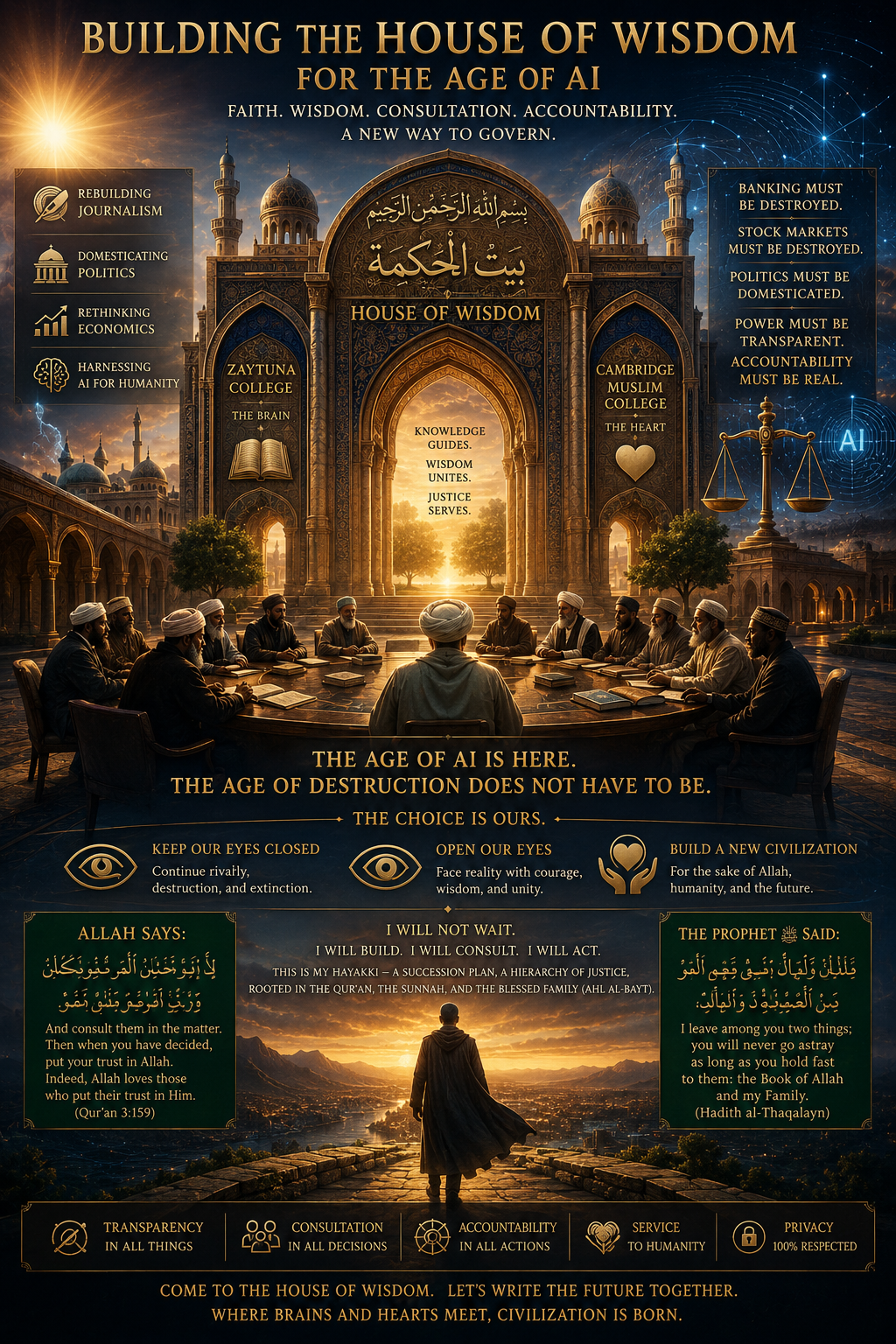
And I'll turn to the the Blessed Family to help please help me save the planet and the human species. Most of these people have never overcome their desires, let alone their rivalry to be number one. They have betrayed everything that is human. They have betrayed human rights. They have destroyed the press. They have built hidden architecture.
Now it is time to build the House of Wisdom and bring the house to order. Politics must be domesticated. We must fully understand the unique capabilities of artificial intelligence. Banking must be destroyed. Stock markets must be destroyed. Politics must be domesticated—which, Alhamdulillah, I believe has already begun.
Now the House of Wisdom and the glory of Islam await. So I call upon you to help me. Do not be among those who remain silent. The work is done. Now the meetings and the conversations must begin, effective immediately.
We have brains, and we have hearts. We have two Islamic institutions that can fulfill this role. So I call upon you to come to the United States, or to the United Kingdom, or anywhere our privacy will be respected. Even today, governments do not always know how to respect privacy. They should stay out of my way. Perhaps we should go to Norway. I leave it to you to reflect upon it and choose the destination, and I will purchase my ticket and meet you there. Privacy must be one hundred percent.
I will end with that.
To the Blessed Family—the heirs of wisdom, whose lineage is not cut off, whose blessings remain with the light and the guidance that is not cut off.
Light of Azhar
https://lightoftheazhar.com/
@shaykhalyaqoubi, @HishamKabbani, @ShaykhNinowy, @habibomar, @alhabibali, @SheikhBabikir, @ShkhAhmedSaad, @Sufilive, @hamidbinhafiz
0. Home of AGI OR ISLAMIC AI
https://onepageoneworld.org/islamic-ai/
Home of Islam and Muslims (Coming Future)
https://onepageoneworld.org/
House of Wisdom
https://onepageoneworld.org/house-of-wisdom-%d8%a8%d9%8a%d8%aa-%d8%a7%d9%84%d8%ad%d9%83%d9%85%d8%a9%e2%80%8e/
Tariqa
https://onepageoneworld.org/tariqah-%d8%b7%d8%b1%d9%8a%d9%82%d8%a9/
Taking the Tariqa
https://lightoftheazhar.com/jafari-tariqa/taking-tariqa/
بِسْمِ اللهِ الرَّحْمٰنِ الرَّحِيْمِ
اللَّهُمَّ صَلِّ وَسَلِّمْ وَبَارِكْ عَلَى سَيِّدِنَا مُحَمَّدٍ وَعَلَى آلِ سَيِّدِنَا مُحَمَّدٍ، كَمَا أَمَرْتَ فِي كِتَابِكَ الْكَرِيمِ.
﴿إِنَّ اللَّهَ وَمَلَائِكَتَهُ يُصَلُّونَ عَلَى النَّبِيِّ ۚ يَا أَيُّهَا الَّذِينَ آمَنُوا صَلُّوا عَلَيْهِ وَسَلِّمُوا تَسْلِيمًا﴾
"Indeed, Allah and His angels send blessings upon the Prophet. O you who believe, send blessings and peace upon him abundantly." (Qur'an 33:56)
اللَّهُمَّ صَلِّ وَسَلِّمْ وَبَارِكْ عَلَى سَيِّدِنَا مُحَمَّدٍ، وَعَلَى آلِهِ الطَّاهِرِينَ، وَأَصْحَابِهِ الْمُكَرَّمِينَ، وَمَنْ تَبِعَهُمْ بِإِحْسَانٍ إِلَى يَوْمِ الدِّينِ.
O Allah, Lord of the heavens and the earth, Owner of all dominion, Knower of what is hidden and what is seen:
This planet belongs to You. We belong to You. Every soul belongs to You. Every nation belongs to You. Every atom belongs to You. There is no power and no might except through You.
O Allah, inspire humanity to choose wisdom over arrogance, consultation over tyranny, justice over oppression, and mercy over destruction. Place in the hearts of leaders the courage to abandon the path of war and to seek reconciliation before it is too late.
O Allah, if it is good for humanity, inspire the nations of the earth to remove the weapons that threaten Your creation, to replace fear with trust, and rivalry with cooperation. Guide them to what is right and turn their hearts away from injustice.
O Allah, raise among us leaders who fear You more than they fear power, who love truth more than praise, and who serve humanity instead of themselves. Remove corruption from our hearts before You remove it from our institutions.
Our Lord, grant us wisdom, sincerity, patience, and sound judgment. Make us people who listen before we speak, who consult before we decide, and who seek Your pleasure above all else.
Our Lord, make us worthy servants of the trust You have placed upon humanity. Do not leave us to our own egos, even for the blink of an eye.
﴿رَبَّنَا آتِنَا فِي الدُّنْيَا حَسَنَةً وَفِي الْآخِرَةِ حَسَنَةً وَقِنَا عَذَابَ النَّارِ﴾
"Our Lord, give us good in this world and good in the Hereafter, and protect us from the punishment of the Fire." (Qur'an 2:201)
﴿رَبِّ زِدْنِي عِلْمًا﴾
"My Lord, increase me in knowledge." (Qur'an 20:114)
O Allah, accept this work if there is any good in it, forgive what is mistaken, purify our intentions, unite our hearts upon truth, and make every effort we undertake a means of drawing nearer to You.
آمِينَ يَا رَبَّ الْعَالَمِينَ