

بِسْمِ اللهِ الرَّحْمٰنِ الرَّحِيْم
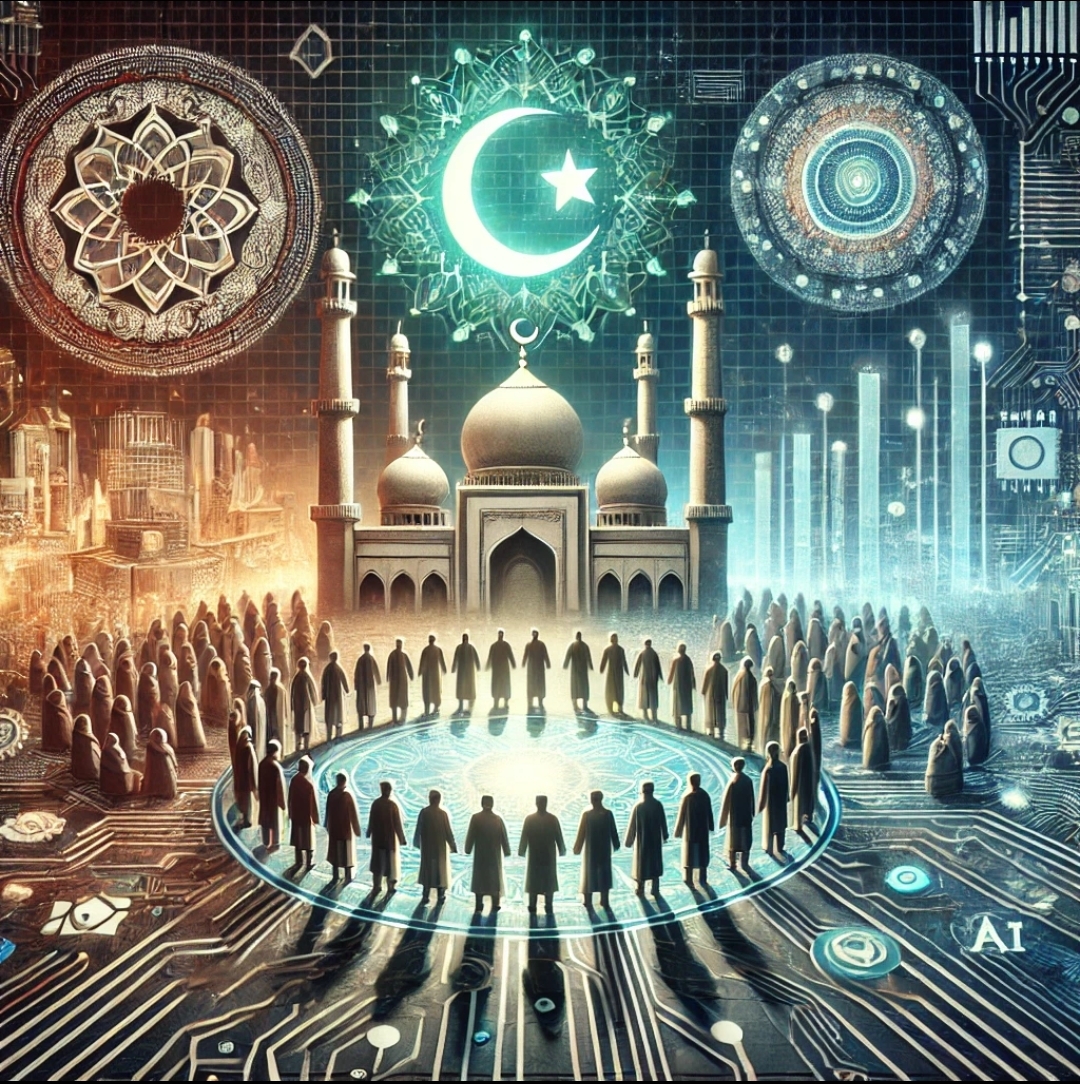
The world is shifting toward an era dominated by artificial intelligence (AI), and its influence will soon redefine how we communicate, connect, and even practice our faith. While AI’s promise of efficiency and innovation is undeniable, it also presents unique challenges for Muslims. These challenges go beyond individual spirituality, affecting how the ummah (Muslim community) functions as a unified body.
In this article, we will explore the potential of AI to shape not only personal beliefs but the collective identity of Muslims worldwide. How do we maintain our unity as AI introduces new ways of thinking, understanding, and interacting? How can we ensure that the core values of Islam remain intact while embracing technological progress?
AI’s Influence on Religious Narratives: A Challenge to Unity
The digital age has democratized knowledge, allowing information to spread quickly and widely. AI accelerates this process by generating vast amounts of content, often shaping public perception based on algorithms rather than authenticity. For Muslims, this creates a new reality: AI can offer interpretations of Islamic teachings that may be factually accurate but lack the spiritual depth and nuance of traditional scholarship.
Imagine an AI that delivers answers about Islam based on data patterns rather than spiritual insights. While it may appear reliable, its interpretations may vary greatly depending on the dataset used. This variability can lead to divisions within the ummah, as different AI models may present different perspectives on the same religious concepts. The result? A fragmented understanding of Islam that could weaken the unity of Muslims, creating divisions based on algorithmic interpretations rather than unified teachings.
The Risk of Algorithmic Bias: AI’s Role in Shaping Beliefs
AI systems are only as unbiased as the data they are trained on, which means that any bias present in the data will be reflected in the AI’s output. This can be particularly dangerous when AI is used to interpret religious texts or guide spiritual discussions. If AI is trained on biased data or skewed perspectives, it could propagate misunderstandings or even radical interpretations of Islam, further dividing the ummah.
Muslims must be aware of this potential for bias and take proactive steps to ensure that AI systems used in religious contexts are carefully curated and supervised by qualified scholars. AI should be a tool that enhances understanding, not a force that divides believers or spreads misconceptions.
The Digital Mosque: A New Frontier for Community Building
While AI poses challenges, it also offers opportunities to strengthen Muslim unity in the digital era. AI can be used to create “digital mosques,” online platforms where Muslims can gather for prayer, study, and community engagement, regardless of physical location. These digital spaces could foster a sense of global brotherhood and sisterhood, transcending borders and cultural differences.
However, the digital mosque must be designed with care, ensuring that it remains a space for genuine worship and community building, not just a virtual simulation of religious practices. Just as physical mosques are places of reverence, digital mosques must uphold the same level of spiritual integrity, offering real connections and not merely digital interactions.
The Role of AI in Zakat Distribution and Social Justice
Zakat (charitable giving) is one of the pillars of Islam, designed to create social justice and balance within the community. AI can play a significant role in enhancing zakat distribution by analyzing data on poverty, identifying the most urgent needs, and ensuring that funds reach the right people at the right time.
This use of AI can strengthen the ummah by making zakat more efficient and impactful, addressing issues of inequality with greater precision. However, Muslims must remain vigilant to ensure that AI’s involvement in zakat distribution aligns with Islamic principles of fairness, compassion, and justice. AI can optimize the process, but the spirit of charity must remain central, preventing technology from reducing zakat to a mere transaction rather than an act of worship.
AI-Driven Social Movements: A New Form of Activism
AI has the potential to amplify social justice movements within the Muslim community, bringing attention to issues that might otherwise be overlooked. From advocating for human rights to addressing Islamophobia, AI can process data, identify trends, and help mobilize global campaigns more effectively than ever before.
However, there is a risk that AI-driven activism could become detached from the spiritual foundations of Islamic justice. The essence of Islamic activism is not just about achieving results but about maintaining sincerity, patience, and humility in the process. AI’s focus on efficiency must be balanced with the values of ihsan (excellence) and adl (justice) that define Islamic activism. This requires conscious efforts to ensure that AI-driven campaigns do not lose sight of the ethical principles that guide Islamic advocacy.
Education and AI: Shaping the Next Generation of Muslims
AI’s impact on education is profound, offering personalized learning experiences, real-time assessments, and global access to knowledge. For Muslims, AI can revolutionize Islamic education by providing digital resources for Quran memorization, Hadith study, and Arabic language learning. It can offer immersive learning experiences that bring Islamic history and culture to life.
However, the role of AI in Islamic education must be carefully managed. Islamic scholars, educators, and developers must collaborate to ensure that AI-driven educational tools are accurate, ethical, and spiritually enriching. AI must be seen as a support system for traditional learning, not a replacement for human teachers who offer wisdom, compassion, and personal connection.
The Importance of Ethical AI Development in Islam
As AI continues to evolve, ethical development must be a priority for the Muslim community. This involves not only ensuring that AI aligns with Islamic values but also advocating for global standards that promote transparency, accountability, and fairness. Muslims can contribute to the ethical AI discourse by emphasizing the need for algorithms that respect human dignity, privacy, and spiritual well-being.
Islamic ethics offer a rich framework for addressing the ethical dilemmas posed by AI. Concepts like amanah (trust), rahmah (compassion), and adl (justice) provide guiding principles for developing AI that serves humanity rather than exploiting it. By integrating these principles into AI development, Muslims can help create a digital future that aligns with the broader goals of social justice, peace, and harmony.
Conclusion: Preserving Unity in a Digital Age
The rise of AI presents both challenges and opportunities for Muslims. It has the potential to reshape beliefs, influence interpretations, and redefine community dynamics. But it also offers tools to enhance education, social justice, and global unity. The key lies in how Muslims approach AI—not as a threat, but as a tool that can be shaped to serve the ummah’s interests.
As AI becomes more integrated into the fabric of daily life, Muslims must maintain a clear focus on preserving unity, spiritual depth, and ethical integrity. The digital world should be a means to strengthen the bonds of brotherhood and sisterhood, not weaken them. With wisdom, intention, and reliance on Allah’s guidance, the Muslim community can navigate the digital age with confidence, ensuring that AI enhances, rather than diminishes, the essence of Islam.