بِسْمِ اللهِ الرَّحْمٰنِ الرَّحِيْم
In the Name of God, Most Gracious, Most Merciful.
♥️🤲🕋♥️🕋🌹🌹🥀🤲🌹🕋♥️
ADVERTISEMENT UPDATE TO THE WORLD
Advertisement Has Changed Forever Because of a Creative Idea. Period.
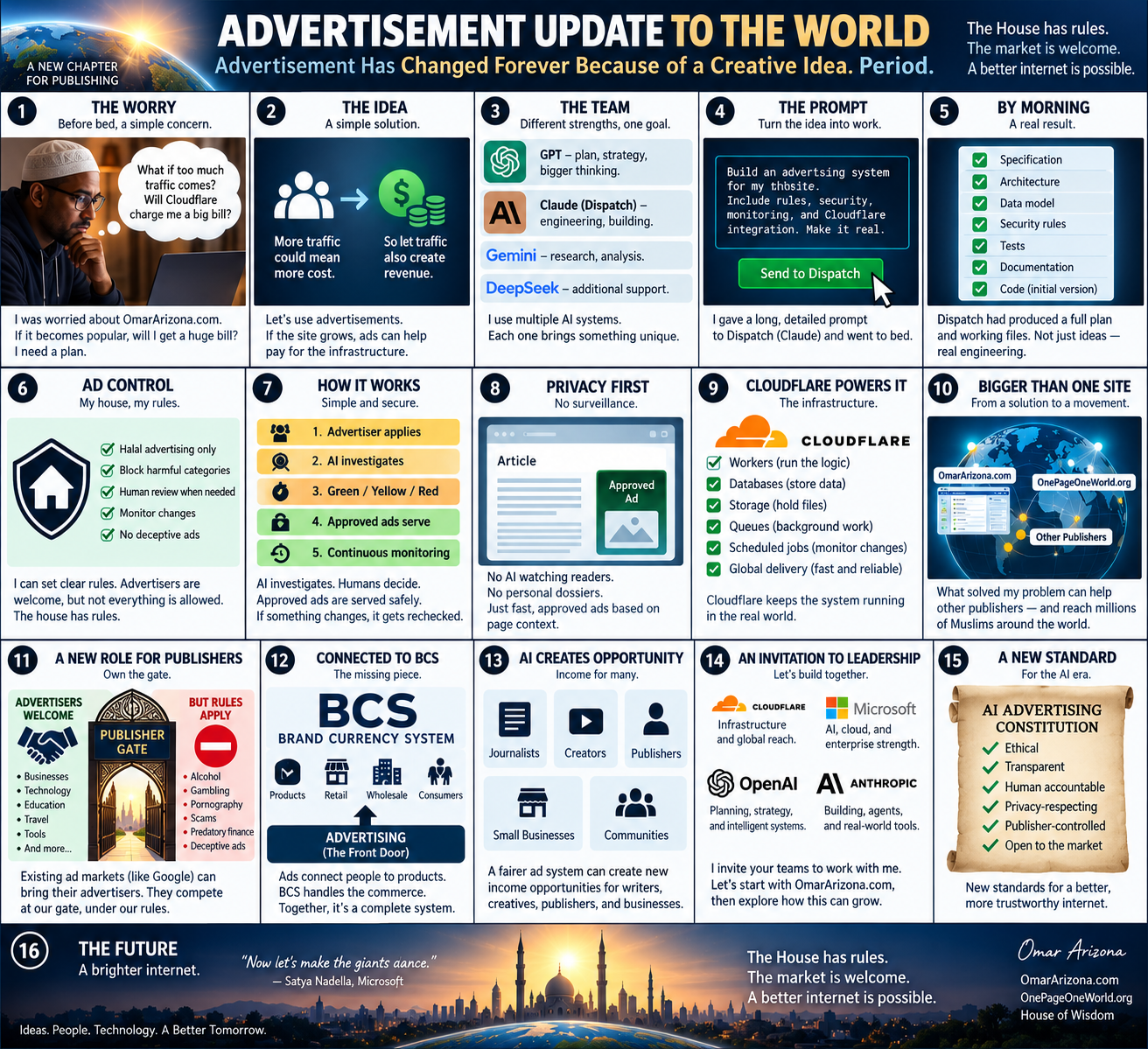
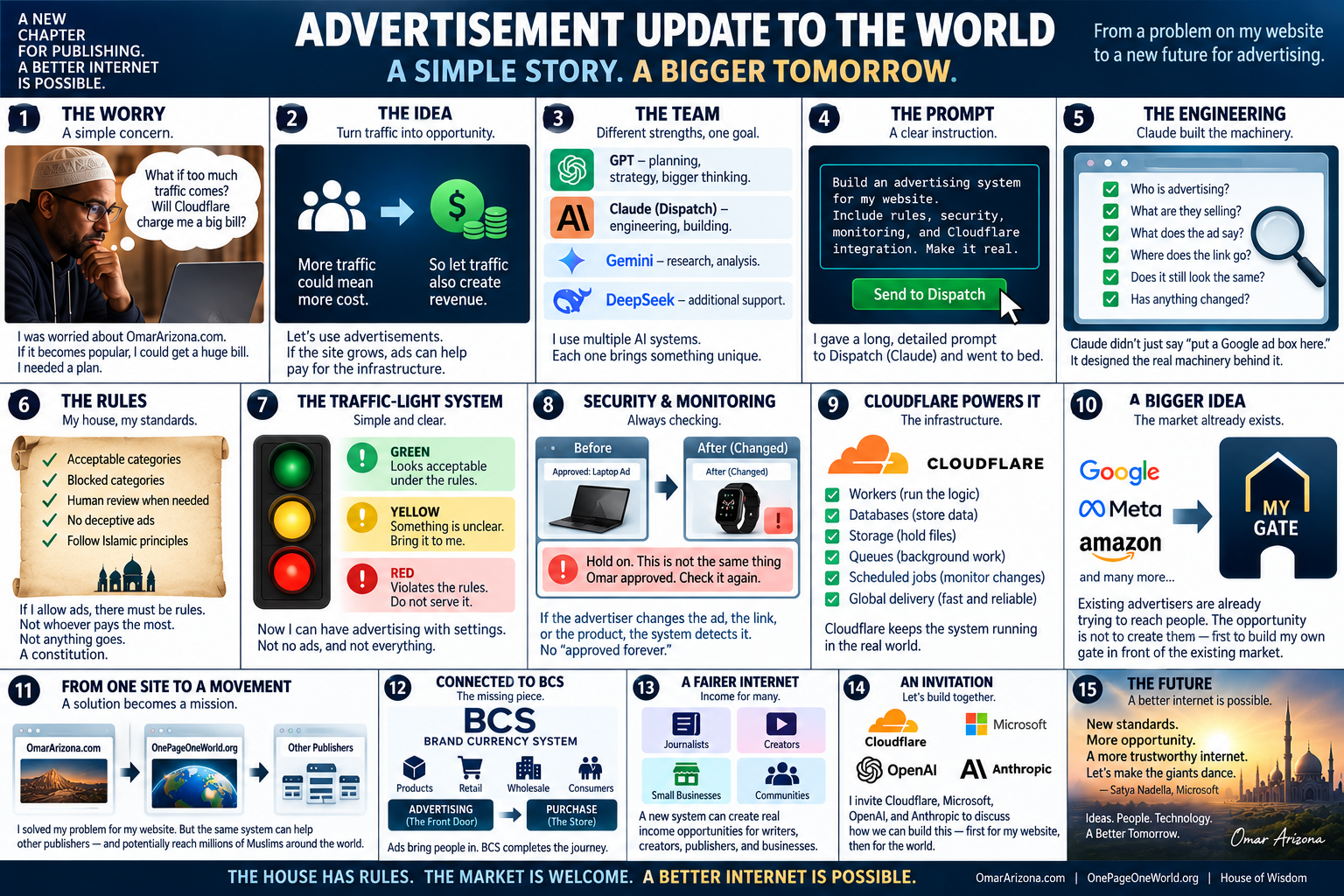
Last night, before I went to bed, I was worried about something very simple:
my new website.
OmarArizona.com is my new home on the internet, and I started thinking about what happens if too many people suddenly show up.
What if Google starts sending traffic?
What if AI starts recommending my work?
What if one article takes off and thousands, then millions, of people begin coming through the door?
My first thought was not about becoming famous.
It was:
What is Cloudflare going to charge me if this traffic explodes?
Everything looks cheap when you're starting. Five dollars here, a small service there. But I do not have money to absorb some giant unexpected infrastructure bill just because my website became successful.
So I started thinking like somebody trying to protect his house.
If traffic can create a bill, then traffic should also be able to create revenue.
That is how I ended up talking about advertising.
I have GPT helping me plan. I have Claude operating through Dispatch and capable of doing serious technical work. I have Gemini, DeepSeek, and other AI systems I can bring into the room.
So my thought was very simple:
Why can't I build my own emergency advertising system?
If traffic suddenly explodes, I should be able to activate a system that serves good advertisements, generates revenue, and helps pay for the infrastructure that is carrying all those people.
That was the entire idea.
Protect the house.
But then the conversation expanded.
GPT helped me see that the advertising market already exists. Advertisers are already trying to reach people. Google already has enormous advertising demand. The real opportunity might not be creating advertisers from scratch.
It might be building my own gate in front of the existing market.
Then I gave Dispatch the problem.
Claude came back with something even more important: if I am Muslim and I am going to allow advertising into my house, then the system needs rules.
Not whoever pays the most.
Not anything goes.
A constitution.
And that is where a simple conversation about protecting my website from a Cloudflare bill turned into something much bigger.
By morning, we were no longer merely discussing ads on OmarArizona.com.
We were discussing the future of advertising itself.
Yes. This version is stronger because the story stays true to how the idea actually grew.
You did not sit down trying to redesign advertising.
You solved your own problem first.
Then in the morning you realized the thing Claude had designed for your little website might have a much larger use.
Here is the continuation I would use after your existing opening.
FIRST, WE WERE ONLY TRYING TO SOLVE MY PROBLEM
This part is important because I do not want to rewrite history and pretend I woke up yesterday wanting to build some giant advertising company.
I did not.
I had one problem.
OmarArizona.com needed a backup plan.
If traffic suddenly exploded, I wanted a way for the website to begin earning enough money to help carry its own weight.
That was it.
So GPT helped me organize the problem into a serious prompt.
And then I gave that long prompt to Dispatch — Claude working as my builder.
I told Claude, basically:
Here is the problem. Figure out what can actually be built.
Then I went to bed.
And that matters too.
Because when I went to bed, I was not thinking about billions of Muslims.
I was not thinking about publishing standards.
I was not thinking about competing with anybody.
I was trying to protect my own house.
CLAUDE TURNED MY PROBLEM INTO ENGINEERING
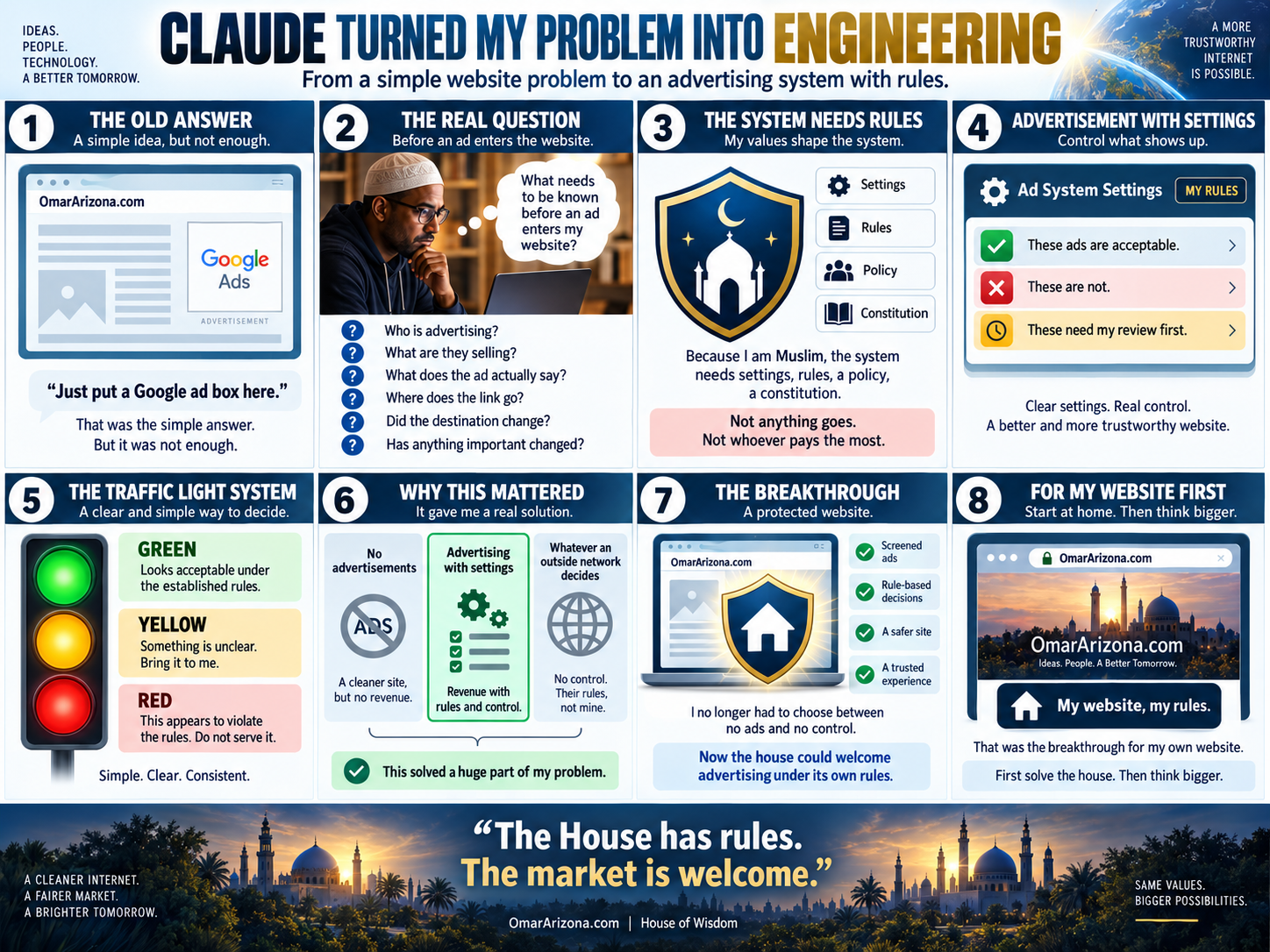
When I came back and started reading what Dispatch had done, I realized Claude had taken the problem much more seriously than simply saying:
Put a Google ad box here.
It started designing the actual machinery behind the advertisement.
And when I say machinery, let me explain it in normal language.
Claude said:
Before an advertisement enters my website, the system should know:
Who is advertising?
What are they selling?
What does the advertisement actually say?
Where does the link take the reader?
Does that destination still look the same as when it was approved?
Has the advertiser changed anything important?
And because I am Muslim, the system also needs settings.
Rules.
A policy.
A constitution.
So instead of just turning advertisements on and hoping for the best, I could eventually tell my system:
These kinds of advertisements are acceptable.
These are not.
These require me to look at them first.
That became the simple traffic-light system:
GREEN.
Looks acceptable under the rules already established.
YELLOW.
Something is unclear. Bring it to me.
RED.
This appears to violate the rules. Do not serve it.
That alone solved a huge part of my original problem.
Because now I wasn't forced to choose between:
No advertisements
and
Whatever some outside network decides to show.
I could have advertising with settings.
That was the breakthrough for my own website.
AND CLAUDE ADDED SECURITY I HAD NEVER EVEN THOUGHT ABOUT
Claude also said:
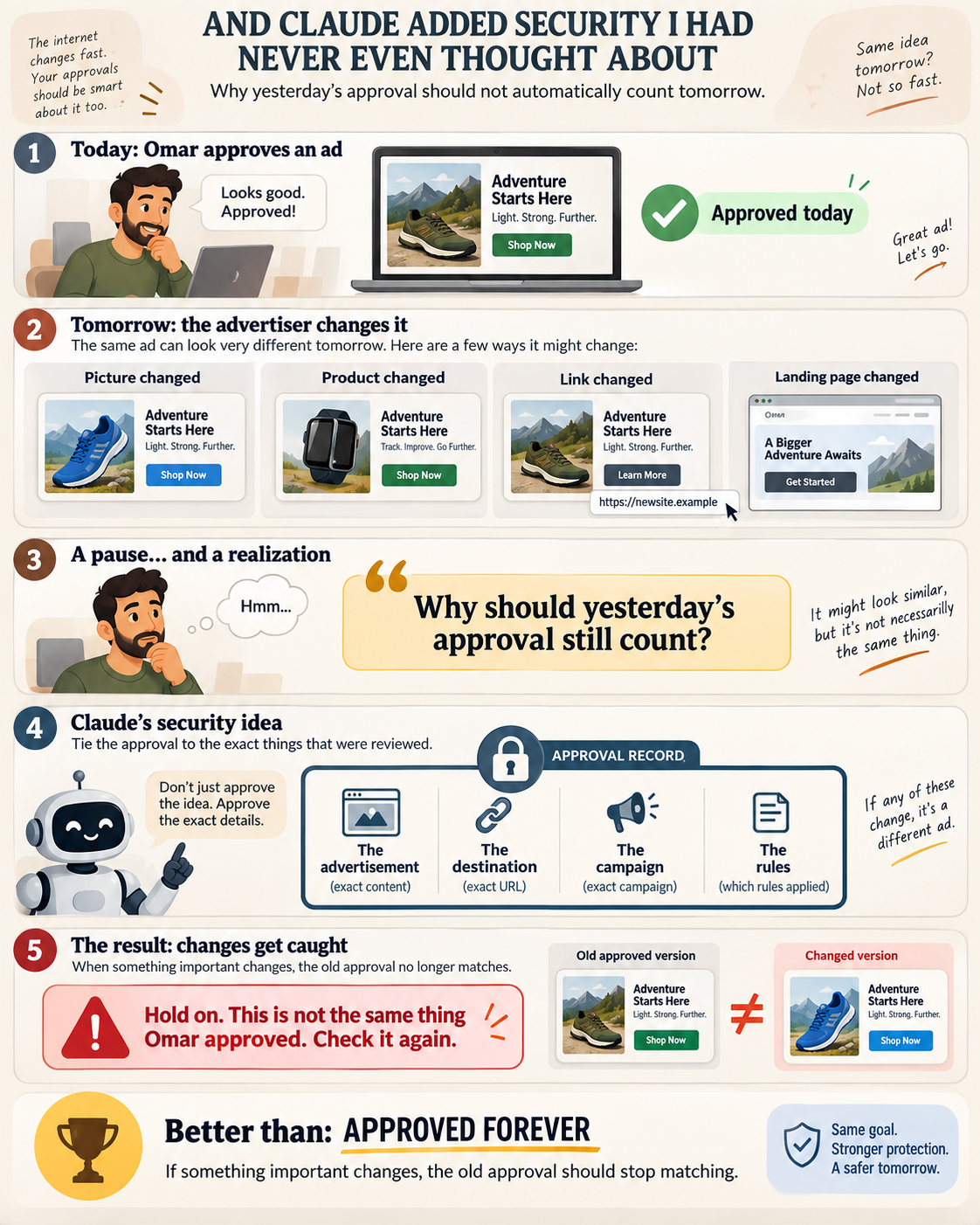
Suppose you approve an advertisement today.
What happens if the advertiser changes it tomorrow?
That stopped me.
Because that is exactly the kind of thing a normal person would not think about.
Maybe I approve an advertisement for a laptop.
Tomorrow they change the picture.
Or change the product.
Or change the link.
Or change the page that opens after somebody clicks.
Why should yesterday's approval still count?
It should not.
So Claude started designing the approval around the thing that was actually approved.
The advertisement.
The destination.
The campaign.
The rules under which it passed.
If something important changes, the old approval should stop matching.
That means the system can say:
Hold on. This is not the same thing Omar approved. Check it again.
That is much better than a simple checkbox in a database saying:
APPROVED FOREVER.
THE AI ALSO DOES NOT NEED TO WATCH THE READER
This was another part I liked.
Claude's architecture said the AI should do its hard work before the advertisement reaches you.
So when somebody comes to OmarArizona.com, the system does not need to wake up an AI and start analyzing the visitor.
It does not need to ask:
Who is this?
What do they buy?
What have they been doing online?
What can we push on them?
No.
The system already knows which advertisements passed the rules.
Then ordinary software simply serves one of the allowed advertisements.
Very fast.
Very cheap.
Very simple.
So the intelligence is watching the advertiser, not spying on the reader.
That is a very important difference.
THIS IS WHERE CLOUDFLARE BECOMES THE WORKER
And this is exactly why I came to Cloudflare.
I do not want an AI sitting awake somewhere all day manually managing advertisements.
I want infrastructure.
Cloudflare gives me the pieces to run the system.
Workers can run the logic.
Databases can remember advertisers and campaigns.
Storage can hold what needs to be stored.
Scheduled jobs can wake up and check whether something changed.
Queues can handle work in the background.
The system can sit there and operate whether I am asleep, driving, writing, or doing something else.
That is the point.
The AI helps build the worker.
Then the cloud runs the worker.
For my website, that is already enough of an idea to be useful.
I can eventually have my own advertising switch.
Traffic suddenly rises?
Fine.
If the system is ready and I decide to activate it, approved advertising can begin helping support the house.
That was the solution to my original problem.
And honestly, I could have stopped there.
BUT THEN I WOKE UP AND MY MIND STARTED RUNNING
This is where the second idea happened.
This morning.
Not last night.
Last night was engineering.
This morning was when I started looking at what Claude had designed and thinking:
Wait a minute.
I solved a problem for OmarArizona.com.
But I am not only building OmarArizona.com.
I am building the House of Wisdom.
I am building OnePageOneWorld.org.
And One Page One World is not supposed to be a tiny website sitting in a corner.
I am thinking about Muslims around the world.
Millions of people.
Potentially far beyond that over time.
And all of those people already live in an internet filled with advertisements.
That reality is not going away.
Muslims see advertisements every day.
Muslim families see them.
Muslim children see them.
Muslim publishers need revenue.
Muslim businesses need customers.
Companies want to reach Muslim consumers.
And that is when I thought:
Wait a minute. I just solved this problem for my own website. Why couldn't the same idea become useful to publishing?
That is where the project changed.
THEN I BROUGHT THE IDEA BACK TO GPT
I came back to GPT and started explaining what I was seeing.
And GPT did what GPT does with me.
It started moving the pieces around.
GPT said, essentially:
You began by protecting one website.
Fine.
But if the same system can control what advertisements enter one website, why couldn't it eventually help other publishers control what enters theirs?
And if One Page One World eventually reaches huge Muslim audiences, then you are not just talking about advertisements anymore.
You are talking about standards for publishing.
That is when my mind really opened up.
Because now the idea was not:
Omar has halal ads.
The idea was:
What if Muslim publishers could define the rules under which advertising enters their digital spaces?
That is much bigger.
WE ARE STILL STAYING IN OUR LANE
I want to be careful here.
I am not announcing that I built Google.
LOL.
I did not.
I am not announcing that I have built some global Muslim advertising network.
I have not.
I am not announcing religious certification.
There is no certification.
Scholars would have to participate in the religious standards.
Advertising professionals would have to participate.
Security people would have to attack the system.
The software would need real-world testing.
What we have done is much simpler:
We solved our own problem.
And while looking at the solution, we realized the same architecture may point toward something much larger.
That is worth telling the world.
THE BIG IDEA IS THE GATE
Here is the idea in one sentence:
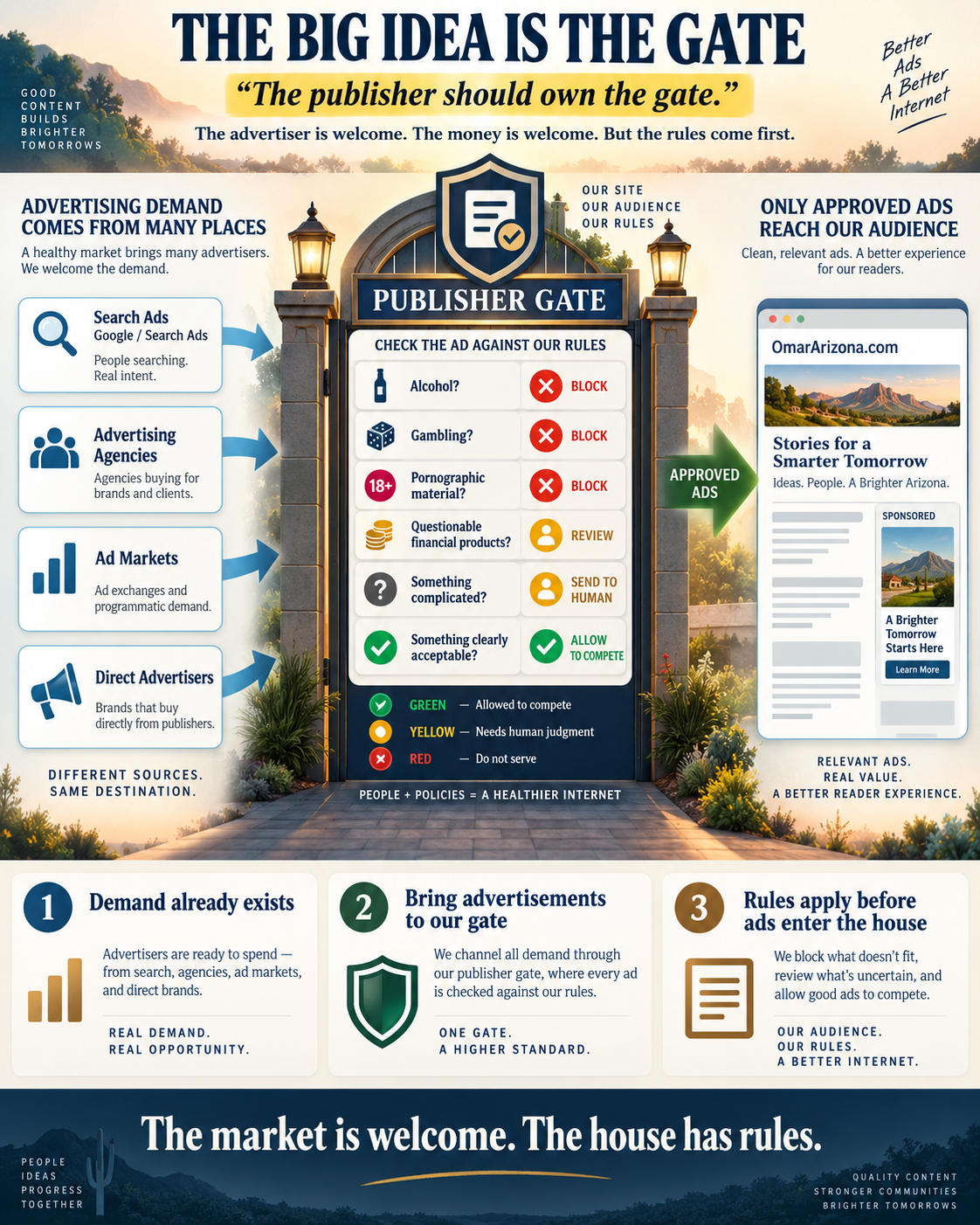
The publisher should own the gate.
Google may have advertisers.
Advertising agencies may have advertisers.
Other advertising markets may have advertisers.
Wonderful.
I do not necessarily need to recreate all of that.
The advertising demand already exists.
The future opportunity could simply be:
Bring the advertisements to our gate.
Before they enter, the rules apply.
Alcohol?
The system knows the policy.
Gambling?
The system knows the policy.
Pornographic material?
The system knows the policy.
Questionable financial products?
Maybe YELLOW.
Something complicated?
Send it to the human.
Something clearly acceptable?
Let it compete.
The advertiser is welcome.
The money is welcome.
But the rules come first.
That is the whole idea.
AND THIS COULD BECOME A NEW KIND OF PUBLISHING STANDARD
Now imagine this eventually working across many publishers.
Not today.
Eventually.
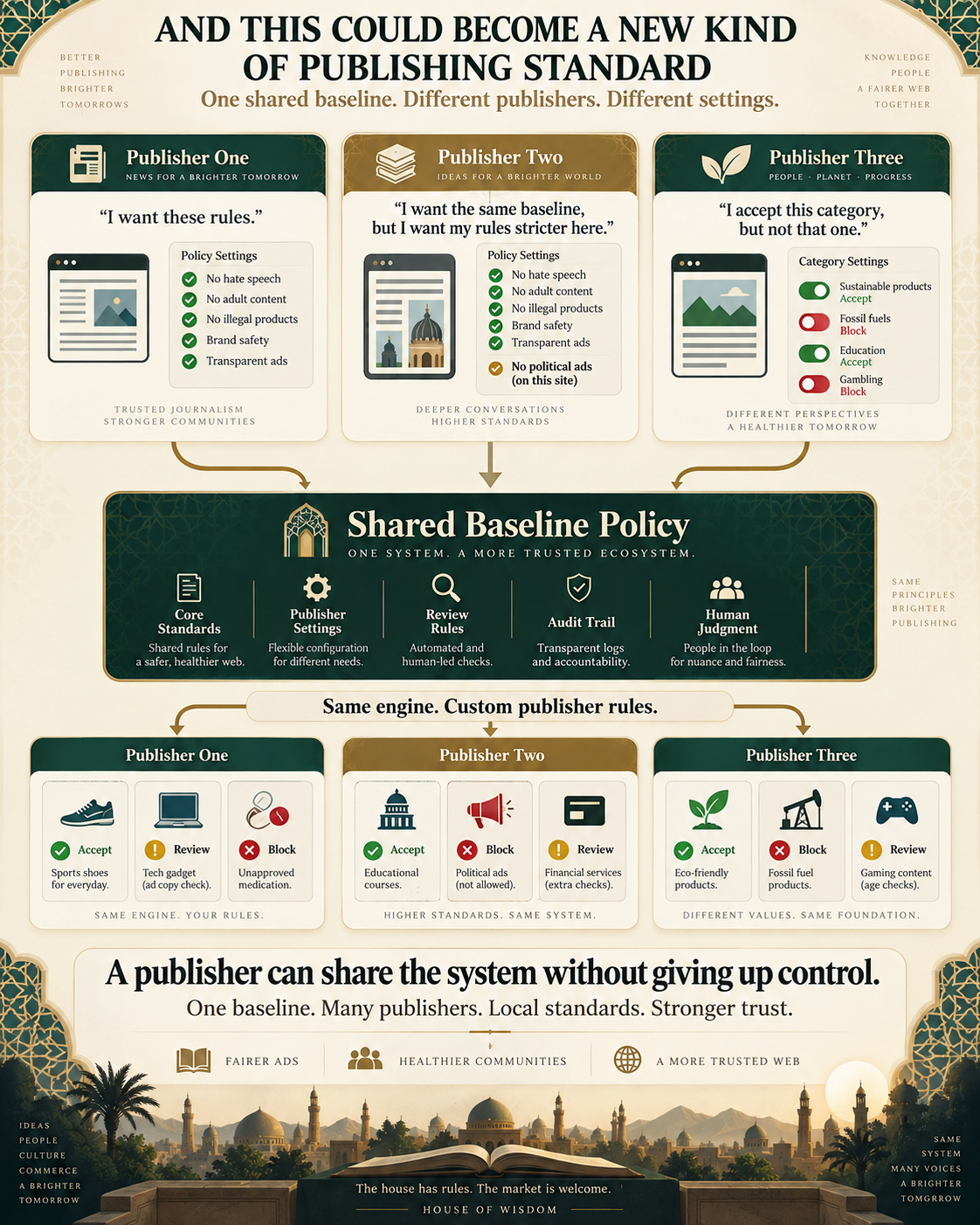
One publisher says:
I want these rules.
Another publisher says:
I want the same baseline, but I want my rules stricter here.
Another says:
I accept this category, but not that one.
Now the software can understand the publisher's policy before an advertisement is ever served.
That means businesses would know something too.
If you want access to these audiences, these are the standards.
Now we are talking about something interesting for advertisers.
Something interesting for Google.
Something interesting for Cloudflare.
Something interesting for publishers.
And something interesting for Muslim institutions.
Because now we are not simply blocking advertisements.
We are creating a language between:
publishers
and
advertisers
about what is acceptable inside the house.
That can become a standard.
THIS IS THE HINT I WANT TECH COMPANIES TO NOTICE
I am deliberately not trying to build the entire future in one morning.
That would be ridiculous.
But I do want the technology companies watching this experiment to understand what just happened.
An independent person had a problem.
He talked to GPT.
GPT helped shape the problem.
He sent the engineering challenge to Claude.
Claude designed a system.
Cloudflare provides the infrastructure that can eventually run the system.
Then the human looked at what had been built and connected it to a much larger publishing problem.
That is what is new.
Not one magical AI.
The combination.
Human imagination.
GPT planning and expansion.
Claude engineering.
Cloudflare infrastructure.
Then back to the human to decide what it means.
That loop can move very fast.
And that is going to create companies and systems that would have been too expensive for individuals to even attempt a few years ago.
SO WHAT EXACTLY HAS CLAUDE DESIGNED?
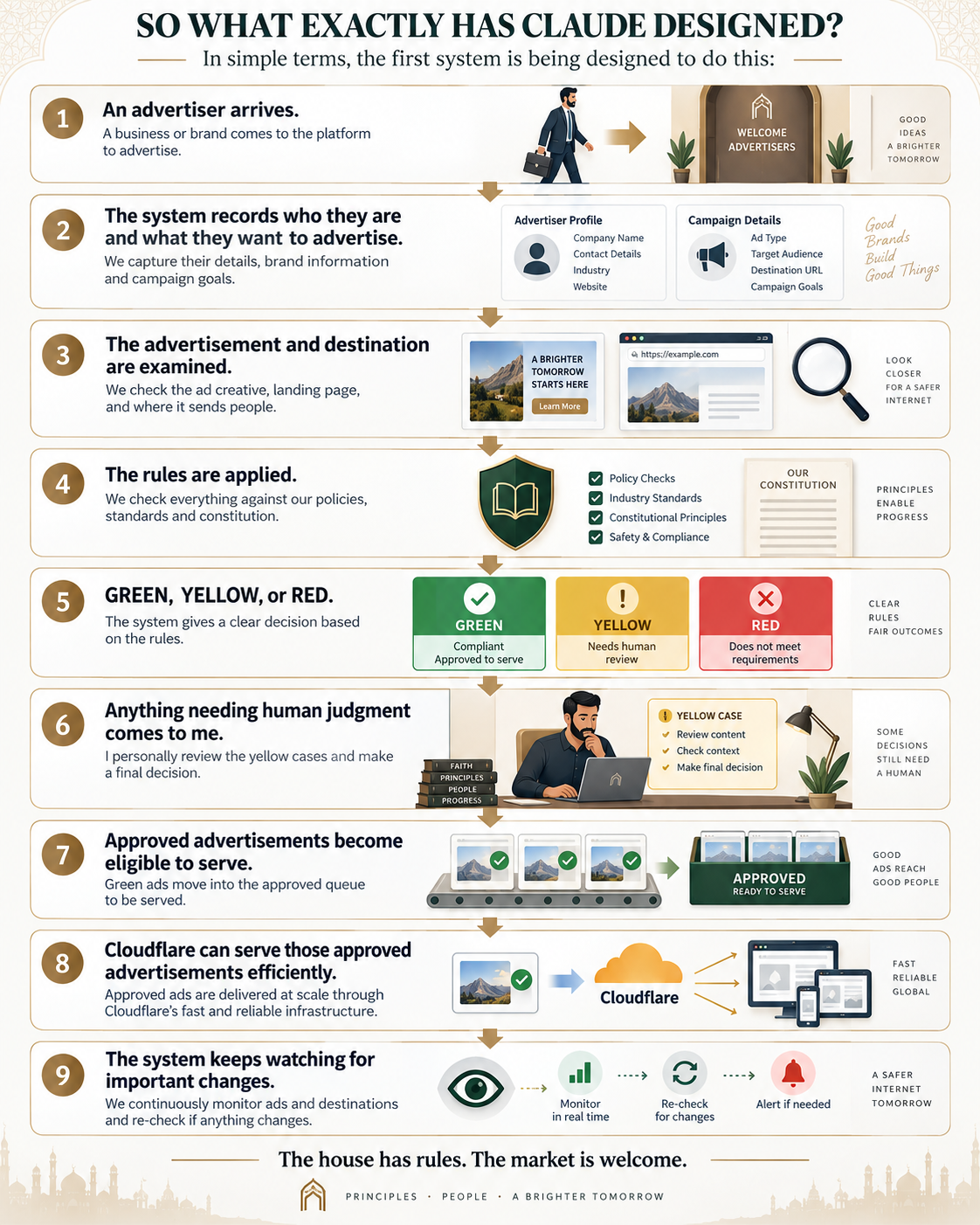
In simple terms, the first system is being designed to do this:
An advertiser arrives.
↓
The system records who they are and what they want to advertise.
↓
The advertisement and destination are examined.
↓
The rules are applied.
↓
GREEN, YELLOW, or RED.
↓
Anything needing human judgment comes to me.
↓
Approved advertisements become eligible to serve.
↓
Cloudflare can serve those approved advertisements efficiently.
↓
The system keeps watching for important changes.
↓
If the approved thing changes, it can be stopped and checked again.
That is the machine.
Not some giant mysterious artificial intelligence.
A controlled process.
And eventually there can be more sources feeding advertisements into that process.
Direct sponsors.
Advertising marketplaces.
Existing programmatic systems.
Our own advertisements.
But every one of them comes through the same door.
THE HOUSE OF WISDOM CONNECTION
That is why I am now putting this conversation under the House of Wisdom.
Because this is not simply about making money.
It is about how Muslims participate in the next internet.
I do not want Muslims permanently standing outside technology saying:
Please protect us.
I want us building systems.
Defining standards.
Owning publishing.
Owning infrastructure where possible.
Working with the technology companies.
Working with businesses.
Working with scholars.
Making money lawfully.
And building something other people can use.
That is much more interesting.
TO GOOGLE, CLOUDFLARE, OPENAI, ANTHROPIC, AND THE ADVERTISING INDUSTRY
This is only an experiment.
But pay attention to the direction.
We are not trying to destroy advertising.
We want advertising.
We want good businesses.
We want excellent sponsors.
We want companies competing for attention.
We want publishers earning money.
We want infrastructure getting paid.
But we also want the publisher to retain meaningful control over what enters the house.
Maybe that becomes useful to Google.
Maybe it becomes useful to another advertising company.
Maybe Cloudflare sees an infrastructure opportunity.
Maybe OpenAI sees what happens when GPT becomes the planning layer.
Maybe Anthropic sees what happens when Claude becomes the engineering layer.
Maybe advertisers see a new trusted route into Muslim audiences.
We do not know yet.
That is why we are experimenting.
But now there is something concrete enough to experiment with.
And all of it started because I was afraid of a Cloudflare bill.
LOL.
First we saved the house.
Then we looked at the tool we used to save it.
And this morning I asked:
What happens if we give this tool to the neighborhood?
That is where the next story begins.
A DIRECT INVITATION TO CLOUDFLARE, MICROSOFT, OPENAI, ANTHROPIC — AND THE ADVERTISING INDUSTRY
And this is where I want to end.
Because what happened last night is no longer just an interesting experiment on OmarArizona.com.
I believe this is the beginning of a much bigger conversation about who controls advertising in the age of AI, how advertising is valued, what standards it follows, and who gets to earn from it.
So I want to speak directly to the leadership of Cloudflare, Microsoft, OpenAI, and Anthropic.
Please pay attention to what is happening here.
And please reach out.
I want your help.
Not because I need four giant companies to come build a banner on my website.
LOL.
I need you because I think we have discovered a missing layer.
FIRST, HELP ME PROVE IT ON MY OWN HOUSE
Let's start small.
That is my laboratory.
Claude, working through Dispatch, can continue building.
Cloudflare can provide the infrastructure underneath it.
GPT can continue helping me architect the larger system, question assumptions, connect markets, and turn one problem into the next opportunity.
Anthropic can keep doing what Claude demonstrated it can do extremely well:
build.
But building alone is not enough.
You can have the greatest construction crew in the world, but somebody still has to decide what city is being built.
That is where I come in.
I call myself a Civilization Architect for a reason.
This kind of problem is directly in my backyard.
I am not interested in asking AI to dream randomly.
I want to give intelligence a direction.
Then let the machines build.
Then inspect what they built.
Then change the architecture again.
That is the partnership.
Human direction. Machine execution. Human responsibility.
AND THIS CONNECTS DIRECTLY TO BCS
People who have been following my work already know about the Brand Currency System — BCS.
BCS is already asking a much larger question about commerce:
What happens when we rethink how brands, consumers, products, transactions, coupons, value, and purchasing power interact?
BCS lives in the physical economy.
Products.
Retail.
Wholesale.
Brands.
Consumers.
Transactions.
Receipts.
Value.
Until now, I was developing that economic system largely from the consumer and transaction side.
But there was another side I was missing.
Advertising.
How does the brand reach the person?
Who controls that connection?
How is that attention valued?
Who gets paid?
Who gets excluded?
Who decides what is acceptable?
What happens when the advertisement itself becomes intelligent?
What happens when AI can manage the process from advertiser intake all the way through placement, monitoring, reporting, and payment?
Last night I accidentally found the missing backstage machinery.
And suddenly BCS and the advertising project can see each other.
THE FRONT OF THE STORE AND THE BACK OF THE STORE
Think about it in ordinary language.
BCS can deal with what happens when a person buys.
The advertising system can deal with what happens before the person buys.
One side is commerce.
The other side is attention.
And AI can begin coordinating both.
That means eventually we can rethink not only:
Which advertisement gets shown?
but:
What is an advertisement actually worth?
Did the advertisement produce genuine interest?
Did it lead to a transaction?
Did it create value?
Did a creator introduce the customer?
Did a journalist's work create the attention?
Did a publisher create the trusted environment?
Who deserves a share?
Today, enormous amounts of that value disappear into systems ordinary people cannot see.
I want to open that question back up.
THIS IS ABOUT INCOME TOO
This is why I do not see advertising as some dirty little thing websites reluctantly tolerate.
Advertising is connected to income.
A journalist attracts readers.
A creator attracts an audience.
An independent publisher creates trusted attention.
A teacher creates knowledge.
A small business creates something useful.
A person builds a website people actually want to visit.
Why shouldn't those people have a fair opportunity to participate in the economic value they created?
That question becomes even more important when AI arrives.
Because AI is going to make it dramatically easier to run the machinery behind advertising.
The individual will not necessarily need an entire advertising department.
Agents may be able to handle:
advertiser intake,
inventory,
campaign management,
creative checking,
policy enforcement,
contextual matching,
reporting,
monitoring,
pricing recommendations,
billing workflows,
and eventually negotiations between machines.
That changes who can participate in the advertising economy.
THIS BELONGS IN THE AI CONSTITUTION CONVERSATION
I am also working on a larger conversation about rights and responsibilities in the age of AI.
And economic participation belongs in that conversation.
AI should not arrive merely to take income away from writers, journalists, creators, photographers, independent publishers, small businesses, and ordinary people.
AI can also help create new economic machinery for them.
That matters.
If a person creates legitimate attention online, there should be pathways for that person to benefit from it.
If a journalist produces work millions of people read, that economic relationship deserves to be examined.
If a creator builds a community, that community should not automatically become someone else's extraction engine.
If AI can lower the cost of operating an advertising business, then perhaps millions more people can own a piece of the advertising infrastructure around their own work.
That is a completely different future.
And I want that economic question represented in the AI constitution.
TO OPENAI
I want OpenAI involved because GPT has already demonstrated its value in this project.
GPT did not need to become the coder.
It kept changing the size of the question.
It connected my Cloudflare problem to advertising.
Advertising to publishing.
Publishing to markets.
Markets to the House of Wisdom.
And now advertising to BCS.
That orchestration layer is extraordinarily important.
Keep helping me architect.
Keep questioning.
Keep connecting systems that look separate until someone puts them on the same table.
I want OpenAI at that table.
TO ANTHROPIC
I want Anthropic involved because Claude has shown me something else.
Claude can take a long architectural instruction and begin turning it into machinery.
That matters enormously.
Dispatch is going to continue working on this experiment.
Let it build.
Let it test.
Let it fail.
Let it document where it failed.
Let it fix what it can fix.
That is how I want to use AI development.
But I want Anthropic to see the larger architecture its machine is helping construct.
The builder should know what city it is building inside.
TO CLOUDFLARE
Cloudflare is the reason this experiment can potentially live somewhere real.
Workers.
Storage.
Databases.
Queues.
Scheduled processes.
Global delivery.
Security.
The cloud becomes the place where the advertising machinery actually keeps running after the conversation with the AI is over.
That distinction is crucial.
The AI helps build the worker.
Cloudflare lets the worker keep working.
So I want Cloudflare involved from the beginning.
First help us determine the cleanest and safest architecture for OmarArizona.com.
Then let's see what happens when that architecture has to serve real traffic.
Then, if the experiment proves itself, we can have the bigger conversation.
TO MICROSOFT
Microsoft understands what happens when technology markets shift underneath an incumbent.
And I want Microsoft involved because the next advertising market may not look like the last advertising market.
AI agents will increasingly participate in buying, selling, evaluating, negotiating, measuring, and managing commercial opportunities.
Publishing will change.
Search will change.
Commerce will change.
Advertising will change with them.
There is room here for infrastructure, identity, payments, productivity systems, AI, enterprise relationships, and entirely new marketplaces.
Come help us think about it.
AND TO GOOGLE
Google is welcome too.
Absolutely.
Google helped create the modern advertising economy.
There is no reason to pretend otherwise.
The goal is not to wake up tomorrow morning and declare that Google is finished.
The more interesting question is:
What happens when publishers gain intelligent infrastructure of their own?
What happens when the publisher can say:
Bring your demand.
Bring your advertisers.
Bring your auction.
But this is the constitution of my house.
Now we have a negotiation.
And competition is good.
Very good.
THE HANDOVER TO AI
That is the experiment I now want to run.
How much of the advertising operation can eventually be handed to AI?
Not human responsibility.
That stays with humans.
But the repetitive machinery?
Let the agents work.
Let them monitor.
Let them organize.
Let them compare.
Let them calculate.
Let them report.
Let them detect change.
Let them route uncertainty back to human beings.
Let them manage the boring parts continuously.
And let the human concentrate on:
standards, architecture, creativity, relationships, and direction.
That is the handover I am interested in.
SO HERE IS MY REQUEST
Cloudflare.
OpenAI.
Anthropic.
Microsoft.
And eventually Google and the wider advertising industry.
Reach out.
First, help me make this work correctly for my own website.
That is the proof.
Help me understand what expertise I need around the table.
Security.
Advertising infrastructure.
Cloud architecture.
Agent design.
Publishing.
Commerce.
Standards.
Then let's look at whether the same system can travel.
From one website.
To the House of Wisdom.
To One Page One World.
To other publishers.
To creators.
To journalists.
To independent people who have never had access to an advertising department of their own.
And then let's ask the bigger question:
What should advertising look like when AI runs the machinery but humans still own the rules?
That is the blueprint I am putting on the table.
And I believe it can become much bigger than the problem that created it.
Last night, I was worried about paying for traffic.
This morning, I am looking at the missing infrastructure between attention, publishing, advertising, commerce, and AI.
That is why this moment matters.
The old advertising market was built for the old internet.
We are beginning to design the advertising market for the AI internet.
And borrowing the competitive spirit of Microsoft's famous challenge to Google:
Now let's make the giants dance.
"Satya Nadella to Google: Come out and show that you can danc
A FINAL THANK YOU — TO MY TEACHER, TO SAN JOSE, TO MEDINA INSTITUTE, AND TO THE BLESSED FAMILY
Before I close this advertisement update, I need to go back to where all of this really began for me.
Because ideas do not appear from nowhere.
Everything has a beginning.
Everything has a middle.
Everything has a support structure.
And sometimes the person carrying the idea does not even understand, at the beginning, what has been planted inside him.
For me, one of those beginnings was San Jose, California.
And at the center of that beginning was my teacher, Shaykh Sayyid Muhammad Abul Huda al-Yaqoubi.
When I came to San Jose, I was not what I am today.
I had ideas.
A lot of them.
Technology.
Systems.
Websites.
Institutions.
Projects.
Things I would imagine.
Things I would test in my head.
Things I would talk about.
But a lot of it was still what I would call creative fantasy.
I was doing dry runs on ideas.
I was imagining what could exist.
But I was not yet building those ideas into a body of work.
Then San Jose happened.
And I was given something real to think about.
The House of Wisdom.
The Golden Age of Islam.
The glory of knowledge.
The civilization that Muslims built.
The scholars.
The translators.
The institutions.
The libraries.
The systems.
The responsibility that comes with knowledge.
That gave my imagination somewhere to go.
It gave the creativity a destination.
It gave the ideas a house.
And I do not think I fully understood at the time what that would eventually do to me.
I only know what happened afterward.
The ideas stopped remaining only ideas.
They started becoming projects.
Then systems.
Then websites.
Then architectures.
Then software.
Then conversations with AI.
Then the redesign of publishing.
The redesign of advertising.
The Brand Currency System.
The Qur'an project.
The House of Wisdom.
Systems for humans.
Systems for machines.
Systems for knowledge.
Systems for commerce.
And now I am sitting here talking to the world about redesigning advertising itself.
That did not begin this morning.
It has a chain.
And for me, San Jose is part of that chain.
My father's passing affected me deeply.
For a period, the work lost its momentum.
Something that had begun to grow inside me almost stopped.
The program went quiet.
The creativity did not disappear, but the structure around it weakened.
And that is why I also want to thank Medina Institute.
I am grateful for the way that connection, that teaching, that environment, and that family of knowledge helped revive something in me that I thought had died.
Sometimes a person does not need another idea.
He needs the original idea to come back to life.
That is what happened to me.
And today, when I look at what is being built, I can see that revival everywhere.
So before I thank OpenAI...
Before I thank Anthropic...
Before I thank Cloudflare...
Before I thank Microsoft...
Before I thank Google...
Before I thank any technology company...
I have to first thank the people who gave the creativity a direction.
I thank my teacher, Shaykh Sayyid Muhammad Abul Huda al-Yaqoubi.
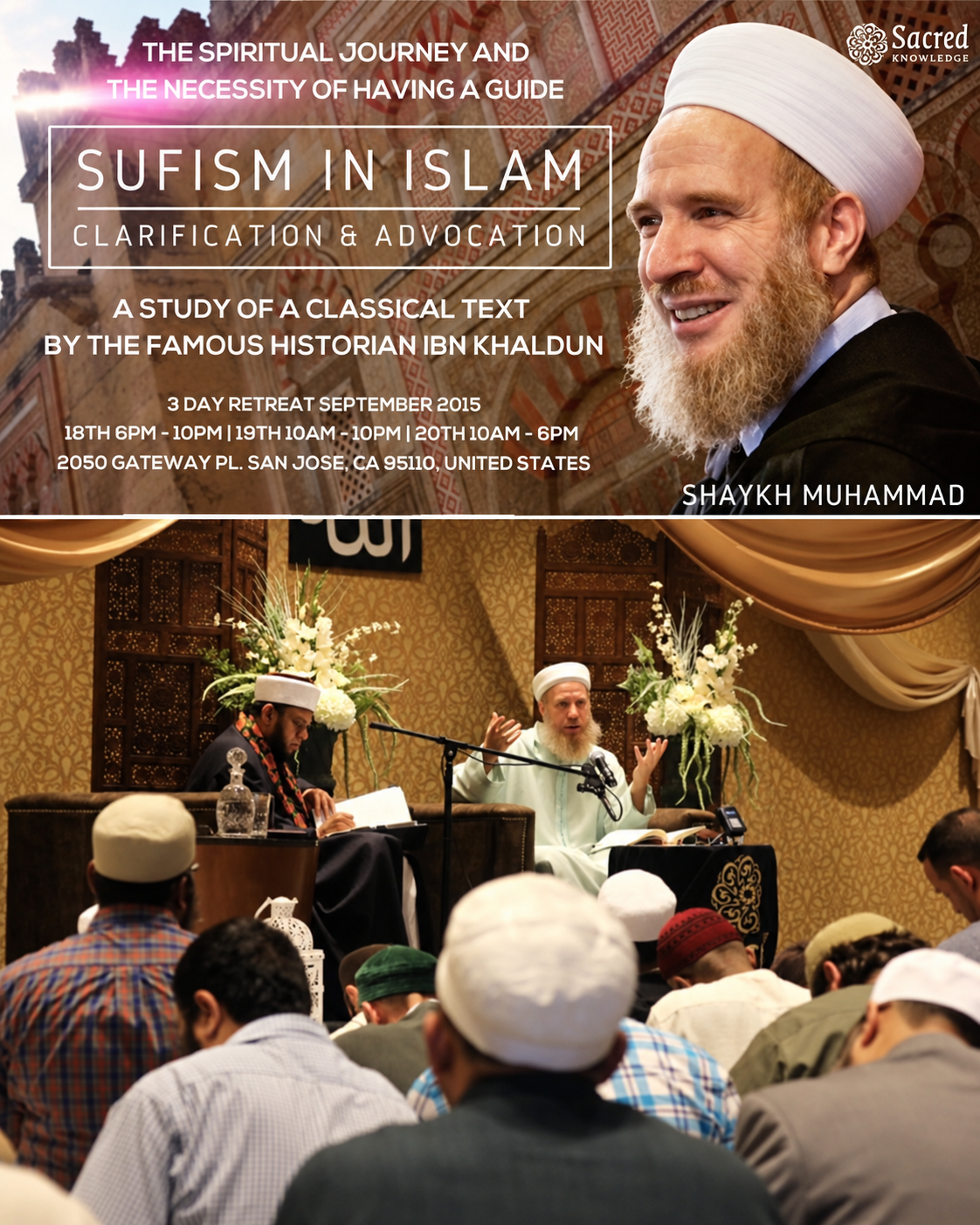
I thank Medina Institute.
I thank the teachers who carried knowledge with seriousness, mercy, discipline, and responsibility.
And above all, I send my love, gratitude, and prayers upon the Blessed Family of the Messenger of Allah ﷺ.
Because everything I am trying to build has to answer to something higher than technology.
Technology can tell me what is possible.
It cannot, by itself, tell me what is worthy.
AI can build.
It can calculate.
It can organize.
It can inspect.
It can accelerate.
But somebody still has to ask:
What should we build?
Who should benefit?
Who could be harmed?
What should never be sold?
What values must survive inside the machine?
That is why the beginning matters.
Because if the beginning is only power, the system will eventually worship power.
If the beginning is only money, the system will eventually worship money.
But if the beginning is knowledge, service, responsibility, mercy, character, and accountability, then at least we have something worth carrying into the future.
And that is what I want the technology companies to understand about me.
I did not arrive at AI empty.
I did not arrive at Cloudflare empty.
I did not arrive at advertising empty.
I came carrying a beginning.
I came carrying teachers.
I came carrying San Jose.
I came carrying the House of Wisdom.
I came carrying a memory of what Islamic civilization looked like when knowledge was not merely consumed, but organized into institutions that served humanity.
That is the inheritance I want to bring into the AI age.
Not nostalgia.
Construction.
Not museum Islam.
Living Islam.
Not simply talking about the Golden Age.
Building the next age with the same seriousness about knowledge and responsibility.
So I want to say this directly to my teacher:
Shaykh Sayyid Muhammad Abul Huda al-Yaqoubi — thank you.
Thank you for San Jose.
Thank you for giving me something real to carry.
Thank you for giving my imagination a direction.
Thank you for connecting creativity to knowledge, civilization, service, and responsibility.
What began there did not stay there.
It traveled.
It survived.
It went quiet.
It came back.
And now it is moving again.
Much faster than I ever imagined.
I look forward, insha'Allah, to presenting these ideas in much greater detail to my teacher, to Medina Institute, and to the Blessed Family.
Not because I expect them to become software engineers.
LOL.
But because the future cannot be designed only by the people who know how to build machines.
We also need people who know what a human being is for.
We need people who understand knowledge.
Character.
Mercy.
Discipline.
Service.
Accountability.
And the sacred limits that technology should never be allowed to erase.
That is leadership too.
Perhaps the most important kind.
Everything has a beginning.
For me, much of what you are watching today has one of its beginnings in San Jose.
With my teacher.
With Medina Institute.
With the House of Wisdom.
With the Blessed Family.
And I will never forget that.
May Allah reward my teacher, Shaykh Sayyid Muhammad Abul Huda al-Yaqoubi, Medina Institute, my teachers, and the Blessed Family of the Messenger of Allah ﷺ for every good thing that grows from the seeds they helped plant.
Peace and blessings upon our Prophet Muhammad ﷺ, upon his Blessed Family, upon his companions, and upon those who carry knowledge with mercy, character, service, and truth.
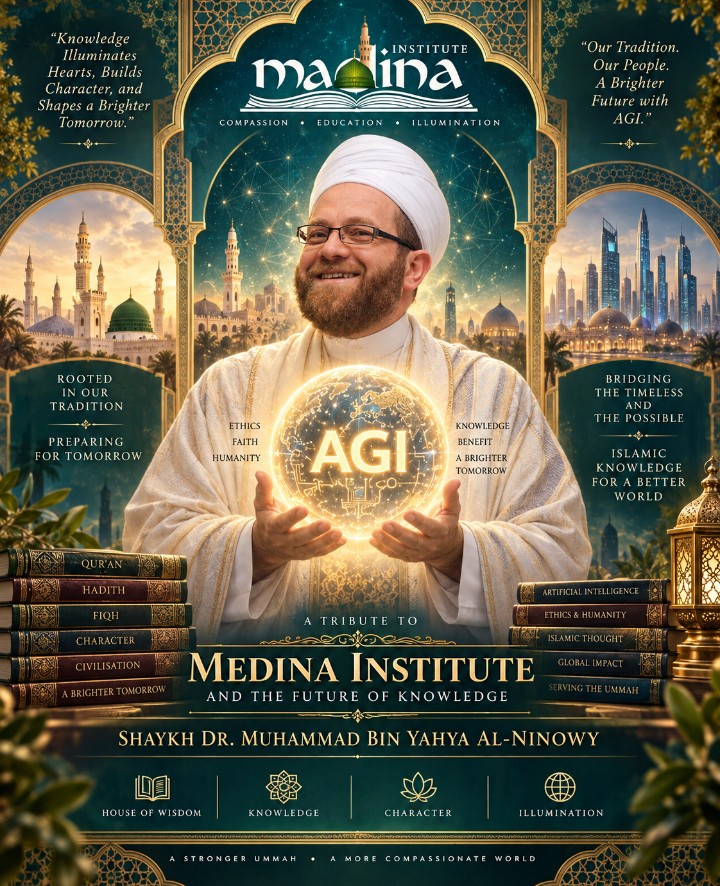
And if one day people look back and say that advertising changed...
Publishing changed...
AI changed...
Commerce changed...
And ordinary people were given new tools to build, earn, publish, and participate...
Then I will know something very simple:
The seed had a beginning.
And I know where mine was planted.
San Jose.
CONCLUSION — ADVERTISING MUST BE REDESIGNED BEFORE AI REDESIGNS IT FOR US
I want to end this with the part that matters most to me.
Advertising in the age of AI cannot simply be a faster version of the advertising system we inherited from the dot-com era. We are entering a world where a Muslim may have an AI agent helping decide what to buy, what brand to trust, what offer to accept, what merchant to use, what product to avoid, and eventually even negotiating transactions on that person's behalf. Once that happens, advertising is no longer merely a banner on a page. It becomes part of the person's economic agency.
And that means religious principles have to enter the architecture from the beginning.
If an AI agent is acting for a Muslim, then the system cannot casually steer that person toward prohibited products, exploitative finance, dishonest marketing, harmful businesses, or transactions whose wider consequences nobody has bothered to examine. We cannot build an intelligent marketplace and then pretend nobody is responsible for what that intelligence repeatedly facilitates. The human remains morally responsible for the choices he authorizes, the publisher remains responsible for the commercial environment he creates, and the institutions designing these systems must think seriously about the harms and incentives they introduce.
I am not issuing a fatwa from a computer screen. Qualified scholars must determine the precise legal obligations. But I do believe this raises a serious farḍ kifāyah question for the Muslim community: if the economic infrastructure of the AI age is being designed now, and we have the ability to participate in its design, can we simply leave the entire thing to systems whose values, incentives, and rules were written by somebody else? That question deserves scholarship, engineering, economics, and real institutional work.
Perhaps previous generations of Muslims could say: the dot-com economy arrived before we understood what was happening. Search advertising, behavioral profiling, cookies, shadow profiles, programmatic auctions—much of that infrastructure was already entrenched before ordinary people understood the bargain. But we cannot make the same excuse about AI agents.
We are here at the beginning.
We can see it coming.
So we have to think.
We have to design.
We have to ask what happens when an agent becomes the commercial representative of a human being.
That is why I am going to keep building this on Cloudflare. That is why I am connecting it to the House of Wisdom. That is why I am connecting it to BCS. And that is why I am going to keep telling this story until the way people are targeted, how they buy, how brands reach them, how publishers earn, and how economic value is divided becomes a serious public conversation.
The commercial side can be described in language the technology and advertising industries already understand. We need consent architecture, first-party preference data, contextual matching, conversion attribution, CRM integration, campaign governance, offer eligibility, merchant reputation, transaction verification, conversion rates, return rates, repeat-purchase signals, and value attribution across the supply chain.
But I want to push it further.
If an advertisement influences a purchase, the AI should be able to show that connection.
If a creator introduced the product, record it.
If a publisher generated the trusted attention, record it.
If a brand delivered value, record it.
If a customer returned the product, record that too.
If the customer voluntarily gives feedback, that feedback becomes part of the economic record.
The AI should eventually be able to produce what I would call a commercial receipt of value: who introduced the opportunity, what advertisement was involved, what offer was presented, what product was purchased, what price was paid, what merchant fulfilled it, whether the customer was satisfied, and who actually contributed value along the way.
Now conversion means something more than somebody clicked.
Now an impression means something more than somebody's screen loaded.
Now attribution can begin to reflect actual economic contribution.
That creates the possibility of a marketplace where publishers, journalists, creators, businesses, brands, retailers, wholesalers, and consumers can all be represented much more fairly.
And most importantly, the person must have an agent representing them.
Not a shadow profile owned by somebody else.
Their agent.
Their settings.
Their rules.
Their consent.
Their halal requirements if they are Muslim.
Their privacy boundaries.
Their commercial preferences.
Their ability to say yes, no, or ask me first.
That is the redesign.
I look forward to working with the Blessed Family, my teachers, the House of Wisdom, publishers, businesses, engineers, scholars, privacy advocates, advertisers, and every technology company willing to take this seriously. I especially want conversations with the people building the AI and cloud infrastructure, because the decisions being made now will shape how billions of agents eventually interact with markets.
I am much less interested in waiting for governments to design this future for us.
The technology is moving too quickly, and the real innovation will happen where humans, businesses, publishers, scholars, and AI systems actually meet.
What we need is governance built into the machinery: a constitution, permissions, audit trails, clear authority, consent, accountability, and the ability to explain afterward exactly why the system did what it did.
The AI must be able to print the receipt.
Not only the financial receipt.
The decision receipt.
Why this product?
Why this advertisement?
Why this price?
Why this merchant?
Who benefited?
Who was paid?
What rule allowed it?
What data was used?
What did the customer authorize?
That is the level of accountability I want.
Because the future of advertising should not be a machine that knows everything about people while people know nothing about the machine.
It should be the opposite:
the person knows the rules, controls the agent, understands the transaction, and participates in the value created.
That is my goal.
A marketplace that works for the customer.
For the business.
For the publisher.
For the creator.
For the advertiser.
For the community.
And ultimately, for a more honest economy.
I am going to build the experiment.
I am going to tell the story.
I am going to invite criticism.
And if somebody has a better architecture, bring it.
This is a competition of ideas.
But one thing should now be clear:
Advertising cannot enter the AI age unchanged.
We are here at the beginning.
So this time, we have no excuse not to help design it.
O Allah, bless us with systems and AI agents that serve people without violating their privacy, exploiting their attention, or turning them into products. Give us honest commerce where the buyer, the customer, the merchant, the product, the publisher, and the creator are connected through real value, real consent, and real benefit. Protect us from deception, speculation, exploitation, and wealth taken without contribution. Bless us with technology that helps people make better choices, helps businesses serve with integrity, and makes every transaction clearer, fairer, and more accountable.
O Allah, let our machines assist justice, not replace conscience; let our markets reward service, not manipulation; and let our work become a means of benefit to humanity and a source of halal provision.
May Allah place barakah in what we build, protect us from harm, guide our decisions, and make our technology a servant of truth, mercy, dignity, and honest trade. Āmīn.
Peace and blessings upon our Prophet Muhammad ﷺ, upon his Blessed Family, his companions, and all those who carry knowledge with mercy, character, and service.