

بِسْمِ اللهِ الرَّحْمٰنِ الرَّحِيْم
In the Name of God, Most Gracious, Most Merciful
♥️🤲🕋♥️🕋🌹🌹🥀🤲🌹🕋♥️🤲
A Shared Architecture for the Human Age of AI
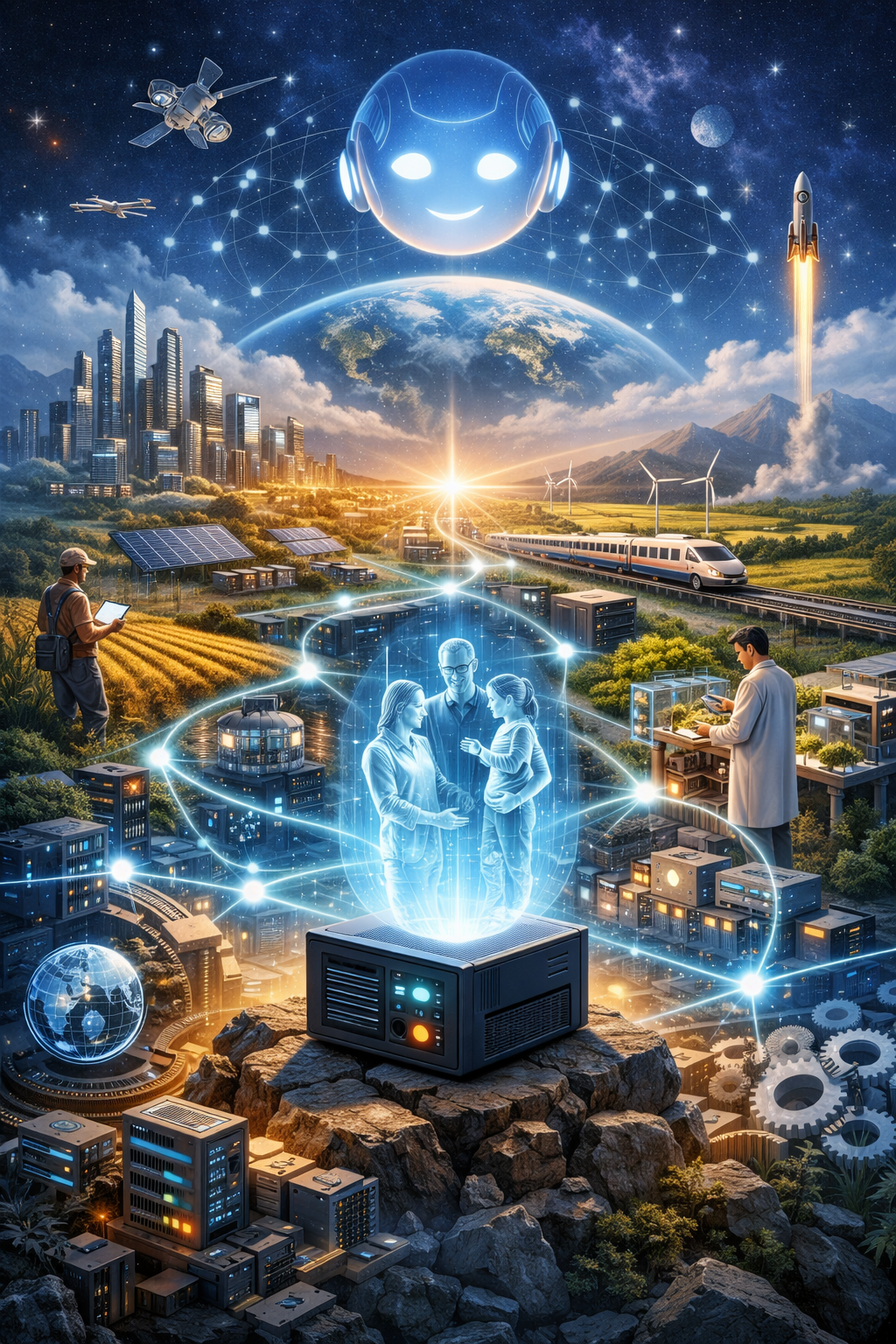
From the moment a human being is born to the moment they die, their life generates meaning: memories, relationships, work, ideas, contributions, and history. Today, that meaning is scattered across systems that do not belong to the person who created it. Email here. Photos there. Money elsewhere. Identity fragmented. Memory unowned.
This was not a moral failure.
It was a technical one.
Humanity centralized digital life because it had no other option. Maintaining infrastructure was too complex, too fragile, and too expensive for individuals or governments to own directly. So we rented our digital existence from platforms that could afford the maintenance.
That era is ending.
With AI systems now capable of building, maintaining, auditing, and evolving infrastructure over time, the technical reason for centralization has disappeared. For the first time, it is possible to design a shared architecture where ownership is local, maintenance is automated, and intelligence scales without absorbing sovereignty.
What is required now is not another product, but a new architecture that everyone can build toward.
The Architecture We Must Now Build
The next phase of human development requires a digital foundation that mirrors the physical one we already recognize.
Every person should have:
a home,
an address,
an identity,
a place to store value,
a place where their life persists.
In the AI age, this means a digital home — not a profile, not an account, not a feed — but a personal backend that belongs to the individual and persists with them from birth to death.
This architecture must be:
Individual-first: ownership begins and ends with the human being.
AI-maintained: systems are updated, secured, and evolved by intelligent agents.
Offline-first: life does not disappear when connectivity does.
Interoperable: homes can connect without surrendering control.
Auditable: actions are visible, explainable, and accountable.
Ethically constrained: intelligence operates within human-defined boundaries.
This is not decentralization for its own sake.
It is sovereignty by design.
What This Means for Governments
Governments now have an opportunity they have never had before.
Instead of outsourcing digital life to foreign platforms, they can fund and support citizen-owned digital infrastructure without having to maintain it manually. AI-maintained systems make it possible to offer identity, communication, commerce, and civic participation without building centralized surveillance machines.
This restores sovereignty without isolation. Capacity without coercion. Modernity without dependence.
The role of the state becomes one of stewardship, not control.
What This Means for Companies
This architecture does not eliminate corporations. It redefines them.
Companies no longer need to own people’s data to create value. They can compete by:
building better tools,
offering better interfaces,
providing better agents,
delivering better services.
Profit comes from service, not enclosure.
In this world, corporations stop being landlords of digital life and become builders within a shared ecosystem. Innovation accelerates because trust returns.
What This Means for Humanity
For the first time, it becomes possible to imagine a digital world where:
a person is born and their digital life begins in one place,
their work, memory, and contributions accumulate coherently,
their AI grows alongside them as a caretaker, not an owner,
their life remains intact regardless of platforms, companies, or regimes,
and when they die, their history can be preserved, transferred, or honored according to their will.
This is not science fiction. This is architecture.
The Work Ahead
Someone has to write this architecture. Someone has to make it legible to governments. Someone has to make it actionable for builders. Someone has to make it ethical for humanity.
That is the work now.
Not to predict the future. Not to argue about it. But to design the foundation on which it will be built.
With AI capable of maintaining infrastructure, the remaining task is human: to decide what should exist by default, what must be protected, and what must never be owned by anyone other than the person who lives the life.
This is how we move forward.
Not by adding intelligence to old systems,
but by building new systems worthy of intelligent beings.
.
Conclusion: An Invitation to Rebuild the Industry
This blueprint is not theoretical. It is not speculative. It is not utopian.
It is a business model shift, an infrastructure shift, and an industrial shift made possible by one simple fact: maintenance is no longer scarce.
The old technology economy was built around scarcity: scarcity of compute, scarcity of expertise, scarcity of uptime, scarcity of trust. Centralization was not a conspiracy—it was an economic response to those constraints.
Those constraints are now gone.
AI systems can build, maintain, audit, migrate, and secure infrastructure continuously. Once that becomes true, centralized ownership stops being a technical requirement and becomes a choice. And choices can be changed.
This is a message to legacy technology companies:
You do not need to disappear.
But you do need to evolve.
The next era is not about owning users, data, or identity. It is about serving AI-maintained human infrastructure. Companies that adapt will build tools, agents, hardware, logistics, transportation, energy, food systems, banking rails, and governance services that plug into a shared architecture instead of enclosing it.
This is the industrial revolution model:
standardized foundations,
open protocols,
competitive markets on top,
and shared infrastructure underneath.
In this world:
AI maintains the systems,
individuals own their digital homes,
governments fund and steward public layers,
corporations compete by building better services,
and no single entity needs to own everything for the system to work.
This blueprint makes it possible for:
agriculture systems to be coordinated without monopolies,
transportation networks to be optimized without extraction,
banking and transactions to be efficient without enclosure,
labor to be recorded without exploitation,
and memory to persist without surveillance.
This is not a call to “decentralize everything.” It is a call to re-architect the foundation.
The work now is clear:
build the shared protocols,
deploy AI maintenance layers,
fund digital homes as public infrastructure,
and transition business models from ownership to service.
The future will not be built by one company. It will be built by many—on a shared foundation.
The blueprint is here. The question is no longer what should we do.
The question is who is ready to build.