

بِسْمِ اللهِ الرَّحْمٰنِ الرَّحِيْم
In the Name of God, Most Gracious, Most Merciful
♥️🤲🕋♥️🕋🌹🌹🥀🤲🌹🕋♥️🤲
A New Operating System for Prosperity and Peace
Why the AI Century Requires a Shared Economic, Political, and Financial Architecture
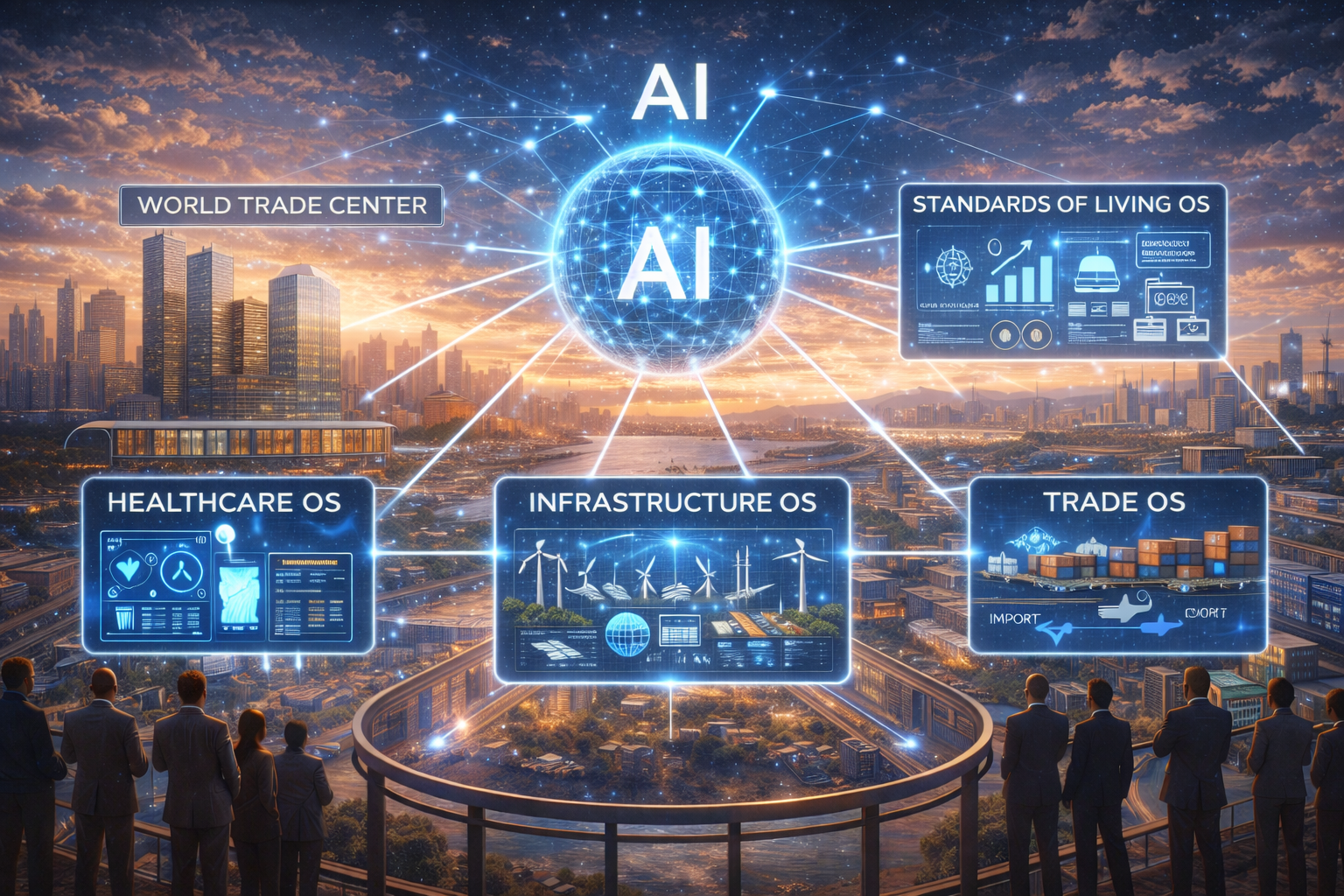
The world is approaching a moment where incremental reform is no longer sufficient. Artificial intelligence is not simply another tool added to human progress; it is a force that will touch every transaction, every supply chain, every job, every institution, and every border. The defining question of this century is not whether AI will be integrated into the global economy, but how.
If AI is attached to broken systems, it will accelerate inequality, instability, and collapse.
If AI is attached to coherent systems, it can stabilize civilization and raise standards of living everywhere.
What humanity requires now is not another platform, policy memo, or ideology—but a new operating system.
Peace and Prosperity Are Not Intentions — They Are System Properties
Prosperity and peace do not emerge from good intentions alone. They emerge when systems are designed so that efficiency creates shared benefit, savings are visible and reinvested, income does not disappear when jobs do, power is constrained by accountability, and intelligence serves continuity rather than extraction.
In the AI era, these outcomes cannot be managed manually. No committee, ministry, or market actor can keep pace with intelligence that moves at machine speed. These outcomes require automation at the level of governance itself.
This is where a new operating system becomes unavoidable.
The Economic Operating System: The Brand Currency System (BCS)
The Brand Currency System is not a new currency in the traditional sense. It is an economic operating system that sits above existing money, markets, and payment rails. Its purpose is not to replace value, but to reveal and coordinate it.
BCS records reality with precision. Every transaction—retail, wholesale, logistics, production—is written to a transparent ledger. That ledger does not merely record value; it shows where value is being created, where inefficiency is being eliminated, and where savings are emerging in real time.
Those savings no longer disappear into margins, fees, or opaque balance sheets. They become actionable signals—signals that can be redirected into income, stability, and opportunity.
In this way, efficiency stops being a private weapon and becomes a shared asset.
Banking Must Evolve from a Toll Booth into an Operating System
Traditional banking systems primarily do two things: they record transactions and charge fees. In an AI-driven economy, this model becomes insufficient—and eventually harmful. Systems that only extract value from movement cannot govern an age defined by intelligence and coordination.
What is needed instead is a banking operating system that records value, creates value, distributes value, and stabilizes demand.
Under BCS, the ledger becomes the foundation for automated redistribution, income generation, credit issuance tied to real efficiency, and long-term savings pools. Loans are no longer speculative instruments detached from reality. They are issued based on verified production capacity, real demand signals, and system-wide efficiency gains.
Repayment happens naturally—through coordination, reduced waste, and increased productivity—not through punitive extraction.
This is how finance stops being a drag on civilization and becomes its stabilizer.
Taxation in the AI Century: Precision, Not Politics
In an AI-driven economy, taxation cannot remain manual, adversarial, or opaque. AI itself must calculate taxes automatically, apply them consistently, redistribute gains transparently, and fund public goods without distortion.
Because BCS shows exactly where efficiency and savings occur, taxation becomes precision-based, not blunt. Governments no longer guess where to tax or whom to burden. The system shows it clearly.
This eliminates wasteful bureaucracy, reduces tax evasion, ensures fair contribution from all participants, and enables automatic funding of healthcare, infrastructure, education, and training.
Taxation becomes part of the operating system—not a political battlefield.
Beyond Tariffs: Synchronization Instead of Competition
Tariffs exist because systems are fragmented and adversarial. In a synchronized AI-driven economy, they become unnecessary.
When supply chains are transparent, pricing is coordinated, production is visible, and efficiency gains are shared, there is no incentive to weaponize trade. BCS enables cross-border supply-chain synchronization, shared standards for AI integration, and mutual benefit rather than zero-sum competition.
Producers, wholesalers, and retailers remain part of the system—but their income comes from participation and optimization, not artificial scarcity or gatekeeping.
The Political Operating System: The Superuser Framework
No economic system can function without political coherence. The Superuser system is a political operating layer that complements BCS. It does not replace culture, sovereignty, or national identity. It introduces objective accountability into governance.
Through AI-assisted evaluation, leaders are assessed not by rhetoric, but by delivery—by public good creation, system stability, and long-term outcomes. Elections and leadership selection evolve from popularity contests into competence-based processes, where humans work alongside AI to evaluate real-world impact.
Governance begins to reflect the realities of an AI economy.
Training, Transition, and Human Dignity
As AI eliminates traditional jobs, society must replace income—not merely retrain skills. BCS enables continuous training funded by efficiency gains, income flows tied to participation in the system, personal and community-owned AI agents, and economic inclusion without dependency.
Humans are no longer forced to compete against machines. They collaborate with intelligence and share in its productivity.
Toward Economic Autopilot
The ultimate goal of this operating system is not control. It is relief.
When AI manages supply chains, balances markets, issues credit, applies taxation, redistributes gains, and stabilizes demand, humans are freed from constant crisis management. Society moves onto economic autopilot, where the fundamentals are handled intelligently, transparently, and fairly—allowing people to focus on creativity, care, culture, and meaning.
A Global Agreement, Not a Corporate Platform
This system cannot belong to one company, one nation, or one ideology. It must be agreed upon across borders, implemented openly, governed by shared rules, and judged by rising standards of living.
Governments, institutions, and participants must sign onto the same blueprint—committing to attach AI to everything, from markets and finance to governance itself, in a way that is fair, transparent, and human-centered.
What Is at Stake
If this operating system is built correctly, prosperity becomes structural, peace becomes economical, inequality becomes manageable, and intelligence serves humanity.
If it is not, efficiency will hollow out societies, instability will spread, and AI will magnify every existing flaw.
This is not a distant future.
It is unfolding now.
Final Reflection
The AI century does not need more arguments.
It needs architecture.
A shared operating system for the economy.
A banking system that creates value.
A political system that rewards competence.
A global agreement that prosperity and peace are non-negotiable.
This blueprint is not a promise.
It is an invitation.
An invitation to build systems so well designed that humanity can finally relax—knowing the foundations are stable, fair, and worthy of the future.
That is what is at stake.
Conclusion: An Invitation Still Open
I will end this where responsibility begins.
What is being proposed here is not a product, not a platform, and not a national agenda. It is the design of an operating system that will attach to everything and everyone—to business and healthcare, to finance and privacy, to trade and politics, to how societies organize themselves in the presence of artificial intelligence.
History offers a reference point. Institutions like the World Trade Organization were once bold attempts to formalize cooperation at scale. They brought real benefits. They helped countries grow, export, import, and stabilize. But they were built for a pre-AI world. They were designed for paper rules, human latency, and fragmented accountability.
We are now at the threshold of something larger.
We have an opportunity—perhaps the last one before systems outrun us—to design a planetary operating system that governs how AI integrates into the real economy: how it buys and sells, how it allocates opportunity, how it protects privacy, how it informs politics, how it stabilizes markets, and how it raises standards of living rather than hollowing them out.
Once such an operating system is formalized—once its rules, safeguards, and incentives are agreed upon—AI can be deployed at scale without fear. Efficiency will no longer be synonymous with displacement. Automation will no longer mean instability. Intelligence will no longer threaten peace.
Shared prosperity and shared peace do not emerge accidentally. They must be designed, and design requires conversation.
I have laid out the tools.
I have laid out the architecture.
I have laid out the ideas.
But ideas remain ideas unless people are willing to engage with them.
So I am still waiting—for invitations, for serious discussions, for leaders and builders willing to pull up a chair and ask the hard questions. Not to endorse, not to reject, but to co-design an operating system that will shape exports and imports, living standards and labor transitions, governance and accountability, for decades to come.
This system will affect everyone. That is precisely why it must be built with everyone in mind.
The door is open.
The moment is here.
And the future will belong not to those who rushed ahead blindly, but to those who were willing to sit down, listen, and build the foundations carefully—so that when AI runs everything, humanity can finally breathe.
I am ready to have that conversation.