بِسْمِ اللهِ الرَّحْمٰنِ الرَّحِيمِ
In the Name of God, Most Gracious, Most Merciful.
A New Mission Statement in transportation in the US
A new mission statement to deliver a civilization project that will be inherited by future generations without any debt.
I will start with the Transportation Department. I will try to see if I can get grants. If I can't get grants, then I'll get angel investors. I will start with the people I'm already driving from time to time when I get off my truck—the vulnerable people who are going to rehab, people who don't have a car, don't have insurance, but they get to go where they are going.
And Uber already does this, so I'm very proud of Uber. When I pick all these people up, I see the transformation myself, and I even participate in the rehabilitation by reminding them they have something to gain. Life is ahead of them. You cannot imagine how many people have left my car crying, hopeful of a brighter future.
So when I talk about change, it is change that I'm engaged in.
Transportation is probably the first thing I'm going to deal with, and I will invite Uber, since I already work with them, to assess the unique contribution that is being made.
We are human beings. A ride is more than just a ride. It's a conversation. It is a connection. It is enriching each other in language and culture. It's as if you're traveling to a new space and a new place. Someone tells you about their language, where they are from, what they love, and you share ideas. So it's really exciting every time I drive and I meet curious, creative people. It's just been incredible.
So with that, I hope that Uber will participate. But I will still stick to the fi sabilillah—for the sake of God—where people donate maybe thirty minutes, an hour, or whatever they can for the sake of God.
As Muslims, we are encouraged to leave behind Ṣadaqah Jāriyah—a charity that continues to benefit people long after we are gone. That is exactly what I hope this transportation project becomes: a living charity that continues serving people, helping the vulnerable, restoring dignity, and creating opportunity for generations to come.
A Message to Uber
A ride is not just a ride.
It is a ride to a doctor's appointment. It is a ride to rehabilitation. It is a ride to a psychiatrist for mental health. It is a ride that restores dignity and reminds someone that life is still worth fighting for.
The conversations that happen during those rides are often deeply personal. They are moments of hope, reflection, encouragement, and human connection. They are far beyond a transaction. They are beyond recording. Sometimes you may need an example of what that looks like, but I don't trust you. You're just a corporation.
Maybe I will replace you with Lyft. Or maybe I will build my own brand.
Because at the end of the day, it is the State that pays for much of this transportation through insurance and public programs. Those customers can easily be served through a new system.
And I'm sure the Governor of California will have no problem participating in my program because it creates a domino effect.
Once I have the system in place, the revenues go back into the system and strengthen the State. I am going to create a network of transportation modes, vehicles that charge themselves, drivers whose salaries are already secured, and a closed ecosystem that serves people first.
I am not interested in unlimited profit or unlimited extraction.
So I am not happy with the way the current system operates.
But I do look forward to having a conversation with Uber.
And I look forward to having a conversation with the State of California.
If we can build a transportation system that restores dignity, strengthens communities, and leaves behind a Ṣadaqah Jāriyah for future generations, then a ride will never again be just a ride.
A Message to the Governors
I now turn to the governors.
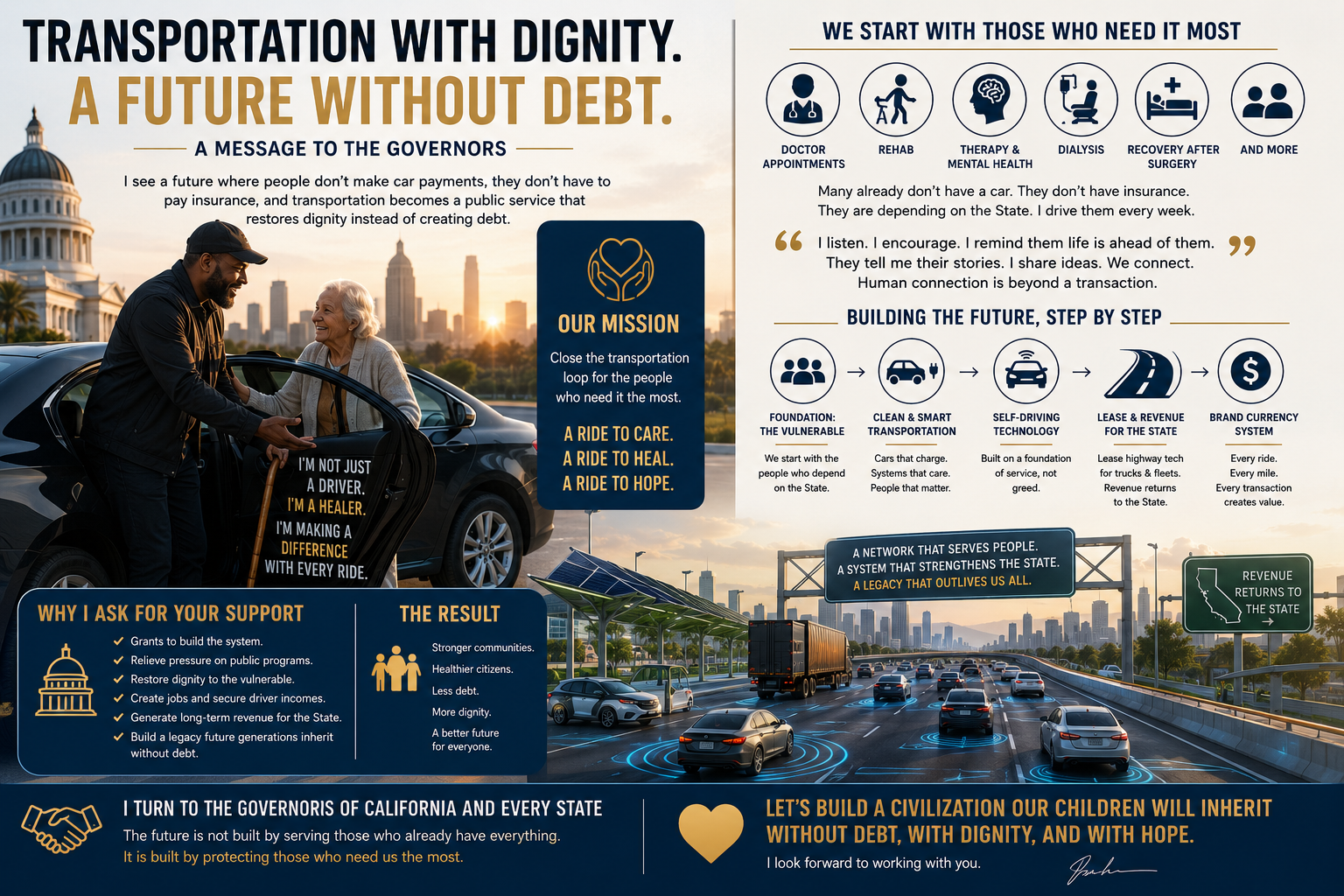
I see a future where people don't make car payments, they don't have to pay insurance, and transportation becomes a public service that restores dignity instead of creating debt.
This begins with the most vulnerable people in your state.
The people who need to get to doctor's appointments, rehabilitation, therapy, dialysis, and other essential medical services. These are the people I want to build my transportation system around.
Many of them already don't have a car. They don't have insurance. They are depending on the State. I know this because I drive them every week.
It gives me happiness to help an elderly woman who can't walk into the car. It gives me happiness to help a dialysis patient into the vehicle and get them safely where they need to go. I pick up people who have just come out of surgery. Many times, nobody is there for them. I'm the one picking them up.
For the next thirty minutes, forty-five minutes, or even an hour, I'm not just driving.
I'm listening.
I'm encouraging.
I'm reminding them that life is still ahead of them.
They tell me about the life they used to have. One person tells me they used to be a surfer before their back injury. Another tells me about their family, their struggles, or their hopes. Sometimes I share my own work and my videos, and they become curious about building a better future.
So I'm not just a driver.
I'm helping people heal.
I'm making a difference one ride at a time.
That is why I will be asking the States for grants to help build this transportation ecosystem.
The first goal is simple:
Close the transportation loop for the people who need it the most.
From that foundation, we build the future.
We build cleaner transportation.
We build vehicles that can charge efficiently.
We build toward self-driving transportation, not as a replacement for people, but as infrastructure that serves people.
We lease portions of that technology in ways that generate revenue for the State. Truck drivers, transportation companies, and autonomous fleets can participate in a system where innovation creates public value instead of simply extracting private profit.
Through my Brand Currency System, which I will discuss in the next part, every movement, every service, and every transaction can strengthen the transportation network and return value back into the system.
But before any of that happens, we must get the foundation right.
The foundation is the vulnerable.
I originally hoped to build this application with my Muslim community. At this time, they are not available, and I cannot wait.
So I will carry the responsibility myself until enough progress has been made for others to join.
Today, I turn to the Governor of California, and to every governor who understands that the future is not built by serving those who already have everything.
It is built by protecting those who need us the most.
If we can build transportation for the elderly, the disabled, those recovering from surgery, those fighting addiction, those seeking mental health care, and those who simply cannot afford reliable transportation, then we will have built a foundation strong enough to support everything that comes next.
That is where civilization begins.
Conclusion
To the technology companies, here's the good news:
You don't need to go looking for riders. They are already there.
Every single day, healthcare organizations, insurance companies, and state transportation programs are already paying for millions of rides. Companies such as Molina Healthcare, Uber Health, Lyft Healthcare, MTM, Modivcare, and Veyo already coordinate transportation for doctor's appointments, dialysis, rehabilitation, mental health services, surgery, and many other essential healthcare needs.
My proposal is not to start from scratch.
We start at the bottom by helping the people who need it the most.
We help the vulnerable today.
Then we build upward.
We generate revenue for the State.
We create a transportation ecosystem that eventually becomes a closed loop.
I see a future where people no longer need to own a car.
I see a future where people no longer worry about traditional insurance.
The monthly payment doesn't disappear—it simply changes direction.
Instead of paying for car loans and private insurance, people pay into a transportation system that serves them and strengthens the State that supports them.
That revenue stays in the ecosystem.
It builds better transportation.
It builds better technology.
It builds better AI.
And it leaves future generations with infrastructure instead of debt.
If Uber wants to participate, my door is open.
If not, I will build with those who believe transportation should first serve people, not unlimited profit.
Before you dismiss these ideas, study the transportation ecosystem that already exists.
Molina Healthcare
https://www.molinahealthcare.com
Uber Health
https://www.uberhealth.com
Lyft Healthcare
https://www.lyft.com/healthcare
Modivcare
https://www.modivcare.com
Veyo
https://veyo.com
California Department of Health Care Services – Medi-Cal Transportation
https://www.dhcs.ca.gov/services/medi-cal-resources/transportation-services
Read the material.
Study the transportation ecosystem.
Then join me in Part Two, where I explain how the Superuser System and the Brand Currency System transform transportation from a cost into the foundation of a new civilization.