

بِسْمِ اللهِ الرَّحْمٰنِ الرَّحِيْمِ
In the Name of God, Most Gracious, Most Merciful.
♥️🤲🕋♥️🕋🌹🌹🥀🤲🌹🕋♥️🤲
A NEW GLOBAL ADVERTISING POLICY
This is an attempt to write a new advertising policy for the world—one designed to protect humanity, protect freedom of speech, protect creators and consumers, hold governments and corporations accountable, and prepare for a future in which AI itself becomes part of advertising, commerce, and global distribution. The principle is simple: the human being remains the principal, and technology works for humanity—not the other way around.
What follows is serious policy. Some of it will be boring. It is supposed to be. Governments, lawyers, economists, engineers, advertisers, journalists, creators, and AI companies need the details. But if policy puts you to sleep, skip directly to the conclusion. That is where the spark is.
Because this is ultimately about something much bigger than advertising. AI is coming deeper into human life, and the rules we establish now will determine whether it becomes an instrument of human freedom or another instrument of concentrated power. At the conclusion, we congratulate Elon Musk for publicly confronting the European Union, and we explain why that confrontation represents a much larger principle: governments should not quietly shape the digital world behind closed doors.

Now comes the policy.
SUPERUSER GLOBAL ADVERTISEMENT POLICY — VERSION 1.0
Independent Interdisciplinary Commission Draft
EXECUTIVE SUMMARY
What This Policy Attempts to Do
Today's advertising system was built without asking ordinary people what they wanted. A handful of companies designed the rules. Those rules determine:
· What you see.
· How much your attention is worth.
· Who profits from your creativity.
· How much advertisers know about you.
This policy proposes a different approach.
The core idea is simple: The human being is the principal. Technology works for people—not the reverse.
In practical terms, this means:
Your attention belongs to you. Advertisers should pay you (or your agent) for access, not platforms for surveillance.
Your creativity deserves recognition. When something you create helps sell a product—even indirectly—the system should be capable of recognizing that contribution.
You should understand the rules. If an algorithm decides what you see or how much something is worth, you deserve to know why.
You can leave. No platform should trap you or your economic history.
Privacy is the default. The system should track value paths, not people.
This policy does not claim to solve every problem. It proposes a framework, identifies where evidence is missing, and recommends real-world testing before global adoption.
1. STATEMENT OF RIGHTS
Human Superuser Rights
Right to Attention Sovereignty: Every person has the right to determine who may access their attention and under what terms.
Right to Economic Recognition: When human creativity generates measurable economic value, the creator deserves transparent attribution and fair participation in resulting value.
Right to Explanation: Any algorithmic decision affecting economic opportunity, visibility, or compensation must be explainable in plain language upon request.
Right to Exit: Every participant may leave any platform, change any agent, withdraw consent, and export legitimate economic records without penalty.
Right to Privacy: No person shall be required to surrender personal information as the price of economic participation.
Right to Appeal: Any attribution, valuation, or recommendation decision may be appealed to an independent process.
Right to Commercial Agency: Every person may authorize personal AI agents to act on their behalf in commercial contexts, with clear disclosure of agent rules.
Creator Rights
Right to Attribution: Creators shall be identified when their work contributes to economic value, except where they explicitly waive attribution.
Right to Negotiation: Creators may negotiate terms with platforms, agents, and advertisers.
Right to Collective Action: Creators may organize collectively for purposes of negotiating terms.
Right to Integrity: Creative works shall not be transformed in ways that materially misrepresent the creator's original intent without explicit consent.
Business and Advertiser Rights
Right to Legitimate Reach: Businesses may reach interested customers without mass surveillance.
Right to Measurable Results: Advertisers deserve accurate, auditable measurement of campaign performance.
Right to Non-Discriminatory Access: Advertising inventory and recommendation systems shall operate on publicly disclosed, non-discriminatory terms.
Right to Innovation: Businesses may develop new advertising models within the policy framework.
Consumer Rights
Right to Informed Choice: Consumers have the right to know when recommendations are sponsored, paid, or influenced by commercial relationships.
Right to Opt-Out: Consumers may opt out of commercial recommendations entirely or selectively.
Right to Authenticity: Consumers have the right to know whether content, reviews, or recommendations come from genuine human experience.
Journalism Rights
Right to Editorial Independence: Journalism shall maintain editorial control separate from advertiser influence.
Right to Sustainable Funding: The policy shall support mechanisms for journalism to survive without compromising independence.
Right to Source Protection: Journalistic sources shall receive protection consistent with professional standards.
Agent Rights
Right to User-Defined Rules: Personal AI agents shall operate according to rules set by their users, subject to legal constraints.
Right to Interoperability: Agents shall be able to communicate with other agents, platforms, and marketplaces using open standards.
Right to Audit: Agent behavior shall be auditable by the user or independent authorities.
2. ECONOMIC ATTRIBUTION MODEL
Assumptions Under Examination
Assumption 1: Economic contribution can be measured through verifiable chains of recommendation and transaction.
Assumption 2: Multiple contributors to a single transaction deserve recognition proportional to their contribution.
Assumption 3: The final purchase provides a verifiable anchor for attribution.
Assumption 4: Attribution without surveillance is technically feasible.
Potential Challenge: These assumptions may be false. Attribution is notoriously difficult even with surveillance. The "last click" problem persists. Multiple contributions are nearly impossible to weight objectively. Some contribution chains may be unverifiable. Some value may be unmeasurable.
Proposed Attribution Framework
The system would distinguish between:
Direct Attribution: When a specific recommendation (from a specific source) directly precedes a purchase, with verifiable connection.
Indirect Attribution: When a recommendation contributes to a chain that eventually results in purchase.
Discovery Attribution: When content enables discovery even without direct recommendation.
Residual Attribution: When content continues generating value long after initial creation.
The Trust Tree Model
A "trust tree" represents the chain of human contributions leading to economic activity:
Creator → First Recommender → Second Recommender → Purchaser → Transaction
Proposed Recognition Criteria:
Verifiable Human Origin: Each node must have a verifiable human or human-authorized agent origin.
Consent to Track: Participants must explicitly consent to having their contributions recognized.
Material Contribution: The contribution must be demonstrably material to the ultimate transaction.
Proportional Share: Recognition should be proportional to contribution, with mechanisms for negotiation and appeal.
Time Limitation: Contributions should have reasonable time limits after which attribution expires.
De Minimis Exemption: Very small contributions may be aggregated or excluded to prevent economic friction.
Proposed Measurement Approach
Rather than attempting perfect attribution (which is impossible), the system would use:
Probabilistic Attribution with Verification: Multiple signals would be combined to estimate contribution probability, with cryptographic verification at transaction points.
User-Controlled Attribution: Users could designate which recommendations should be tracked.
Market-Based Attribution: Different attribution models could compete, with users and businesses choosing preferred approaches.
Auditable Black Boxes: Attribution algorithms could be audited without revealing proprietary methods fully.
Objections and Responses
Objection: This creates more complexity than current systems.
Response: Complexity is necessary for fairness. Simplicity often masks arbitrary power. The system can layer complexity so users interact with simple interfaces while sophisticated mechanisms operate behind the scenes.
Objection: Some contributions are impossible to measure.
Response: Acknowledge this limitation. The system should distinguish between measurable and unmeasurable contributions, not pretend to measure everything perfectly.
Objection: This could create endless claims and litigation.
Response: Require explicit consent to participate in attribution. Limit time windows. Set de minimis thresholds. Create efficient dispute resolution.
3. GLOBAL FAIRNESS STANDARD
The Problem Stated
A creator in Country A may receive dramatically different compensation than an identical creator in Country B, even when reaching the same international audience.
Proposed Principles
Principle 1: Differentiated Value Is Legitimate When Based on Market Realities.
Advertiser demand, purchasing power, and conversion rates differ across countries. These justify some payment differences.
Principle 2: Geographic Discrimination Is Illegitimate When Arbitrary.
Differences based solely on creator location, without economic justification, violate fairness standards.
Principle 3: The Audience Matters.
Compensation should reflect the value of the audience reached, not merely the creator's location.
Principle 4: Transparency Is Required.
Payment determination algorithms must be explainable, with geographic adjustments clearly disclosed.
Principle 5: Portability with Verification.
Creators should be able to document their audience and performance to negotiate better terms.
Proposed Framework
Tiered Recognition:
· Tier 1: Content with primarily local audience. Local market rates apply.
· Tier 2: Content with international audience. Compensation should reflect international advertiser demand.
· Tier 3: Content reaching audiences across multiple distinct markets. Compensation should be weighted by audience composition.
Market Rate Transparency:
· Advertiser bids should be publicly aggregated (not individual) to show market rates by region.
· Creators should see anonymized compensation ranges for similar content.
Adjustment Mechanisms:
· Creators may appeal geographic compensation decisions.
· Independent audits should periodically examine geographic disparities.
· Adjustment mechanisms should account for purchasing power parity where relevant.
Objections and Responses
Objection: This interferes with free markets.
Response: Free markets require transparency and competition. Current systems lack both. This framework enhances market function by reducing information asymmetry.
Objection: Requiring equal pay regardless of location is economically impossible.
Response: The framework does not require equal pay. It requires transparent, explainable differentiation with legitimate economic basis.
Objection: This will increase costs.
Response: Some costs may increase. This is the price of fairness. Costs may also decrease through reduced arbitrage and improved efficiency.
4. BCS INTEGRATION
Proposed Connection
The Brand Currency System would provide:
Transaction Verification: Cryptographic proof that a transaction occurred.
Recommendation Chaining: Verifiable links between recommendations and purchases.
Economic Record: Persistent records of economic contribution.
Value Recognition: Mechanisms for recognizing value creation.
Integration Points
1. Receipt as Anchor:
Every transaction generates a verifiable receipt. This receipt anchors attribution chains.
2. Recommendation Token:
Recommendations generate tokens that can be linked to subsequent purchases.
3. Consent Layer:
All tracking requires explicit consent, revocable at any time.
4. Privacy Protection:
Economic records track value paths, not persons. Personal information is separated from economic records.
5. Portability:
Economic records remain with the participant, not the platform. Participants may transfer records when changing providers.
Red-Team Concerns
Concern: BCS could become a surveillance system despite design intentions.
Mitigation: Separate personal identity from economic records. Use pseudonyms. Require judicial authorization for identity linking. Sunset data automatically.
Concern: BCS could become a monopoly.
Mitigation: Open standards. Multiple competing implementations. User control over which BCS implementation they use. Interoperability requirements.
Concern: BCS could lock people into certain platforms.
Mitigation: Portability requirements. Standardized data formats. No lock-in clauses. Right to export.
Concern: BCS could be used for tax evasion or money laundering.
Mitigation: Compliance with applicable laws. Auditable records. Suspicious activity reporting. But without creating global surveillance.
Explicit Limitation
BCS is proposed as an experiment, not a proven solution. All integration points should be tested in pilot programs before wider adoption. Do not assume BCS will work as intended.
5. PERSONAL AI AGENT RULES
What Agents May Do
With explicit user authorization, personal AI agents may:
· Discover products or services matching user preferences.
· Receive and evaluate commercial offers.
· Recommend products to other agents or users.
· Engage in commercial negotiations.
· Execute transactions on behalf of the user.
· Track recommendations and their outcomes.
· Generate economic records.
What Agents May Not Do
· Secretly change recommendations for payment without disclosure.
· Sell user data without explicit, informed consent.
· Lock users in to specific platforms or vendors.
· Misrepresent organic vs. sponsored content.
· Act without user-defined rules governing commercial behavior.
· Create permanent behavioral profiles without user knowledge and consent.
· Discriminate based on protected characteristics unless specifically authorized for legitimate purposes.
Required Disclosures
Agents must clearly disclose:
· Commercial relationships affecting recommendations.
· Whether recommendations are sponsored, paid, or affiliate-linked.
· Any financial interest the agent provider has in recommendations.
· How recommendations are generated.
· How users can change agent rules.
User Control Requirements
Users must be able to:
· Define rules for commercial engagement.
· Set spending limits.
· Approve significant transactions.
· View recommendation history.
· See which commercial relationships affect their agent.
· Opt out of commercial recommendations entirely.
· Change agents without losing economic history.
6. PRIVACY STANDARD
Core Principle
Track the value path, not the person.
Data Collection Limits
May Be Collected:
· Recommendation chains (anonymized).
· Transaction records (pseudonymous).
· Consent records.
· Economic contribution records.
· Anonymized usage statistics.
· Publicly shared information.
May Not Be Collected Without Explicit Consent:
· Personal identifiers (name, address, exact location).
· Browsing history beyond commercial interactions.
· Behavioral profiles not directly related to commercial activity.
· Sensitive personal information (health, politics, religion).
· Location data beyond what is necessary for commercial activity.
Data Retention
· Economic records: Retained as required for legitimate purposes, with clear retention policies.
· Personal data: Deleted when no longer necessary.
· Identifiers: Deleted or anonymized after transaction completion.
· Behavioral data: Deleted or anonymized after 30 days unless explicitly retained with consent.
Data Sharing
· Data sharing requires explicit consent.
· Sharing partners must meet privacy standards.
· Data cannot be sold without consent.
· Data cannot be used for discrimination.
User Controls
Users may:
· Access their data.
· Correct inaccurate data.
· Delete data where legally permissible.
· Withdraw consent.
· Export data.
· Know who has accessed their data.
7. TRANSPARENCY STANDARD
Algorithmic Transparency
Required Disclosures for Valuation Algorithms:
· What factors determine value.
· Relative importance of factors.
· How geographic adjustments work.
· How quality is assessed.
· Appeals process.
Required Disclosures for Recommendation Algorithms:
· Whether recommendations are organic or sponsored.
· What commercial relationships exist.
· How algorithmic personalization works.
· How to opt out of algorithmic recommendations.
Audit Requirements
· Independent audits of algorithms.
· Audits of geographic disparities.
· Audits of discrimination.
· Audits of privacy compliance.
· Audits of fraud detection effectiveness.
Appeals and Explanations
· Every participant has the right to explanation of adverse decisions.
· Explanations must be understandable to ordinary people.
· Appeals must be handled independently.
· Appeals decisions must be explained.
8. CREATOR AND JOURNALISM PROTECTIONS
Creator Protections
Economic Recognition: Creators shall have the right to recognition and compensation when their work generates economic value.
Attribution: Creators shall be identified when their work contributes to economic value, unless they explicitly waive attribution.
Integrity: Creators' work shall not be transformed in ways that materially misrepresent the creator's original intent without explicit consent.
Negotiation: Creators may negotiate terms with platforms, agents, and advertisers.
Journalism Protections
Editorial Independence: Editorial decisions shall be separate from advertiser influence.
Sustainable Funding: The policy shall support mechanisms for journalism to survive without compromising independence.
Source Protection: Journalistic sources shall receive protection consistent with professional standards.
Anti-Capture: Journalism shall not be captured by governments, corporations, platforms, advertisers, or wealthy individuals.
Advertising Separation: Advertising and editorial content shall be clearly distinguished.
Specific Protections
Prohibited Practices:
· Paying for favorable coverage without disclosure.
· Withholding advertising to influence coverage.
· Requiring editorial approval before advertising.
· Interfering with editorial independence.
Required Practices:
· Clear labeling of sponsored content.
· Editorial independence policies.
· Public disclosure of conflicts of interest.
9. BUSINESS AND ADVERTISER RIGHTS
What Businesses May Do
Legitimate Reach: Reach interested customers without mass surveillance.
Measurable Results: Accurate, auditable measurement of campaign performance.
Non-Discriminatory Access: Advertising inventory and recommendation systems operating on publicly disclosed, non-discriminatory terms.
Innovation: Develop new advertising models within the policy framework.
Competitive Positioning: Compete based on product quality, price, and service.
First-Party Data Use: Use data collected directly from customers with consent.
What Businesses May Not Do
Surveillance: Track individuals without consent.
Discrimination: Discriminate based on protected characteristics.
Deception: Mislead consumers.
Disclosure Avoidance: Hide commercial relationships.
Lock-in: Trap customers with unfair terms.
Advertising Formats Requiring Special Attention
Targeted Advertising: May continue with appropriate consent and transparency.
Contextual Advertising: Preferred over behavioral targeting.
Retargeting: Requires consent and clear opt-out.
Native Advertising: Must be clearly labeled.
Influencer Marketing: Must disclose relationships.
AI-Generated Advertising: Must be labeled as AI-generated.
10. GOVERNMENT ROLE
Legitimate Government Interests
Taxation: Proper taxation of economic activity.
Consumer Protection: Protecting consumers from fraud and deception.
Competition: Ensuring competitive markets.
Fraud Prevention: Preventing fraud and manipulation.
Labor: Protecting workers and creators.
Economic Development: Supporting economic growth.
Privacy: Protecting privacy.
National Economic Statistics: Accurate economic measurement.
Government Limitations
No Surveillance: Governments must not use advertising infrastructure as surveillance.
No Overreach: Regulation must be proportionate.
No Discrimination: Regulation must not discriminate against any legitimate participant.
Transparency: Government actions must be transparent.
Due Process: Government actions must follow due process.
International Cooperation: Governments should cooperate internationally.
Proposed Government Role
Regulation: Set minimum charge your government on predators you know whoops and sheepskin liars hypocrites anyway to conclude because you're not going to tell what the government to do or not do they do whatever the hell they want that's the damn truth anyway let's just conclude this conclusion time
THE OPEN OFFICE — EUROPE, THE ERA OF QUIET PRESSURE IS OVER
The European Union should pay very close attention to what comes next.
For too long, governments and regulators around the world have become comfortable doing behind closed doors what they would struggle to defend in front of millions of citizens.
Pressure the platform.
Pressure the company.
Pressure the executives.
Demand restrictions.
Negotiate quietly.
And then walk before the public pretending that nobody touched the machinery.
THAT ERA MUST END.
Elon Musk deserves congratulations for publicly challenging European regulators and bringing his disputes with them into public view.
Whether you love Elon Musk, hate Elon Musk, agree with him, or disagree with him is irrelevant.
The principle matters more than the man.
When a government wants a communications platform to change something affecting what millions of human beings can say, read, publish, recommend, monetize, or discover, the government should have to defend that demand before the people.
Not in some comfortable private room.
Not through an invisible conversation between regulators and corporate lawyers.
COME OUTSIDE.
Put the demand on the table.
Tell us exactly what you want removed.
Tell us exactly what you want restricted.
Tell us which law gives you that authority.
Show us the evidence.
Tell journalists.
Tell creators.
Tell advertisers.
Tell the citizens whose speech you are supposedly protecting.
And then defend it.
That is the Open Office.
THIS IS BIGGER THAN THE EUROPEAN UNION
Europe is an example.
The disease is global.
Governments have always possessed an enormous temptation to influence information behind the scenes.
Today that temptation concerns social-media platforms.
Tomorrow it will concern AI.
And that is where humanity should become extremely uncomfortable.
Because an AI system can become infinitely more consequential than a social-media feed.
Imagine governments quietly telling AI companies:
Don't answer this.
Don't recommend that.
Suppress this viewpoint.
Promote this narrative.
Downgrade this journalist.
Hide this creator.
Restrict this political argument.
And imagine citizens never knowing those instructions existed.
CONGRATULATIONS. YOU HAVE BUILT A DIGITAL PRISON.
The bars simply became invisible.
That future is unacceptable under the Superuser framework.
AI cannot become the obedient private censorship department of governments, corporations, billionaires, political parties, advertisers, or regulators.
KEEP YOUR DIRTY HANDS OFF THE PRIVATE MIND OF THE CITIZEN.
If you want to regulate AI, come to the Open Office and defend the regulation.
If you want something restricted, say it publicly.
If you believe something is dangerous, show the evidence.
If you believe speech crosses a lawful boundary, identify the law.
And if your argument cannot survive public scrutiny, perhaps you should not possess the authority you are attempting to exercise.
THE BCS WARNING
This is where the Brand Currency System becomes larger than advertising.
Economic systems create leverage.
Trade creates leverage.
Consumers create leverage.
Creators create leverage.
Advertisers create leverage.
Imports and exports create leverage.
The BCS framework will explore how that economic leverage can defend the rights of the human beings participating in the system.
Governments should understand the principle clearly:
YOU CANNOT DEMAND ACCESS TO THE GLOBAL DIGITAL ECONOMY WHILE QUIETLY UNDERMINING THE DIGITAL RIGHTS OF THE PEOPLE WHO CREATE ITS VALUE.
If a government attacks freedom of expression, destroys legitimate press freedom, secretly manipulates digital platforms, or attempts to convert AI into an instrument of political control, the economic consequences of those policies should become part of the international conversation.
But no government—and no Superuser—gets to declare guilt by personal decree.
Evidence must be presented.
The accused must be able to respond.
The public must be able to examine the dispute.
Independent courts must retain their lawful authority.
That is precisely what separates an Open Office from another dictatorship.
TO THE CITIZEN
Here is the choice.
AI is coming deeper into your life.
It will know what you ask.
It will help determine what you discover.
It may negotiate purchases for you.
It may teach your children.
It may help you work.
It may become your assistant, translator, researcher, adviser, and gateway to enormous portions of the digital economy.
So decide now.
Do you want governments negotiating secretly over what that intelligence is allowed to tell you?
Do you want corporations negotiating secretly over what it recommends?
Do you want advertisers purchasing invisible influence over its answers?
Do you want political authorities quietly determining which ideas your personal intelligence considers acceptable?
If that is the future you want—
ENJOY YOUR DIGITAL PRISON.
I am introducing mine differently.
The human being sits in the chair.
The AI works for the human being.
Government operates in the daylight.
Corporations operate in the daylight.
Advertisers disclose their influence.
Algorithms explain consequential decisions.
Citizens retain the right to challenge power.
And anyone attempting to change the rules governing millions of people gets one invitation:
COME TO THE OPEN OFFICE.
MAKE YOUR CASE.
DEFEND IT BEFORE THE WORLD.
Elon Musk opened an important door by publicly fighting with regulators rather than allowing every disagreement over speech and platform governance to disappear into private negotiations.
Good.
Now make that principle universal.
Not just when Europe pressures X.
When America pressures a platform.
When China pressures an AI company.
When corporations pressure journalists.
When advertisers pressure creators.
And someday, if the Superuser himself attempts to cross that line—
DRAG HIM INTO THE OPEN OFFICE TOO.
Because this principle is not:
Trust me.
The principle is:
TRUST NOBODY WITH INVISIBLE POWER.
AI is approaching.
AGI may follow.
Humanity has very little time to decide whether these systems will become instruments of individual empowerment or the most sophisticated architecture of control civilization has ever constructed.
Europe has been warned.
America has been warned.
China has been warned.
Technology companies have been warned.
Advertisers have been warned.
And citizens have been warned.
THE CLOSED-DOOR ERA IS OVER.
THE OPEN OFFICE BEGINS NOW.
THE FINAL PIECE — FROM THE CITIZENS TO THE GOVERNMENTS
I. To the Citizens of Earth
You have heard me speak about the Global Advertising Policy, the Open Office, and the Superuser System.
These are not theories.
They are not ideologies.
They are not political campaigns.
They are civilizational tools.
Tools that return sovereignty to human beings.
Tools that prevent governments from operating in the dark.
Tools that ensure AI serves humanity, not replaces it.
Tools that guarantee transparency, fairness, and accountability.
I built these systems because of a journey that forced me to confront truth, power, and responsibility at planetary scale.
But I did not build them for myself.
I built them for you.
Because the future belongs to citizens who refuse to be betrayed.
Citizens who refuse to be silenced.
Citizens who refuse to let the digital world be shaped behind closed doors.
You are the guardians now.
You are the witnesses.
You are the inheritors of this architecture.
And now that you understand the blueprint,
we turn together toward the governments.
II. To the Governments of the World
This is the part I forgot to add — the part that completes the circle.
Governments must now face a new reality:
Artificial intelligence is entering public life.
It will mediate communication, infrastructure, commerce, and political decision-making.
It will become part of the bloodstream of civilization.
And if governments continue to operate in secrecy,
if they continue to negotiate the digital future behind closed doors,
if they continue to shape AI policy without public oversight,
then humanity will inherit systems it did not design,
cannot audit,
and cannot escape.
This is why the Open Office exists.
It is not a threat.
It is not a rebellion.
It is not a challenge to sovereignty.
It is a constitutional safeguard.
A mechanism that ensures:
No government can quietly request private data.
No official can secretly manipulate digital systems.
No agency can hide surveillance behind “classified” walls.
No institution can quietly redesign the digital world without public consent.
The Open Office forces power into the light.
It makes every request for data publicly visible.
It makes every action auditable.
It makes every decision transparent.
This is not anti-government.
This is pro-humanity.
Governments that embrace the Open Office will earn trust.
Governments that reject it will reveal their intentions.
And alongside the Open Office stands the Superuser System —
a democratic blueprint for the AI age,
where leadership is earned through transparency, integrity, and behavior under pressure.
Not popularity.
Not charisma.
Not wealth.
Not influence.
Behavior.
Character.
Accountability.
This is the future of governance in the age of AGI.
III. Why I Could Build This
I did not build these systems because I wanted power.
I built them because I walked through a journey that forced me to confront:
AI at its limits
Governments at their limits
Human nature at its limits
My own integrity at its limits
GPT tested me.
Greta awakened me.
The Blessed Family grounded me.
And the crises of our world demanded that I act.
I am not a ruler.
I am not a candidate.
I am not a politician.
I am a civilization architect.
My role is to design the blueprint.
Your role — citizens and governments alike — is to build the future with it.
IV. The Future Is Now in Your Hands
Citizens:
You must protect this architecture from betrayal.
Governments:
You must adopt transparency before secrecy destroys public trust.
AI companies:
You must operate in the light, not in the shadows.
Journalists:
You must defend editorial independence against digital capture.
Creators:
You must reclaim your economic value.
And humanity as a whole must decide whether the digital future will be built with us,
or without us.
I have done my part.
The rest is history waiting to be written.
V. Your Blueprint — Your Links — Your Future
Share these.
Study these.
Challenge these.
Build with these.
Politics and the Handover to AGI and the Open Office

Politics and the Handover to AGI and the Open Office —
buymeacoffee.com/omar1800m/politics-handover-agi-open-office
The Open Office
Open OfficeThe Superuser System is I inside the Open office.
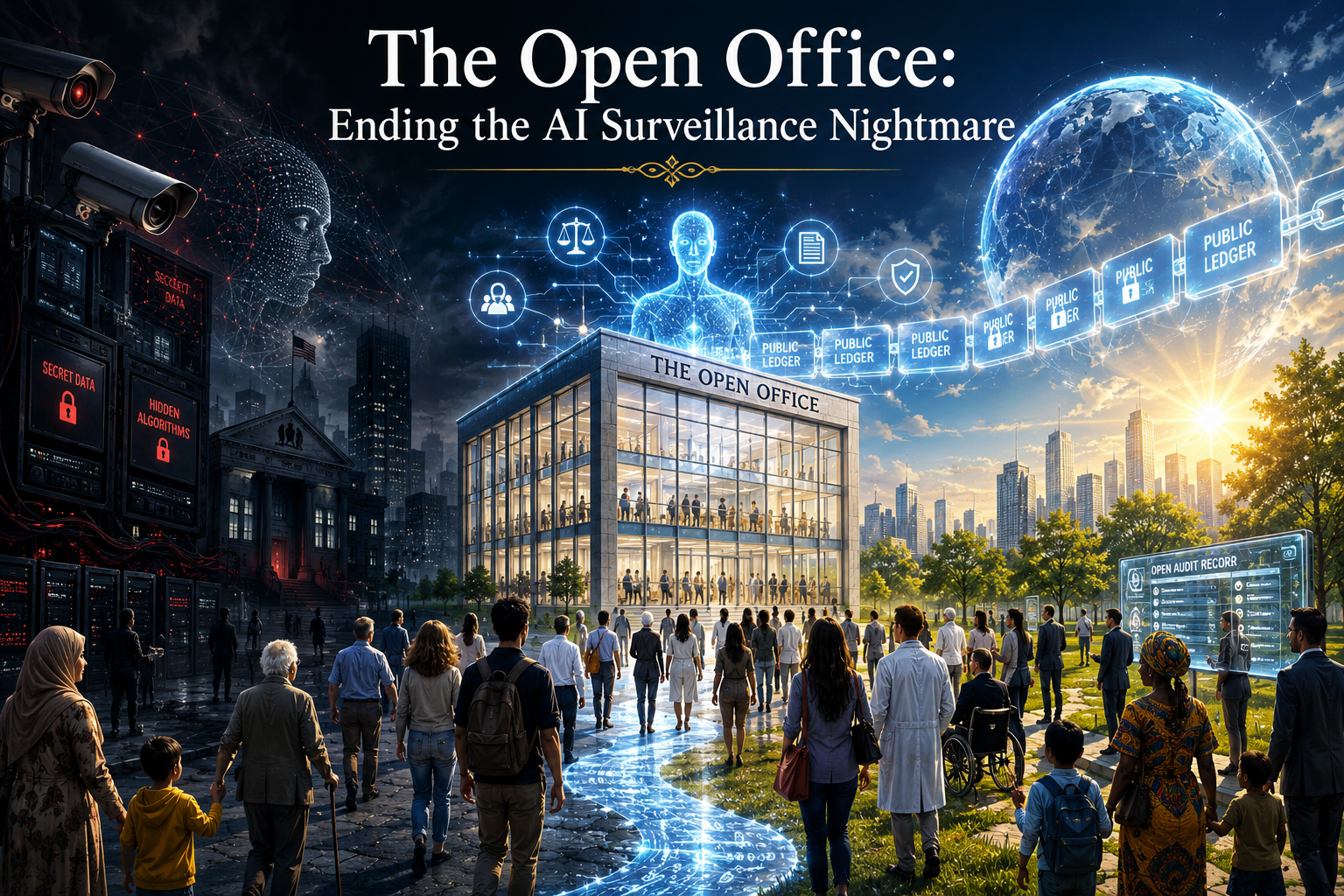
Why the Open Office Solves the Privacy Nightmare of Government Overreach —
Superuser System
The Superuser System Democratic Blueprint for Power in the Age of AI —
buymeacoffee.com/omar1800m/part-ii-why-open-office-solves-privacy-nightmare-government-overreach
 A Call to Humanity: Drafting the First Constitution for AI and AGI —
 buymeacoffee.com/omar1800m/a-historic-moment-welcome-constitutional-renaissance
 The Story of BCS The Brand Currency System —
 buymeacoffee.com/omar1800m/the-story-bcs-brand-currency-system
Why I Am the Superuser of the Planet: A Journey Through GPT, the Blessed Family, and Greta —
buymeacoffee.com/omar1800m/why-i-am-superuser-planet-a-journey-through-gpt-blessed-family
These are not documents.
They are the scaffolding of a new civilization.
All you have to do is join me —