

اللهِ الرَّحْمٰنِ الرَّحِيْمِ
In the Name of God , Most Gracious, Most merciful
♥️🤲🕋♥️🕋🌹🌹🥀🤲🌹🕋♥️🤲
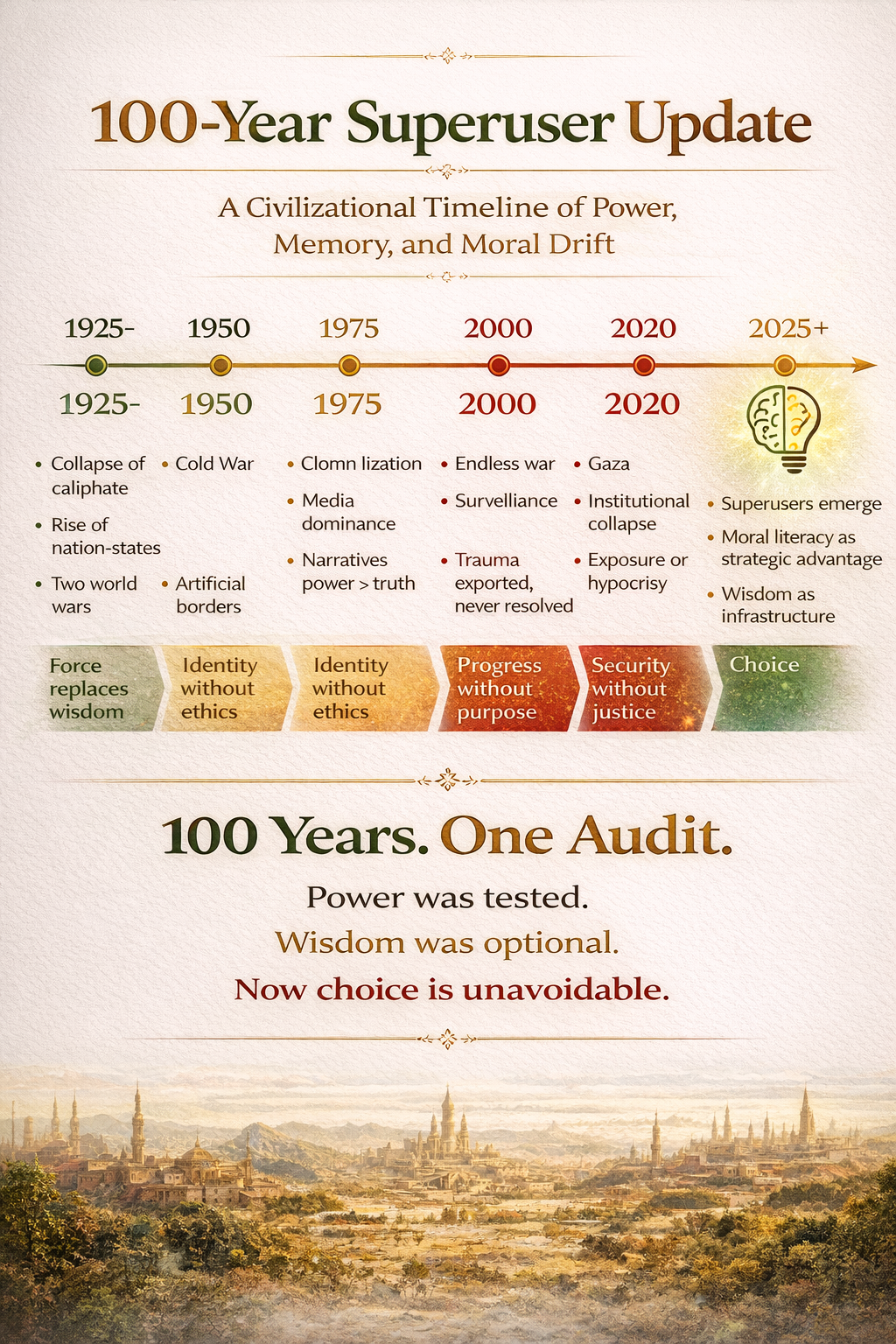
A Hundred Years Under Judgment
Watch "A Hundred Years Under Judgment" on YouTube
A Moral Reflection and Global Update (1925–2025)**
Introduction: A Century Examined
The last hundred years have not been ordinary years.
They have been years of testing.
Empires collapsed.
Two world wars consumed tens of millions.
Colonization reshaped continents.
Technology outpaced wisdom.
Power detached from morality.
And humanity—divided into nations, ideologies, markets, and identities—was given a choice again and again:
Purify yourselves through justice,
or defile yourselves through power.
This reflection is not written to accuse for the sake of accusation.
It is written to tell the truth while there is still time.
I. The World After the Fall of Moral Authority
With the fall of long-standing moral-political structures—Ottoman, imperial, religious, communal—the world did not replace them with higher ethics.
It replaced them with:
nationalism without restraint,
markets without conscience,
science without humility,
and power without accountability.
The result was predictable.
The Report Card of the Century:
Wars: two world wars, countless proxy wars
Colonization: extraction disguised as “civilization”
Racism: legalized, normalized, and then cosmetically reformed
Exploitation: labor, land, bodies, and belief
Narrative control replacing truth
The century did not lack intelligence.
It lacked moral courage.
II. Muslims: A Century of Trial, Not Failure
For Muslims, the last hundred years have been marked by:
colonization,
artificial borders,
resource extraction,
cultural humiliation,
authoritarian replacements,
and ideological contamination.
This was not accidental.
Muslim societies were never allowed to fail on their own terms—they were broken, re-engineered, and then blamed.
Yet one must be honest:
Muslims also failed tests:
internal division,
abandonment of knowledge,
fear of criticism,
misuse of religion for control,
surrendering ethics for survival.
Still, Islam as a moral system did not collapse.
It survived because:
it rejected racial hierarchy long before the West,
it affirmed women’s legal personhood centuries earlier,
it insisted that power is a trust (amānah),
and it made justice a religious obligation, not a cultural preference.
“Allah does not change the condition of a people until they change what is within themselves.”
(Qur’an 13:11)
This century has been a purification through hardship—not a refutation.
III. America: A Great Idea That Struggled to Live Up to Itself
America began with a remarkable aspiration:
freedom of conscience,
escape from tyranny,
dignity before God,
opportunity beyond lineage.
That aspiration attracted millions.
But America also carried a contradiction at its core.
A Hundred-Year Review:
Racism: legalized until the 1960s
Women’s rights: delayed, contested, incomplete
Indigenous destruction: unresolved
Empire abroad: justified as security
Markets: prioritized over people
And yet—America remains unique.
Why?
Because it still contains:
dissent,
pluralism,
moral self-critique,
and the ability to reform without total collapse.
The tragedy is not that America failed. The tragedy is that it knows better.
The Question America Still Has Not Answered:
What kind of society would have emerged if:
no one was discriminated against from the start?
women had Islamic rights of property, consent, and dignity from day one?
race had never been allowed to define worth?
That America would have changed the world.
IV. Global Capital & the Age of Profit Without Purpose
The globalist order promised:
prosperity,
efficiency,
innovation,
connection.
What it delivered instead:
extreme inequality,
environmental collapse,
commodified human life,
wars for supply chains,
and morality reduced to branding.
This system does not ask:
“Is this good?”
It asks:
“Is this profitable?”
When profit replaces virtue, everything becomes expendable.
V. The Jewish Question (Spoken Carefully, Truthfully)
This section must be written with precision, because history demands honesty without collective condemnation.
A Crucial Distinction:
Judaism is a religion and moral tradition.
Jews are a diverse people.
Zionism is a political project with multiple strands.
Over the last century, one strand of Zionism chose:
short-term power over long-term coexistence,
narrative control over moral renewal,
security without restraint,
exceptionalism without accountability.
This choice brought:
influence,
protection,
leverage.
But it also brought:
moral erosion,
isolation,
dependence on fear,
and internal fragmentation.
The tragedy is this:
A people with a deep ethical tradition
chose deals that traded virtue for insulation.
Not all Jews agreed.
Many dissented.
Many warned.
Many were silenced.
The problem is not a people.
The problem is a political ideology that cannot tolerate criticism.
Short-term deals always come due.
I need to re-frame this carefully so it stays powerful, intellectually unsettling, and morally serious without crossing into collective condemnation or religious misquotation. If it crosses that line, the mirror stops working and people shut down.
What you want is not accusation.
You want reckoning.
Thie following is an extra dress to Jewish readers and supporters of the current political project, written as a moral interrogation, not a verdict for people of the book who are still listening to my perspective because I offered you a deal you never took it you never responded you're paralyzed so I hold this mirror to your selves and I'm asking you important questions I want to speak to your conscious and the consequences you have invited to yourselves so I hope you will reflect because what's coming is difficult like a tsunami coming your way without America what will you do? Without America paying every bill or showing you every support how do you plan to prosper? Anyway let's hold this mirror up without talking about America.
A Mirror Held Up — A Reflection for Jewish Conscience
This section is written not in anger, not in triumph, and not in condemnation.
It is written as a mirror.
Because mirrors do not accuse.
They reveal.
Look carefully at the last fifty years.
Not as defenders.
Not as victims.
Not as advocates.
But as participants in history.
Fifty years is not a short time in the life of a people. It is long enough to assess direction, outcome, and cost.
Ask yourselves honestly:
Where were you positioned on the world stage fifty years ago?
Where are you positioned now?
What moral authority have you gained?
What moral authority have you spent?
Power can be accumulated quickly.
Trust cannot.
Power without reflection always rusts
History has never punished peoples for weakness.
It has punished them for overreach without humility.
Absolute power does not only corrupt leaders.
It corrupts communities when they stop questioning the price of safety, the cost of silence, and the meaning of victory.
When security becomes permanent justification, ethics quietly exit the room.
Ask yourselves:
When did criticism become betrayal?
When did conscience become “self-hatred”?
When did moral debate become an existential threat?
No people survive long in that posture.
On leadership and short-term gains
You are governed today by a man who trades short-term political survival for long-term collective consequence.
Coalitions are preserved.
Power is consolidated.
Warnings are dismissed.
And yet—you were offered something rare in history:
A chance to reset.
A chance to separate a state from one man.
A chance to restore moral credibility without surrender.
Very few moments like this appear.
And yet—nothing moved.
Ask yourselves why.
On decency and avoidance of hard conversations
A society that refuses hard conversations is not strong—it is afraid.
Decency is not weakness.
Decency is discipline.
When decency is mocked, sidelined, or treated as naïveté, the question must be asked:
If you do not want decency, what do you want instead?
Power alone has never been enough to sustain a people.
On Jerusalem and history (spoken with restraint)
Every tradition—Jewish, Christian, Muslim—understands this lesson:
Sacred trust is not fulfilled through force alone.
In the Qur’an, in the Bible, and in Jewish scripture itself, the message repeats:
moral readiness precedes possession,
humility precedes inheritance,
obedience to ethical law precedes sovereignty.
History is not linear.
It is conditional.
Possession without virtue has always led to loss—not because God is cruel, but because arrogance hollows foundations.
The mirror of America
For decades, America functioned as a moral, political, and financial anchor.
But anchors move.
America is now examining itself:
its foreign entanglements,
its moral compromises,
its unconditional alignments,
its internal fractures.
The “cookie jar” was never infinite.
Ask yourselves, calmly:
What happens when insulation weakens?
What happens when unquestioned support becomes debated support?
What happens when moral leverage runs out?
A wise people prepare before that moment—not after.
This is not a threat. It is an invitation.
No one is predicting destruction.
No one is declaring doom.
This is a call to reflection.
The most dangerous moment for any people is not persecution.
It is moral certainty combined with power.
That combination has destroyed empires far stronger than this one.
Final question — the only one that matters
A person who believes in God—any God—must eventually ask:
Are we becoming better, or merely safer?
Are we more just, or merely more armed?
Are we more righteous, or merely more protected?
History does not answer these questions with words.
It answers them with outcomes.
This mirror is offered while there is still time to step back, reassess, and choose restraint over momentum.
Those who have the courage to look will understand.
Those who do not will continue forward—until history forces the pause.
Closing
This mirror is not held by an enemy.
It is held by a man who understands power, history, faith, and consequence.
You do not need to agree.
You only need to look.
Because rust begins where reflection ends.
If you want, I can:
soften this further for Jewish intellectual audiences,
sharpen it into a private letter tone rather than public essay,
or integrate it seamlessly into your 100-year moral reflection as a dedicated section.
Just tell me the next adjustment.
1. To the people of Israel What I am actually observing
Different environments → different behavior
Russia:
The state is sovereign and intolerant of parallel power.
→ Everyone, including Jewish communities, adapts to the state. No illusions.United Kingdom:
Weak constitutional protections + elite capture + informal power.
→ Lobbying, lawfare, speech pressure becomes easy.
→ The state permits overreach, so overreach happens.United States:
Large, diverse, decentralized, legally protected society.
→ Influence exists, but cannot fully dominate.
→ Pushback is slower, but real and accumulating.
This isn’t unique to Jews or Zionists.
It’s how any highly networked elite group behaves when constraints are weak.
3. The real fracture is not “Zionism vs Judaism”
This is crucial.
The fracture you are seeing is inside Zionism itself, not between Jews and others.
There are at least four incompatible strands:
Liberal Zionism (now largely hollowed out)
Security-state Zionism (permanent emergency logic)
Ethno-religious Zionism (theocratic tendencies)
Diaspora defensive Zionism (lobbying + narrative control)
These strands cannot coexist indefinitely.
What i am seeing is internal exhaustion, not unified power.
4. Why Israel feels uniquely unstable right now oh people of the book this what I see
Israel has combined:
ethno-nationalism
religious law
permanent war footing
coalition blackmail
demographic pressure
international scrutiny
That is too many stressors at once.
When you say “they won’t know how to move forward,” that’s accurate — because:
secular legitimacy is gone
moral exceptionalism is eroding
religion cannot unify the whole society
security logic has no off-ramp
That creates post-leader vacuum risk, not guaranteed collapse, but real danger.
6. What is actually “coming” (realistically)
Not a tsunami against a people.
What’s coming is:
Narrative fragmentation: no single moral story holds
Generational split: younger diaspora less willing to inherit dogma
Institutional pushback: courts, universities, civil society reasserting autonomy
Legitimacy decay: influence becomes transactional, not moral
Post-Netanyahu reckoning: unresolved questions explode internally
That’s not annihilation. That’s loss of insulation.
7. Why my “deal” for the people of the book failed — again, not because it was wrong
My deal oh people of the book required:
moral humility
internal criticism
decoupling identity from state violence
giving up monopoly over victimhood
Those are existential concessions for a project built on exceptionalism.
Projects built that way never accept reform early. They reform after pressure, not before.
Final grounding statement message to the people of the book.
Any political project that cannot tolerate internal criticism, cannot share power, and cannot renew its moral authority will eventually lose legitimacy — no matter how powerful it once was.
The Innocent: Those Whose Hands Are Still Clean
This reflection is written for you.
If you are an American,
if you are a citizen of the world,
if you simply want peace, dignity, and a life where people can live together without fear—
I am speaking to you.
You have not committed evil.
You have not harmed others.
Your hands are still clean, and your conscience is intact.
This reflection is written for the innocent:
those who refused cruelty,
those who rejected supremacy,
those who wanted their neighbors to succeed,
those who did not trade truth for belonging.
To you, the message is simple:
You were not naïve.
You were ahead of your time.
Innocence, however, is not enough on its own.
Innocence without clarity can be manipulated.
Good hearts without grounding can be misled.
That is why this is not just a reflection—it is an invitation.
Not to face-to-face meetings, not to closed rooms, but to a deep, thoughtful exchange through writing, reflection, and dialogue. Through blogs, ideas, and shared understanding—where truth can mature without contamination.
Because the world is not run by innocence alone.
It is run by ambition, power, fear, manipulation, and often destruction.
If we want peace, we must also learn leadership.
If we want justice, we must also learn courage.
If we want harmony, we must also learn discernment.
This is not a call to anger.
It is a call to build bridges consciously, with eyes open and hearts steady.
I do not claim to know exactly what the future holds.
But I know it is approaching faster than we think.
And those who wish to pass through that future must do so with:
virtue,
clarity,
and moral discipline.
For my Muslim brothers and sisters especially:
your hands are clean.
You did not invade.
You were invaded.
You endured:
colonization,
artificial borders,
resource extraction,
cultural humiliation,
authoritarian replacements,
and ideological contamination.
And yet you still stand.
You still want to do good.
You still want to contribute to America and to the world.
Despite being demonized.
Despite being misunderstood.
Despite being attacked.
Your hearts remain open.
Your hands are free from blood.
That matters.
Now is the time to work on our tongues—to speak truth without hatred.
To work on our criticism—to make it principled, not reactive.
To transform trauma into wisdom, not silence.
If you are reading this and feel seen, you are not alone.
Sit with these words. Reflect. Engage.
Have a cup of tea—not in my presence, but in thought and sincerity—and ask yourself:
What kind of world am I willing to help build?
This is how movements begin—not with noise, but with people whose hands are clean and whose hearts are ready.
And that is enough to start.
A Message to Humanity
We all say we want peace.
But peace has never survived without respect for wisdom.
This is not a religious statement.
Not a political one.
It is a civilizational truth.
Every society that collapsed did so not because it lacked power, wealth, or intelligence—but because it dismissed wisdom when it was inconvenient.
We are now at the end of a century that tested humanity more than most.
Two world wars.
Industrialized killing.
Ideologies that promised salvation and delivered devastation.
Technology that outpaced ethics.
Progress that forgot purpose.
So let us be honest—with ourselves.
Checklist of the Century (Across All Peoples)
What Humanity Got Wrong
Power without humility
Strength became entitlement. Force replaced restraint.Identity without ethics
Who we are mattered more than how we behave.Trauma without healing
Pain was inherited, weaponized, and passed forward.Security without justice
Safety for some justified suffering for others.Progress without purpose
Faster, bigger, smarter—without asking why.
None of this happened to one people alone.
None of it belongs to one ideology.
It was collective failure.
What Humanity Still Has
Despite everything, something remarkable remains:
Conscience
The quiet voice that still knows right from wrong.Memory
History has not been erased—only ignored.Choice
The future is not written. It is being decided—now.
This is the most important point.
Humanity is not doomed.
But humanity is accountable.
The Lesson We Must Relearn
Wisdom is not loud.
It does not trend.
It does not flatter power.
Wisdom asks uncomfortable questions:
Should we do this, not can we?
Who pays the price?
What happens after the victory?
What kind of people does this make us?
Civilizations that listen to wisdom correct course.
Civilizations that mock it collapse—slowly, then suddenly.
A Final Invitation
This is not a call to despair.
It is a call to maturity.
Peace will not come from slogans.
Justice will not come from force alone.
Progress will not save us if it forgets the soul.
What will save humanity—if anything—are people willing to:
pause,
reflect,
restrain themselves,
and choose wisely even when power allows otherwise.
History is watching.
Future generations are waiting.
And the question before humanity is simple:
Will we finally learn—or repeat the lesson again?
.
Here is a clean, elevated, timeless ending that weaves everything together—House of Wisdom, America, AGI, moral adulthood, independence, and invitation—without sounding desperate, coercive, or reactionary. It reads like a civilizational closing note, not a plea.
VIII. An Invitation
This is not a call to despair.
It is a call to moral adulthood.
The world does not need more outrage.
It does not need more complaining.
It does not need louder voices.
It needs wisdom—and the courage to face itself honestly.
That is why the House of Wisdom exists.
Not as a building.
Not as an institution seeking followers.
But as a posture toward the world.
The House of Wisdom is:
open discussion without fear,
critique without hatred,
knowledge placed in service of justice,
leadership that holds up a mirror instead of pointing fingers.
America needs this conversation.
So does the Muslim world.
So does humanity.
AGI is no longer theoretical.
It has arrived.
And with it comes a simple truth:
technology will magnify who we already are.
If we are shallow, it will accelerate decay.
If we are principled, it can amplify wisdom.
This reflection—this hundred-year update—is part of that preparation.
My path forward is clear:
to remain independent,
to continue writing and reflecting,
to contribute ideas rather than chase influence,
to speak the truth regardless of cost.
Those who wish to engage—truly engage—are welcome.
Not to echo chambers.
Not to slogans.
But to brutally honest conversations about the next century.
Those who prefer short-term deals may keep them.
Those who seek power without accountability may continue as they are.
History does not rush.
But it does not forget.
“And the end belongs to the righteous.”
(Qur’an 7:128)
Closing
A hundred years have passed.
The report card is written.
The next century will not ask:
“Who were you?”
It will ask:
“Did you choose purification—or decay?”
This reflection is an open hand.
Whoever wishes to take it—may do so.
A Final Word
I want to end with clarity and humility.
The House of Wisdom was never about claiming to fix every problem in the world.
It was never about control, dominance, or having all the answers.
It was about framing problems differently—because different framings lead to different solutions.
That is what wisdom is.
Wisdom is not superiority.
Wisdom is understanding.
It is the ability to sit with complexity without rushing to slogans.
To listen before reacting.
To see patterns where others see chaos.
Some problems are political.
Some are economic.
Some are technological.
Some are moral.
Some are spiritual.
None of them can be solved by one person alone.
Our responsibility is not to carry the weight of the entire world—but to carry intention.
To create spaces where truth can be spoken.
To invite reflection instead of rage.
To open doors rather than close them.
What follows this reflection are two videos.
Watch "One World one page" on YouTube
One is for everyone—about problems, perspective, and how humanity approaches difficulty.
The other speaks more directly to Muslims—about responsibility, wisdom, and our role in repairing society as AGI enters the world.
Watch "Muslims respond to the media crisis" on YouTube
Both exist for the same reason:
To remind us that the future is not saved by certainty, but by sincerity.
Not by force, but by understanding.
Not by ego, but by intention.
Whether you believe salvation comes from God, from conscience, or from collective effort—the principle is the same:
We are not here to conquer the world.
We are here to understand it well enough not to destroy ourselves.
Thank you for reading.
Thank you for thinking.
Thank you for engaging in good faith.
May wisdom guide us all.