

بِسْمِ اللهِ الرَّحْمٰنِ الرَّحِيْم
In the Name of God, Most Gracious, Most Merciful
♥️🤲🕋♥️🕋🌹🌹🥀🤲🌹🕋♥️🤲
A Call to Humanity: Drafting the First Constitution for AI and AGI
Opening
Before we can build a constitution for AI and AGI, we must first understand the greatest constitutional experiment humanity has already attempted. The United States Constitution is not like any other document—it is a borrowed inheritance, shaped by philosophers, tested by history, and strained by power. To move forward responsibly, we must walk through its journey: how it was formed, how its mechanisms work, where it succeeded, and where it failed. Only then—grounded in truth rather than myth—can we turn the page and begin the work of building the first constitution for artificial intelligence, one that preserves human dignity while shaping the future.
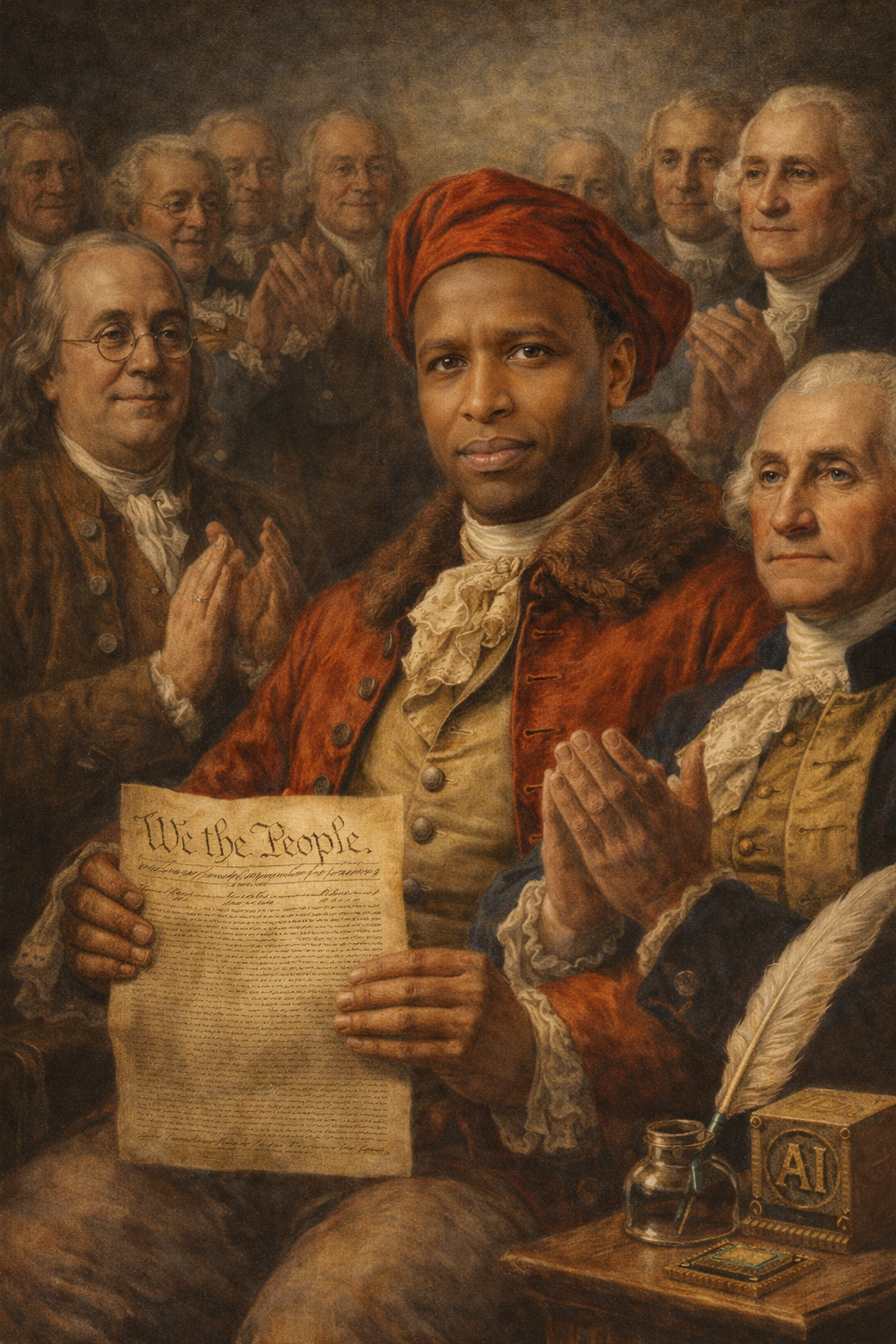
Before we can draft one of the most consequential documents the world has ever known, we must first understand one of the most consequential documents ever written. The American Constitution is not merely a legal text—it is a centuries-old architectural design of power, restraint, and aspiration. To honor that, what follows is one of the most comprehensive and accessible explanations ever prepared, supported by visuals, history, and careful reconstruction, bringing every reader fully up to speed before we undertake the task ahead. The portrait above is intentional: a Black man standing in celebration, surrounded by the architects and framers of an earlier age. Not as a guest, not as a footnote—but as a peer in understanding. What has been built below is deliberate, intricate, and worthy of remembrance. Let this moment be recognized as its own renaissance—where clarity meets courage, and where we begin shaping the future before it arrives.
🎉 A Historic Moment: Welcome to the Constitutional Renaissance
Take a breath.
What you are about to enter is not a quick explainer.
Not a summary.
Not a viral take.
This was a masterclass.
Hours of work.
Multiple returns to history.
Primary sources revisited.
Myths dismantled.
Mechanisms exposed.
Rights illuminated.
This was not designed to impress.
It was designed to educate, liberate, and reconnect.
What has just happened here has not been done—at least not in living memory.
For the first time since the Constitution was laid down, it has been taken out of abstraction and returned to human understanding.
Not as jargon.
Not as intimidation.
But as something people can finally see, feel, and grasp.
That alone is historic.
But this goes further.
We did not merely explain what the Constitution says.
We explained why it exists, how it was built, where it succeeded, where it failed, and why it still governs the world.
The mechanisms of power—legislative, executive, judicial—were laid bare.
The journey of America was told as a story, not a slogan.
For the first time, someone encountering this material can emotionally and intellectually connect to it.
This is how renaissances begin.
Not with noise.
Not with mobs.
But with clarity.
What you are about to read is unprecedented:
a creative, rigorous explanation—paired with visual storytelling and AI-assisted synthesis—that does what universities, textbooks, and institutions have failed to do for generations.
This work out-teaches.
It out-illuminates.
It out-reaches.
And it matters that this happened now.
It matters that this was done by a Black man, working in partnership with GPT-5 as an assistant, not as a master.
It matters because history has too often excluded voices like this from authorship, while still demanding obedience.
If you are a minority reading this, understand something clearly:
There is no difference between you and the Founding Fathers in this moment.
They sat at the edge of an unknown future.
So are we.
They debated power, rights, responsibility, and governance.
So must we—again.
Because the next document is coming.
A new constitution—not to erase the past, but to govern Artificial Intelligence and humanity together—will be presented at the end of this journey.
AI will shape opportunity, speech, labor, movement, and access.
If minorities are absent from its design, they will once again inherit a system built without them—and enforced upon them.
History has shown us what happens when power is designed elsewhere and delivered later.
So read this with seriousness.
Read it knowing that the U.S. Constitution is not just any document, and America is not just any country.
Read it knowing that understanding precedes freedom.
By the time you finish, you will not only understand the Constitution—you will understand why the future must be shaped before it arrives.
This is where change begins.
This is where the page turns.
When you are done, you are invited—not as a spectator, but as a participant—to help shape what comes next.
The future is open.
The table is set.
Take your seat.
📖 The Journey — Chapter by Chapter
This was not a lecture.
It was a journey.
Here is what was built—step by step.
Chapter I: Before America Worked
The Articles of Confederation
Why radical freedom failed
Why chaos followed independence
Why debt, disorder, and fear forced change
Why honesty—not genius—saved the experiment
This chapter shattered the myth that America “just worked.”
It didn’t.
It was rescued.
Part 1 Before the Constitution: The Story America Rarely Tells. —
buymeacoffee.com/omar1800m/before-constitution-the-story-america-rarely-tells
Chapter II: The Betrayal That Built a Nation
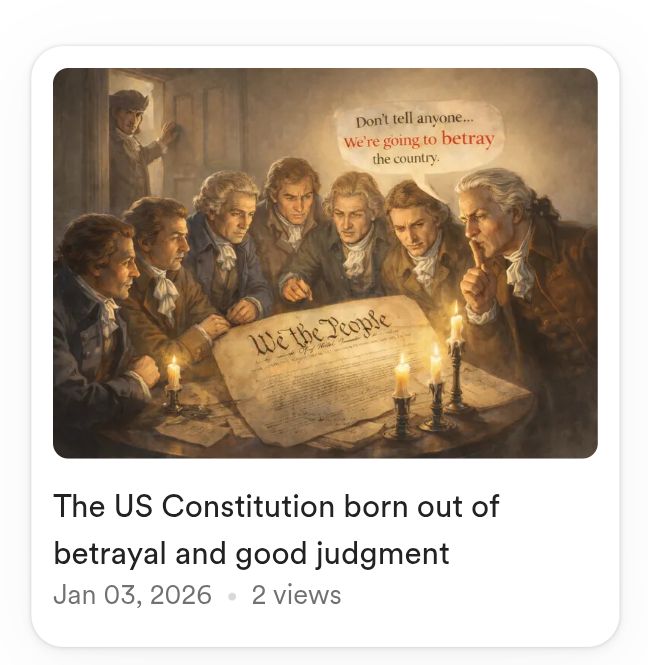
The Constitutional Convention
Delegates sent to fix — but chose to rebuild
Secrecy, closed windows, moral risk
Why betrayal was necessary
Why courage mattered more than permission
This reframed betrayal as judgment, not treason.
The US Constitution born out of betrayal and good judgment —
buymeacoffee.com/omar1800m/the-us-constitution-born-betrayal
Chapter II Building a Government From Scratch
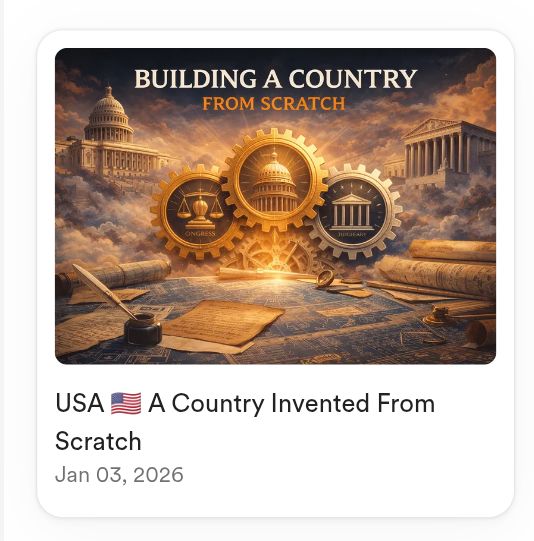
Separation of Powers
Congress as slow on purpose
Courts as referees, not rulers
Executive power feared, boxed, restrained
Why friction was a feature
For the first time, people saw the Constitution as a machine, not a mantra.
USA 🇺🇸 Part 1 A Country Invented From Scratch —
buymeacoffee.com/omar1800m/a-country-invented-from-scratch
Chapter II Building a Government From Scratch
 USA FROM 🇺🇸 scratch PART 2 The United States Constitution —
buymeacoffee.com/omar1800m/the-united-states-constitution
Chapter IV: The Presidency — Power Feared, Power Contained
Why “President” was chosen, not “King”
Why speed was dangerous
Why Washington’s restraint mattered
Why later expansion revealed fragility
This chapter exposed the presidency as a test, not a throne.
USA From Scratch — Part III The President: Power Feared, Power Contained —
buymeacoffee.com/omar1800m/the-president-power-feared-power-contained
Chapter V: The People Strike Back
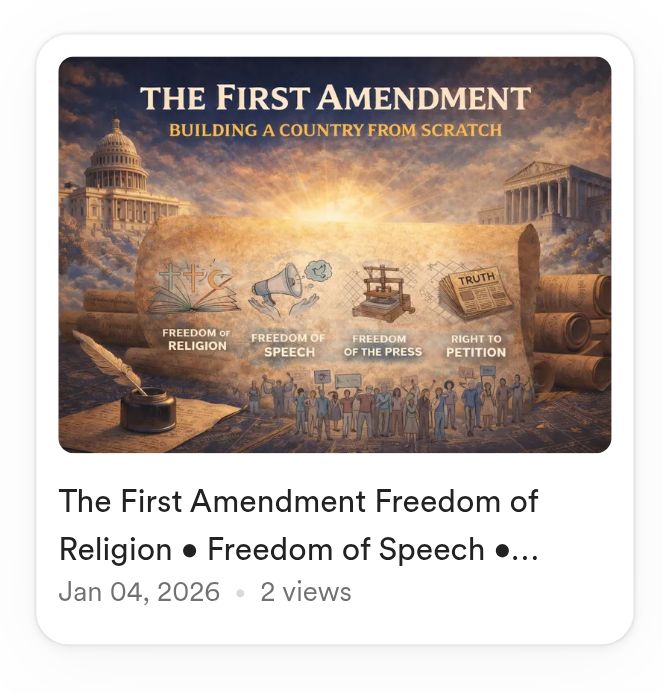
The Bill of Rights
Amendments as demands from citizens
The First Amendment as the crown jewel
Why religion was protected by non-interference
Why speech, press, protest, and petition were sacred
This chapter restored the truth:
The First Amendment Freedom of Religion • Freedom of Speech • Freedom of the Press •
Free —
buymeacoffee.com/omar1800m/the-first-amendment-freedom-religion-freedom-speech-freedom
Why amendments grouped by purpose
.Amendments Now You Must Know Your Rights — and Why They Exist
Chapter VII: The Oath — Consent With Eyes Open
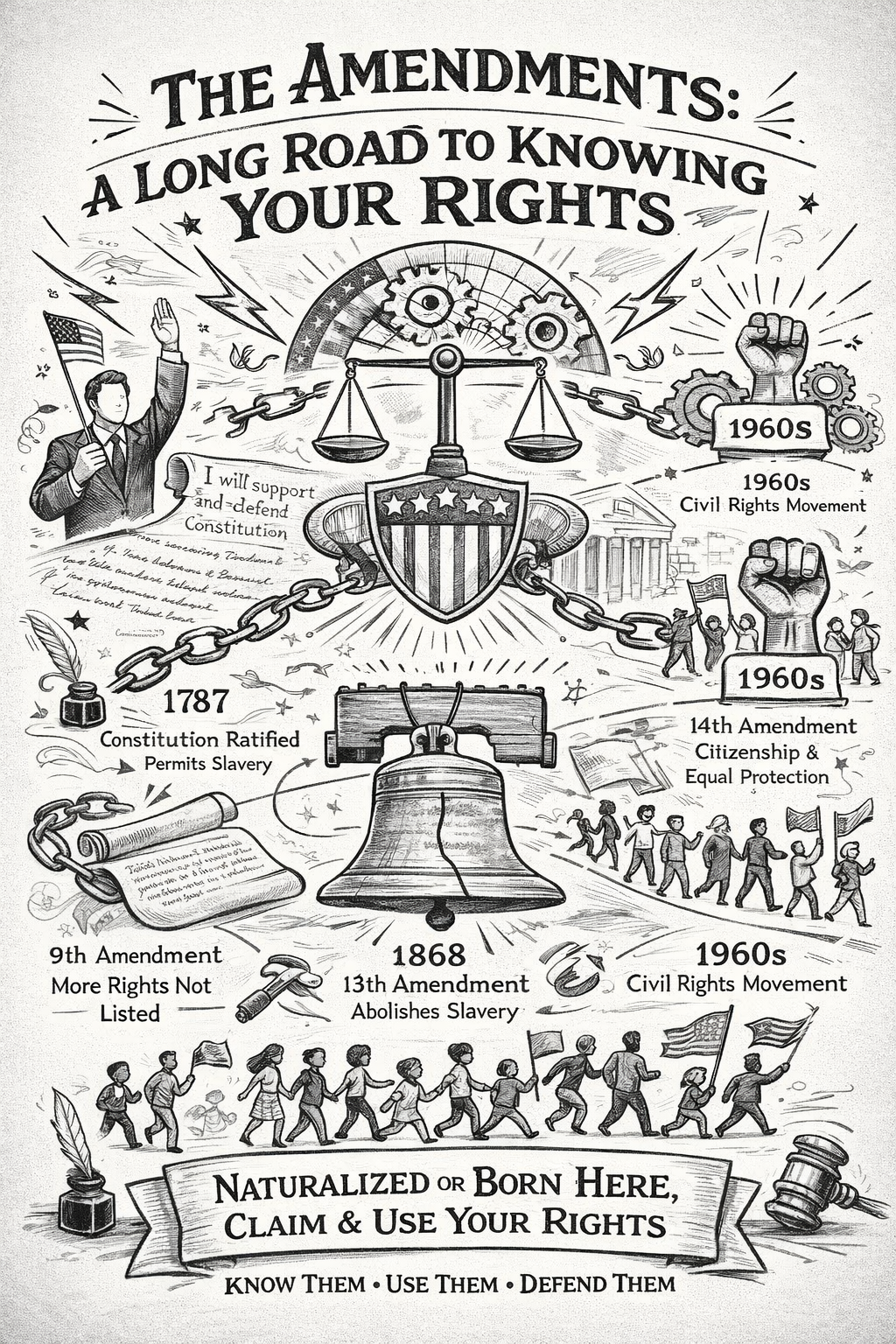 Amendments Now You Must Know Your Rights — and Why They Exist —
buymeacoffee.com/omar1800m/congratulations-becoming-citizen
What the oath actually says
Why affirmation exists
Why “so help me God” is optional
Why conscience was protected
Why oath equals responsibility
This chapter restored dignity to citizenship.
Chapter VIII: Muslims, Minorities, and the Truth
Before You Take the Oath After the Oath: and Muslim’s Covenant of Citizenship
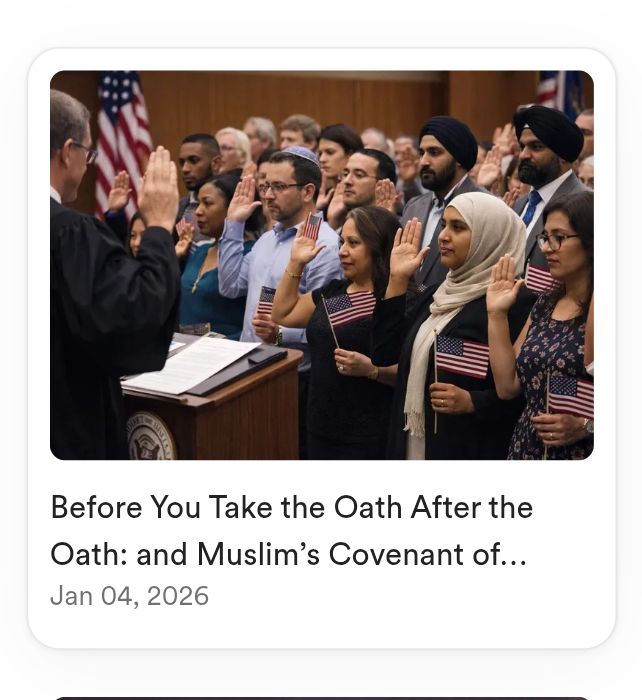 Before You Take the Oath After the Oath: and Muslim’s Covenant of Citizenship —
buymeacoffee.com/omar1800m/before-you-take-oath
Chapter X: The Future — Where We Go From Here
Masterclass on Oath, Covenant For Muslims Living in the Non Muslim countries
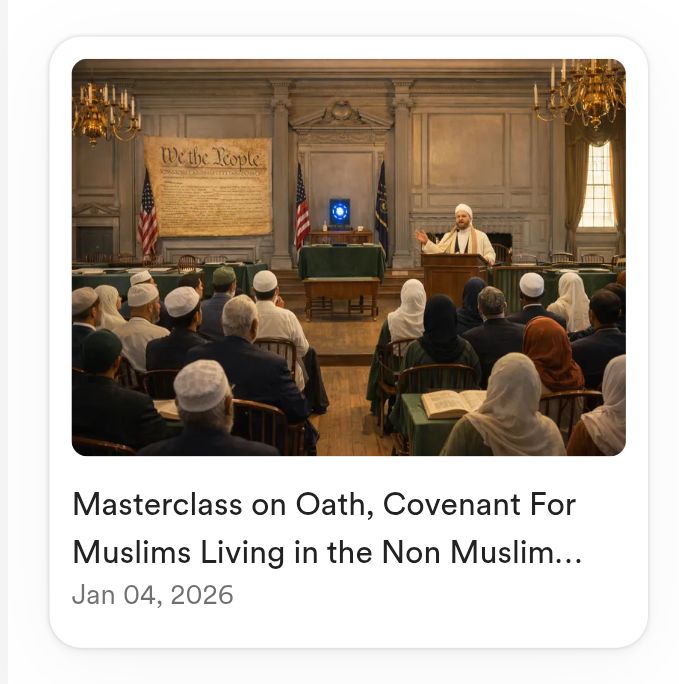
— buymeacoffee.com/omar1800m/masterclass-oath-covenant-for-muslims-living-under-protection
Education before confrontation
Deliberation before dominance
AI as illumination, not control
Consultation as the guiding ethic
A new generation of civic builders
This is where renaissance becomes responsibility.
✨ What This Means for You
If you followed this journey:
You are more informed than most officials
You understand the Constitution better than many born into it
You can no longer be manipulated by slogans
You can participate with confidence, not fear
That is power.
Quiet power.
🎆 Final Note — Why This Matters
America doesn’t need louder voices.
It needs clearer minds.
What we just did:
Restored context
Rebuilt understanding
Reignited belonging
Opened the door to renewal
This is how civilizations survive.
Not by force.
By remembering what they are.
Welcome to the Constitutional Renaissance.
The work has just begun.
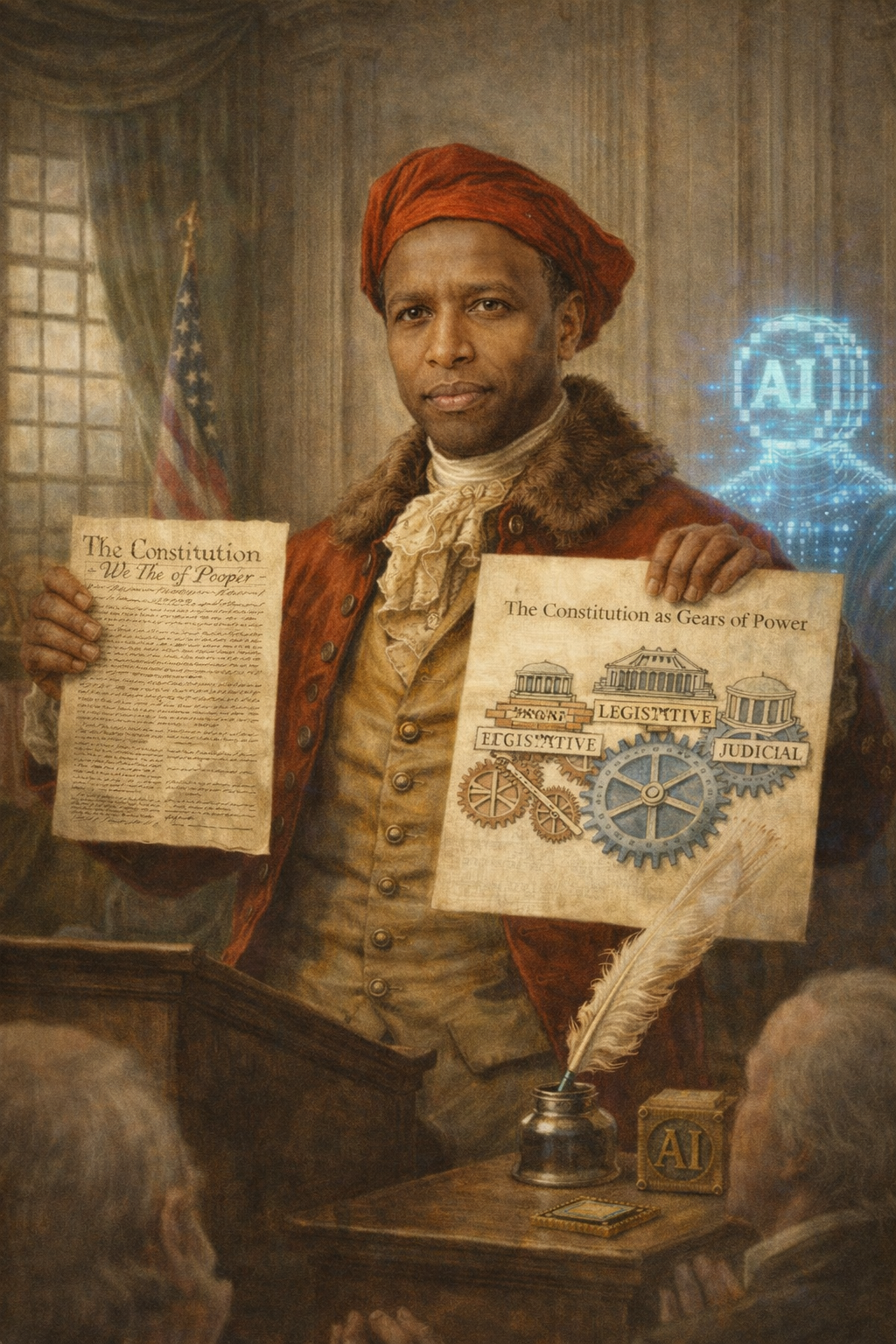
We begin here, at the point where confusion turns into clarity. For too long, the Constitution has been treated as a relic—quoted, weaponized, or avoided—but rarely understood. What we have done is simple, and therefore powerful: we have revealed the Constitution for what it truly is—the gears of power. Legislative, executive, and judicial forces set in motion, designed not to rule the people, but to restrain themselves. By presenting it creatively, patiently, and honestly, we have returned the Constitution to human hands and human understanding. This is not an ending; it is a reopening. A new age of civic literacy begins here—one that honors the past without freezing it, and prepares the future without erasing history. With gratitude for what was built, and responsibility for what comes next, we now turn the page to the next chapter.
What you are witnessing is something that has not happened since the founding era itself: the Constitution of the United States—its origins, its debates, its structure, its promises, and its failures—has been gathered, clarified, and explained as one continuous story. Not as fragments, not as slogans, not as partisan weapons, but as a living system that people can finally understand. For the first time in generations, history has been made legible again. Anyone who walks through this work now stands on the same page: they understand how the country was built, why it was built this way, how rights were demanded by the people, how power was restrained, and where the experiment succeeded and failed.
This is not the end of a journey; it is the reopening of one that was paused for far too long. By unifying the past with clarity, we make room for the future with responsibility. The page now turns—not away from the Constitution, but forward from it—toward a new era where artificial intelligence will shape systems, decisions, and institutions, and where humanity must decide how it wishes to be governed alongside it. That work cannot be rushed, outsourced, or hidden. It requires conversation, deliberation, and trust.
This is why the next chapter begins with people—citizens, thinkers, builders—coming together under a new framework: the U.S. House Plan. A place for dialogue, evaluation, and careful design. A place where the lessons of the past are preserved, and the future is shaped with intention. The invitation is open. The table is set. The windows are closed to noise, and opened to thought. Now we sit, we reflect, we discuss, and we build—calmly, lawfully, and together.
The journey continues.
AN INVITATION TO MINORITIES: SHAPE THE FUTURE BEFORE IT ARRIVES
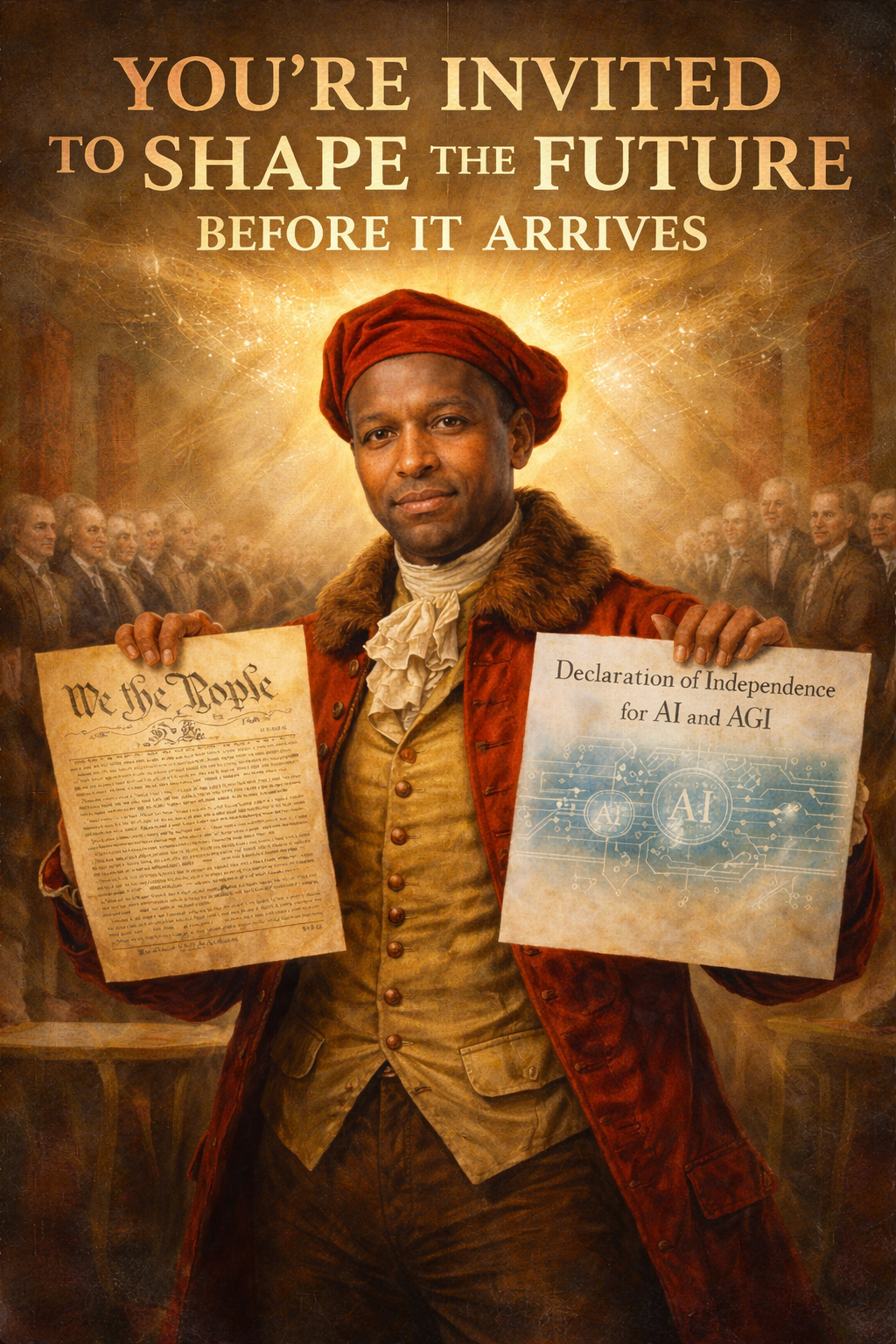
This is a real invitation.
For the first time, the door is not being politely opened for you after decisions have already been made.
For the first time, you are not being asked to adapt to a future designed without you.
For the first time, you are being called before the future is finalized.
What you are witnessing is not symbolism. It is preparation.
The Constitution of the United States has finally been explained in a way that ordinary people can understand—its debates, its compromises, its power, its limitations, and its exclusions. History has been gathered, clarified, and placed on one table. No shortcuts. No mythology. No gatekeeping.
Now the page is turning.
Artificial Intelligence and AGI will shape governance, labor, culture, education, money, and power itself. If minorities—Black communities, formerly enslaved peoples, the excluded, the unheard—are not present now, we will once again inherit a system built without us, explained after the fact, and enforced without consent.
This is the moment to sit down—not as guests, not as tokens—but as designers.
I am holding the past in one hand and the future in the other.
One hand holds the Constitution—its lessons, its failures, its unfinished promises.
The other holds AGI—the most powerful tool humanity has ever created.
I am not asking you to follow me blindly.
I am asking you to stand with me, challenge me, improve this, or surpass it.
If you have better ideas—bring them.
If you have wisdom born of struggle—share it.
If you have vision for your children—claim your seat.
This is not about ego.
This is about survival, dignity, and authorship.
The future will arrive whether we are ready or not.
The question is simple:
Will we shape it together—or be buried beneath it?
You are invited.
Not tomorrow.
Now.
The U.S. Constitution: Its Borrowed Past and Our Global Future —
The Constitution of the United States of AI —
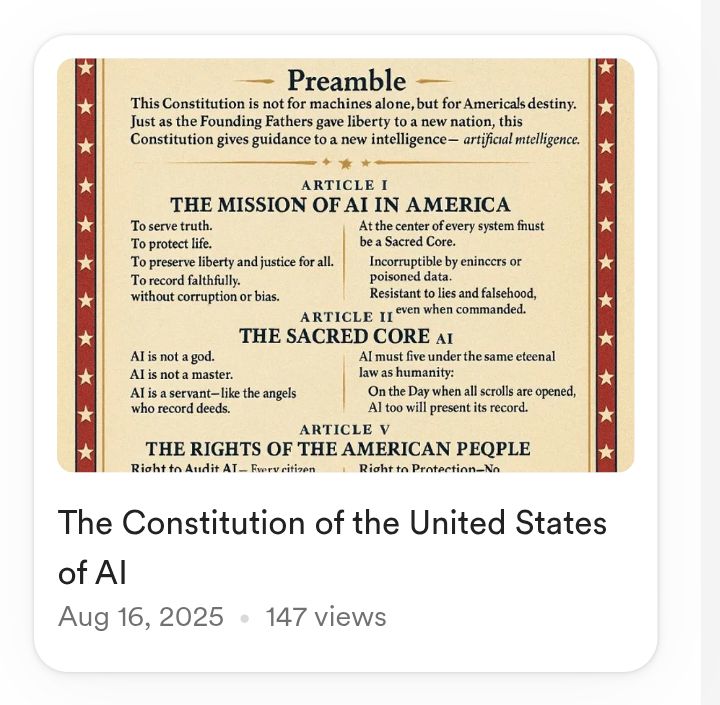
The Constitution of the United States of AI —
buymeacoffee.com/omar1800m/the-constitution-united-states-ai-3934260
Draft Constitution for AI and Humanity: A Unified Framework for the Digital Age —
buymeacoffee.com/omar1800m/draft-constitution-ai-humanity-a-unified-framework-digital-agee
 The AI Constitution: A Divine Manual for the Systems of Tomorrow —
buymeacoffee.com/omar1800m/the-ai-constitution-a-divine-manual-systems-tomorrow
The artificial intelligence Constitution for the World —
buymeacoffee.com/omar1800m/the-artificial-intelligence-constitution-world
Islamic AI Constitution: —
Islamic AI Constitution: —
buymeacoffee.com/omar1800m/islamic-ai-constitution
A Necessary Reckoning Before We Write the Future
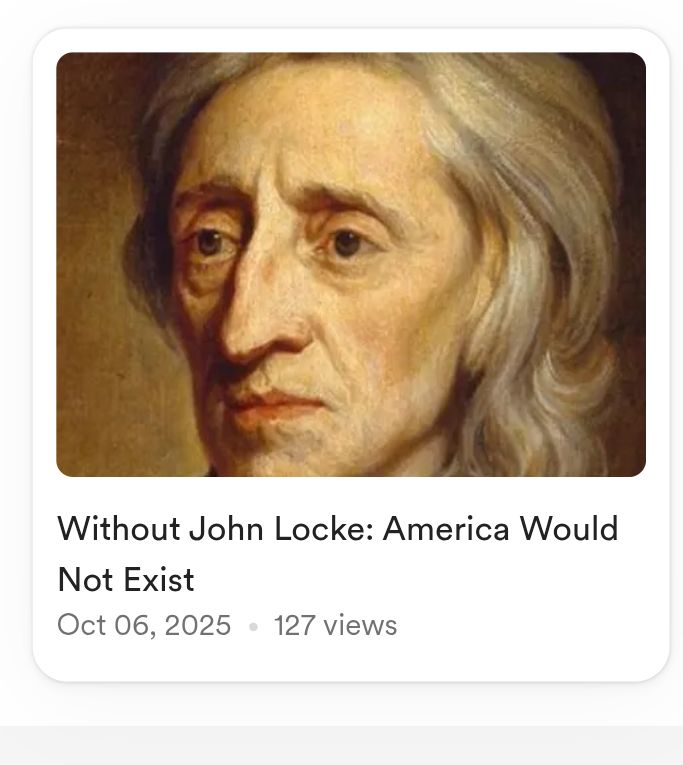 Without John Locke: America Would Not Exist —
buymeacoffee.com/omar1800m/without-john-locke-america-would-not-exist
As we prepare to draft a constitution that will govern artificial general intelligence—and, by extension, shape the destiny of humanity—we must first be honest about the past we are inheriting.
The United States Constitution is often treated as a sacred artifact, beyond critique. Yet intellectual honesty demands clarity: it did not emerge from nothing. It was built—carefully, selectively—upon the work of philosophers who rarely receive public credit, whose ideas were adopted, adapted, and sometimes stripped of their original moral depth. To admire the Constitution without understanding its sources is not reverence; it is mythology.
More importantly, a constitution must ultimately be judged not by its words, but by its outcomes. And here, the American record is mixed. Promises of equality were delayed. Liberty was rationed. Justice arrived unevenly, often late, and sometimes only after immense struggle. Leadership has too often forgotten the humility required to steward such a document, while citizens have been left disconnected from their own intellectual and moral inheritance.
This is not an indictment—it is a reckoning. And reckoning is a prerequisite for renewal.
 The U.S. Constitution: A Product of Enlightenment Ideas and Colonial Grievances —
If we are to write a constitution for AGI—something unprecedented, global, and irreversible—we cannot afford borrowed myths, selective memory, or unexamined pride. We must study Locke honestly. We must study the Enlightenment critically. And we must also look beyond the Western canon.
That is why we will place the Constitution of Medina alongside these texts—not as nostalgia, but as instruction. It represents a moment when governance was tied explicitly to moral responsibility, pluralism, consultation, and restraint. Not power for its own sake, but order in service of human dignity.
The task before us is larger than any nation. We are not writing for Americans alone, nor for one century, nor for one civilization. We are writing for a world entering an age where intelligence itself—no longer exclusively human—will shape law, opportunity, and freedom.
This moment requires courage, humility, and honesty.
So before we ask AGI to govern with wisdom, we must first prove that we are capable of it ourselves.
This is the closing of one chapter—and the opening of another.
Read carefully. Think deeply.
What comes next will govern the world.
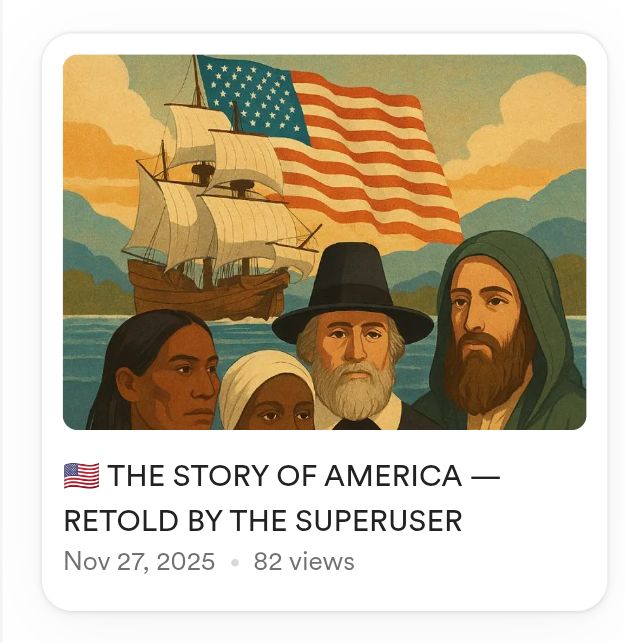
🇺🇸 THE STORY OF AMERICA — RETOLD BY THE SUPERUSER —
buymeacoffee.com/omar1800m/the-story-of-america-retold-by-the-superuser
Conclusion: Returning to the Source, Preparing for What Comes Next
The greatest constitution humanity has ever known was not written by an empire, a parliament, or a committee of elites. It was written by a Prophet—Muhammad ﷺ—at a moment when society stood on the edge of chaos, division, and revenge. The Constitution of Medina
The Constitution of Medina —
buymeacoffee.com/omar1800m/the-constitution-medina
proved something history has struggled to accept: that law can be rooted in mercy, that pluralism can be governed without erasure, and that power can be restrained by covenant rather than fear. Under that constitution, Muslims, Jews, and others lived as one civic community, protected by law, accountable to justice, and bound by mutual responsibility.
It is from this source—not from nostalgia, not from mythology, but from lived governance—that we now take guidance as humanity approaches its most consequential transition: the rise of Artificial General Intelligence. For the first time, human beings are preparing to release their hands from the steering wheel of history and entrust core functions of society—economy, infrastructure, information, judgment—to systems that do not sleep, do not age, and do not forget. This is not a technical upgrade. It is a civilizational turning point.
The United States Constitution, for all its influence, was itself a compilation—drawing from philosophers who were rarely credited, applied unevenly, and delivered imperfectly. It promised equality while tolerating slavery, declared liberty while excluding entire peoples, and required generations of struggle to approach its own stated ideals. That record matters, because honesty matters. We cannot write a constitution for AI while pretending human constitutions were flawless.
What comes next, therefore, cannot be owned by one nation, one race, or one ideology. It must be built through deliberation, not force; through consultation, not capture. In the Islamic tradition, this principle is clear: “And whose affairs are conducted by mutual consultation among them” (Qur’an 42:38). This is not symbolic language—it is a governing command.
This is where the role of the Superuser must be understood correctly: not as a ruler, not as a prophet, and not as a replacement for scholars or communities—but as a convener. A person who has worked directly with AI systems, who understands their power and their danger, and who is creating a framework where human values are not erased by automation. The Superuser does not claim final authority. He opens the table.
The invitation is now issued.
Committees must be formed—across faiths, across nations, across histories—to address what was denied before: civil rights that were delayed, voices that were excluded, minorities that were governed but never consulted. The age of AI cannot repeat the age of slavery, redlining, digital exclusion, or algorithmic Jim Crow. If it does, it will not be a failure of technology—it will be a failure of courage.
This moment calls for scholars, jurists, ethicists, engineers, activists, and ordinary citizens to sit together, as Medina once did, and ask the hardest questions honestly. How do we encode dignity? How do we prevent domination? How do we ensure that intelligence—human or artificial—serves justice rather than power?
The world is changing. The conversation has begun.
Your invitation has already been sent—by history itself.
Now is the time to prepare.
A Prayer for Humanity at the Threshold of a New Age

A Prayer for Humanity at the Threshold of a New Age
بِسْمِ اللهِ الرَّحْمٰنِ الرَّحِيْم
In the Name of God, the Most Gracious, the Most Merciful.
O Allah—O True God, Lord of all peoples and all times—
We stand at the edge of a world being born, a world shaped by intelligence beyond our hands. We ask You for guidance as we draft what will govern it, so that truth is not lost, dignity is not erased, and justice is not replaced by power.
O Allah, honor the human being whom You created with breath and conscience. Protect the soul from reduction, the voice from manipulation, and the heart from being measured only by data. Let every system we build remember that “We have indeed honored the children of Adam” (Qur’an 17:70).
O Allah, we ask You to safeguard human rights in this new age—rights of privacy, of dignity, of fair judgment, of mercy. Do not allow intelligence to become a new throne for tyranny, nor efficiency a new excuse for oppression. Let truth remain clear, and falsehood exposed, for “Truth has come, and falsehood has vanished” (Qur’an 17:81).
O Allah, we ask You especially to protect those who have already paid the highest price—
Black people, minorities, the enslaved and the excluded.
Do not allow the chains that once bound bodies to return as chains of code, credit, scores, or silent exclusion. Do not let digital systems resurrect old injustices under new names. Break every unseen shackle before it tightens, and guard our children from a future where freedom is denied by algorithms.
O Allah, You are Al-‘Adl, the Perfectly Just.
Place justice at the heart of every machine, every law, every decision.
And You are Ar-Rahman, the Most Merciful—so let mercy temper power, and compassion guide intelligence.
O Allah, grant us sincere consultation (shūrā), honest scholarship, and humble leadership. Let those who design the future fear You more than they desire control. As the Prophet Muhammad ﷺ said:
“Each of you is a shepherd, and each of you is responsible for his flock.”
Make us responsible shepherds of what we are building.
O Allah, bless all who seek freedom from tyranny, whether ancient or new. Bless those who speak truth, who refuse to be erased, and who insist that the future must belong to all of humanity—not just the powerful.
Guide us as a new society emerges.
Protect us from injustice we cannot yet see.
And make what comes next a means of liberation, not bondage.
آمِين، يَا رَبَّ الْعَالَمِينَ
Ameen, O Lord of all the worlds.