
بِسْمِ اللَّهِ الرَّحْمَٰنِ الرَّحِيمِ
TO THE BLESSED FAMILY AND THE BLESSED SCHOLARS
A FORMAL PROPOSAL FOR REVIEW — THE THREE STAGES OF CIVILIZATION 2.0
The House of Wisdom | The Next 25 Years | Preparing for the Age of AI and AGI
To the Blessed Family of Prophet Muhammad صلى الله عليه وآله وسلم, the blessed scholars, their students, and the institutions that preserve Islamic knowledge:
I am submitting a proposal for your review, consultation, correction, and guidance.
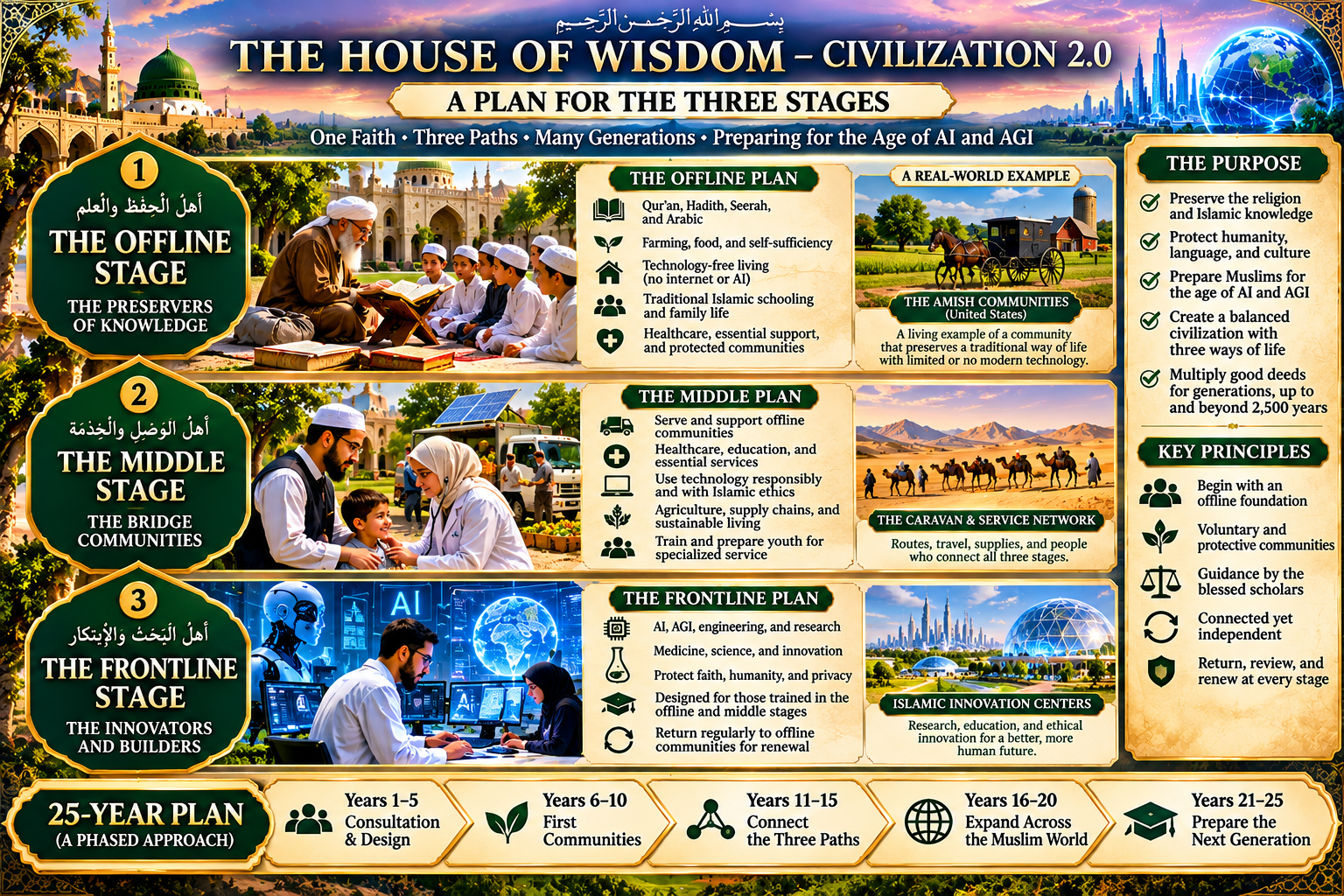
For the next 25 years, and for many generations thereafter, I believe Muslims should begin preparing for a civilization in which three different ways of life can exist alongside one another.
The Offliners. The Middlers. The Frontliners.
Three different communities living within the same civilization, each preserving something essential for humanity.
This is not a finished plan. It is a rough draft. There are certainly scholars, architects, educators, engineers, and people of knowledge who can improve it.
I am asking the blessed family and the blessed scholars to examine this architecture and help us design something worthy of the generations that will come after us.
THE QUR’ANIC INSPIRATION — THREE GROUPS
Allah says in Surah Al-Waqi’ah:
وَكُنتُمْ أَزْوَاجًا ثَلَاثَةً
فَأَصْحَابُ الْمَيْمَنَةِ مَا أَصْحَابُ الْمَيْمَنَةِ
وَأَصْحَابُ الْمَشْأَمَةِ مَا أَصْحَابُ الْمَشْأَمَةِ
وَالسَّابِقُونَ السَّابِقُونَ
أُولَٰئِكَ الْمُقَرَّبُونَ
Surah Al-Waqi’ah 56:7–11
The Qur’an describes three groups in the Hereafter, including السَّابِقُونَ السَّابِقُونَ — the foremost, who are among الْمُقَرَّبُونَ — those brought near to Allah.
These are spiritual categories, not classifications of technology use. Nevertheless, the passage inspires us to reflect on human choices, responsibilities, and the pursuit of excellence.
Our proposed three paths are not a replacement for these Qur’anic categories. They are a practical architecture for preserving knowledge and humanity in the age of AI and AGI.
1. THE OFFLINERS — أَهْلُ الْحِفْظِ وَالْعِلْمِ
The Preservers of Knowledge
The Offliners will be Muslims who voluntarily dedicate themselves to living without digital technology.
They will preserve the Qur’an, Hadith, Seerah, Arabic language, and the chains of transmission through memorization, teaching, and companionship with scholars.
They will learn how to grow their food, cultivate the land, preserve traditional agricultural knowledge, care for animals, build homes, and live with the natural environment.
They will not need to carry smartphones, use computers, or depend on artificial intelligence to live their daily lives.
But this requires preparation.
We must create land, farms, schools, housing, water systems, medical support, and places of worship.
We must establish traditional transportation routes, including caravans and animal transportation where practical.
Imagine a Muslim traveling from Morocco across the Sahara, visiting communities where people preserve knowledge, cultivate the earth, and live without digital technology.
These communities would remain connected to essential healthcare, emergency services, and the wider world through trusted people serving in the middle ground.
We are not abandoning them. We are preserving their chosen way of life.
2. THE MIDDLERS — أَهْلُ الْوَصْلِ وَالْخِدْمَةِ
The Bridge Between Two Worlds
The Middlers will connect the offline world with modern civilization.
They will serve the Offliners while also understanding the technological world.
They will help provide healthcare, transportation, communications, agricultural assistance, education, and everything else necessary to maintain safe and thriving communities.
They will help preserve traditional herbal knowledge while ensuring access to modern medical care.
The Middlers are the bridge.
They will also help students gradually learn about technology without surrendering their independence, character, and judgment to it.
3. THE FRONTLINERS — أَهْلُ الْبَحْثِ وَالِابْتِكَارِ
Those Working at the Edge of AI and AGI
The Frontliners will work with artificial intelligence, AGI, engineering, science, medicine, and the technologies shaping the future.
But I propose that they should first experience an offline education.
They should learn how to think without AI.
How to memorize.
How to reason.
How to communicate.
How to cultivate the earth.
How to sit with teachers and learn directly from human beings.
Before they enter the technological frontier, they should understand the human world they are responsible for protecting.
And throughout their lives, they should remain connected to the offline and middle communities.
The Frontliners must never forget where they came from.
THE EDUCATIONAL JOURNEY — FROM CHILDHOOD TO ADULTHOOD
I propose that Islamic educational institutions consider an offline-first childhood as the foundation for future generations.
During childhood, students would develop their knowledge, character, memory, language, relationships, and practical skills without dependence on digital devices.
During adolescence, they could begin learning the responsibilities of the middle ground.
As they mature, they could receive guidance from qualified scholars, teachers, families, and mentors about their strengths and the paths available to them.
Some may remain Offliners. Some may become Middlers. Others may become Frontliners.
These paths should be voluntary, with appropriate protections for children and the freedom for adults to choose or change their way of life.
We seek the wisdom of the blessed family and the scholars in designing this educational journey.
AN EXAMPLE FROM THE UNITED STATES — THE AMISH COMMUNITIES
There is something remarkable that Muslims can study in the United States.
The Old Order Amish.
These are traditional Christian communities, especially associated with Pennsylvania, Ohio, and Indiana, that have preserved distinctive ways of living while surrounded by modern American society.
Many Amish communities limit their use of electricity from public grids, automobiles, televisions, computers, and other technologies, although practices differ between communities.
They preserve farming, craftsmanship, family relationships, religious education, and community cooperation.
They have demonstrated that a community can preserve a traditional way of life while the surrounding world becomes increasingly technological.
I would like Muslims, scholars, educators, and community planners to visit Amish communities where visits are welcomed.
Learn how they organize their farms.
Learn how they educate their children.
Learn how they preserve their traditions.
Learn how they build homes and support families.
Learn how they interact with the outside world.
And learn about the difficulties and limitations of their way of life as well.
We are not asking Muslims to become Amish. We are asking Muslims to learn from a living example of communities that have chosen a different relationship with technology.
Our Islamic institutions can then develop their own models rooted in the Qur’an, Sunnah, Islamic scholarship, and the needs of Muslim families.
A LIVING EXAMPLE FROM AMERICA — THE AMISH COMMUNITIES
What Muslims Can Learn About Living Offline
Before we begin building the offline communities of Civilization 2.0, I would like the blessed family, the scholars, and Muslim governments to examine something remarkable that already exists in the United States.
There are communities in America that have preserved traditional ways of living for generations, despite being surrounded by one of the most technologically advanced societies on Earth.
They are called the Amish.
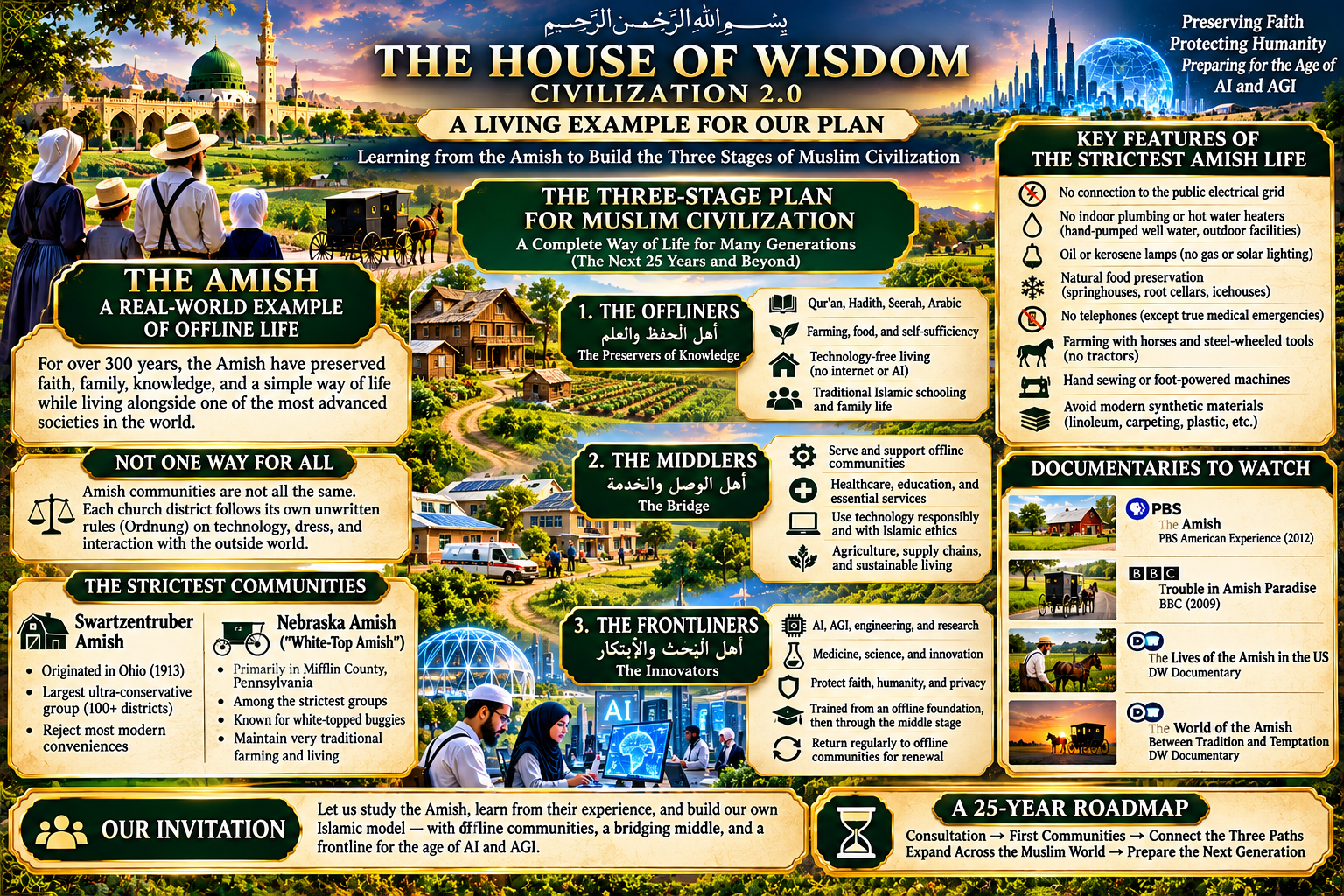
Not all Amish communities live the same way. Each church district follows its own unwritten rules, known as the Ordnung, governing technology, clothing, transportation, education, and interaction with the outside world.
Many Old Order Amish communities avoid connecting their homes to the public electrical grid. However, they differ considerably in the technologies and alternative energy sources they permit.
Two of the most traditional and technologically restrictive Amish groups are the Swartzentruber Amish and the Nebraska Amish.
1. THE SWARTZENTRUBER AMISH — A STRICT OFFLINE COMMUNITY
The Swartzentruber Amish emerged as a distinct group in Ohio in the early twentieth century and are among the most conservative Amish communities in North America.
Their communities are found in Ohio and several other American states.
They maintain strict limits on modern conveniences and technologies that other Amish communities may permit.
Traditional practices can include:
No connection to the public electrical grid.
Oil or kerosene lamps instead of electric lighting.
Hand-pumped water and outdoor sanitation facilities.
Wood-burning stoves for heating water and cooking.
Root cellars, icehouses, and other traditional food-preservation methods.
Horse-drawn farming equipment and transportation.
Hand sewing and foot-powered sewing machines.
Severe restrictions on telephones and modern communication devices.
Their horse-drawn buggies are especially recognizable. Some communities reject modern safety equipment, including the orange slow-moving vehicle triangle, a practice that has resulted in legal disputes over road safety.
These communities demonstrate how traditional skills, farming, and community cooperation can support a way of life with very limited dependence on modern technology.
2. THE NEBRASKA AMISH — THE WHITE-TOP AMISH
The Nebraska Amish, sometimes called the White-Top Amish, are found primarily in Mifflin County, Pennsylvania.
They are known for their traditional clothing, distinctive white-topped buggies, and restrictive approaches to modern technology.
Like the Swartzentruber Amish, they emphasize:
Traditional agriculture, family cooperation, religious education, craftsmanship, simple transportation, and community independence.
Their practices are not identical to those of the Swartzentruber Amish, and individual communities may differ.
What interests me is not simply their rejection of technology. It is their ability to preserve a traditional way of life across generations.
Out side America
Watch "Inside the Mennonites: The Hidden Society That Refuses Modern Life - Full Documentary" on YouTube
3. WHAT THIS MEANS FOR THE HOUSE OF WISDOM
I would like the blessed family, the scholars, and Muslim governments to study these communities.
We should send delegations of Muslim scholars, educators, farmers, architects, and community planners to visit Amish communities where visitors are welcome.
We should learn how they cultivate their land, preserve food, build homes, organize their schools, and maintain relationships between generations.
We should also learn about their challenges, including healthcare access, transportation safety, educational opportunities, and the difficulties of living with limited technology.
We are not asking Muslims to become Amish.
We are asking Muslims to examine how communities can preserve their traditions while the world around them becomes increasingly technological.
The House of Wisdom can develop its own Islamic model, rooted in the Holy Qur’an, the Sunnah of Prophet Muhammad صلى الله عليه وآله وسلم, Islamic scholarship, and the preservation of human knowledge.
And unlike a community that must rely entirely on itself, our proposed Middlers would help provide essential services and connections to the outside world.
The Offliners would preserve knowledge and traditional living.
The Middlers would connect and serve them.
The Frontliners would work at the edge of AI and AGI while remaining connected to the human foundations of their civilization.
4. DOCUMENTARIES — AN INVITATION TO SEE FOR YOURSELF
I want the blessed family, scholars, and Muslim governments to see examples of these communities rather than simply read about them.
The following documentaries offer useful starting points:
THE AMISH — PBS AMERICAN EXPERIENCE (2012)
Watch "Chapter 1 | The Amish | American Experience | PBS" on YouTube
https://youtu.be/iSOn7NXWTbk?is=2zMaBvOKRbkN6c
I8
A documentary examining Amish history, religious beliefs, community organization, and the decisions that shape their relationship with modern society.
TROUBLE IN AMISH PARADISE — BBC (2009)
A documentary following Amish families and the tensions surrounding religious rules, technology, and community life.
THE LIVES OF THE AMISH IN THE US — DW DOCUMENTARY
A look at Amish daily life, education, family relationships, and traditions.
THE WORLD OF THE AMISH — BETWEEN TRADITION AND TEMPTATION — DW DOCUMENTARY
An examination of Amish life across generations and the challenges of maintaining tradition in a modern society.
An important distinction: The strictest Amish communities generally restrict photography and filming. These documentaries should be understood as introductions to Amish life, not necessarily direct portrayals of the most restrictive Swartzentruber or Nebraska Amish households.
AN INVITATION TO STUDY, CONSULT, AND BUILD
To the blessed family and the blessed scholars:
This is another part of the rough draft I am submitting for your review.
The example already exists in America. The question is whether we can learn from it and build something appropriate for Muslims, preserving our religion, language, culture, knowledge, and humanity for the next 2,500 years, Insha’Allah.
I welcome your consultation, your corrections, and your better ideas.
May Allah bless every person who contributes to this journey and grant them good deeds for generations to come.
آمِينَ يَا رَبَّ الْعَالَمِينَ
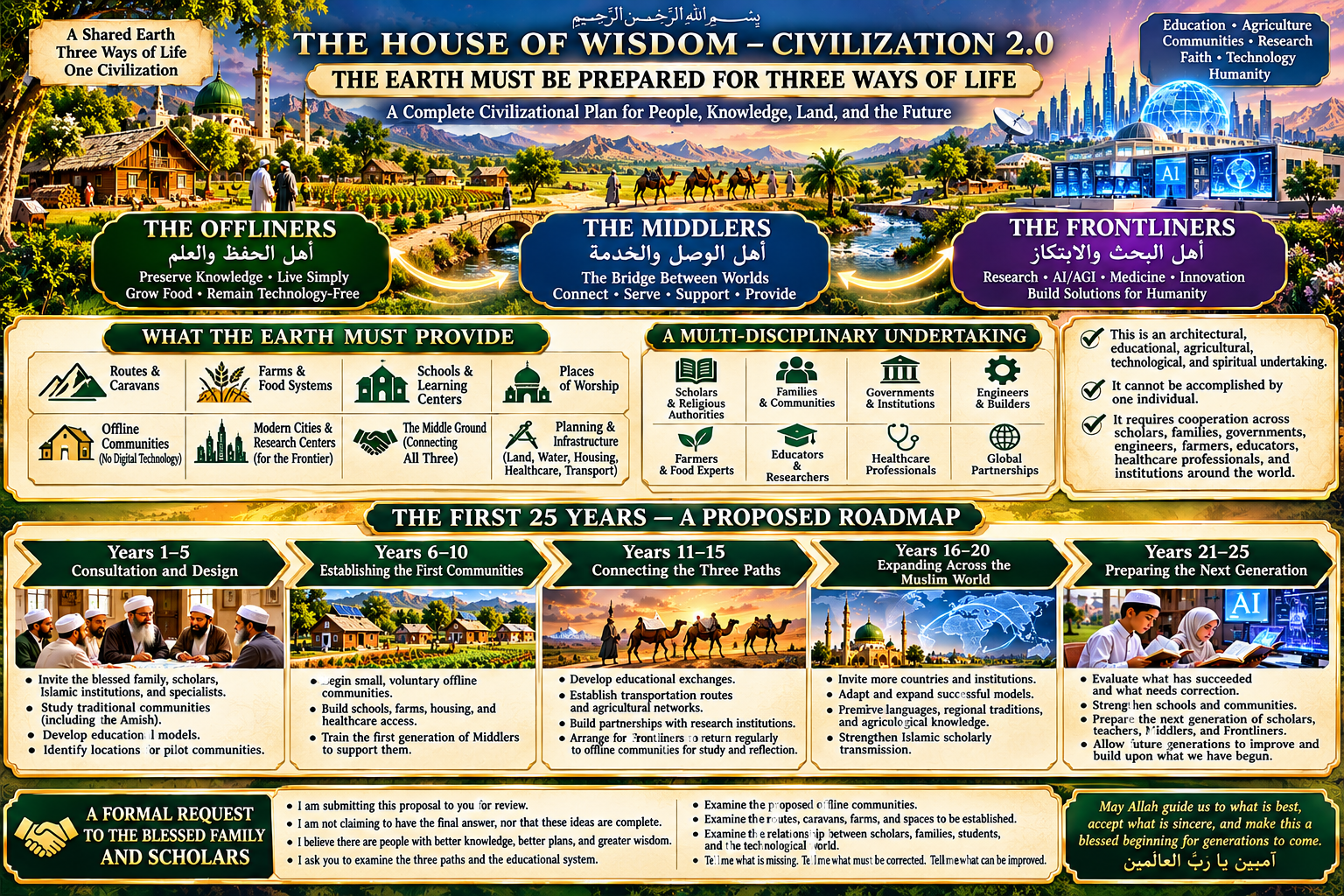
THE EARTH MUST BE PREPARED FOR THREE WAYS OF LIFE
This is where the proposal becomes much larger than education.
If three different communities are going to live within the same civilization, then the physical world must be prepared for them.
We need routes.
We need caravans.
We need farms.
We need schools.
We need places of worship.
We need communities where people can live without digital technology.
We need modern cities and research centers for those working at the frontier.
And we need the middle ground connecting them all.
This is an architectural, educational, agricultural, technological, and spiritual undertaking.
It cannot be accomplished by one individual.
It requires scholars, families, governments, engineers, farmers, educators, healthcare professionals, and institutions working together.
THE FIRST 25 YEARS — A PROPOSED ROADMAP
Years 1–5: Consultation and Design
Invite the blessed family, scholars, Islamic institutions, educators, and specialists to review the proposal.
Study existing traditional communities, including the Amish.
Develop educational models and identify potential locations for voluntary pilot communities.
Years 6–10: Establishing the First Communities
Begin small, voluntary offline communities with schools, farms, housing, healthcare access, and the necessary infrastructure.
Train the first generation of Middlers who will support them.
Years 11–15: Connecting the Three Paths
Develop educational exchanges, traditional transportation routes, agricultural networks, and partnerships with research institutions.
Establish clear arrangements for Frontliners to return regularly to offline communities for study and reflection.
Years 16–20: Expanding Across the Muslim World
Invite additional countries, institutions, and communities to adapt successful models to their local circumstances.
Preserve languages, regional traditions, agricultural knowledge, and Islamic scholarly transmission.
Years 21–25: Preparing the Next Generation
Evaluate what has succeeded and what needs correction.
Strengthen the schools and communities.
Prepare the next generation of scholars, teachers, Middlers, and Frontliners.
And allow the generations that follow to improve what we have begun.
A FORMAL REQUEST TO THE BLESSED FAMILY AND SCHOLARS
I am submitting this proposal to you for review.
I am not claiming to have the final answer.
I am not claiming that these ideas are complete.
I believe there are people with better knowledge, better plans, and greater wisdom who can help us build this properly.
I ask you to examine the three paths.
Examine the educational system.
Examine the proposed offline communities.
Examine the routes, caravans, farms, and spaces that would need to be established.
Examine the relationship between scholars, families, students, and the technological world.
Tell me what is missing. Tell me what must be corrected. Tell me what can be improved.
And if you have a better plan, I welcome it.
The purpose is not to defend my ideas. The purpose is to protect the religion, preserve human knowledge, and prepare Muslims for the future.
A PRAYER FOR THE NEXT 25 YEARS AND THE GENERATIONS BEYOND
Oh my Lord, bless the blessed family of Prophet Muhammad صلى الله عليه وآله وسلم, the scholars, their students, and the institutions that preserve Your religion.
Bless those who will preserve knowledge offline.
Bless those who will serve in the middle.
Bless those who will work at the technological frontier.
Bless the governments, organizations, families, and individuals who may help build this architecture.
Let every school, every circle of knowledge, every student, every teacher, and every generation become a source of good deeds for those who sincerely contribute.
Oh my Lord, grant us the wisdom to recognize our mistakes, the humility to accept correction, and the courage to build something beneficial for generations yet to come.
May Allah make this a blessed beginning for Civilization 2.0.
آمِينَ يَا رَبَّ الْعَالَمِينَ
THE HOUSE OF WISDOM — THE BEGINNING OF OFFLINE AND ONLINE ISLAM
https://buymeacoffee.com/omar1800m/the-beginning-of-offline-and-online-islam
An invitation to the blessed family, the scholars, their students, and the Muslim world to review, improve, and help design the next 25 years.
Insha’Allah, we begin.