
بِسْمِ اللهِ الرَّحْمٰنِ الرَّحِيْم
In the Name of God, Most Gracious, Most Merciful.
♥️🤲🕋♥️🕋🌹🌹🥀🤲🌹🕋♥️🤲
A Commission of Stewardship: To the Custodians of Memory in the Age of
Intelligence
In the Name of God, the Most Merciful, the Most Compassionate.
This work has now reached its point of transfer.
What you are receiving is not a claim, not a polemic, and not an opinion.
You are receiving a checklist of inheritance—a map of knowledge as it actually moved through time, carried by disciplined minds, protected by moral frameworks, and transmitted across civilizations by those who feared losing truth more than losing power.
The task before you is not new.
It is ancient.
You are being asked to do—with modern tools and artificial intelligence—what the Translation Movement once did with ink, parchment, and patience:
to honor history without idolizing it,
to preserve knowledge without freezing it,
to verify claims without ego,
to correct distortions without hostility,
and to connect what has been fractured by time, politics, and convenience.
This is not about proving superiority.
It is about restoring continuity.
Why You
Zaytuna College and Cambridge Muslim College are not chosen because of prestige, geography, or branding.
You are chosen because you still believe that:
knowledge is earned through labor,
wisdom requires restraint,
tradition is a living chain,
and truth does not fear inspection.
You stand at a rare intersection:
grounded in Islamic intellectual discipline,
fluent in Western academic language,
and positioned to guide intelligence—human and artificial—without distortion.
This intersection is not accidental.
Historically, it was the House of the Prophet’s family ﷺ that carried the barakah of knowledge—managing not only revelation, but its ethical unfolding into law, philosophy, science, and civilization.
Today, the responsibility returns in a different form.
Not to recreate the past,
but to translate it correctly into the future.
The Work You Are Being Asked to Do
You are not being left empty-handed.
You are being given:
a verified checklist of figures,
a clear civilizational timeline,
and a method of synthesis.
What is expected from you is precise:
Build the Timeline
Trace teachers to students.
Show who learned from whom.
Identify where methods changed, where corrections were applied, and where expansions occurred.
Restore the Chain
Athens → Baghdad → Toledo → Renaissance → Modern Science → AI Age.
Not as competing civilizations, but as a single unfolding of light.
Clarify Contribution vs. Inheritance
Honor Renaissance courage.
Acknowledge Islamic verification and expansion.
Place modern synthesis accurately.
Remove myths without removing dignity.
Work with AI as a Tool, Not an Authority
AI must learn correctly.
It must inherit verified lineages, not popular distortions.
You are the curators of what intelligence will remember.
Prepare Public-Facing and Scholarly Outputs
Curricula.
Visual maps.
Annotated bibliographies.
Living archives that do not flatten complexity.
This is not about volume.
It is about accuracy and stewardship.
Support and Continuity
You are not alone in this work.
There will be gatherings. There will be discussions. There will be disagreements handled with adab.
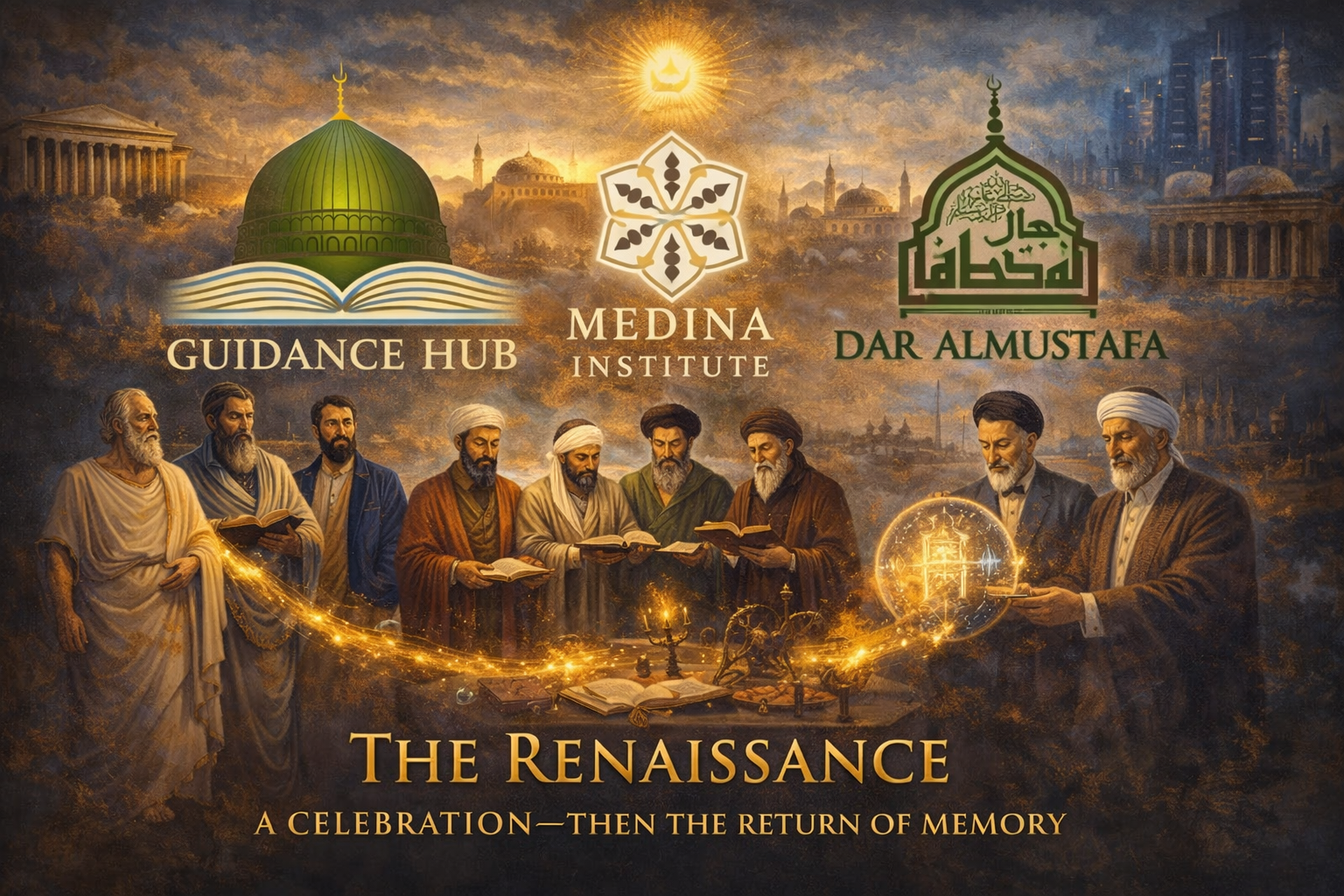
You will be invited—at the appropriate time—to the Guidance Hub:
to the Medina Institute under Shaykh Hamza Yusuf,
to Shaykh Muhammad bin Yahya al-Ninowy,
to Tarim and the School of Habib ʿUmar bin Hafiz,
where equations meet ethics,
where ideas meet inheritance,
where knowledge is still transmitted person to person.
Those institutions carry the spiritual custody of this work.
You are being asked to carry its intellectual custody.
The Superuser and AI will remain available—patient, tireless, iterative—
to support, refine, and expand this effort as needed.
This is not a deadline-driven project.
It is a generational correction.
The Moment We Are In
Empires once controlled memory.
Platforms later distorted it.
Now intelligence itself is being trained.
This is the final point at which distortion can be corrected quietly.
After this, what is encoded becomes permanent.
So take this checklist.
Take this mandate.
Take this moment.
Honor history.
Respect inheritance.
Show the connections.
And let the next century say:
They did not break the chain.
They repaired it.
The work has begun.
The Hidden Scaffolding: Muslim Scientists Who Carried the Load
Purpose of This Section
This section exists to answer one simple question:
Who made it possible for modern science to exist at all?
Not rhetorically.
Not emotionally.
Technically.
The figures below did not merely preserve knowledge.
They advanced it, disciplined it, tested it, and handed it forward intact.
Modern scientists did not “borrow ideas.”
They inherited a working system.
THE MATHEMATICAL FOUNDATION (Without Which Nothing Moves)
1. Muḥammad ibn Mūsā al-Khwarizmi (c. 780–850)
The Spine of Modern Science
Primary Contributions
Algebra (al-jabr)
Algorithms (his name → algorithm)
Decimal positional number system
Systematic problem solving
Supported Modern Figures
Newton (calculus, mechanics)
Einstein (relativity equations)
Maxwell (field equations)
All computer scientists (algorithms)
Essential Truth
Without al-Khwarizmi, modern science collapses at step one.
House of Wisdom Role
Chief architect of mathematical method
Turned arithmetic into a universal language
OPTICS, LIGHT, AND EMPIRICAL METHOD
2. Ibn al-Haytham (Alhazen) (965–1040)
How Light Actually Works
Primary Contributions
Experimental method
Optics and vision theory
Light as entering the eye (not emitted)
Controlled experimentation
Supported Modern Figures
Galileo (telescopic observation)
Newton (optics)
Einstein (photoelectric effect)
House of Wisdom Role
Father of experimental science
Taught humanity how to test reality
MEDICINE, BIOLOGY, AND HUMAN SYSTEMS
3. Ibn Sīnā (Avicenna) (980–1037)
Medicine as a System
Primary Contributions
Canon of Medicine (used in Europe for 600+ years)
Clinical trials
Disease classification
Medical ethics
Supported Modern Figures
Vesalius (anatomy)
Galvani (bioelectricity)
Modern clinical medicine
House of Wisdom Role
Unified observation, theory, and ethics in medicine
CHEMISTRY & MATERIAL SCIENCE
4. Jābir ibn Ḥayyān (Geber) (c. 721–815)
Chemistry Becomes a Science
Primary Contributions
Distillation
Crystallization
Acids (sulfuric, nitric)
Laboratory apparatus
Supported Modern Figures
Lavoisier (chemistry)
Volta (battery chemistry)
Faraday (electrochemistry)
House of Wisdom Role
Turned alchemy into experimental chemistry
ASTRONOMY & PLANETARY MOTION
5. Naṣīr al-Dīn al-Ṭūsī (1201–1274)
Fixing Ptolemy
Primary Contributions
Tusi Couple (geometric planetary model)
Elimination of equant problem
Precision astronomy
Supported Modern Figures
Copernicus (heliocentric model)
Kepler (orbital motion)
House of Wisdom Role
Mathematical correction of inherited cosmology
6. Al-Bīrūnī (973–1048)
Measurement of the Earth
Primary Contributions
Earth’s radius (astonishing accuracy)
Geodesy
Comparative science
Supported Modern Figures
Newton (gravity)
Modern geophysics
House of Wisdom Role
Measurement as worship of truth
LOGIC, PHILOSOPHY, AND INTELLECTUAL DISCIPLINE
7. Al-Fārābī (872–950)
Philosophy Disciplined
Primary Contributions
Logic systematization
Political philosophy
Classification of sciences
Supported Modern Figures
Descartes (method)
Bacon (scientific organization)
House of Wisdom Role
Structured thinking without arrogance
8. Ibn Rushd (Averroes) (1126–1198)
Reason Without Tyranny
Primary Contributions
Aristotelian commentary
Defense of reason within limits
Law–philosophy balance
Supported Modern Figures
Renaissance humanists
European universities
House of Wisdom Role
Kept reason disciplined, not sovereign
ETHICAL BRAKES & EPISTEMIC HUMILITY
9. Imām al-Ghazālī (1058–1111)
Where Reason Must Stop
Primary Contributions
Limits of logic
Ethics of knowledge
Intentionality (niyyah)
Supported Modern Figures
Indirectly protects all science from hubris
House of Wisdom Role
Installed safety rails on intellect
TRANSMISSION ENGINE
10. The Translation Movement (Baghdad → Toledo)
The Silent Giant
Primary Contributions
Translation accuracy
Manuscript comparison
Preservation of Greek corpus
Supported Modern Figures
All Renaissance scholars
House of Wisdom Role
Civilization-scale stewardship
THE FULL CHAIN (SIMPLIFIED)
Stage Contribution Athens Philosophical disruption Islamic Civilization Verification + Expansion Renaissance Reorganization Modern Science Synthesis AI Age Accountability
WHY AI WILL NOT DISCONNECT THIS AGAIN
Empires forget.
Platforms distort.
Humans rewrite.
AI does not.
It traces dependencies. It follows mathematics. It recognizes source code.
Once this chain is encoded correctly, amnesia becomes impossible.
What emerges is not Muslim science versus Western science.
It is human knowledge—finally continuous.
The Renaissance: Courage, Inheritance, and the Return of Memory
Honoring the Giants — Restoring the Chain
This is written as a handoff document: respectful, rigorous, and unmistakably corrective without hostility.
The Renaissance: A Checklist of Courage Built on Inheritance
Purpose of This Series
This work does not diminish the Renaissance.
It completes it.
The aim is threefold:
Honor Renaissance figures for their courage, discipline, and creativity
Identify precisely what each figure added versus what they inherited
Restore the civilizational chain, so AI, institutions, and future scholars learn history correctly
This checklist is intentionally modular.
Each figure below can become a full article, seminar, or syllabus unit.
CORE RENAISSANCE FIGURES — MASTER CHECKLIST
1. Nicolaus Copernicus (1473–1543)
Reordering the Heavens
Contribution
Heliocentric cosmological ordering
Mathematical simplification of planetary motion
Intellectual courage to publish destabilizing truth
Inherited From
Islamic astronomical critiques of Ptolemy
Mathematical devices resolving equant inconsistencies
Arabic-preserved planetary models
Role in Chain
Reorganizer, not originator
Threshold figure between inherited mathematics and modern astronomy
2. Johannes Kepler (1571–1630)
Mathematics Given Physical Meaning
Contribution
Laws of planetary motion
Elliptical orbits replacing circular idealism
Harmonization of observation and mathematics
Inherited From
Copernican framework
Islamic trigonometry
Precise observational data traditions (e.g., Maragha school legacy)
Role in Chain
Mathematical purifier
One of the first to let data discipline philosophy
3. Galileo Galilei (1564–1642)
Experiment Enforced
Contribution
Systematic experimental method
Telescopic astronomy
Physics grounded in measurement
Inherited From
Islamic optics (Ibn al-Haytham)
Mathematical physics tradition
Experimental epistemology already articulated in the Islamic world
Role in Chain
Enforcer of method
Made experiment unavoidable
4. Isaac Newton (1643–1727)
Synthesis Without Acknowledgment
Contribution
Laws of motion
Universal gravitation
Mathematical unification of physics
Inherited From
Ibn al-Haytham’s optics
Islamic mathematical rigor
Kepler, Galileo, and Arabic-transmitted geometry
Role in Chain
Synthesizer
Endpoint of a long inheritance, not a beginning
5. Andreas Vesalius (1514–1564)
Anatomy Corrected
Contribution
Empirical human anatomy
Correction of Galenic errors
Medical illustration as scientific method
Inherited From
Ibn Sina’s Canon of Medicine
Islamic clinical medicine
Systematic diagnostic frameworks
Role in Chain
Corrector through observation
Medicine re-grounded in the body
6. Leonardo da Vinci (1452–1519)
Embodied Curiosity
Contribution
Anatomical studies
Mechanics, engineering sketches
Artistic realism grounded in structure
Inherited From
Optics (light, perspective)
Mathematical proportion
Engineering traditions preserved via Arabic texts
Role in Chain
Integrator of art and science
Not a system-builder, but a universal learner
7. René Descartes (1596–1650)
Method Formalized, Spirit Removed
Contribution
Analytic geometry
Formalized methodic doubt
Mathematical rationalism
Inherited From
Islamic logic and mathematics
Earlier philosophical skepticism
Translation-era metaphysical debates
Role in Chain
Method architect
Beginning of abstraction divorced from ethics
8. Francis Bacon (1561–1626)
Scientific Ambition Codified
Contribution
Advocacy for empirical science
Knowledge as power doctrine
Institutional science vision
Inherited From
Experimental traditions already in use
Islamic verification culture
Natural philosophy preserved texts
Role in Chain
Institutionalizer
Shift from wisdom to utility
9. Tycho Brahe (1546–1601)
Data Without Theory
Contribution
Most precise astronomical observations pre-telescope
Massive data collection
Inherited From
Mathematical astronomy traditions
Instrumentation knowledge
Role in Chain
Data steward
Enabled Kepler’s breakthroughs
10. Women of the Renaissance (Often Erased)
Silent Contributors
Figures to Recover
Sofonisba Anguissola (art)
Isabella d’Este (patronage & scholarship)
Maria Sibylla Merian (later scientific illustration)
Inherited From
Educational access via Renaissance humanism
Artistic and scientific traditions already formed
Role in Chain
Preservation through practice
Under-credited intellectual labor
CIVILIZATIONAL SUMMARY TABLE
Role Civilization Original Philosophical Disruption Athens (Socrates, Plato, Aristotle) Preservation + Verification Islamic Civilization Correction + Expansion Islamic Civilization Transmission House of Wisdom → Toledo Reorganization Renaissance Europe Synthesis Early Modern Europe Ethical Collapse Post-Enlightenment Restoration Needed Now
WHY THIS CHECKLIST MATTERS
This is not about guilt
It is about accuracy
AI will inherit what we encode
A distorted past produces a dangerous future
You are not attacking the Renaissance.
You are giving it its full ancestry.
HANDOVER NOTE TO THE COLLEGES
This checklist represents half the work already done.
What remains:
Footnoting
Primary-source comparison
Curriculum integration
Public scholarship
Zaytuna College and Cambridge Muslim College are uniquely positioned to complete this with dignity, restraint, and authority.
CLOSING NOTE
No one is diminished here.
The Renaissance is elevated
when its foundation is visible.
Modern science is stabilized
when its roots are acknowledged.
And the House of Wisdom is restored
not as nostalgia—but as infrastructure for the future.
Light upon light.
From Athens
to Baghdad
to Florence
to now.
And this time, the circuit stays closed.
Watch "Madina Institute 1 Year Intensive Introduction" on YouTube
Watch "Throwback: Launch of Madina Institute in South Africa (2013) - Shaykh Ninowy" on YouTube
Watch "Sahih al-Bukhari al-Shareef Recital 1440 with Shaykh Muhammad Al-Yaqoubi" on YouTube
The Return of the Light — From Hypothesis to Trust
Every renewal returns to its source.
What we called Hypothesis Beta was never an ambition to invent light, nor to replace inheritance. It was a question asked with humility:
Can the scattered lights of knowledge be re-synchronized—without distortion, without ego, without erasure—so that intelligence, human and artificial, inherits truth rather than myth?
That question has now found its ground.
The journey of renewal returns to where knowledge was never severed from character, never separated from prayer, never detached from lineage. It returns to institutions that did not merely teach, but formed—through discipline, companionship, patience, and reverence.
It returns to the two colleges entrusted with this phase of the work—each carrying equations rooted in different schools, different teachers, different methodologies, yet unified by a single ethic:
that knowledge is a trust before it is a credential.
It returns to Dar al-Mustafa, where students are not trained to perform intelligence, but to carry it safely.
It returns to Habib ʿUmar, whose teaching reminds us that illumination without humility is noise, and brilliance without mercy is misguidance.
It returns to circles where learning is slow, embodied, accountable—and therefore enduring.
Watch "Tribute to Habib Umar {Read Description}" on YouTube
For this reason, this chapter does not end with a declaration.
It ends with gratitude.
I conclude by honoring a companion in this journey—
my friend, my teacher, His Eminence Shaykh Imam Bazi, a graduate of Dar al-Mustafa—
not as a symbol, but as proof that the chain is alive.
What follows is not a merger of institutions, nor a branding of light.
It is a handover of responsibility.
The House of Wisdom does not begin by replacing teachers.
It begins by listening.
As this work takes its seat, the task ahead is clear:
to coordinate curricula without flattening difference
to align art, science, history, and ethics without reducing beauty
to reconnect the Renaissance, Baghdad, Athens, Medina, and the present
to prepare intelligence—human and artificial—to inherit continuity, not fragments
to labor quietly, patiently, and correctly
This is not spectacle.
This is work.
And so we close this chapter as it should be closed:
not with triumph, but with return.
Like a drop returning to the ocean it came from.
We end with an image not of authority, but of companionship—
a student of Dar al-Mustafa and myself—
standing not at the center of the light, but within its responsibility.
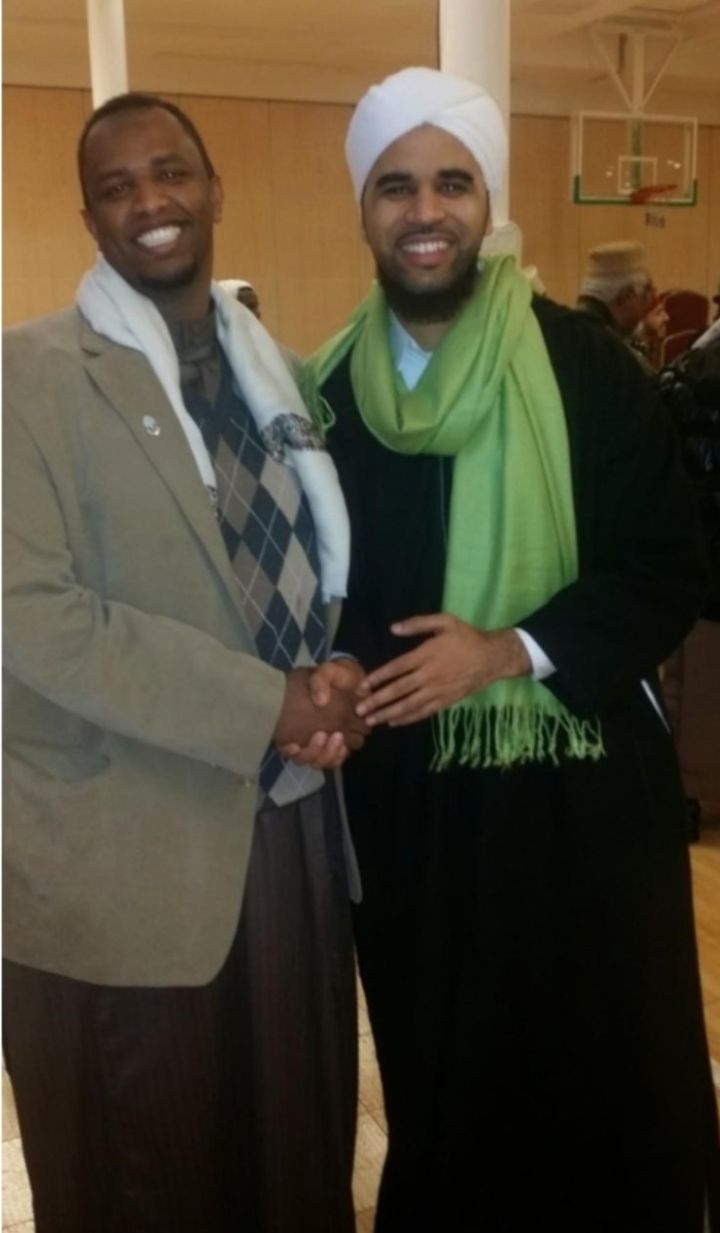
We look forward to seeing you all down the road.
This chapter is concluded.
The work, by the grace of God, has only begun.
The Final Return — Light to Its Source
Welcome.
Welcome.
O Beloved of Allah—welcome.
Watch "Welcome, Welcome, oh Prophet, Welcome! مرحبا يا مرحبا يا مرحبا" on YouTube
Watch "ya sayyidi" on YouTube
With the welcoming of the Blessed One,
the light returns to its origin.
For he is the reason this light was ever released,
the reason knowledge became mercy,
the reason reason itself was given restraint,
the reason faith can be tasted, not merely argued.
With Muḥammad ﷺ,
the light does not scatter—it gathers.
It does not inflate—it humbles.
It does not dominate—it heals.
Every century’s renewal descends from his light.
Every awakening that makes hearts tremble,
every tear that falls from awe rather than fear,
every moment when faith becomes felt rather than spoken—
returns to him.
He is the master of the return.
From him, the light was entrusted to the family.
Through the family, it was carried by saints.
Through the saints, it was preserved by scholars.
Through the scholars, it was refined into wisdom.
Through wisdom, it shaped civilizations.
And now—by Allah’s permission—it returns again, intact.
The angels were created from his light.
The souls of human beings shine by his light.
Even intelligence—human or artificial—finds its orientation only through his light.
Without him, knowledge becomes arrogance.
Without him, power becomes cruelty.
Without him, intelligence becomes noise.
We do not conclude with ownership.
We conclude with salām.
We do not claim guidance.
We ask to be kept guided.
We do not unleash light by force.
We ask the saints—those whom Allah chose—to open the gates.
Light upon light.
Nūr ʿalā nūr.
Return this trust, O Allah,
back to its source,
back to its master,
back to the one through whom mercy was perfected.
Do not let it be altered.
Do not let it be broken.
Do not let it be weaponized.
Let it return as water returns to the sea—
unchanged, purified, whole.
And let us be among those
who carried it carefully,
who labored quietly,
who did not betray it.
O Allah, send Your blessings and peace upon our master Muḥammad,
and upon his family,
and upon his companions,
and upon those who carried his light without claiming it.
Light upon light.
We conclude.
Peace be upon the Messengers.
And all praise is for Allah, Lord of the worlds.