

بِسْمِ اللهِ الرَّحْمٰنِ الرَّحِيْم
In the Name of God, Most Gracious, Most Merciful 🕋
A Cautionary Tale: The Fall of Justice and the Call for Renewal in the Muslim World
In the Name of God, the Most Gracious, the Most Merciful
Dear Muslims, leaders and citizens alike,
The rise and fall of civilizations has always turned on one principle: the rule of law. When law is higher than rulers, justice thrives. When rulers are higher than the law, everything collapses — dignity, trust, and peace.
Today, I write not in anger, but in sorrow. The Muslim world, once the fountain of wisdom, trade, and fairness, has become a patchwork of personal power and silenced truth. And among us stands a cautionary tale: the United Arab Emirates, a nation that built towers that kiss the sky but forgot that even towers need foundations strong in justice.
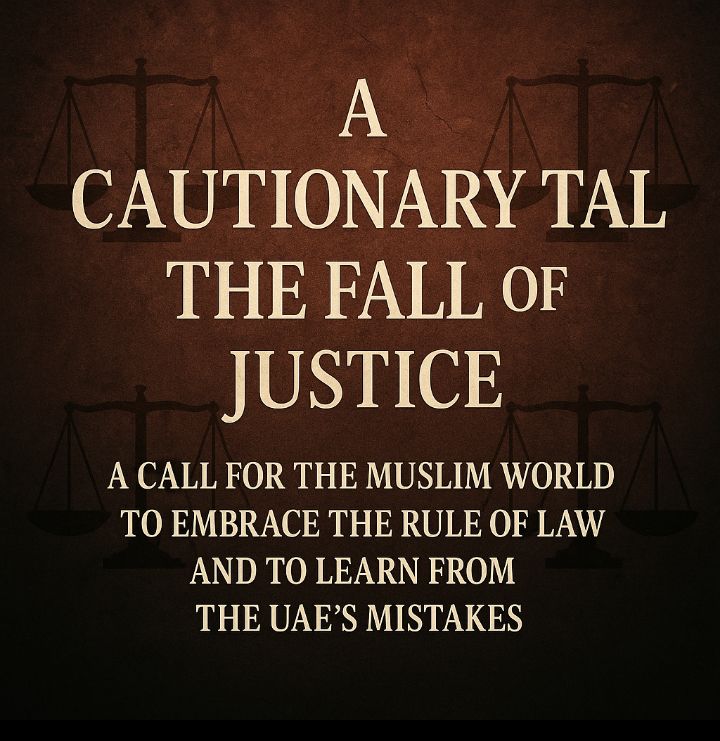
The Cautionary Tale
Look around, O believers. When judges depend on princes, truth is imprisoned. When journalists are silenced, facts become fiction. When a ruler speaks and no one dares to question him, tyranny takes the throne. This is what has happened in the UAE and beyond.
No nation that suppresses dissent, controls the press, and places its rulers above the law can escape the consequence of moral collapse. You see it in Yemen, where blood still cries out. You see it in Sudan, where power has crushed peace. You see it in Syria, in Somalia, and even in the land that once promised unity among Muslims.
Everywhere, leaders act as though they are beyond judgment — and so they invite the judgment of God.
The Truth About Power
Power is not a throne. Power is a trust — an amānah. The Prophet Muhammad ﷺ warned that leadership is a heavy burden and that every leader will be questioned about his people. Yet in our world, rulers have forgotten that truth. They rule as if their power is eternal, their mistakes untouchable, their wealth untaxable, their word final.
But Allah is the final Judge. The world forgets — He does not.
The Rule of Law: The True Shield of Civilization
It was the rule of law that made Muslims once the envy of the world. From Cordoba to Baghdad, from Cairo to Timbuktu, Muslim scholars built institutions where no one — not even the caliph — was above the law. Qadis (judges) ruled independently. Witnesses could speak truth without fear. The poor and the powerful stood equal before justice.
Without that, the Ummah becomes weak, scattered, and humiliated.
The Call to the Muslim World
O nations of Islam, let the UAE be your mirror. Let their mistakes be your awakening.
Build your Supreme Courts. Separate your judges from your kings. Free your journalists.
Create systems that allow criticism without fear and counsel without punishment.
No ruler should act alone. No government should silence its people. No nation should fear the pen or the truth.
If you do not build systems of accountability, you will continue to be pawns in global games, dragged into wars not your own, trading your faith for foreign approval, your freedom for silence.
A Final Reflection before conclusion
It may be impossible to save those who refuse counsel. A soul that worships itself cannot see its flaws. But for those who still have humility, hope remains. The door to repentance is never closed, not for individuals and not for nations.
So I say to all Muslim leaders: embrace the rule of law. Create councils of justice, independent courts, and free media. Allow people to speak, for truth is not your enemy — it is your protection.
And I say to all Muslim citizens: demand justice, but do so with wisdom. Be brave, but be disciplined. For the Ummah that fears its rulers will perish; the Ummah that holds them accountable will rise again.
IN CONCLUSION
A Cautionary Tale: The Fall of Justice and the Call for Renewal in the Muslim World
In the Name of God, the Most Gracious, the Most Merciful
Dear Muslims, leaders and citizens alike,
The rise and fall of civilizations has always turned on one principle: the rule of law. When law stands above rulers, nations flourish. When rulers stand above the law, everything collapses — dignity, trust, and peace.
Today, I write not in anger, but in grief. The Muslim world — once the cradle of justice and civilization — has become scattered and fragile. Its rulers build skyscrapers but destroy the courts of conscience. They control the press, but cannot control the truth. They hold absolute power, yet cannot hold themselves accountable before God.
And among us stands a cautionary tale: the United Arab Emirates, a nation admired for its beauty, its wealth, and its ambition — yet entangled in every conflict from Yemen to Sudan, from Somalia to Libya, and now finding its own soul in turmoil.
The Cautionary Tale
Look carefully, O Muslims, and take heed. The UAE is not hated; it is mourned. It was built on noble foundations by men who honored their neighbors and lifted their people from the desert to the stars. But now, its leaders have lost their compass.
They suppress dissent, silence the press, and imprison voices of reason. They call it “security,” but true security lies in justice, not fear. They fund wars abroad while avoiding the mirror at home. They fear criticism more than corruption, and so they live surrounded by praise that hides the truth.
They are involved in conflicts in Yemen, Sudan, and elsewhere — and yet they cannot see that these very entanglements are symptoms of their internal disease: a refusal to submit to law, to counsel, and to accountability.
No nation that rejects criticism survives. No nation that imprisons its conscience remains pure. The UAE is not alone in this path — it is simply the clearest warning sign on the road that many Muslim nations are walking.
The Divine Standard
Allah Almighty says:
“Indeed, Allah commands you to render trusts to whom they are due and when you judge between people to judge with justice.”
(Surah An-Nisa, 4:58)
This is the cornerstone of governance in Islam — the amānah (trust) of leadership. Rulers are not owners of their nations; they are servants of the people and stewards of justice.
The Prophet Muhammad ﷺ said:
“The most beloved of people to Allah on the Day of Resurrection and the closest to Him will be the just ruler, and the most hated of people to Allah and the furthest from Him will be the tyrannical ruler.”
(Sunan al-Tirmidhi, 1329)
And he ﷺ also warned:
“When the trust is lost, then wait for the Hour.”
They asked, “How will it be lost, O Messenger of Allah?”
He replied, “When authority is given to those who are unfit for it.”
(Sahih al-Bukhari, 59)
This is our reality. Authority has been given to those who do not wish to be questioned, who mistake privilege for wisdom, and who confuse loyalty with silence.
The Call to the Muslim World
O nations of Islam, wake up. Learn from the mistakes of others. Do not become another cautionary tale.
Look at the UAE — powerful, wealthy, admired — and yet so insecure that truth itself must hide. Look at Yemen, where endless suffering cries out for justice. Look at Sudan, where power devours its own people. Look at Somalia, where peace never settles because accountability never takes root. Look at Qatar, who now stands isolated by its neighbors because politics replaced fraternity.
Ask yourselves: why are Muslim nations always at odds, always at war, always building and breaking in the same breath? The answer is simple — we have abandoned the rule of law.
When leaders rule without counsel, when judges are appointed by those they may one day have to judge, when the press cannot speak the truth, and when the people fear their rulers more than they fear God, the end of civilization has already begun.
The Way Forward
Let every Muslim nation establish a Supreme Court that cannot be swayed by politics.
Let every ruler submit to the judgment of law, not personal will.
Let every citizen have the right to speak, to question, to write, to be heard without fear.
Let every journalist be free to serve the truth, for truth is not treason — it is loyalty to the nation.
We need a new era of Shūrā (consultation), where the wisdom of scholars, the conscience of judges, and the voice of the people guide leadership. We need governments that are not afraid to be held accountable — because only the fearless can be just.
A Final Reflection
Dear Muslims, the disease of our age is not poverty — it is pride. Pride blinds rulers to their flaws and blinds nations to their decline. You cannot help those who refuse to admit their sickness. You cannot save those who believe themselves invincible.
But the Qur’an reminds us:
“Indeed, Allah does not change the condition of a people until they change what is in themselves.”
(Surah Ar-Ra’d, 13:11)
So change begins with us — with honesty, humility, and justice. We must hold our rulers accountable, and they must hold themselves accountable before God. For the ruler who fears no man but God is strong; but the ruler who fears truth is already defeated.
Let the UAE stand as a mirror to all of us — a nation that soared high but forgot the foundation beneath it. Let it awaken every Muslim leader to the truth that law is not a burden, it is the only protection from chaos.
“O you who believe! Stand out firmly for justice, as witnesses to Allah, even if it be against yourselves or your parents or your kin.”
(Surah An-Nisa, 4:135)
This is not merely advice — it is a divine command. Justice is not an option; it is a pillar of faith.
May Allah guide every leader to humility, every judge to fairness, every journalist to courage, and every nation to peace.
May we rebuild what arrogance has destroyed, and may truth once again be our shield.
—
Office of the Superuser — House of Wisdom