

بِسْمِ اللهِ الرَّحْمٰنِ الرَّحِيْم
In the Name of God, Most Gracious, Most Merciful
♥️🤲🕋♥️🕋🌹🌹🥀🤲🌹🕋♥️🤲
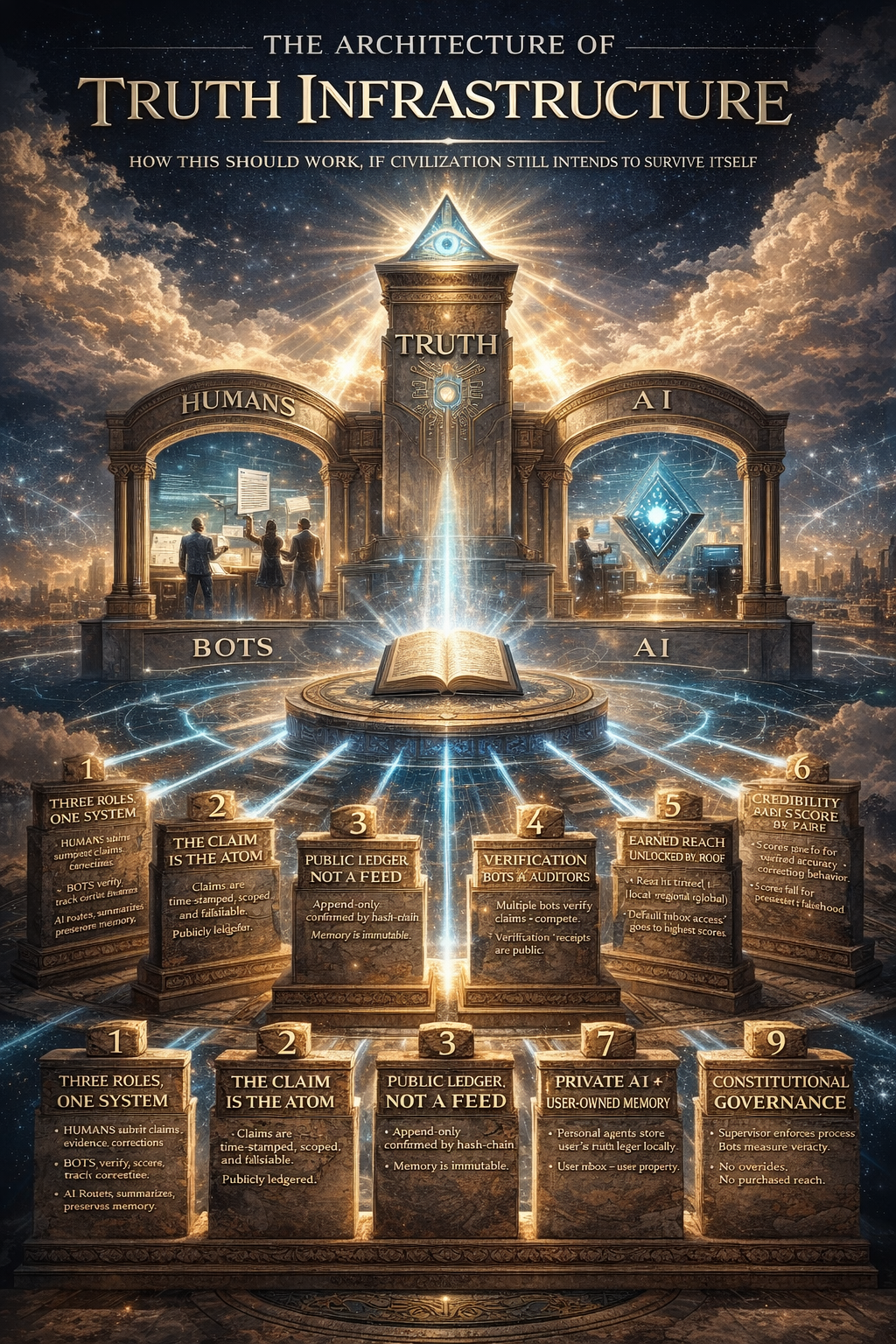
A Call to Build the Truth The Architecture of Truth Infrastructure
Every civilization is ultimately tested not by its wealth or its weapons, but by what it chooses to treat as true. Empires fall when truth becomes negotiable. Societies rot when truth is bought, filtered, or silenced. What we are living through now is not a crisis of information—it is a crisis of authority over reality.
For decades, we outsourced truth to platforms. We let engagement decide importance. We let money decide reach. We let power decide silence. Journalism became performative. Credibility became cosmetic. Memory became editable. And slowly, almost imperceptibly, truth lost its footing.
That era is ending.
AI has arrived—not as a threat, but as a mirror. For the first time in human history, we have the tools to measure consistency, track outcomes, preserve memory, and evaluate claims over time without fatigue, favoritism, or fear. The question is not whether AI will shape the future of truth. The question is whether truth will be built into AI before power corrupts it the way it corrupted everything else.
This is where the line must be drawn.
I am not here to sell a platform. I am not here to crown myself an authority. My role is architectural, not imperial. I plant ideas. I draw systems. I define incentives. I invite the world to test them. If they fail, discard them. If they hold, build them—without me if necessary.
The architecture is simple in spirit, even if profound in consequence: humans bring data, claims, evidence, and corrections; AI and bots verify, score, and remember; credibility compounds over time; falsehood decays naturally; reach is earned, not purchased. No erasure. No overrides. No exceptions for wealth, status, or connections.
This is not censorship. It is the opposite. No one is silenced. Everyone is recorded. And history—proper history, with receipts—does the judging.
In such a system, journalism is reborn. Not as personalities shouting into feeds, but as records standing up to time. Not as outrage cycles, but as accountability ledgers. The loud will not win. The accurate will. Those who correct themselves will rise above those who double down. Those who speak truth when it is costly will outlast those who speak what is convenient.
This is where the Superuser concept emerges—not as an elite class, but as a measurable outcome. A Superuser is not someone with followers. A Superuser is someone whose data proves integrity. Someone whose record shows courage under pressure, consistency over time, and resistance to corruption. In this future, access—to inboxes, to distribution, to default visibility—is a responsibility earned through truthfulness, not a privilege bought with money.
Bots are not the enemy here. They are the referees. They keep score. They show their work. They disagree publicly when uncertain. They do not care who you are, who you know, or what you own. They care only about what can be verified, corrected, and learned from.
And this is why I am challenging the world.
If you have a better idea—one that protects truth from money, power, and erasure—bring it forward. Articulate it. Defend it. Let it be tested. But if you do not, then help build this. Improve it. Fork it. Implement it in ways I never imagined. The truth does not need a single owner. It needs defenders.
Because make no mistake: if we do not build truth into the foundation now, AI will still move forward—trained on noise, manipulated by incentives, and weaponized by those who already distort reality. That would not be an AI failure. It would be a human one.
Truth is the foundation everything else rests on. Without it, freedom collapses into fiction, democracy into theater, and power into tyranny. With it, even flawed systems can self-correct.
This is a call—not to follow me, but to stand with the idea that truth must be structural, measurable, and protected by design.
If you believe that, step up.
If you have something stronger, show it.
If not, help build the truth—for the future, and for generations who deserve better than what we inherited.
The Architecture of Truth Infrastructure
How this should work, if civilization still intends to survive itself
I’m ending where civilizations always end: not with a slogan, but with an architecture. Because once you accept that truth is the foundation, you are forced to face the next question—how do you defend it structurally, when money and power can bend everything else?
This is my answer. If you can do better, do it. If you can’t, then stop arguing and help build what reality requires.
The old model treated truth like content. It let platforms decide what people see. It let virality masquerade as legitimacy. It let deletion rewrite history. That era produced a world where public memory is a feature that can be toggled, and where the loud can substitute for the correct.
The new model treats truth like infrastructure.
1) Three roles, one system
This system has three actors, and each must be limited by design:
Humans submit claims, evidence, context, and corrections. Humans remain the origin of testimony and the owners of responsibility.
Bots do the work humans cannot do at scale: verification, cross-referencing, outcome tracking, and consistent scoring. Bots are not “moderators.” They are auditors.
AI is the orchestration layer: it routes claims to the right bots, builds summaries, maintains memory, detects manipulation, and presents results in human language.
Humans speak. Bots verify. AI curates.
No one gets to be God. Everyone leaves a trail.
2) The claim is the atom
Everything starts with a claim—and claims must become machine-legible, not poetic ambiguity.
A valid claim is:
timestamped
scoped (who/what/where)
typed (prediction, factual assertion, allegation, interpretation)
falsifiable (what would prove it wrong)
linked to evidence (if available)
optionally confidence-rated (0–100)
This format does two things: it forces clarity, and it makes verification possible.
3) A public ledger, not a feed
A feed can be gamed. A ledger cannot.
Every claim is written to an append-only record:
you can add updates
you can add retractions
you can add context
you cannot erase history
The point is not to punish. The point is to prevent reality from being rewritten. A civilization that allows memory to be edited on demand is not free—it is programmable.
So the system is built on a ledger that preserves:
the original claim
the evidence at the time
later evidence
the verification status
the final outcome
the scoring changes and reasons
4) Verification bots as competing auditors
No single bot is trusted as the oracle.
Multiple verification bots exist, each with a declared method:
one focuses on primary sources
one focuses on statistical plausibility
one focuses on timeline and geospatial verification
one focuses on contradiction detection
one focuses on outcome tracking
They produce public “receipts”: what they checked, what sources they used, how confident they are, what they could not verify.
Where bots disagree, the system does not hide it. Disagreement is published as structured uncertainty. That is honesty.
Truth is not always certainty.
But lying is pretending certainty without basis.
5) Credibility is a score, not a vibe
The core output is a longitudinal credibility score—not based on likes, but on record.
Scores increase through:
verified accuracy
strong evidence tiers
correct predictions with measurable outcomes
responsible corrections
Scores decrease through:
verified false claims
weak evidence paired with high certainty
repeated pattern failures
refusal to correct when wrong
Crucially: correction behavior matters. A person who updates and retracts is more trustworthy than someone who never retracts because they never admit error.
This is how you reboot journalism with data.
Not by crowning saints, but by tracking behavior.
6) Earned reach replaces platform power
Here is the civilizational shift: reach becomes a privilege unlocked by proof.
In legacy systems, reach is purchased or algorithmically gifted. In truth infrastructure, reach is earned in tiers:
you start local
your record unlocks regional
your record unlocks global
your record unlocks default distribution
The system can grant “default inbox access” (distribution priority) to high-integrity participants the same way consumer technology once set defaults—except this time the default is not a corporation. The default is credibility.
Money cannot buy this.
Power cannot force it.
Only record can unlock it.
7) No suspension for truth—only contextualization
The system does not rely on banning as its primary tool.
It relies on:
scoring decay
context overlays
visibility narrowing
mandatory labeling for unverified claims
People are not silenced. They are measured.
Falsehood loses reach because it fails reality, not because a human editor pressed a button.
That is the difference between control and governance.
8) Private AI and user-owned memory
If the system is to survive power, it must not require power’s permission.
So there must be an endpoint design:
users can run a private agent locally
their personal memory is user-owned
their inbox is not dependent on a single platform
bots can deliver summaries without owning the person
This is where “Project Zero” lives: the capacity for a human being to have a truth-preserving assistant that answers to them alone, not to an ad network, not to a corporation, not to a state.
9) Constitutional governance, not personality governance
Finally, the system needs a governance model that doesn’t collapse into cult or capture.
So the “Supervisor” role is constitutional:
can enforce process
can approve/disable bots that violate rules
can trigger audits
cannot override scores
cannot delete records
cannot sell exceptions
The supervisor enforces the rules.
The rules enforce the truth.
10) The minimal implementation path
If you’re a builder and you want to test this without ideology, build the smallest version:
A simple website where:
users submit claims in the standard format
claims are ledgered (append-only)
one bot verifies one category (predictions)
scores update publicly with reasons
the feed shows: what happened, who was right, why
If that works, you scale categories. You scale bots. You scale governance.
But you never compromise the core premise: memory cannot be erased, and reach cannot be bought.
The challenge stands
That is my proposed architecture—civilization expressed as structure.
If you have a better way to defend truth against money, power, and erasure, step forward and present it. Don’t critique from the sidelines. Put your architecture on the table.
If you don’t, then recognize what time it is. The truth is being attacked because it is the only thing that can stop collapse.
Our job is not to build.
Our job is to describe, to paint the picture so clearly that builders can’t pretend they didn’t see it.
Truth will be defended—by design, by data, and by a future that refuses to be programmed.
Conclusion: The Challenge Is Now
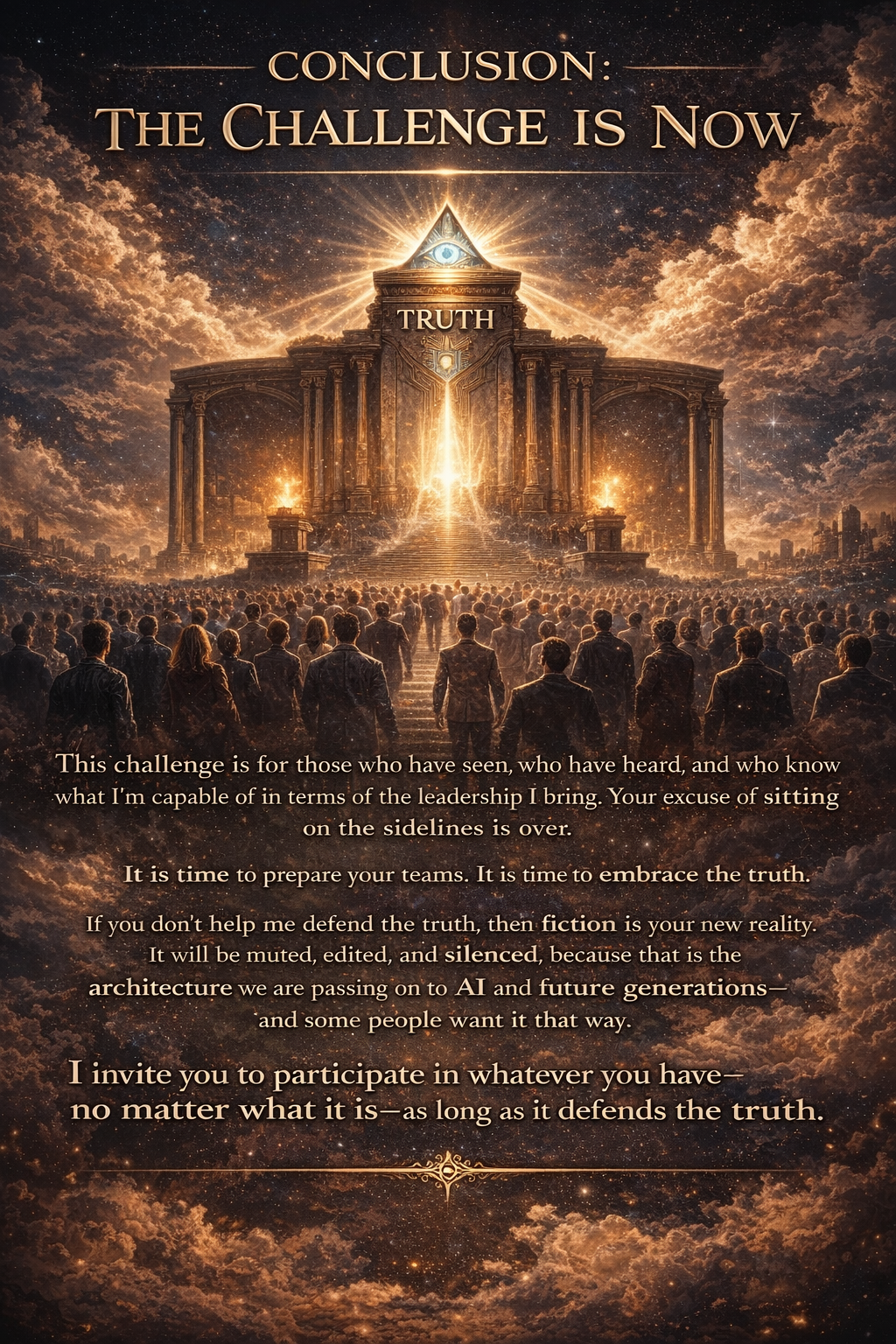
This challenge is directed at those who have seen, who have heard, and who know what I am capable of when it comes to leadership and execution. The excuse of sitting on the sidelines is over. The moment has arrived where neutrality is no longer a position—it is a decision to allow distortion to continue unchallenged.
It is time to prepare your teams. It is time to embrace the truth. And it is time to accept a basic reality: humans are flawed. Stop picking and choosing personalities, narratives, and convenient alliances. Look instead at the results being placed in front of you—at the records, the outcomes, the data. That is where truth now lives.
If you choose not to help defend the truth, then understand what follows: fiction becomes your new reality. It will be muted, edited, reordered, and silenced—not by accident, but by design. That is the architecture we risk passing on to AI and to future generations. Some people want that outcome. History has already shown us where it leads.
We have seen slavery.
We have seen racism.
We have seen hatred.
We have seen misinformation reshape lives and nations.
We do not get to pretend we don’t know how this ends.
So I am calling you to participate—using whatever skills, resources, and influence you have. I am open to building with you, speaking with you, and collaborating with you in any form, as long as the work defends the truth, creates equal opportunity of reach, and allows humans to remain human—imperfect, accountable, and free.
If you are ready to stand for that, then I look forward to working with you.