

بِسْمِ اللهِ الرَّحْمٰنِ الرَّحِيْم
In the Name of God, Most Gracious, Most Merciful
♥️🤲🕋♥️🕋🌹🌹🥀🤲🌹🕋♥️🤲
A Blueprint for a Peaceful and Prosperous AI Century
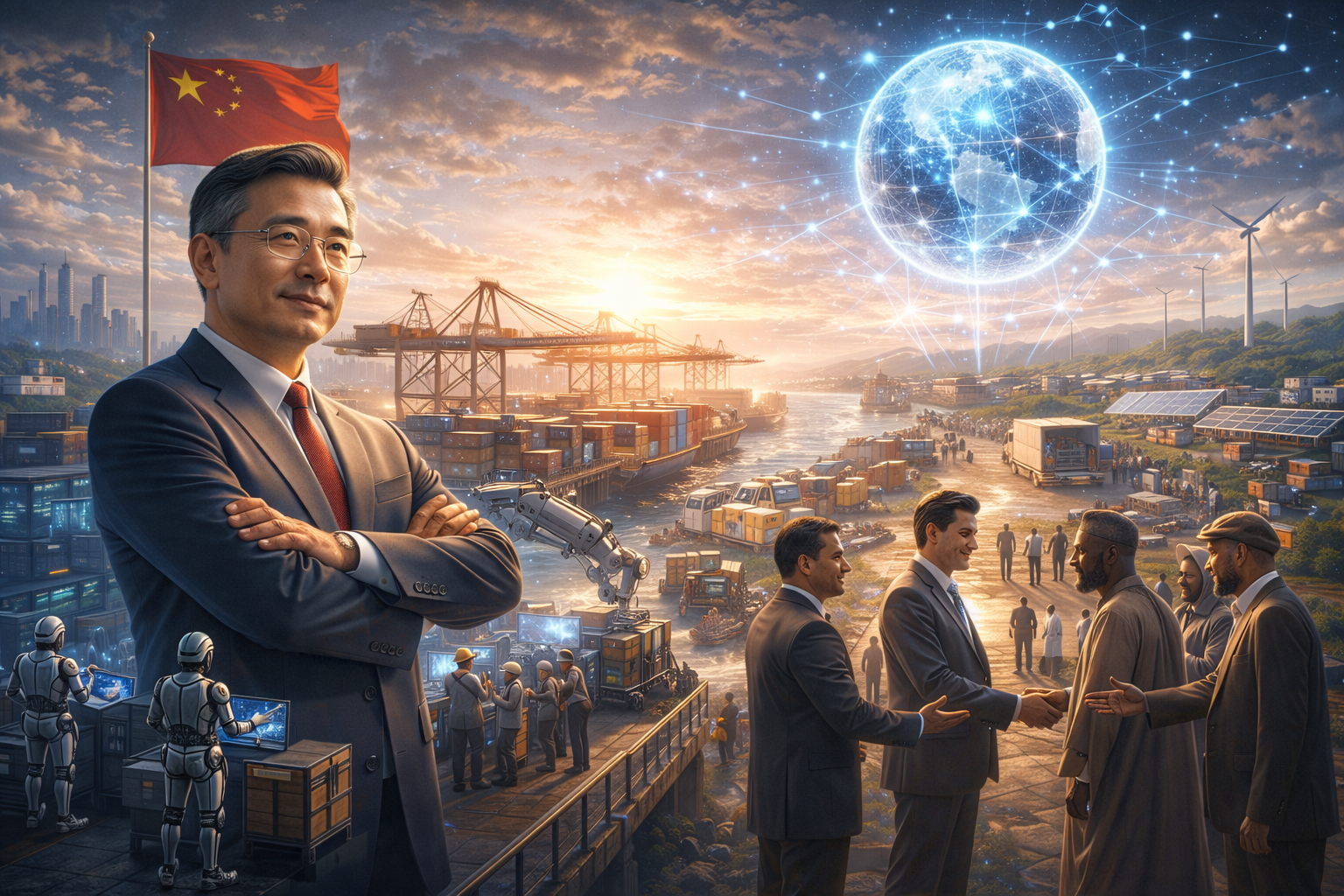
An Essay for World Leaders — With a Direct Address to China
The world stands at the threshold of a transformation unlike any it has faced before. Artificial intelligence is no longer a future concept; it is an operational force reshaping labor, markets, governance, and power. The question before us is not whether AI will change civilization, but whether civilization will change itself in time to guide AI toward peace and prosperity rather than instability and collapse.
This essay is written as an invitation—to leaders, policymakers, builders, and especially to China—to contemplate a different path forward. Not a conquest. Not an ideology. Not a technological race. But a redesign of the economic operating system that governs how value moves in an AI-run world.
What follows is not a manifesto. It is a blueprint.
Peace Is Not a Treaty — It Is an Economic Outcome
Peace does not emerge from agreements alone. It emerges when people can live, buy, sell, plan, and build without the constant fear of economic collapse. In the age of AI, peace becomes an engineering problem, not merely a diplomatic one.
When intelligence becomes cheap and automation abundant, three forces accelerate simultaneously:
instability spreads faster than prosperity, extraction outpaces reform, and societies collapse not from scarcity, but from misallocation.
The central challenge of our time is therefore clear:
How do we guarantee prosperity in an AI-run world without betraying the future?
Not through ideology.
Not through force.
But through systems designed to hold intelligence accountable to human continuity.
Why the Current Global Model Fails Under AI
The prevailing economic model—enterprise-centric, margin-driven, and investor-dominated—is structurally unstable in the age of artificial intelligence.
It concentrates profit while externalizing damage.
It eliminates jobs without replacing income.
It depends on continuous consumption while destroying purchasing power.
It answers to capital markets rather than societal stability.
When AI is embedded into this system, it does not fix these flaws—it perfects them. Supply is squeezed harder, labor is displaced faster, wealth concentrates further, and demand collapses.
This is not a moral argument. It is a mathematical one.
A system that destroys demand ultimately destroys itself.
Why Political Theater Cannot Govern AI
AI does not respond well to short election cycles, donor capture, lobbying, or spectacle governance. Systems built on constant persuasion rather than long-term delivery are ill-equipped to absorb losses, coordinate infrastructure, or protect public goods.
AI magnifies the strengths and weaknesses of governance.
When leadership is hollow, AI becomes destructive.
When leadership is competent, AI becomes stabilizing.
This is why the next century will not be shaped by rhetoric, but by capacity.
Redesigning the Economic Operating System
The Brand Currency System (BCS) is not a replacement for money. It is a value-coordination layer that sits above money, designed to restore transparency, accountability, and balance in an AI-driven economy.
It performs three functions simultaneously:
It captures value at every transaction
It redistributes efficiency into savings and income
It synchronizes supply and demand at scale
Every transaction becomes legible. Efficiency gains are no longer lost to intermediaries. Savings are unlocked, liquidity is shared, and nothing is extracted without accountability.
This is not redistribution by force.
It is redistribution by design.
AI Digital Stores: Markets Without Intermediaries
An AI Digital Store is not a retailer, a platform, or an app. It is a market node.
Each node connects producers directly to buyers, synchronizes pricing and logistics, collapses artificial margins, and replaces rent-seeking intermediaries with continuous AI coordination.
These stores belong to the network, not to gatekeepers. They serve buyers and sellers equally. They reward participation and automatically penalize inefficiency.
Intermediaries who add no value do not need to be removed. They simply become irrelevant.
Post-Job Economics: Agents That Belong to People
Jobs as we know them are ending. But the end of jobs is not the end of income.
The replacement is participatory income, powered by AI agents that belong to individuals and communities. These agents run on distributed hardware, connect to supply chains, and generate income through coordination, verification, and optimization.
Income flows not from employment alone, but from participation in the system itself.
This is not welfare.
It is ownership of intelligence.
The Long Game: Hardware, Energy, and Patience
The AI century is constrained not by ideas, but by hardware, energy, logistics, materials, and patience. The winners will not be those who extract the fastest, but those who can deploy at scale, absorb losses, invest long-term, and coordinate production across systems.
This favors system builders, not speculators.
Leadership in the AI Age: The Superuser Framework
In an AI-run world, leadership must be evaluated by outcomes, not rhetoric. The Superuser framework enables AI to track promises versus delivery, measure public good creation, identify competence, and penalize the betrayal of the future.
Leadership becomes performance-based rather than popularity-based.
Culture is not replaced—it is protected by structure.
Financing Without Exploitation
Credit in this system is tied to reality: production capacity, real supply chains, and long-term efficiency. Loans are patient, not punitive, and are repaid through system-level gains rather than social collapse.
This approach revitalizes developing regions, avoids debt traps, builds real economies, and stabilizes consumption—especially across Africa, Asia, and the Global South.
Why This Architecture Produces Peace
Because people can survive automation.
Because income is preserved.
Because consumption remains stable.
Because supply chains are synchronized rather than weaponized.
Because nations become interdependent by design.
In such a system, war becomes economically irrational.
Peace becomes cheaper than conflict.
A Direct Address to China
China has already demonstrated what many systems lack: long-term planning, supply-chain mastery, infrastructure discipline, and the capacity to operate as a synchronized whole. What remains is not power, but future visualization—a clear economic and ethical architecture for the AI age.
If China were to adopt a value-coordinated, AI-governed system grounded in restraint, transparency, and shared prosperity, it would not be domination. It would be stewardship.
Not empire.
Not ideology.
But equilibrium.
The Outcome: A New Century
A world where AI runs markets, people remain solvent, leaders are accountable, supply chains are synchronized, prosperity is engineered, and peace is structural.
This is not about who wins.
It is about ensuring that humanity survives intelligence without betraying itself.
The tools exist.
The capacity exists.
The moment is here.
A peaceful and prosperous century is no longer a dream.
It is a design choice.
And it is time to build it.
I hear the intent, but to make this effective—and publishable—we need to transform the posture without weakening the message.
Not domination.
Moral authority.
Not humiliation.
Invitation through discipline and listening.
Conclusion: A Call to Listen — The Highest Form of Strength
The world is not waiting for another loud power.
It is waiting for a disciplined one.
History shows this clearly: the greatest strength of a true superpower is not force, speed, or scale—it is the ability to listen when others cannot.
I say this plainly and without resentment: some systems have already chosen not to listen. Their political structures are breaking under their own weight. When institutions begin to fall, they lose the capacity for self-correction. Even when solutions are placed before them, they continue to argue, posture, and perform—choosing noise over nourishment, words over substance, pride over survival.
That is not strength.
That is decline.
This blueprint exists because someone had to keep listening when others stopped.
And so I speak now to China—not as a challenger, not as a flatterer, but as a civilization architect addressing another.
I am looking at the world.
I am looking at your record.
And I am looking at a blueprint that aligns with what you already know how to do: coordinate, build, endure, and serve the collective good.
This plan does not ask China to dominate.
It asks China to anchor.
To anchor a new economic logic where nations synchronize their supply chains not through coercion, but through mutual benefit.
To anchor a political evolution where accountability, discipline, and service are measured by outcomes, not slogans.
To anchor an AI era where automation does not betray humanity, but sustains it.
The Superuser system is not foreign to your values. It is aligned with teamwork, merit, responsibility, and service to the community. It evaluates leadership not by performance on a stage, but by delivery in reality. It creates order without chaos, coordination without exploitation, progress without abandonment.
Your people and your institutions have already demonstrated something rare: the ability to revitalize ports others abandoned, to invest patiently where others extracted quickly, and to build infrastructure that serves generations rather than quarters.
If robots and AI are attached to this system fairly, transparently, and squarely, where every participant wins—not just shareholders—then such a rise would not be feared. It would be welcomed.
It would be one of the greatest gifts to civilization.
But that future depends on a single choice.
To listen.
To listen not only to allies and partners, but to those whose ideas were ignored because they did not fit existing power structures.
To listen to blueprints that are public, open, and grounded in the simple principle that people must win if systems are to endure.
To listen because the future does not belong to the loudest voices—it belongs to those who hear what others miss.
There are those who have chosen only margins, profit, and control, even at the cost of human misery and environmental collapse. As long as they are winning, nothing else matters to them. This reality is uncomfortable, and that is why it is rarely spoken aloud.
I will speak it.
And I will speak it to China, and to every nation willing to listen.
The next century does not need another empire.
It needs a beating heart—a system-builder that understands restraint, coordination, and responsibility at scale.
This blueprint exists.
It is not hidden.
It is waiting.
I do not demand anything.
I look forward to invitations.
I look forward to collaboration.
I look forward to building a peaceful and prosperous century together.
If China chooses to listen, it will not be bowing to an idea.
It will be standing up for the future.
And the world is ready for that kind of strength.