

Substack for Authors (Part 1): The frustrating reality of starting from zero, and what I wish I’d understood about the platform earlier.
 Image generated with ChatGPT
I’ve been getting a few questions from authors about Substack lately, and quite a few of them come back to the same confusion: what exactly is a Note, what counts as a Post, and which one are you supposed to use?
It doesn’t help that everything on the platform looks a little bit like publishing. You write something, click a button, and it goes somewhere. But does it go to your subscribers’ inboxes? Does it appear in other people’s feeds? And is that person who just followed you actually on your email list?
When I started The Sustainable Solopreneur, these little distinctions took me longer to figure out. They are important especially for authors who already have books to write and don’t want another confusing publishing workflow.
This is the first article in my Substack for Authors beginner series. I’m taking the questions people keep sending me and working through them one at a time, using real authors rather than another generic list of marketing tips. I’ll link each article to the next as and when it’s published.
Quick thing before I get into it. If you’re an author figuring out book marketing, newsletters and the business side of publishing, you can subscribe to my FREE newsletter, The Sustainable Publishers.
First, What Actually Happens When You Publish?
The easiest analogy is to think of Notes as Substack’s version of X (formerly Twitter). They’re shorter updates in a scrolling social feed: a thought, a question, a link, an image, a video, or a Restack of somebody else’s work. Other people can reply or share your Note, and it can reach readers who don’t already subscribe to you. When you publish a Note, it doesn’t automatically get sent as a newsletter email, though readers may see it through notifications or a Notes roundup.
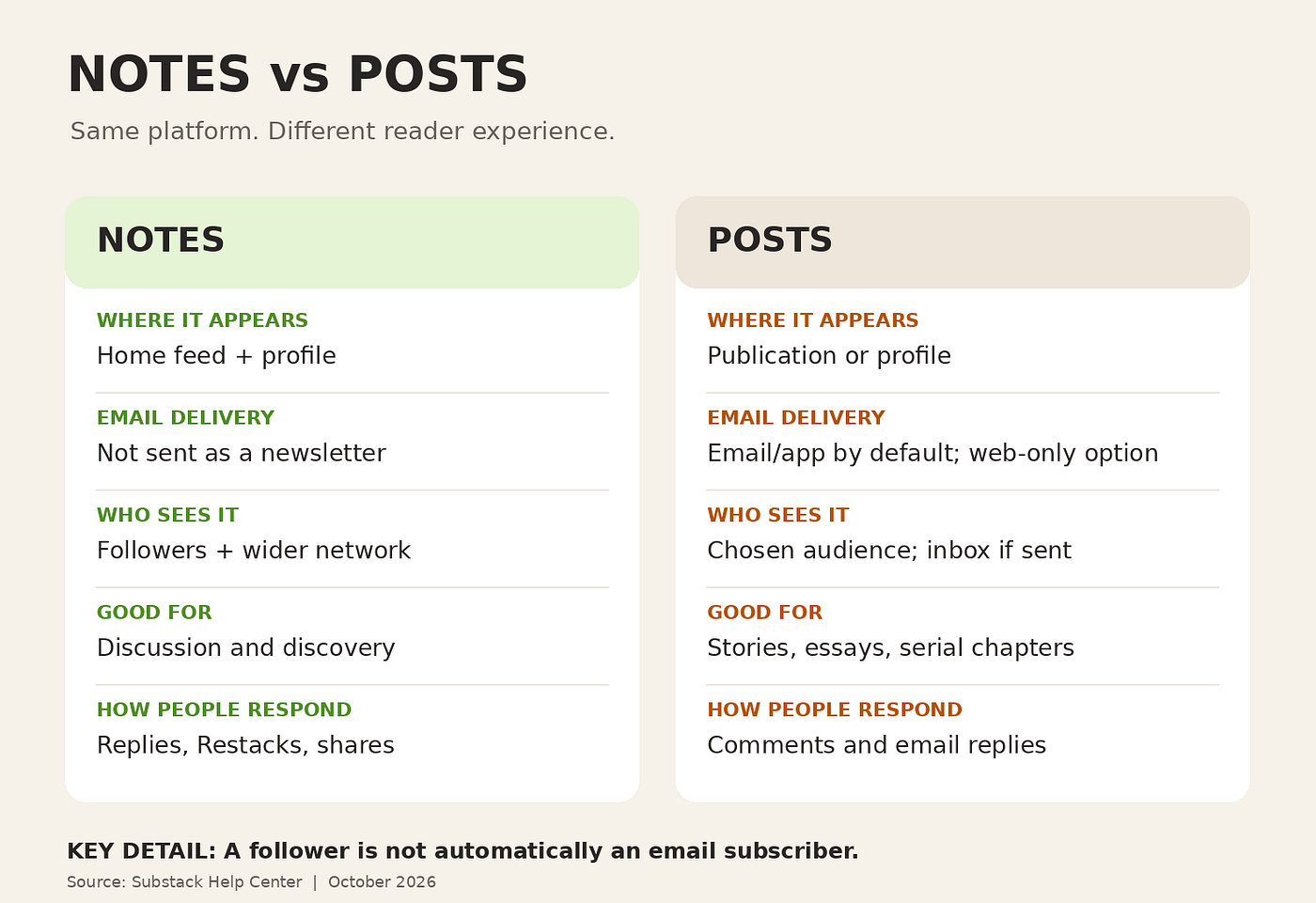
A Post is closer to a Medium article, except Substack can also deliver it directly to your subscribers’ email inboxes and app inboxes. It lives on your publication or profile, and could be an essay, a serialized fiction chapter, a podcast episode, a video, or an update that’s only a few paragraphs long. You choose who can read it, including whether it’s free or paid subscribers, and before publishing you can turn off email delivery if you want it to appear only on the web. In other words, a Post is not simply ‘a longer Note.’ It’s a different publishing and delivery format.
There’s also a distinction that catches people out: a follower and a subscriber are not the same thing. Someone can follow you to see your Notes without subscribing to your publication or giving you an email address. If they subscribe, they can receive your Posts. The follower count isn’t automatically your newsletter list.
On desktop, you can start a Note from Create → Note, or begin a longer Post from your publication dashboard with Create → Article. After publishing a Post, you can share it into Notes so people in the feed can discover it. That’s separate from whether you chose to send the original Post by email.
That’s the basic mechanics. What interested me more was how authors are using each format.
Some Authors Are Doing Much More Than Posting Book Updates
Ian D. M. Taniels had a different problem. He was writing serial fiction, meeting other authors through Notes, and realised how hard it was for readers to discover all the fiction scattered around Substack. Those Notes and conversations eventually led him to create House of Chapters, a curated home for serialized stories, organized by genre, with a podcast featuring writers from the indie publishing community. That’s a much more ambitious use of the platform than simply announcing a new chapter.
For a very different example, I liked what nonfiction author and critic Laurie Stone has done with Notes. Rather than posting promotional teasers, she writes miniature stories and flash memoirs that work as complete pieces in the feed. In an interview published by Substack, she talked about giving people a reason to enjoy the writing before asking them to follow anything. In the month discussed in that interview, more than 20% of her new subscribers had come from Notes. That was her experience at the time, not a result every author should expect.
And one of the most unusual fiction projects I found was Jessica Huckabay’s Roots of Time. Readers create characters inside her fantasy world, make decisions through polls and comments, and help determine which story paths she writes next. There’s even a map to navigate the branching story and a chat for the role-playing side. The Posts carry the actual story and its choices; the interaction turns the audience into participants. I’m not suggesting every author needs to build an entire interactive fantasy universe, but it certainly made the usual ‘share a deleted scene’ advice look a little unimaginative.
Another nonfiction example worth studying is Jami Attenberg, author of 1000 Words: A Writer’s Guide to Staying Creative, Focused, and Productive All Year Round. Her CRAFT TALK newsletter is also home to the #1000wordsofsummer project, where readers join a two-week writing challenge and receive daily letters from Attenberg and guest writers. They check in through comments and a separate Slack community, and the project gives people something to do together rather than simply another book announcement. The community is much bigger than the indie examples above, but the principle is useful even with 50 subscribers: the Post can be a shared event, not just another article.
These authors aren’t all the same size, and their results aren’t promises. But they show the possibilities: serialized-fiction discovery, flash memoir, interactive storytelling and an actual writing community. There’s much more here than repeating “buy my book” in a feed.
Nicolas Cole brought up another interesting possibility in his Commercial Fiction Club newsletter: early-reader communities. He describes fiction authors giving their most invested readers access to a book in progress, a place to discuss it and opportunities to offer feedback. Some charge for that access. I can see how Posts and conversations could work together here. The Post might carry a new chapter or an update from the writing process, while comments or Chat let readers take part instead of just waiting for launch day.
I wouldn’t rush into making that a paid community as a beginner, though. Someone who loves reading your fantasy novels doesn’t necessarily want to learn how to write one, and a membership also creates work you have to keep delivering. There’s a whole separate conversation to have about which extras readers genuinely want and whether they’re worth an author’s time. I’ll come back to that in a future article.
So Where Do Notes Fit, and Where Do Posts Fit?
For me, the question is what kind of experience the reader needs, rather than how many words I want to write.
For example, a mystery writer might share a strange historical discovery in a Note and ask readers what they think. A related Post could explore the story behind that detail and how it changed the manuscript. A nonfiction author could try a question in Notes, then publish a proper explanation in a Post after seeing where readers get stuck.
Of course, not every Note has to promote a Post, and not every Post needs a Note campaign. A serialized-fiction chapter can be the main reason someone subscribes in the first place.
Why Notes Matter More When Nobody Knows You Yet
Here’s a mistake I see beginners make, and I understand it because writing a proper article feels like the respectable thing to do. You’ve just opened a Substack, you have no subscribers yet, and you spend days rewriting the first Post. You fiddle with the headline, swap the introduction around and convince yourself it has to be a masterpiece. Then you publish it and, quite possibly, hear nothing. After another three or four Posts get the same response, it becomes tempting to decide that Substack doesn’t work.
The writing might have been perfectly good. The problem is that hardly anyone knew it existed. Your first few Posts can give new readers something worthwhile to find when they visit, but publishing a great article doesn’t automatically put it in front of strangers. That’s where Notes deserve much more attention at the beginning. They circulate through Substack’s social feed, and people who don’t follow or subscribe to you can discover them through conversations, recommendations, replies and Restacks.
So if you’re starting from zero, I would put at least as much effort into showing up in Notes and talking to people as I would into polishing the next long Post. I’m not suggesting you stop writing proper articles. I just wouldn’t spend all your available energy on a perfect newsletter while the people who might enjoy it have never seen your name.
I made a small resource for this exact blank-screen problem: The Substack Notes Starter Pack. It’s 30 fill-in-the-blank templates covering hooks, stories, useful ideas, social proof, product mentions and engagement. It’s optional, obviously, but if you’re spending 20 minutes wondering what to write in the feed, it can give you a starting point without having to invent a format every day.
My First 30 Days on Substack: A Routine I’d Actually Keep
If I were starting a new author Substack today, I’d begin with one to three Notes a day and one good Post a week. Three to five Notes daily would be my ideal if I could comfortably maintain it. But I would much rather publish one decent Note every day than post ten on Monday, disappear for three days and repeat the whole cycle whenever I feel motivated. Consistency gives people more chances to recognise you, and it gives you a much better sense of what kinds of conversations lead to readers.
Week 1: Get the basics clear. Your bio should tell people who you are, what you write and why they’d want to hear from you. ‘I write cosy mysteries set in small towns and share stories about the places that inspire them’ says a lot more than ‘Author. Dreamer. Coffee lover.’ Then publish your first Post and start showing up in Notes. No need to spend three days choosing a banner font.
Week 2: Keep the Notes going and publish another proper Post. Try a few different kinds of Notes: a question worth discussing, an observation from your research, something you’re reading, a short original piece, or an interesting conversation with another author. Reply to comments and spend some time reading other people’s work rather than treating Notes like a billboard.
Week 3: Repeat the routine, and look for genuine connections. Maybe someone writing in your genre has an interesting publication. Maybe there’s a reader or reviewer who keeps joining your conversations. Recommend work you genuinely like, join useful discussions and explore a collaboration if there’s a natural fit. You don’t need to manufacture networking opportunities with everyone who has a subscriber count.
Week 4: Publish your fourth Post, continue with the Notes schedule and look at what happened. Which Notes started conversations? Did anybody visit your profile or subscribe afterwards? Are the people engaging with you interested in your books, or are they mostly other authors talking about writing? That last question matters more than it might seem.
At a sustainable pace of one to three Notes a day, that’s roughly 30–90 Notes and four substantial Posts in your first month. If you can comfortably manage three to five Notes daily, you could publish more, but I wouldn’t chase the bigger number just to have a bigger number. And there’s no promise that 90 Notes equals a particular subscriber milestone. The useful part is that you’ve given people plenty of chances to encounter your work and you’ve begun learning what they respond to.
If you want a bit more structure beyond the Notes themselves, I also have The Substack Growth Engine. It contains 23 AI prompts for things like positioning your publication, welcome emails, collaboration outreach, building digital products and turning interested readers into customers. That part is more relevant if you’re eventually building a business around your writing rather than just publishing fiction for its own sake.
One thing I’d be careful about with either resource: they’re starting points, not content you should copy from an AI tool and paste straight into Substack. Use the prompts or templates to get unstuck, then put your own stories, opinions, personality and actual experiences into the result. People don’t need another hundred accounts publishing the same polished, vaguely inspirational Note. They need a reason to recognise YOU.
One Last Thing Before You Press Publish
If you’re about to publish your first Post, check the delivery settings before you hit send. Substack lets you choose who can read it and whether to send it to subscribers by email and the app inbox, or publish it on the web only. That choice matters: editing a Post after it has already been emailed updates the web version, but doesn’t resend a corrected email. Notes work differently and don’t trigger the same newsletter blast.
Notes and Posts overlap, but they aren’t interchangeable. Once I understood how each reached readers, the platform became much easier to use.
Next in Substack for Authors: profiles, publications, followers, subscribers, Restacks and recommendations. I’ll link Part 2 here when it’s live, and the series will be connected in both directions.
Have you seen an author using Substack in an unusually creative way? Send me their publication. I’d love to feature more independent writers in this series.
See ya in part 2,
Vinayak
And if you’re working out book marketing and reader relationships yourself, you can subscribe to my FREE newsletter, The Sustainable Publishers. I write about email lists, publishing economics and the experiments I’m making along the way.