

 Image generated with ChatGPT
A lot of author Substacks I come across follow the same pattern. There’s a cover reveal, then a preorder link, then an “only two weeks to go” post, then a launch day post, and then things go pretty quiet until the next book.
I understand why. You wrote a book, and you want people to read it. But if every email is about the book, a new reader has no real reason to subscribe before they already care about the book. That’s a hard sell when nobody knows who you are yet.
So for Part 3, I wanted to look at what authors are actually publishing on Substack when it works. I mean documented examples, where you can see the numbers or at least the format. There are already plenty of lists out there telling you to share deleted scenes.
Quick thing before I get into it. If you’re an author figuring out book marketing, reader lists and the business side of publishing, you can subscribe to my FREE newsletter, The Sustainable Publishers.
The Author Whose Newsletter Outgrew Her Novel
Naomi Kanakia wrote about this on her Substack, Woman of Letters, back in December 2024. Her literary novel came out with a small press that year and sold roughly 700 to 800 copies in about six months. By her own account, it was hard for the book to stand out among hundreds of other new releases.
In the same period, her newsletter went from about 600 subscribers on the day the novel came out to almost 2,900. Around 70% of her subscribers joined after the novel’s release.
What was she sending them? Book reviews, critical essays, some poetry, and her own fiction by email every week. Most posts start from a book she’d recently read. People got something good to read every week, and the novel was one more thing they could pick up if they liked her.
I find that encouraging, because you clearly don’t need a bestseller to build a readership. It’s also slightly annoying, since it means the newsletter has to be worth reading by itself, and that takes far more work than posting a preorder link.
So what does that look like in practice? Here are five approaches I found, with real authors behind each one.
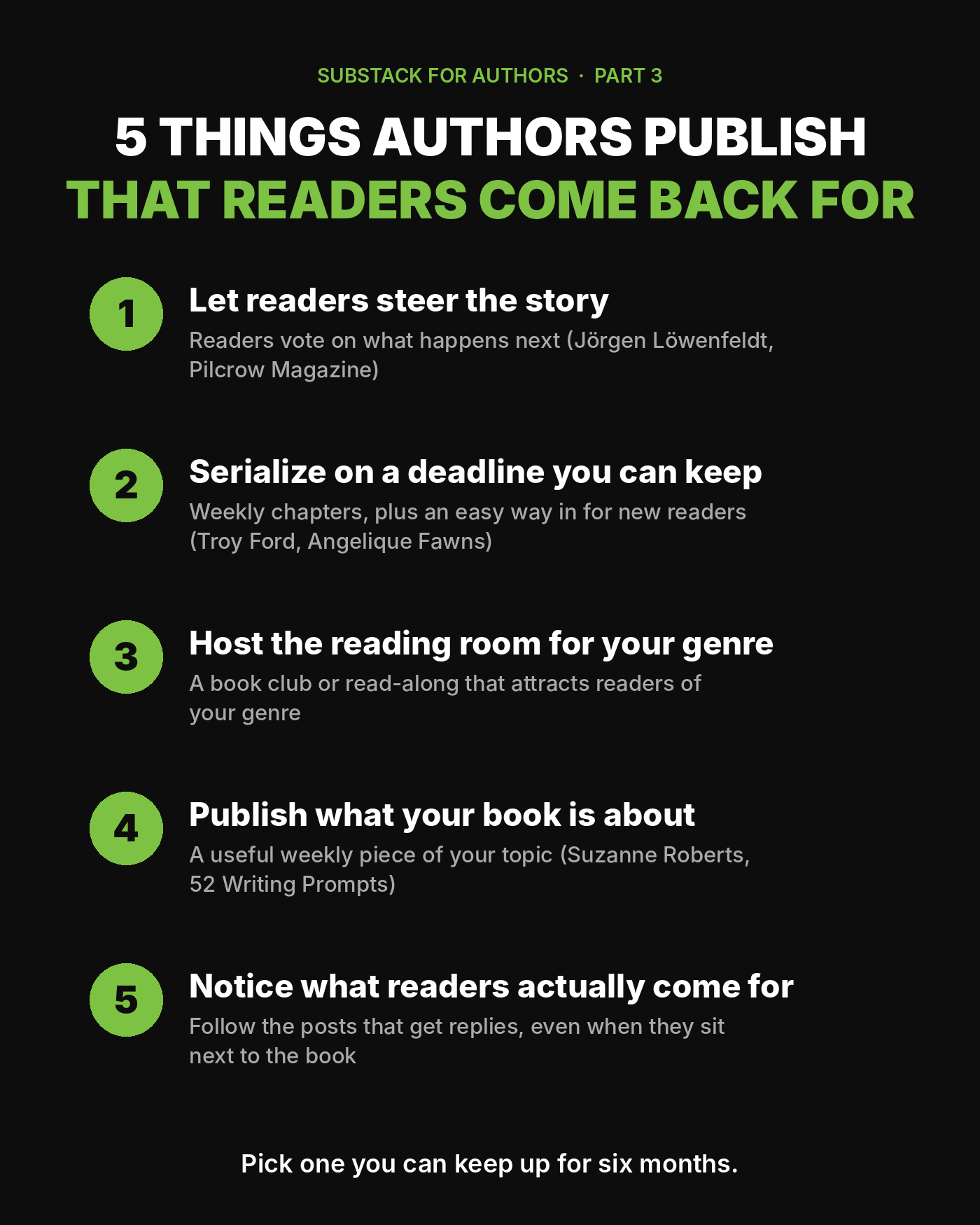
1. Let Readers Steer the Story
A March 2026 piece in Compact on how Substack revived the serial novel has a couple of good examples here.
Jörgen Löwenfeldt runs a project he calls “windchime” in his newsletter. At the end of each chapter he gives readers five possible directions for the plot. They vote over the following week, and the winning option becomes the next installment. The paths that lose are never published.
Pilcrow Magazine tried something similar at a bigger scale with a serialized novel competition. Subscribers voted on excerpts from unpublished novels, and the winner was serialized over the following months.
What I like about this is that readers have a reason to show up beyond “the next chapter is out.” They’re part of how the story gets made, so they come back to see whether their pick won. It does mean giving up some control, so it suits writers who enjoy improvising more than those who’ve planned every twist.
2. Serialize on a Deadline You Can Keep
Serial fiction is one of the most common things authors try on Substack, so I looked at how a couple of people doing it well set it up. Troy Ford wrote in Writer’s Digest about serializing his novel Lamb chapter by chapter. For his first 11 months on Substack he didn’t post any fiction at all. He wrote book reviews and personal stories while he figured the platform out. Once he started posting chapters, the weekly deadline kept him motivated, and his subscriber count grew five-fold in about six months. He released the novel in June 2025, at 55.
Speculative fiction writer Angelique Fawns described her setup for SFWA. She publishes a 1,000-word chapter of her space opera every Wednesday. She also brought an existing list of about 1,000 contacts over from MailerLite, which helped, and she’s since passed 2,600 subscribers.
Subscribe to Pro Writer Tools to remove upgrade prompts from your unlocked stories.
Both of them picked a schedule they could maintain alongside everything else, and then stuck to it. One thing I’d add from Part 2 of this series is to make it easy for someone to start reading in week twelve. If a new subscriber lands on chapter 14 with no way to find chapter 1, you’ve probably lost them. I went into that in You Finally Have Substack Followers. But Would They Read Your Book?
3. Host the Reading Room for Your Genre
Fiction authors tend to skip this one, which is a shame because I think it’s one of the smartest. Substack has been home to plenty of book clubs for a while. In a 2023 roundup of book clubs on Substack’s own blog, Downtime had readers vote on the next book, gave subscribers a discount on the pick and added an author interview and discussion threads. Emily’s Walking Book Club mixed in-person walks on Hampstead Heath with Zoom calls and monthly discussion threads, some of which passed 100 comments.
Now picture a thriller author running a monthly read-along of thrillers they love, including other people’s books. The people who join are thriller readers, which is exactly the audience your own book needs. Part 2 was about how easy it is to end up with a list full of other writers. A reading room mostly attracts people who read your genre for fun.
It also takes some pressure off. What you need is good taste in your own genre and a thread where people can argue about the ending, which is much easier to produce every week than a new chapter.
4. Publish the Thing Your Book Is About, Every Week
Nonfiction authors, this one’s mostly for you. Suzanne Roberts started her Substack, 52 Writing Prompts, as a one-year weekly series. Each post had some personal writing on a monthly theme and a short writing prompt. New posts are free for a couple of weeks and then go behind a $5 a month paywall, and paid subscribers also get occasional live workshops.
About two years in, she realized she had enough material for a craft book. She pitched her publisher, the University of Nebraska Press, and signed a contract based on a proposal. Her editor told her the Substack following “was definitely a perk.” She also says her Substack revenue now exceeds her yearly royalties from her seven previously published books.
The book grew out of the newsletter, so readers had already been getting value from her for years before there was anything to buy. If you write nonfiction, ask what your book helps people do, and whether you could give them a small, useful piece of that every week.
5. Notice What Readers Actually Come For
I’ll admit this last one is less comfortable to read if you’re mainly a novelist. Elle Griffin serialized her novel Obscurity on Substack in 2021 and 2022. According to the same Compact piece, when she polled her 45 paid subscribers, none of them were interested in the novel. They’d come for her other writing. Angelique Fawns noticed something similar on a smaller scale, where her short-story market research drew more enthusiasm than her fiction.
You can keep writing fiction and still take this seriously. The thing that builds your audience might sit right next to your book, like your research or the way you work out a plot, and that can be what people subscribe for. Pay attention to which posts get replies and which ones get silence, and be willing to follow that for a while.
How to Pick Yours
You don’t need all five of these. Trying to run a serial, a book club and a weekly prompt series at the same time is a fast way to burn out, especially if you have a day job like I do.
I’d ask three questions before choosing. First, can you keep it up every week for six months alongside your normal life? I’d take a modest format you’re still running in month six over a brilliant one you quit in week four.
Second, would someone who has never heard of your book still open this email? If the honest answer is no, it’s probably a promotional email dressed up as content.
And third, does it point back to the kind of book you write? A thriller read-along makes sense for a thriller author. A weekly recipe roundup probably doesn’t, unless your detective cooks.
Once you’ve picked a format, you’ll also need to talk about it on Notes so new people can find it. If staring at a blank Notes box is where you get stuck, I put together a $1 Substack Notes Starter Pack with about 30 templates for different kinds of Notes. Treat them as a starting point and add your own stories and opinions before posting, because raw AI output on Substack is very easy to spot.
If you missed the start of this series, Part 1 covers how Notes and Posts work together when you’re starting from zero, and my article on how authors can grow an email list from zero goes into the early growth side.
If you’ve tried any of these formats, or something completely different, tell me in the comments. I’d genuinely like to know what’s working for authors right now, because I’ll probably use some of it in the next part of this series.
See ya,
Vinayak.
And if you’re an author trying to build the marketing side without turning yourself into a full-time content machine, you can subscribe to my FREE newsletter, The Sustainable Publishers. I write about book marketing, email lists, publishing economics and what I’m testing as I go.