

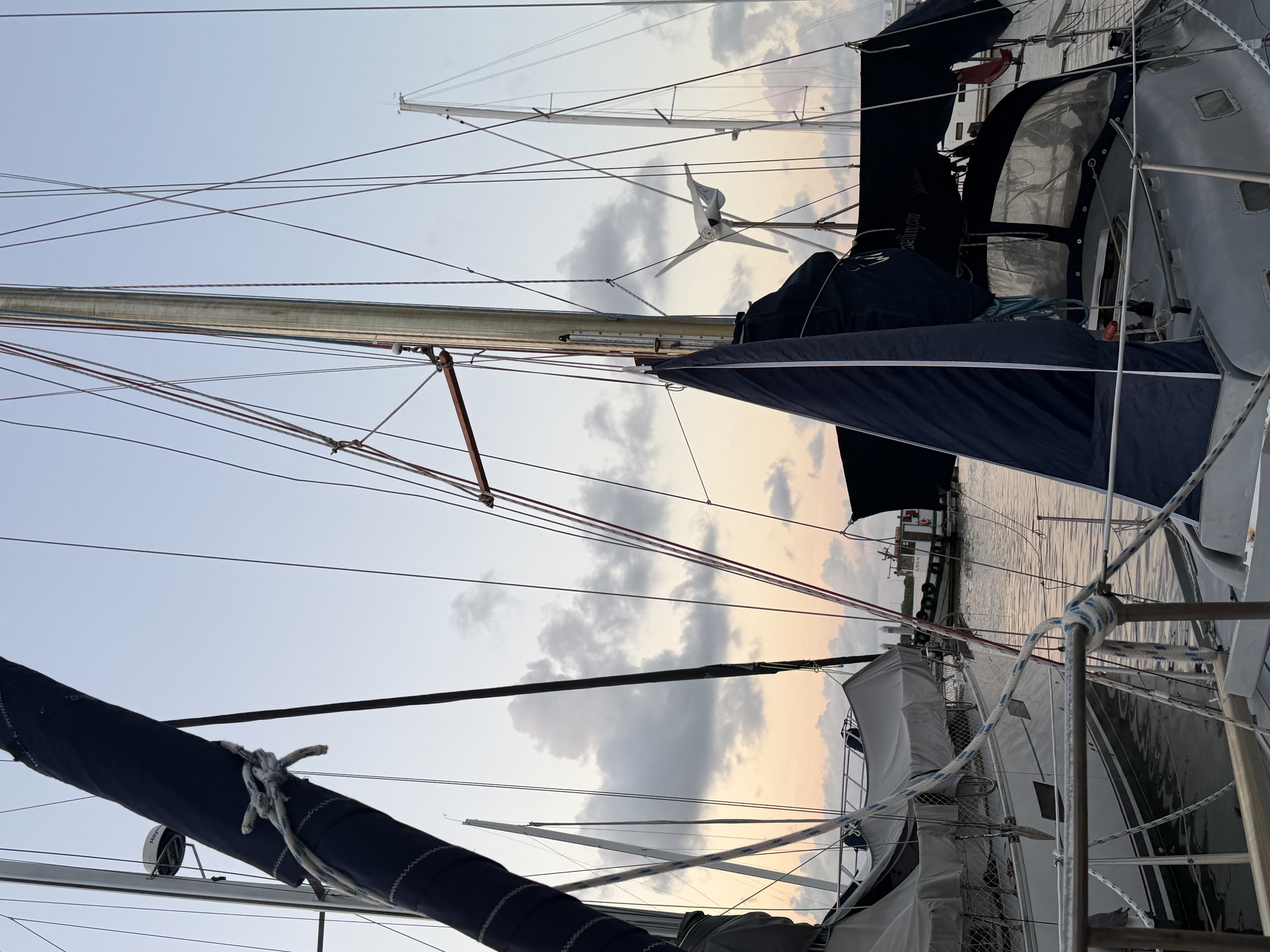
The hanging bar on the foredeck
It is no exaggeration to say I am overwhelmed.
Overwhelmed with the good wishes from the oldmansailing community – and in particular by the number of people who have their own shoulder injury stories to share.
The result has been a turmoil of emotion as I have been buffeted by thoughts that “it’s all hopeless” alternating every few seconds with “there must be a way”.
Take, for instance, the Australian who tore his rotator cuff while re-positioning the anchor on the bow of his 42footer in the Med. By the time he got home, his doctor insisted he needed physiotherapy. But he had new sailing plans and did not go back for a check-up for six months. By that time the shoulder was so well healed, the doctor assumed it must be the result of extensive physio. He wouldn’t believe that everyday sailing was just as good.
On the other hand, I think the real low point came with a comment from a 76-year-old sailor from Tennessee. His situation seemed virtually identical to mine (although, his boat was a Beneteau). This man was eight weeks into his repair surgery and he began his email with this warning: “I can tell you that you will need help for the first month or so. Ask the surgeon about renting an ice machine with a shoulder harness, it will reduce the pain and the swelling, I used mine for 2 weeks. Physiotherapy started after 10 days and is twice per week. My medication is typically 2 extra strength Tylenol at night and as needed. It’s important to stay ahead of the pain in the first couple of weeks.”
He added that he was not allowed to lift ANYTHING (this is after two months, don’t forget). He could not get on his boat, much less down the companionway. The prospect of continuing to live aboard was clearly laughable.
As well as the ice pack, it seems I must get hold of a good heating pad, and I should seriously consider asking a relative to come out to Brazil to help me because: “You will not be able to do this on your own if you expect to recover. I am shocked at how many men I have met that did not follow the instructions and ended up re-tearing the repair and having to repeat it all. I could not sleep in a bed until this week - rent a recliner…“
I stabbed the screen as if deleting the words would delete the reality. Men who did not follow the instructions and ended up re-tearing the repair… when did I ever follow instructions?
Interestingly, this made sense of something I had seen on the website of a physiotherapist in El Paso (I spend a good deal of time trawling physio websites.) This man maintained that the chances of recovering from a rotator cuff tear were just as good with physiotherapy alone as they were with surgery and physiotherapy. The figures, he maintained, were virtually identical – yet the healthcare industry (the American healthcare industry) would always promote surgery because that was where the greatest profit was to be found.
And then there landed an email from Paul, the techie in Florida. He thanked me for the video I had sent him – only, I hadn’t sent him a video (at least not consciously). I watched it. A retired surgeon called John M Kirsch talking about his book: Shoulder Pain: The solution & prevention.
Kirsch had spent 30 years operating of people’s shoulders before realising that most of the procedures were unnecessary.
Apparently, it all came down to children and monkey bars – those horizontal ladders in playgrounds that children love to swing along by their hands. Except you don’t see monkey bars anymore – too many health and safety concerns.
All the same, human beings are born with a shoulder joint that is designed for swinging from monkey bars, or branches or vines like Tarzan. Children have not yet lost this ability – but as we grow up and stop using our shoulders in this way, the joints change shape (and by coincidence, make it harder for rotator cuff injuries to heal.
Kirsch proposed that hanging by the hands and recovering the original shoulder structure enabled patients to repair their own rotator cuff tears. In other words, the solution to a lot of shoulder injuries is hanging from monkey bars – or any convenient overhead structure.
Patients who spend half an hour a day hanging by their hands recover without the need for surgery. He had the research and the statistics to back it up.
Immediately, I WhatsApped the doctor, asking him to hold the surgery – at least while I tried this. The best news was that initial results could be expected in ten days – full recovery in as little as a few weeks.
Do you see what this means? I could carry on to Sydney! The Chichester Challenge is not dead after all!
Well, obviously, I had to get started immediately. First I needed a “hanging bar”.
I raided the focsle. There are shelves on each side – convenient for when it was a two-berth cabin instead of “the shed”. I found a nicely-varnished length of hardwood (a strut from an early version of the cockpit table). This I suspended from both ends with a length of 5mm line which in turn hung from spare headsail halyard running up and down the spinnaker halyard with a shackle – the spinnaker halyard being fastened to an eyebolt on the foredeck and winched tight.
It worked after a fashion, although if it was low enough for me to grab, I couldn’t exactly hang from it – unless you count still having my feet on the deck but bending my knees.
The hanging bar Mark II reversed the halyards (the spinnaker is Dyneema) without much difference.)
Mark III used the spinnaker pole topping lifts (without much improvement, it turned out.)
At every stage, I tried it. It hurt like hell.
The physio websites had all counselled: “If it hurts, stop doing it.”
Dr Kirsh said: “At first, the exercise may seem counter-intuitive because it is painful. After time, the pain subsides and is replaced with a feeling of well-being.”
It wasn’t until the evening that I experienced this feeling of well-being. All day, every hour on the hour, I had made the effort to catch the hanging bar as it swung above my head in the wind and then tried to build up my hanging time from the first excruciating seconds. I wasn’t sure it was doing any good.
Then, in the evening, I cast around for some way of doing it below – after all, I would have to carry on with this exercise, even in the Southern Ocean.
The centre hatch was open. You could hang from that. I remember Hugo hanging from it when he came to visit in the Caribbean. I tried it – bending my legs until my whole weight was hanging by my hands. First there was that excruciating pain – added to the uncomfortable rim of the hatch. But then, at about five seconds, it disappeared, to be replaced by the somewhat gratifying sensation you get from a really good first-thing-in-the-morning stretch.
I carried on doing this every hour throughout the evening – and then a couple of times in the night. I wouldn’t say I’m cured. But something is happening, and it isn’t costing me £3,500, plus the cardio-screening or the recliner rental…
See also: https://www.kirschshoulder.com/