
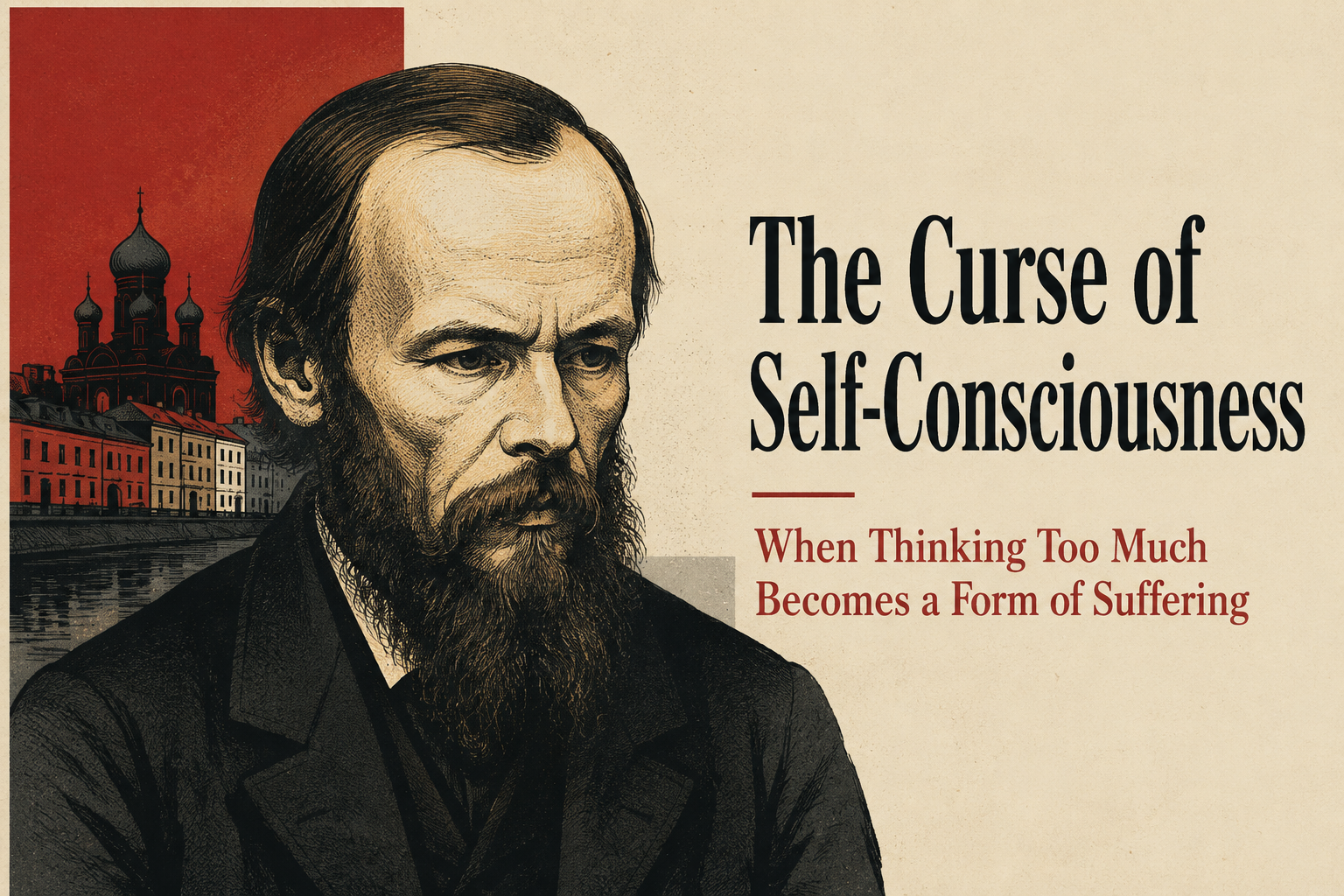
When Thinking Too Much Becomes a Form of Suffering
Imagine lying awake at three in the morning.
Not because of noise. Not because of pain. Not because anything in the external world is demanding your attention.
But because your own mind will not stop.
It is replaying something you said three days ago. Analyzing the exact tone of someone's response to you. Constructing elaborate scenarios about what a particular silence meant. Examining your own motives with such intensity that you can no longer tell what you actually feel versus what you are performing. Watching yourself think about yourself thinking.
And the longer it goes on… the more exhausted you become. And the more exhausted you become… the louder it gets.
You are not being haunted by the world.
You are being haunted by yourself.
Most people know this feeling. That particular torture of a mind turned entirely inward. That experience of consciousness folding back on itself again and again until thinking becomes its own form of imprisonment.
But very few people have described this experience with the honesty and precision and brutal self-awareness of Fyodor Dostoevsky.
Because Dostoevsky did not just write about this condition. He lived it. He dissected it. He built entire human beings out of it. Characters so paralyzed by their own awareness. So consumed by the act of observing themselves. So trapped inside the infinite regress of their own consciousness that they could not perform the simplest acts of ordinary living.
And through them… he showed us something about ourselves that we would very much prefer not to see.
That thinking… the very thing we celebrate as the highest human faculty… can become the most exquisite form of self-inflicted suffering ever devised.
The Underground Man and the Mirror That Never Stops Reflecting
Dostoevsky's most devastating portrait of self-consciousness lives in a short and almost unbearably uncomfortable book called Notes from Underground.
The narrator… a man who never receives a name… introduces himself immediately as sick. Spiteful. Unattractive. And then spends the entire book analyzing why he is sick and spiteful and unattractive with such obsessive thoroughness that you begin to understand something profound.
The analysis is the sickness.
The Underground Man is not suffering from his circumstances. He is suffering from his awareness of his circumstances. From his inability to stop examining every thought before he acts on it. From the peculiar torture of watching himself from the outside while simultaneously living from the inside.
He writes that a man of acute consciousness cannot have any particular desire. Cannot want anything with genuine commitment. Because the moment he wants something… he immediately examines the wanting. Dissects it. Finds its contradictions. Discovers the vanity or the fear or the self-deception underneath it. And the wanting collapses.
He is too aware to act. Too conscious to live.
Dostoevsky called this the curse of the thinking man. And he meant it literally. As a curse. Something that doubles back on the person carrying it and uses their greatest capacity… their intelligence… as the instrument of their torment.
When Consciousness Becomes a Hall of Mirrors
Here is the specific mechanism that Dostoevsky identified with such uncomfortable precision.
Ordinary people… the people the Underground Man envies with a burning and humiliating intensity… act directly from their impulses. They want something and they pursue it. They feel something and they express it. They make decisions from a place of relative wholeness. Without the constant interruption of the observing self watching the experiencing self and finding it wanting.
But the hyper-conscious person cannot do this.
Every impulse is immediately observed. Every feeling is immediately analyzed. Every action is anticipated and pre-judged before it occurs. And in the gap between impulse and action… the endless commentary of self-awareness inserts itself.
Am I doing this for the right reason? What does wanting this say about me? How will this appear from the outside? Is this genuine or is it performance? And if it is performance… am I performing even the act of questioning whether I am performing?
The mirror reflects the mirror. Endlessly. Without resolution.
Søren Kierkegaard described something similar when he wrote about the dizziness of freedom. The paralysis that comes not from having no choices but from being too aware of every possible choice and its implications simultaneously.
But Dostoevsky goes further. He shows us that this paralysis is not merely intellectual. It is deeply moral and deeply painful. Because the person trapped in this hall of mirrors is not just unable to act.
They are unable to feel that what they feel is real.
And a person who cannot trust their own experience… who must always insert the observing commentary between themselves and their own life… is a person living at permanent distance from themselves.
Not present. Not absent. But hovering. Always hovering. Just outside the reach of their own existence.
The Suffering of Seeing Too Clearly
Here is where Dostoevsky becomes genuinely dangerous to read if you recognize yourself in him.
Because part of the curse he describes is that the hyper-conscious person is often… right.
The Underground Man's observations about human nature are frequently accurate. His dissections of social performance and self-deception and the vanity underneath ordinary ambition are often devastatingly true.
His problem is not that he sees wrongly.
His problem is that he cannot stop seeing.
Cannot turn the apparatus off. Cannot choose to be a little less aware in exchange for a little more capacity to simply live.
Friedrich Nietzsche understood this dimension of the problem. He wrote that we suffer from the disease of history. The inability to act because we are too aware of what every action means. Too burdened by context and consequence and the weight of our own reflection.
He called the person capable of acting despite this awareness… the one who could forget. Not in the sense of stupidity. But in the sense of being able to set down the examining mind temporarily. To step fully into the moment without simultaneously narrating the moment from the outside.
The person who cannot forget… who must always be aware of being aware… pays an enormous price.
They trade the ability to be moved by life for the ability to understand it.
And understanding a life you cannot be fully present inside… is its own particular kind of hell.
Dostoevsky's Own Underground
Here is something important to understand about where this insight came from.
Dostoevsky was not theorizing about self-consciousness from a comfortable distance.
He lived inside it. Violently. Completely.
He was a man who analyzed his own suffering with the same relentless precision his characters brought to theirs. Who experienced the particular torture of watching himself feel things while simultaneously being unable to simply feel them. Who stood before a firing squad at twenty-eight years old… believed he was about to die… and found himself observing his own terror with a part of his mind that refused to stop functioning even in that extremity.
He survived. Was sent to Siberia. Spent four years in a labor camp surrounded by ordinary criminals. Men who did not think deeply. Did not examine. Did not dissect their own motivations or philosophize about their suffering.
And what he discovered there… what four years in the most brutal conditions he had ever faced taught him… was something he spent the rest of his literary life trying to articulate.
The men who suffered with the most dignity… were not the most intelligent. Not the most self-aware. Not the most conscious of the layers of meaning in their situation.
They were the ones most capable of being simply and completely present to their experience without the constant interference of the observing mind.
Life could reach them directly. Without the commentary. Without the buffer.
And he… the man of acute consciousness… envied them with everything he had.
The Redemption Dostoevsky Believed In
But here is where Dostoevsky separates himself from simple despair.
Because he did not write about self-consciousness as a permanent and inescapable sentence. He wrote about it as a condition. A specific kind of suffering that pointed… if you were willing to follow it to its end… toward something beyond itself.
He believed that the person who had genuinely exhausted the possibilities of the thinking self… who had followed consciousness all the way down into its deepest and most uncomfortable underground… arrived eventually at a choice.
Not an intellectual choice. Not a reasoned conclusion.
A leap.
The Russian literary tradition calls this the moment of grace. The point where analysis exhausts itself and something else becomes possible. Where the person who has thought themselves to the edge of what thought can offer… finally encounters what lies beyond it.
For Dostoevsky this was love. Not romantic love. Not sentimental love. But the kind of love that requires you to step genuinely outside yourself. To be so fully oriented toward another person that the observing self goes quiet for once. To experience something larger than consciousness can contain and stop trying to contain it.
In his great novels… The Brothers Karamazov. The Idiot. Crime and Punishment… the characters most consumed by self-consciousness find their only relief not in more thinking. But in moments of radical openness. Confession. Compassion. The terrifying vulnerability of letting someone else actually see them.
Not the analyzed self. Not the performed self. Not the self watching itself from the outside.
The real self. Beneath all the layers. Shaking and uncertain and present.
The Weight You Are Carrying
So now look honestly at your own mind.
Not at the content of your thoughts. At the structure of them.
How often are you thinking about your thinking? How frequently do you observe yourself in the middle of living rather than simply living? How many times each day do you interrupt your own experience with the commentary of the self watching the self?
There is a beautiful line from the Buddhist tradition that Dostoevsky would have recognized immediately. The finger pointing at the moon is not the moon.
The thought about the experience is not the experience.
And a life spent primarily in the thought about the experience… is a life lived almost entirely at one remove from itself.
The Silence on the Other Side
Here is the truth that ties everything together.
The cure for self-consciousness is not more self-consciousness.
It is not a more sophisticated analysis of why you cannot stop analyzing. It is not another layer of awareness placed over the layers that are already crushing you.
It is something far simpler. Far harder. Far more frightening for the kind of mind Dostoevsky described.
It is the willingness to put down the mirror.
Not permanently. Not in denial. Not through the comfortable numbness of distraction.
But in the deliberate choice to step into your own life without the running commentary. To feel without immediately examining the feeling. To act from something genuine without pre-judging it from the outside. To be… for moments at a time… simply and completely here.
Without the narrator. Without the analyst. Without the self watching the self watching the self.
Just you. In your own life. Present to it.
Dostoevsky spent his entire literary life mapping the underground. Every corridor. Every trap. Every particular form of suffering that a mind turned entirely on itself could produce.
But he mapped it so that you could see it.
Not to live there forever.
But to find… finally… the way out.
The door is not at the end of more thinking.
The door is where the thinking stops.
And on the other side of it…
Your life is waiting.