
How everyday indifference becomes a source of human suffering
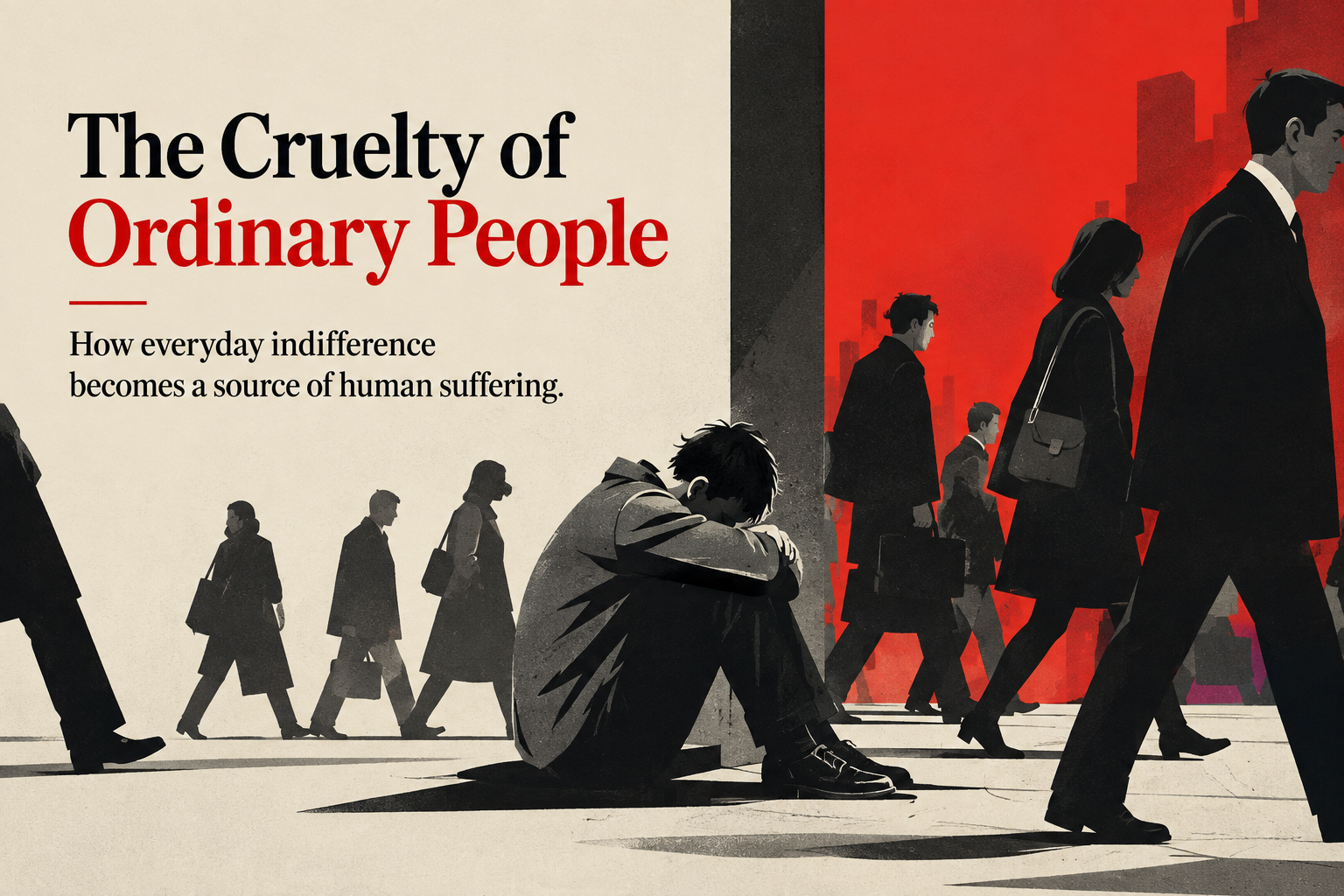
Most of us grew up believing cruelty belonged to other people: villains in films, dictators in history books, the faceless "monsters" on the evening news. Cruelty, we were told, was loud and obvious, the sort of thing you'd recognise at once and, naturally, refuse to take part in.
It's a comforting story. It's also wrong.
Because the truth, the one that sits quietly at the back of the room while we're busy congratulating ourselves, is that most suffering in this world isn't caused by monsters. It's caused by people like us, on ordinary days, doing nothing in particular.
The Opposite of Love
Elie Wiesel, who survived Auschwitz and Buchenwald, put it better than anyone:
"The opposite of love is not hate, it's indifference."
Sit with that for a moment. We tend to imagine hate as the great enemy of kindness. But hate, at least, pays attention. Hate looks you in the eye. Indifference doesn't bother. Indifference scrolls past, crosses the road, turns up the volume, tells itself it's not its problem. And it is the most common human failing on earth, precisely because it takes no effort at all.
Think of the last time you walked past someone sleeping rough. Did you feel something, a small tug, a flicker of discomfort, and then move on within three seconds? Of course you did. So did I. That flicker is the moment where cruelty lives. Not in some dramatic act of violence, but in the small, well-rehearsed decision to look away.
The Man Who Was Just Doing His Job
In 1961, the philosopher Hannah Arendt travelled to Jerusalem to watch the trial of Adolf Eichmann, one of the chief organisers of the Holocaust. She expected, as everyone did, to meet a monster. Instead she found a rather dull, careerist bureaucrat who seemed less driven by hatred than by a staggering failure to think about what he was doing.
Out of that observation came one of the most unsettling phrases of the twentieth century: the banality of evil.
Arendt wasn't excusing him. Quite the opposite. Her point was far more disturbing: that terrible things don't require terrible people. They only require ordinary people who stop asking questions, who follow procedure, who tell themselves that responsibility lives somewhere further up the chain.
We like to think we'd be different. Psychology suggests we'd mostly be the same.
Just Following Instructions
In the early 1960s, the Yale psychologist Stanley Milgram ran an experiment that has haunted the rest of us ever since. Volunteers were told to deliver electric shocks to a stranger in another room whenever he answered questions incorrectly, with the voltage climbing each time. The "stranger" was an actor, and the shocks were fake, but the volunteers didn't know that. They heard his protests. They heard his screams.
And a striking number of them kept going, simply because a man in a grey lab coat calmly told them to continue.
These weren't sadists. Many were visibly distressed. They sweated, argued, trembled, and then obeyed anyway. Milgram himself later reflected that ordinary people, simply doing their jobs, could become agents in a terrible destructive process, even when its effects were plainly visible to them.
What chills me isn't the obedience. It's the comfort of it. How easy it is to hand our conscience to someone else and feel lighter for the loss.
The Crowd That Never Moves
Cruelty also hides in numbers.
In 1964, a young woman named Kitty Genovese was murdered in New York, and the newspapers reported that dozens of neighbours had watched or heard and done nothing. The story shocked the world. (Later research has shown the details were more complicated than the headlines suggested, and that some neighbours did try to help. But the story stuck because it felt true.)
Psychologists John Darley and Bibb Latané studied what came to be called the bystander effect, and the finding is oddly simple: the more people present, the less likely any one of them is to act. Everyone assumes someone else will step in. Everyone glances at everyone else for a cue. Everyone sees calm faces and concludes, it must be fine.
So the crowd, collectively, does nothing, and not one of them is a villain. Each is a perfectly decent person, quietly waiting for somebody braver to go first.
Cruelty With a Smile
Not all everyday cruelty is silent, though. Some of it is chatty. Some of it is friendly, even.
It's the colleague who makes the same "joke" about the new girl's accent every single morning, and laughs when she doesn't. It's the family member who comments on your weight "out of concern." It's the group chat that goes quiet when one particular person writes. The friend who "forgot" to invite you. The manager who sighs, loudly, every time you ask a question.
None of these would make the news. None would be called abuse. And yet ask anyone who has lived on the receiving end and they'll tell you this: it's the small stuff that wears you down. Drip, drip, drip. A thousand tiny cuts, each one deniable, each one delivered by someone who'd be genuinely offended if you called them cruel.
That's the trick of ordinary cruelty. It always has an alibi. I was only joking. I didn't mean it like that. You're too sensitive. Everyone does it.
The Machinery of Not-Caring
If cruelty is so common, why don't we see it in ourselves?
Partly, it's the sheer scale of suffering. We're handed the whole world's pain on a glowing rectangle each morning: wars, floods, famines, tragedies. No human heart was built to hold all that, so we do what any sensible creature does and switch off. Psychologists call it compassion fatigue. Joseph Stalin, so the grim line goes, supposedly said that one death is a tragedy and a million is a statistic. Whoever said it first, the insight is uncomfortably accurate. We can weep over one child's photograph and shrug at a thousand.
Partly, too, it's distance. It's far easier to ignore suffering that happens to someone we'll never meet, whose face we'll never see, whose name we'll never learn. Our modern lives are built on a vast web of such distances: the cheap shirt, the delivered dinner, the gadget in your pocket. Somebody, somewhere, paid for our convenience. We simply never have to watch them do it.
And partly, let's be honest, it's because caring is costly. It takes time. It's awkward. It might make us late, or uncomfortable, or unpopular. Indifference is the cheapest option on the menu, and we are all, at some level, bargain hunters.
What Silence Does
There's a line from Martin Luther King Jr. that I come back to often:
"In the end, we will remember not the words of our enemies, but the silence of our friends."
Silence feels neutral. It feels safe, even polite. But silence is never really empty; it always carries a message. When someone is being mocked and the room says nothing, the message is this is acceptable. When a person asks for help and nobody answers, the message is you're on your own.
Wiesel understood this better than most. Accepting the Nobel Peace Prize in 1986, he said:
"We must always take sides. Neutrality helps the oppressor, never the victim. Silence encourages the tormentor, never the tormented."
That's a hard sentence to read, because it takes away our favourite hiding place. There is no neutral ground. There's only the choice we make, and the choice we pretend not to be making.
So What Do We Do?
I don't want to end on despair, because the same ordinary people who are capable of cruelty are capable of its opposite. The research shows it too. In Milgram's later variations, when even one other person refused to continue, obedience dropped dramatically. Courage, it turns out, is contagious. So is decency.
This is the strangely hopeful half of the story. If one voice in a crowd can break the spell, then you might be that voice. If one person standing up can give permission to a dozen others, then the small act matters far more than it feels like it does in the moment.
It doesn't have to be heroic. It can be as modest as:
Saying "that's not funny" when a joke lands on someone's pain.
Sitting with the person who's eating alone.
Asking, simply, "Are you okay?", and then waiting for a real answer.
Noticing the flicker, that tiny tug of discomfort, and not walking past it.
The Italian writer and Auschwitz survivor Primo Levi warned us:
"It happened, therefore it can happen again."
He was talking about atrocity, but the principle scales down to the kitchen table and the office corridor. Cruelty doesn't arrive in a single dramatic moment. It's built, slowly and politely, from ten thousand small refusals to care.
And so, by the same logic, is kindness.
The Quiet Choice
Here's what I think about when I think about all this: nobody wakes up and decides to become cruel. It happens by degrees, through the accumulation of small evasions, each of which seemed reasonable at the time. A glance averted. A call not returned. A comment let slide. A hand not offered.
The good news, if there is any, is that the same mechanism works in reverse. We become kind the same way we become cruel: one ordinary choice at a time.
So the next time you feel that familiar flicker, the small, inconvenient tug of someone else's pain, don't rush to smooth it over. Don't scroll past. Don't tell yourself that somebody else will handle it.
Because, most of the time, the "somebody else" is simply another ordinary person, waiting for you to go first.