

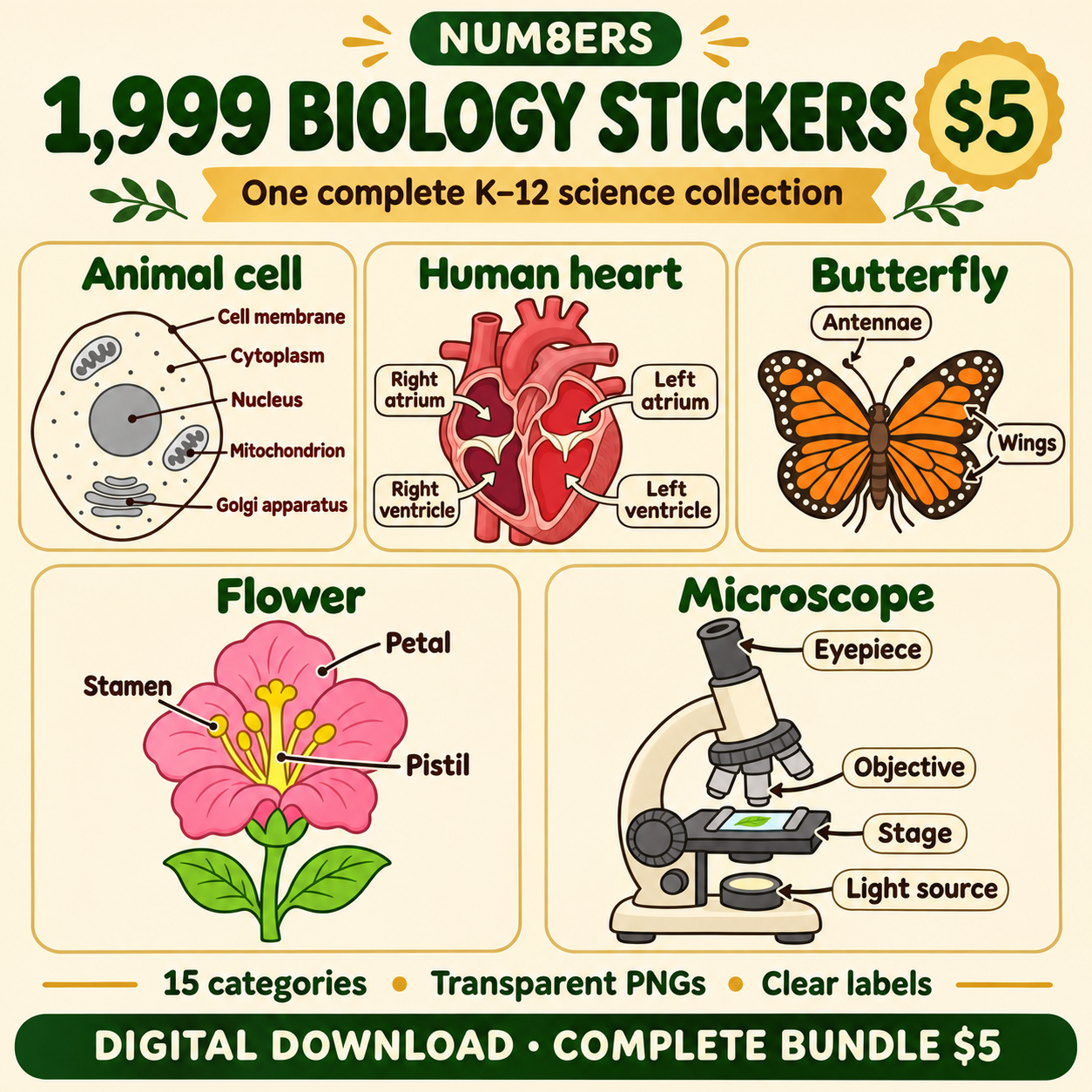
A clear diagram can be the starting point for a useful science activity. Add a labelled animal cell to a worksheet, place a food web beside a set of questions, or build a revision page around the human heart.
Our Biology Stickers & Clipart Bundle brings together 1,999 individual PNG illustrations for $5. The collection uses natural-color 2D artwork, clear English labels and transparent backgrounds, with topics organized into 15 category folders.
Explore the previews and get the complete biology bundle for $5 →
One collection, from living things to human anatomy
The bundle spans a broad K–12 topic range, so you can select the illustrations that fit your learner and lesson. Start with familiar plants and animals, move into cells and genetics, or explore organs, ecosystems and practical biology.
Some examples you will find inside:
Cells and genetics: animal cells, plant cells, the nucleus, DNA structure and mitosis.
Human biology: the heart, lungs, brain, kidney and neurons. This folder alone contains 442 stickers.
The living world: flowers, butterflies, photosynthesis, food webs and sustainable farming.
Practical and everyday science: microscopes, test tubes, the scientific method, hydroponics, bread fermentation and yogurt production.
The shop listing includes six preview posters showing multiple labelled designs, so you can look at the artwork before buying.
Five ways to use biology clipart in your learning materials
1. Build focused revision pages
Choose a sticker for the topic you are studying and place it beside your own notes. For example, use the nucleus illustration alongside a short explanation of its parts, or compare the animal-cell and plant-cell designs on one page. Titles and labels are already built into the images.
2. Create classroom worksheets
Add an illustration to a document and write your own questions around it. A food web can accompany questions about feeding relationships; an organ diagram can support a structure-and-function activity. Choose a print size that keeps the labels readable.
3. Make flashcards with a purpose
Put a labelled image on one side and a question or explanation on the other. You could ask what a structure does, how two organisms differ, or which step comes next in a process.
4. Add visuals to lesson slides
Import the PNGs into a presentation or design app that supports transparent images. Because the backgrounds are transparent, you can place the artwork on your own slide layout without a rectangular background around each sticker.
5. Assemble homeschool and science-journal activities
Pick a small group of related topics rather than using the whole collection at once. A plant lesson might bring together a flower, photosynthesis and hydroponics. An everyday-biology activity could connect yeast, bread fermentation and yogurt bacteria.
What is included in the $5 download?
1,999 individual PNG stickers, each covering a unique topic.
15 named category folders and a topic list documenting 59 subcategories.
A searchable offline HTML gallery with category filters and links to individual PNGs.
CSV/JSON manifests, the original topic list, a style guide, scientific reference notes and generation prompts.
One complete ZIP, approximately 2.08 GB (1.94 GiB), for a one-time $5 purchase.
The folders cover Foundations, Scientific Biology, Cell Biology, Biochemistry, Cellular Processes, Genetics, Evolution, Microbiology, Plant Biology, Animal Diversity, Human Biology, Ecology, Practical Biology, Advanced Biology, and Applied & Everyday Biology.
Explore all 15 biology sticker categories
A large download is useful when you can find what you need. The category folders give you a starting point, while the offline gallery lets you search for an individual topic. Here is how the collection is organized and how you might use each area when planning a learning activity.
Foundations — 90 stickers
Begin with the familiar language of living things. This part of the collection provides an entry point for younger learners and introductory science activities. Choose a small selection of images, ask learners what they notice, and build a vocabulary page around their answers. A flower, for example, can become the focus of an observation activity before you introduce a more detailed discussion of plant structures. Keep the task short and match the vocabulary to the learner.
Scientific Biology — 42 stickers
Use this folder when you want to connect biological topics with the ways science is studied. It can sit alongside your own explanations, discussion prompts and classroom routines. Before selecting a design, decide whether your goal is to introduce a term, describe a method or encourage a question. This helps you choose an illustration for a specific purpose rather than filling a page with unrelated science pictures.
Cell Biology — 117 stickers
Cell illustrations work well for comparison and structure-and-function activities. The preview includes an animal cell, a plant cell and a nucleus, each with readable labels. Place two designs on a page and ask students to identify shared features and differences using their course materials. For a second task, choose one labelled structure and ask students to explain its role in their own words. The image supplies a visual reference; your questions supply the learning task.
Biochemistry — 112 stickers
This folder extends the collection into the chemical side of biology. Use the topic list to locate designs relevant to your current unit, then pair them with the terminology and explanations used in class. For older students, a useful page layout is an image on the left and three short notes on the right: what the topic means, where it appears in the course, and one question still to answer. Select only designs appropriate to the lesson.
Cellular Processes — 84 stickers
Process illustrations can provide a starting point for explaining change over time. The previews show photosynthesis and mitosis among the collection's topics. Ask learners to narrate a process, connect a label to an explanation, or write a caption for each stage shown. If you use a sequence, check the order and wording against your teaching material before printing. Leave enough space around the picture for students to add their own explanation.
Genetics — 134 stickers
Genetics topics can be easier to discuss when the same visual reference appears beside the written task. The DNA structure preview is one example from this area. You might use a relevant design on a glossary page, in a revision slide or beside a comparison question. Choose the level of detail your learners need, and ask them to explain the vocabulary rather than simply copying labels. The collection supports your lesson; it does not determine the syllabus.
Evolution — 60 stickers
Use the evolution folder to locate artwork for the topics you already teach. An effective activity can begin with one image and a carefully framed question, followed by a written explanation based on course material. Avoid placing several complex ideas on a single small card. For revision, create a consistent format with a topic title, the chosen illustration and a brief prompt asking the student to explain a relationship, example or piece of evidence.
Microbiology — 84 stickers
Microbiology artwork can connect microscopic topics with broader biology lessons. Look through the gallery before deciding which design matches your teaching objective, especially when a diagram is simplified. Pair the image with a short reading, vocabulary exercise or student explanation. Natural-color artwork does not mean every microscopic structure has a distinctive visible color in an unstained specimen; these are educational illustrations intended to represent topics in a clear, consistent style.
Plant Biology — 166 stickers
Build plant lessons around related examples rather than isolated pictures. The collection includes plant structures and other plant-focused topics, while the previews show a flower and photosynthesis. You could prepare an observation page, a labelled reference sheet or a journal spread connecting a plant structure with a question about its function. If learners also examine a real plant, ask them which features they can observe directly and which features require an explanatory diagram.
Animal Diversity — 166 stickers
Animal artwork can support identification, comparison and descriptive writing activities. The butterfly preview gives a sense of the natural colors and clear labelling used in the collection. Choose a few relevant designs and ask learners to compare visible features, using an age-appropriate reference to support their answers. For younger learners, a simple vocabulary activity may be enough. For older learners, use the images as the starting point for a more precise biological explanation.
Human Biology — 442 stickers
The largest category offers a wide range of human-biology topics. The preview poster shows the heart, lungs, brain, kidney and neuron, making it a useful place to assess the style before purchasing. Create an organ reference page with an image, a function statement and a question connecting it to a wider system. For revision, ask students to explain a labelled structure without reading their notes, then compare their answer with the relevant textbook section.
Ecology — 221 stickers
Ecology illustrations can connect organisms with their surroundings and relationships. The food-web preview is one example you can use to plan an explanation or question set. Ask learners to interpret the arrows, explain a relationship, and support their answer using what they have been taught. When printing a complex diagram, allow enough space for labels and arrows to remain distinct. A larger image with two focused questions can be more practical than a crowded page.
Practical Biology — 145 stickers
Practical topics bring equipment and scientific work into the same visual collection. Microscopes, test tubes and the scientific method appear in the previews. Use an equipment illustration for a preparation sheet, a vocabulary card or a recap after a demonstration. Treat the artwork as a visual resource rather than an instruction manual: classroom procedures, equipment handling and practical safety should come from your approved teaching instructions and the requirements of the actual activity.
Advanced Biology — 81 stickers
This folder adds further topics for lessons that require more detail. Browse the topic list and inspect a design before deciding whether it fits your learners' current level. You can place an illustration beside a reading question, use it in a presentation, or ask students to connect it with earlier ideas. A broad collection lets you choose across topics, but each selected image still needs to match the terminology and depth of the course you teach.
Applied & Everyday Biology — 55 stickers
This category helps you plan activities that connect biology with familiar settings. The previews include hydroponics, bread fermentation, yogurt production and sustainable farming. A useful prompt is: where does this topic appear outside the classroom? Let learners use the illustration as a starting point, then write their own explanation using a suitable source. You can also group a few related images into a journal page about food, growing plants or the environment.
Three lesson formats you can prepare with the bundle
A cell-comparison worksheet
Start with the animal-cell and plant-cell PNGs. Place them side by side in a document, leaving a generous space below each image. Add three tasks: identify features shown in both diagrams, describe a difference, and explain the role of one selected structure. Adapt the wording to your learners and check the answer expectations against the lesson. Since the labels are built into the PNGs, plan this as a comparison or explanation exercise rather than assuming the download includes an unlabelled version.
For a follow-up task, ask students to close their reference notes and write a short summary from memory. Then let them review the images and improve one part of their explanation. You can reuse the same page structure with a different pair of topics later. This gives your materials a consistent layout while keeping the questions tied to the subject being studied.
A human-biology revision station
Choose a small selection of organ illustrations, such as the heart, lungs, brain and kidney. Give each station one image and one short prompt. Students might explain a function, identify a labelled structure or connect the organ with a wider system. Keep the written task focused enough to complete in a few minutes. The goal is to make students explain an idea, not simply recognize a familiar picture.
Prepare your own answer guide before the lesson and decide how students will check their responses. You could ask them to annotate a worksheet, discuss an answer with a partner or return to their course notes. Use the collection's natural-color style consistently across the stations, and print a sample page first to check the smallest labels. The same designs can later become a reference slide or an individual revision page.
A biology-in-everyday-life journal spread
Choose two or three applied topics, such as bread fermentation, yogurt production and hydroponics. Place the PNGs around a central question about how biology appears in familiar activities. Give learners room to write an explanation for each example. You can provide a short reading or direct them to an appropriate class resource, then ask them to connect the image with vocabulary from the lesson.
Finish with a reflection question: which example could they explain most clearly, and what additional information would they need for another example? This format works as a lesson recap or a homeschool discussion page. Keep practical activities separate from the illustration task unless you have suitable instructions and supervision. The stickers provide visual material; the lesson design, explanation and assessment remain in your hands.
Make your pages readable before adding more artwork
Start with the question or learning objective, then choose an image that supports it. A single well-sized diagram often gives you more room for useful student work than several small stickers. On a worksheet, leave a clear margin around the image and enough writing space for the expected answer. On a slide, check whether the text is readable from the back of the room. If a label becomes too small, enlarge the image or split the material across two pages.
Keep an original PNG unchanged and work with copies inside your documents. Resize proportionally so circles, cells and organs do not become stretched. When placing a transparent image on a colored page, check the contrast of every label and leader line. A background that looks attractive on screen may make small text harder to read when printed. Before producing a class set, print one page at the size you intend to use.
For digital notes, a practical routine is to choose the topic, insert the image, add your own explanation and finish with a question you can answer later. Keep related topics together and avoid importing hundreds of unused files into a single notebook. The offline gallery can act as your browsing tool, while the notebook contains only the images relevant to your current work. This keeps the collection manageable even when you teach or study several biology units.
Frequently asked questions about the biology sticker bundle
Are these physical stickers or digital files?
This is a digital download containing individual PNG images. Nothing is shipped. You can import the images into compatible documents, presentations and note-taking apps, or print selected designs at a suitable size. Preparing adhesive labels or print-and-cut layouts would be a separate task using your own software, paper and equipment.
Can I edit the labels or download vector versions?
The included PNGs are raster artwork with flattened English titles and labels. Individual words and diagram parts are not supplied as editable layers. You can resize and position an image in your document, but the bundle does not include editable vector files or a separate unlabelled version of every design.
Does the collection match a particular exam board?
The collection covers a broad K–12 topic range rather than one complete exam-board syllabus. It is a supplementary visual resource. Teachers, students and parents should select relevant topics and use the terminology, explanations and assessment requirements from their own course. Buying the bundle does not replace a textbook, lesson sequence or syllabus check.
What does transparent PNG mean for my worksheets?
The area around the sticker artwork has transparency, so the image can sit on your document background without an opaque rectangular canvas. Artwork, labels and some design elements inside the sticker remain visible. Use a compatible app and inspect your exported document to make sure it preserves the appearance you expect.
How large is the download, and what device should I use?
The complete ZIP is approximately 2.08 GB, also expressed as 1.94 GiB. A computer is a practical choice for downloading, extracting and browsing the whole collection. Allow room for both the ZIP and the extracted files. Keep the folder structure intact if you want the offline gallery's links to individual PNGs to continue working.
Can I share the collection with other teachers?
Your purchase is for personal study and your own classroom or homeschool teaching, including finished learning materials for your own students. It does not include distributing the raw collection to colleagues, uploading the PNG folders publicly or reselling the ZIP. If another teacher wants the source collection, share the product page so they can review and purchase their own copy.
How was the artwork made?
The illustrations were created with AI image generation and visually reviewed. Preview posters are available on the product page so you can assess the style and level of detail before buying. As with any supplementary teaching resource, inspect the design you plan to use and check its labels and simplifications against your lesson material.
What is the simplest way to start using 1,999 designs?
Begin with one lesson, not the entire library. Search for three relevant topics, inspect the PNGs and build a single worksheet or revision page. Once that page works for your learners, return to the gallery for another small group of designs. You can grow your own set of finished teaching materials gradually while keeping the original collection organized.
How to find and use your stickers
Download the ZIP from your purchase confirmation.
Extract the complete folder on a computer with enough free space.
Open K12_Biology_Stickers/index.html in your browser to browse and search the gallery, or open a category folder directly.
Import the PNGs you need into your worksheet, presentation or notes. Keep the extracted folder structure intact so the gallery links work.
A few details before you buy
These are digital raster PNG files. Titles and labels are flattened into the artwork. Most images are 1254 × 1254 pixels; some use wider or taller layouts to suit the topic. The download contains individual designs rather than prearranged print-and-cut sheets, and no physical stickers are shipped.
The artwork was created with AI image generation and visually reviewed. This is a supplementary visual resource covering a broad topic range; select designs appropriate to your lesson and check them against your teaching material.
Your purchase covers personal study and your own classroom or homeschool teaching, including finished learning materials for your own students. Resale, public redistribution of the raw PNGs or ZIP, and repackaging the collection as another clipart bundle are excluded.
Ready to build your next science resource?
Browse the sample posters, see the full category breakdown, and choose the biology visuals that fit your next lesson.
Get all 1,999 biology stickers for $5 →
Thank you for supporting NUM8ERS and our educational resources.