

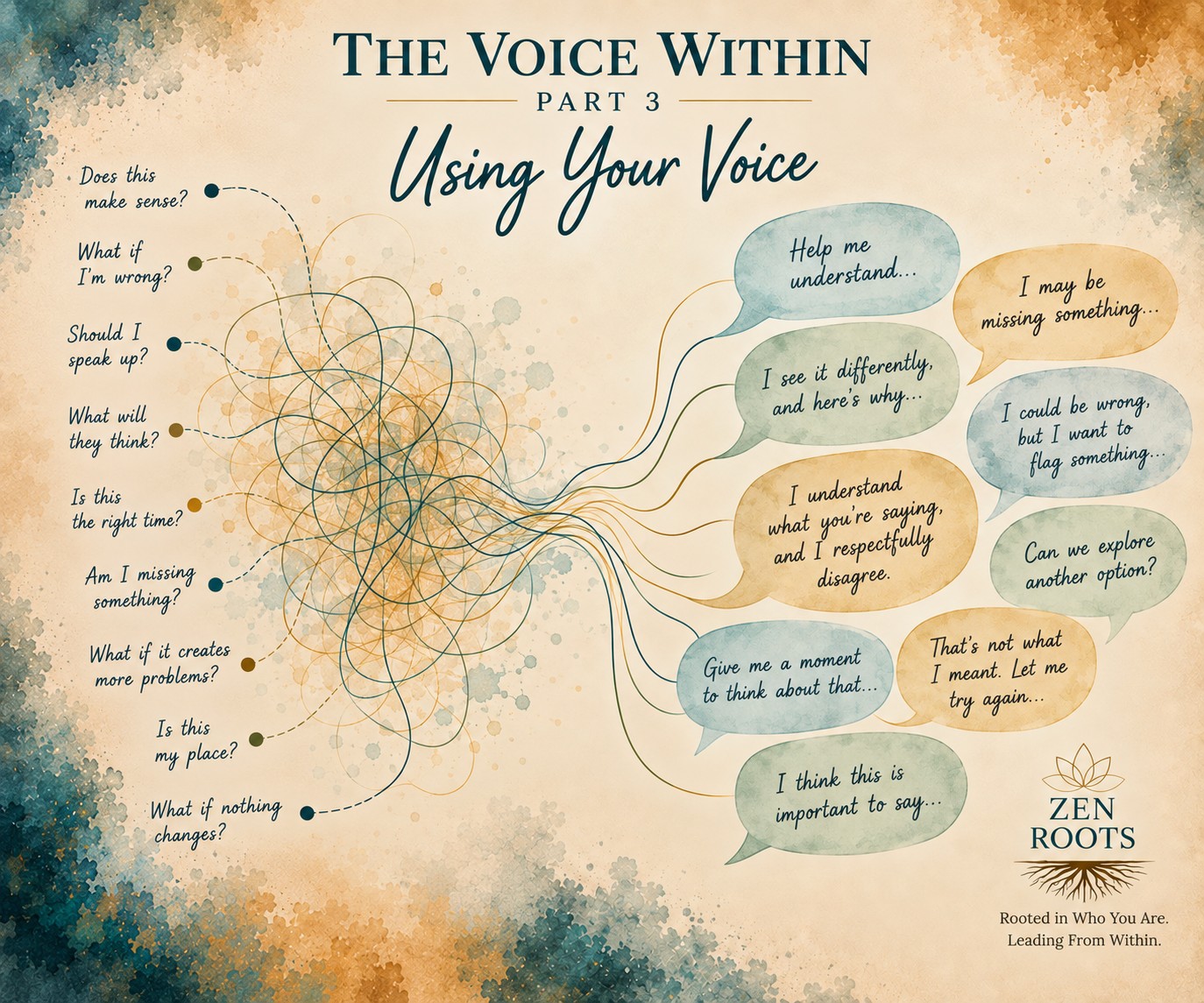
Knowing What to Say and How to Say It
In Part 1 of The Voice Within, I wrote about learning to recognize those quiet signals that tell us something deserves our attention. In Part 2, I explored what happens when fear enters the conversation and makes us question whether we should say anything at all.
But eventually, we arrive at the next question: Once I decide something really does need to be said, how do I say it? 👀🤔
I’ve learned that using your voice isn’t about finding the perfect words. It’s about being intentional with the ones you choose.
Before I Say the Thing
I wish I could tell you that before I speak, I calmly work through some beautifully organized mental checklist. I don’t. My brain is usually moving about 100 miles an hour.🧠🏃🏽♀️
But somewhere in those few seconds, I am thinking about the message. Why does this need to be said? Who am I saying it to? What do I want them to understand? And what do I hope happens as a result? Then I think about my audience.
That matters because using your voice isn’t simply saying whatever is in your head exactly as it arrived there. Trust me, some of the words that arrive in my head absolutely need editing before they make it out of my mouth.
The message can remain authentic while the delivery changes.
That’s something I’ve gotten better at understanding over the years. Authenticity doesn’t require me to communicate exactly the same way with everyone. I can consider the person, the environment, and the relationship without changing the substance of what I need to say.
The goal isn’t simply to speak. The goal is to communicate.
Curiosity Gives Me Somewhere to Start
One of the most useful things I’ve learned is that I don’t have to know everything before I open my mouth. In fact, nine times out of ten, I start with a question:
“Help me understand…”
“I may be missing something…”
“I could be wrong, but I want to flag something…”
I ask questions because I want to make sure I understand what I’m responding to before I form a conclusion. Sometimes the answers change my perspective. Sometimes they give me information I didn’t have. Sometimes I ask all the questions and still have to say, “I’m sorry, I’m still not understanding.” I’m comfortable with that.
And sometimes I get the information I need, understand exactly what someone is saying, and still disagree. I’m comfortable with that too. “I understand what you’re saying, and I respectfully disagree.”
Curiosity doesn’t require us to abandon our perspective. It simply creates room to make sure we’ve understood someone else’s before deciding what we want to say about it. And when I do disagree, I want to be able to explain why.
I’ve learned that having a different perspective is one thing. Being able to articulate it respectfully and clearly is another. That’s a skill.
Using Your Voice Doesn’t Mean Getting Your Way
This may be one of the biggest lessons I’ve learned about using my voice. Recently, a new process was introduced at work that I didn’t think was particularly useful. It felt more formal and detailed than necessary, and I questioned whether what was being asked would provide enough value to justify the effort.
So I said something. I explained my concerns and listened to the response. After some back-and-forth, it became pretty clear that the decision wasn’t going to change.
So I let it go. Not because I suddenly agreed. Not because I regretted saying something. I had said what I needed to say. The other person heard me. We disagreed. And that was okay.
Using my voice successfully does not mean getting the outcome I wanted.🎯
That’s an important distinction. There have been times throughout my career when I’ve wanted it clearly understood that I disagreed with a decision or had concerns about an approach. I believe there is value in communicating those concerns while there is still an opportunity for them to be considered.
But once I’ve done that, I also have to recognize what belongs to me and what doesn’t. My responsibility is to communicate my perspective. I don’t get to control what another person does with it.
Sometimes using your voice changes the conversation. Sometimes it changes the decision. And sometimes absolutely nothing changes. That doesn’t mean speaking was pointless.
You Don’t Have to Say It Perfectly
Of course, even when we’re intentional, we’re still going to get it wrong sometimes. I’ve stopped in the middle of conversations and said:
“Give me a minute. I need to gather my thoughts.”
“I don’t think I’m communicating this clearly. Let me try again.”
“That’s not what I meant.”
And one I use frequently: “Maybe I’m not explaining this well. Let me try another way.”
I don’t consider those moments evidence that I’m a poor communicator. That is communication.🗣️
Communication isn’t a perfectly delivered speech. It’s the work of trying to make sure the message someone receives resembles the message you intended to send. And that’s why I don’t believe we should wait until we’re confident, polished, or exceptional communicators before we start using our voices.
It’s a little like deciding you need to get in shape before you’re willing to go to the gym. That’s backwards. You go to the gym to get stronger. Communication works the same way. 💪🏽
You cannot wait until you’re an exceptional communicator before you start using your voice. Using it is part of how you become one.
You practice. You stumble. You overexplain. You realize something didn’t land the way you intended. You clarify. You try again. And little by little, you get better.
The Voice Within
When I started this series, I began with something simple: Pay attention. There’s something here. Because before we can use our voice, we have to recognize it.
Then comes the harder part. We have to notice all the things that try to convince us not to use it. Fear of being wrong. Fear of how we’ll be perceived. Fear of disagreement. Fear of what might happen if we say the thing.
And then, eventually, we have to practice saying it. Not perfectly. Not fearlessly. Not with the expectation that everyone will agree. Just intentionally.
If I had to summarize what using my voice means to me now, it would be this:
Using my voice doesn’t mean I’m always right. It doesn’t mean my voice is more important than anyone else’s. It means I recognize the value in myself, my thoughts, my experiences, and my perspective enough to express what I think and feel.
Sometimes that will begin with a question. Sometimes it will end in disagreement. Sometimes I’ll realize I was wrong. Sometimes I’ll say it badly and have to try again. And sometimes I’ll say exactly what I needed to say and still not get the outcome I wanted.
That’s okay. Because the goal was never to make my voice the loudest in the room. The goal was to stop treating it like it didn’t belong there.
Recognize it. Understand what tries to silence it. Practice using it.
That’s what it means, for me, to lead from within.🌱