

Wade Keller has been here since 1987.
He was sixteen years old, living in Bloomington, Minnesota, when he built the thing that new journalism is currently congratulating itself for inventing.
Independent audience.
No access deal.
No corporate shield.
No institution between the writer and the crowd.
A direct, unmanaged, fully accountable relationship with the people consuming his work that was built from scratch, inside an industry specifically engineered to make it impossible.
He is still here.
He has been here every week for thirty-eight years.

The people now arriving at independent journalism, some of them genuine, some of them carrying thirty years of access economics in their muscle memory and calling it a fresh start, are walking into a space Wade Keller built before most of them were thinking about media as a career.
What he built is the standard and the lesson he hands anyone coming through the door is the same one he learned at sixteen: the crowd was always the authority. You either build for that reality or you don’t last.
Professional wrestling in 1987 operated under kayfabe, a formal code of enforced fiction that required everyone inside the business to maintain the illusion that what happened on screen was real competition, unscripted, with genuine stakes. Everybody protected The Business.
I wrote about it Here
The authorized outlets, Pro Wrestling Illustrated, Inside Wrestling, The Wrestler, were promotion-friendly, not because their editors lacked curiosity, but because their business model required it.
Access Media.
The WWF advertising account paid for the magazine. The WWF press access produced the content. The relationship was the product. Honest reporting would have terminated the relationship. So honest reporting did not happen.
Vince McMahon did not merely uphold kayfabe. He weaponized it.
Television contracts, advertising relationships, and wrestler employment agreements all served the same function, keeping the machinery of the business invisible to the audience consuming the product.
Not talking about it is part of the fandom.
The audience knew the official story was not the whole story and nobody inside the institutional press was equipped or motivated to close the gap because their access depended on not closing it.
Keller was sixteen.
He had no press credential to lose, no advertiser to placate, no institutional relationship with the WWF publicity department.
There was no access deal requiring the fiction be maintained.
That structural independence, which looked from the outside like as amateur status, was the only condition under which honest reporting was possible, he understood that before he had language for it.
He built on it anyway.

The Pro Wrestling Torch Newsletter launched in October 1987 with thirteen subscribers paying by mailed check.
Each issue treated professional wrestling the way a labor reporter treats a factory, who runs it, how it runs, at what cost to the people doing the work, and what the people in charge don’t want the audience to know.
That was a radical act inside an industry with a formal enforcement mechanism designed to prevent it.
The Torch Talk interview series became the first ongoing format in which wrestlers, promoters, and announcers spoke on record about the interior mechanics of professional wrestling.
Before Torch Talk, nobody inside the business talked candidly to press about the business because the authorized press wasn’t asking and the unauthorized press didn’t exist.
Keller made it exist.
Every long-form candid wrestling conversation that exists today, every shoot interview, every podcast where a performer describes what the locker room actually looked like, descends from the format a teenager in Minnesota formalized with no institutional backing and no permission from the industry he was covering.
Before the internet made real-time information free, Keller ran a 900-number hotline. Fans paid per minute to hear recorded updates, backstage developments, contract disputes, creative decisions, what was actually happening behind what they were watching on television.
Two information streams running simultaneously, the authorized WWE broadcast presenting kayfabe, and Keller’s hotline telling the audience what the broadcast was not telling them.
That is the function independent journalism is supposed to serve. It is the function corporate media structurally cannot serve without terminating its own business model.
In 1999 he launched PWTorch.com.

The subscriber-supported paywall he built predates Substack by over a decade. The VIP archive now contains over 1,800 newsletter back issues and more than 10,000 podcasts — a continuous contemporaneous record of how an industry was analyzed and reported in real time, not reconstructed retroactively, not filtered through the promotion’s preferred narrative, for thirty-eight consecutive years.
One of my favorite episodes was The May 13, 2019, Wade Keller Pro Wrestling Post-Show features a detailed caller account describing a chaotic WWE creative environment under Vince McMahon, highlighting last-minute script changes, extreme micromanagement, and low writer morale. The caller detailed how the “audience of one” approach resulted in poor storylines and rendered the creative team’s work largely unused.
Link to it, Here
Tony Khan, who runs All Elite Wrestling, was writing letters to the Torch editor section as a teenager. The crowd Keller built produced the next generation of operators. That’s what a real independent media operation looks like across time.
In 2015, the George Tragos/Lou Thesz Professional Wrestling Hall of Fame gave Keller the Jim Melby Award for excellence in wrestling journalism. The institutional recognition arrived twenty-eight years after he started.
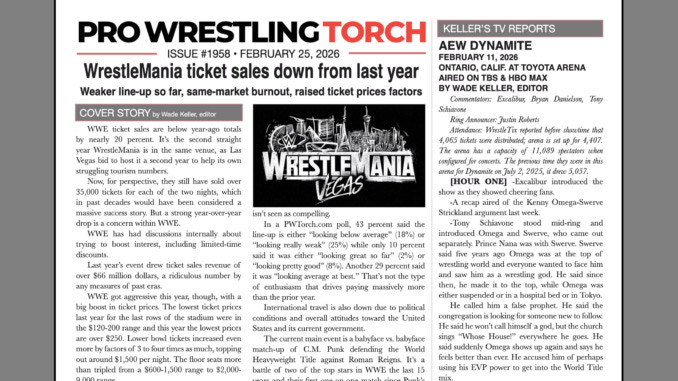
The Internet Wrestling Community didn’t wait for Pro Wrestling Illustrated to tell them who mattered. They built their own consensus about whose push was earned and whose was manufactured, whose character connected and whose was a corporate construction with no organic foundation and they were right more often than the people being paid to make those decisions professionally.
The IWC is the proof of concept for everything new journalism is claiming to discover about audience sovereignty.
The crowd decides who is over.
The crowd builds the hierarchy.
The writer who understands that the crowd is the authority and that without corporate shielding they are fully visible to that crowd, accountable directly and without a buffer builds something real.
The writer who doesn’t get it exposes exactly what they are the moment the institution stops covering for them.
Keller’s operation was the infrastructure that crowd ran on.
The newsletter told you what was actually happening when the audience decided what mattered. That relationship is what thirty-eight years of continuous publication looks like. It is not an accident. It is the only thing that lasts.

There is a version of going independent that is not going independent.
It’s leaving a corporate institution with your institutional reputation in your pocket, your access-era source network in your phone, your former institution in your bio, and your expectation that the influence will follow you because you are the same person who had it.
If you don’t do the work, you may as well start an only fans because your curated identity is all you’ve got.
The influence was never yours. It belonged to the institutional infrastructure behind you.
The Corporation with the distribution and the access that made sources return your calls.
The corporate shield that absorbed your accountability when you got something wrong. You were the talent. The institution was the promotion. And the promotion’s power does not walk out the door with the talent.
Professional wrestling demonstrates this repeatedly.
When a wrestler left the WWF for WCW, they found out immediately whether the crowd was there for them or for the brand. Some were over enough to carry it. Most found out the institution had been doing more work than they understood.
The ones who couldn’t draw without the infrastructure went back, faded, or found a smaller room where their reputation from the big show still held residual weight.
The corporate media crossover is running the same program in front of an audience that has spent years watching institutional media manage narratives on behalf of the institutions it covers.
The American media audience is like the IWC.
They are plugged in, connected, and fully capable of distinguishing between a voice that is accountable directly to them and a voice that is counting on borrowed credibility from a structure that no longer exists behind it.
American people are rejecting characters who don’t bring information and truth.
The crowd knows what they want.
The IWC knew in 1987. The American media crowd know now.
Corporate media is the kayfabe medium.
The authorized outlets present the version of events the institutions being covered have approved for distribution. The access is contingent on the coverage. The coverage is contingent on the access.
This isn’t journalism this is the magazine that needed the WWF advertising account and the people who built their careers inside that system are not independent journalists because they left it.
They are kayfabe workers who came through the curtain.
What they do next is the question their new work will answer in public with no institution absorbing the result. Whether they build something genuinely accountable to the audience or reconstruct the same managed relationship with a smaller infrastructure behind them is the question.
Wade Keller built this.
Not the concept of it.
Not a version of it.
This, the subscriber model, the long form interview format, the paywall archive, the counter-narrative running alongside the authorized broadcast, the direct unmediated relationship with an audience that the crowd’s own judgment built and maintains.
He built it at sixteen in Bloomington, Minnesota, inside an industry with a formal code of secrecy backed by legal threats and advertising leverage and the most dominant media operator in his field actively working to suppress outside coverage.
He built it without institutional validation, without peer recognition from a serious media world that considered his subject too low-culture to merit examination, without the expectation that the recognition would ever come.
He built it because there was a market for it because the authorized version was insufficient.
The gap between what was presented and what was actually happening was enormous and nobody with institutional credentials was equipped or motivated to close it. He closed it himself, every week, for thirty-eight years.
New journalism is learning the ropes, now.
Some of them will build a real connection to their fan base.
Some of them will find out the institution was doing more work than they understood.
The ones who last will be the ones who understand what Keller understood at sixteen, you are not the authority, the crowd is the authority, your job is to give the crowd what they want, a peek behind the curtain.
Welcome to new media, it’s called covering Kayabe.