
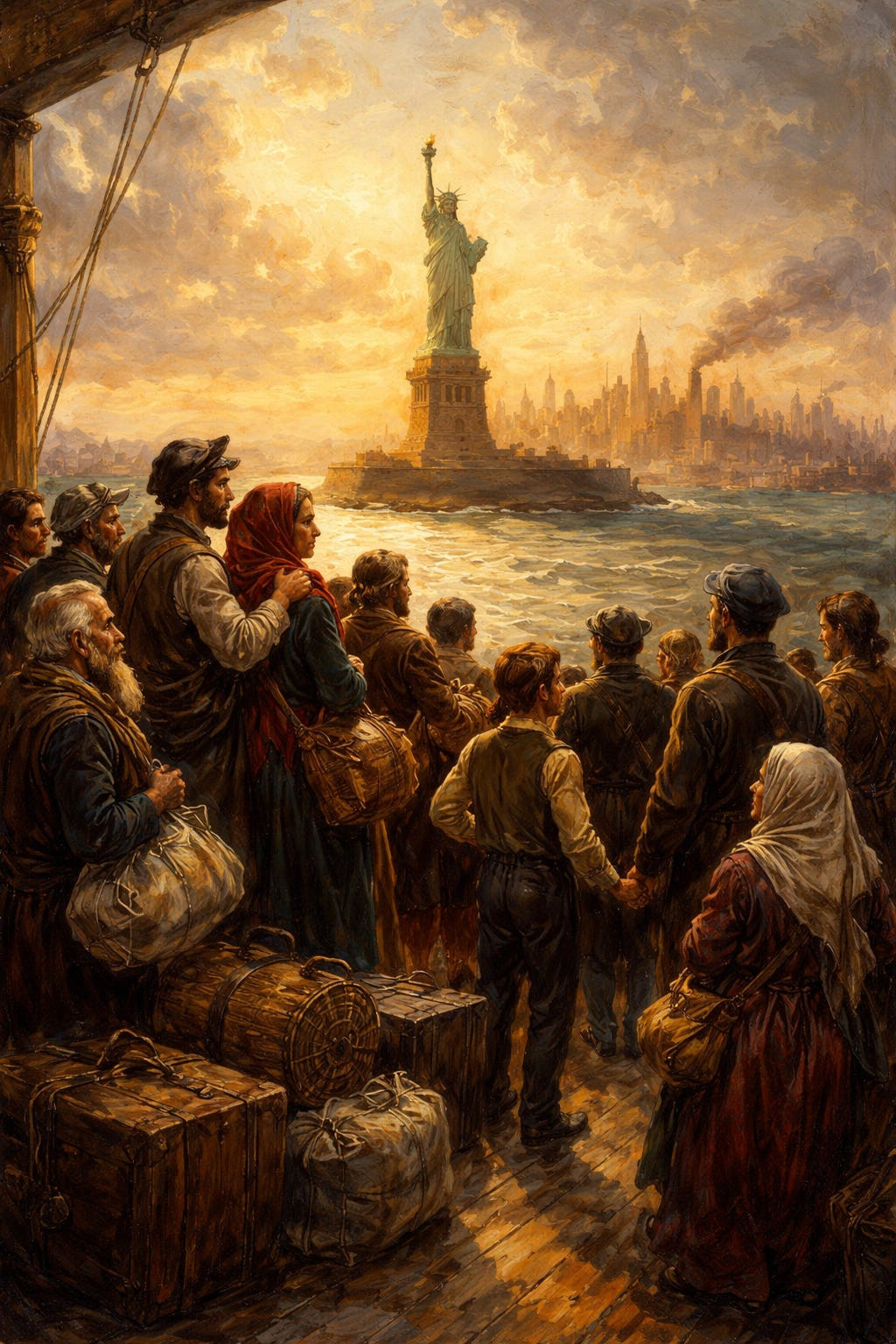
America has an immigration problem.
The problem isn’t people at the border. The problem is that last century of immigration doesn’t remember slavery.
The mythology of arrival at Ellis Island with the huddled masses at the golden door, creating the melting pot is not a description of America, it’s a management of American memory.
It centers the story on those who came after, who were processed through a system already built, and asks nothing of them regarding what that system was built on or what it cost.
You know, “The right way”.
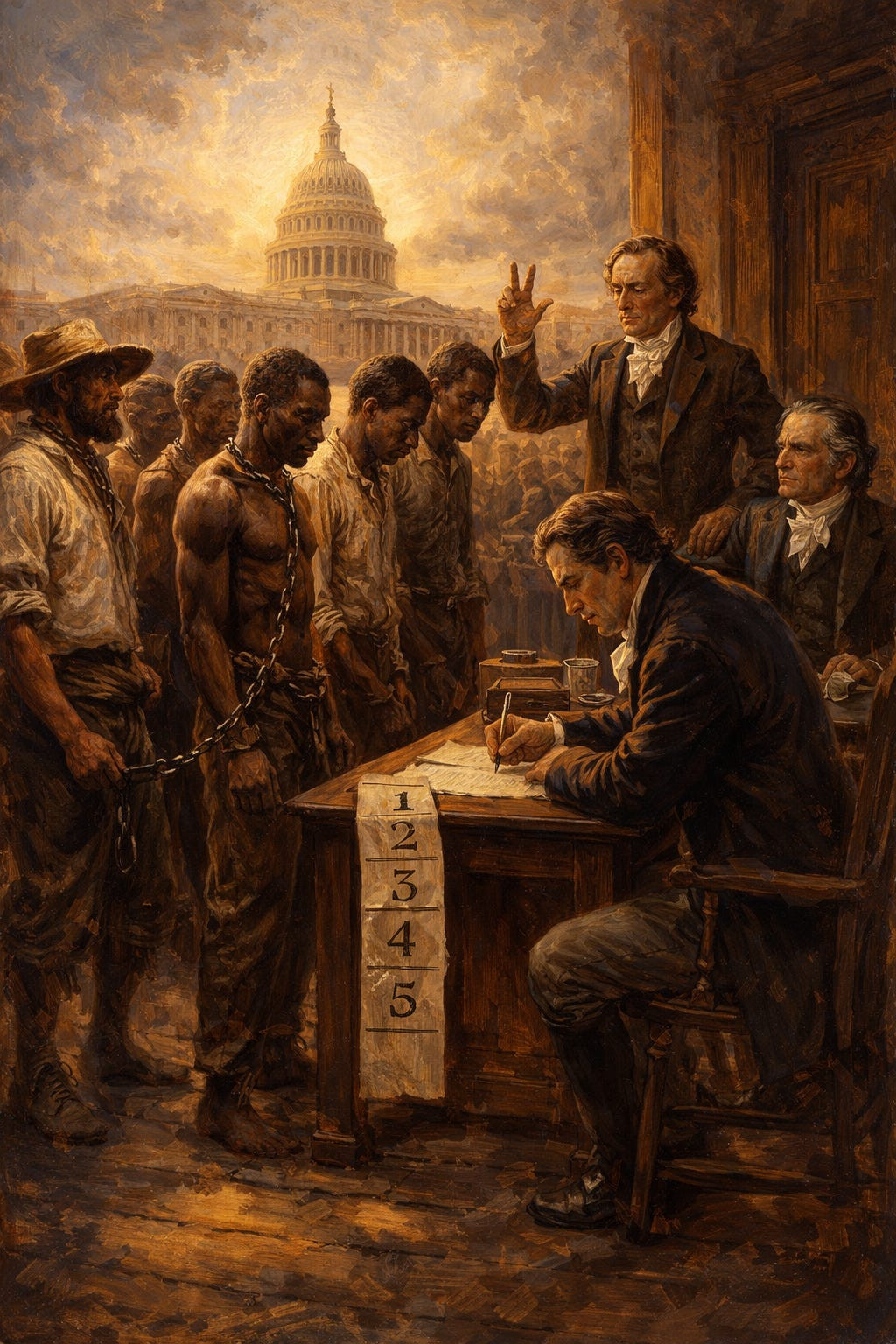
The founding document of the United States of America had to be amended to count human chattel, American enslaved Black people, as human beings.
The original text of Article I, Section 2, Clause 3 of the Constitution allocated political representation according to “the whole Number of free Persons” plus “three fifths of all other Persons.”
Human chattel was assigned a numerical value that gave their enslavers more power in Congress than they would have held without them.
By 1811, this produced eighteen additional slave-state representatives beyond what Southern states would have held if enslaved people had not been counted at all.
The Fourteenth Amendment, ratified in 1868, three years after the Civil War ended, superseded the three-fifths clause by requiring that representation be apportioned by counting the whole number of persons.
The amendment did not arrive because the nation had a change of heart, it arrived because 620,000 people died.
The document that is cited in every argument about who belongs here, who has rights here, who is legal here, that document was written by men who owned other men as property and considered that arrangement compatible with the phrase that all men are created equal.
Emancipation did not end the apparatus, it reorganized it.
Within the first two years after the Civil War, white legislatures across the former Confederacy passed what were called Black Codes, laws modeled on the slave codes they replaced, designed to restrict the movement and labor of newly freed people. Unemployment was criminalized.
Vagrancy, defined to capture any Black man without verifiable employment, became a prosecutable offense. Nine Southern states updated their vagrancy laws in 1865 and 1866 alone.
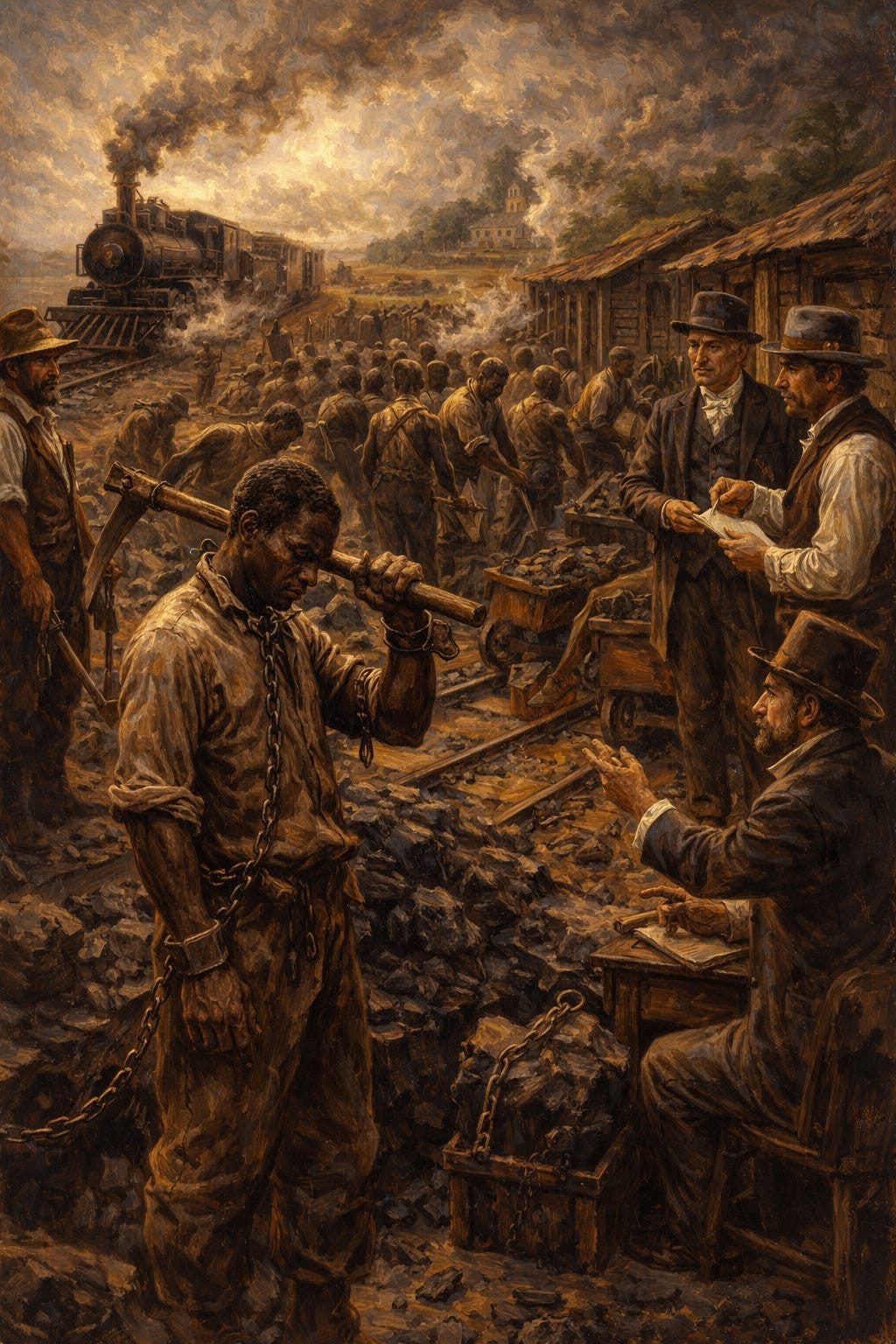
What followed was convict leasing, a system in which states sold the labor of imprisoned people, overwhelmingly Black, imprisoned for the new offenses the codes had created, to private railways, mines, and plantations.
The constitutional basis was the Thirteenth Amendment itself, which abolished slavery “except as a punishment for crime.”
The exception became the system.
In Alabama in 1888, the state leased all state prisoners and half of all county prisoners to a single Birmingham coal mining company. Ninety percent of those prisoners were Black. The practice persisted in various forms until 1941.
The primary was the only election that mattered across the one-party South, and the Democratic Party, exercising what courts initially ruled was its right as a private organization, excluded Black voters entirely.
The white primary was not informal custom, it was codified law.
Texas passed a statute in 1923 explicitly authorizing the party to limit primary participation to white voters. It was not until Smith v. Allwright in 1944, an 8-1 decision in a case argued by Thurgood Marshall, that the white primary was ruled unconstitutional.
In 1940, before the ruling, 30,000 eligible Black adults had registered to vote in Texas. By 1947, that number was 100,000.
The systematic denial of mortgage lending and federal housing guarantees to Black Americans in neighborhoods designated by the federal government as hazardous, redlining, structured the postwar American suburb and the intergenerational wealth it produced.
The GI Bill, hailed as the great democratizing instrument of the 20th century, was administered through institutions and processes that largely excluded the Black veterans it nominally covered.
There was COINTELPRO, the FBI’s Counter Intelligence Program, running from 1956 to 1971, which surveilled, infiltrated, discredited, and sought to destroy civil rights and Black power organizations.
It’s targets included Martin Luther King Jr., Malcolm X, the Black Panther Party, the Southern Christian Leadership Conference, and the Student Nonviolent Coordinating Committee.
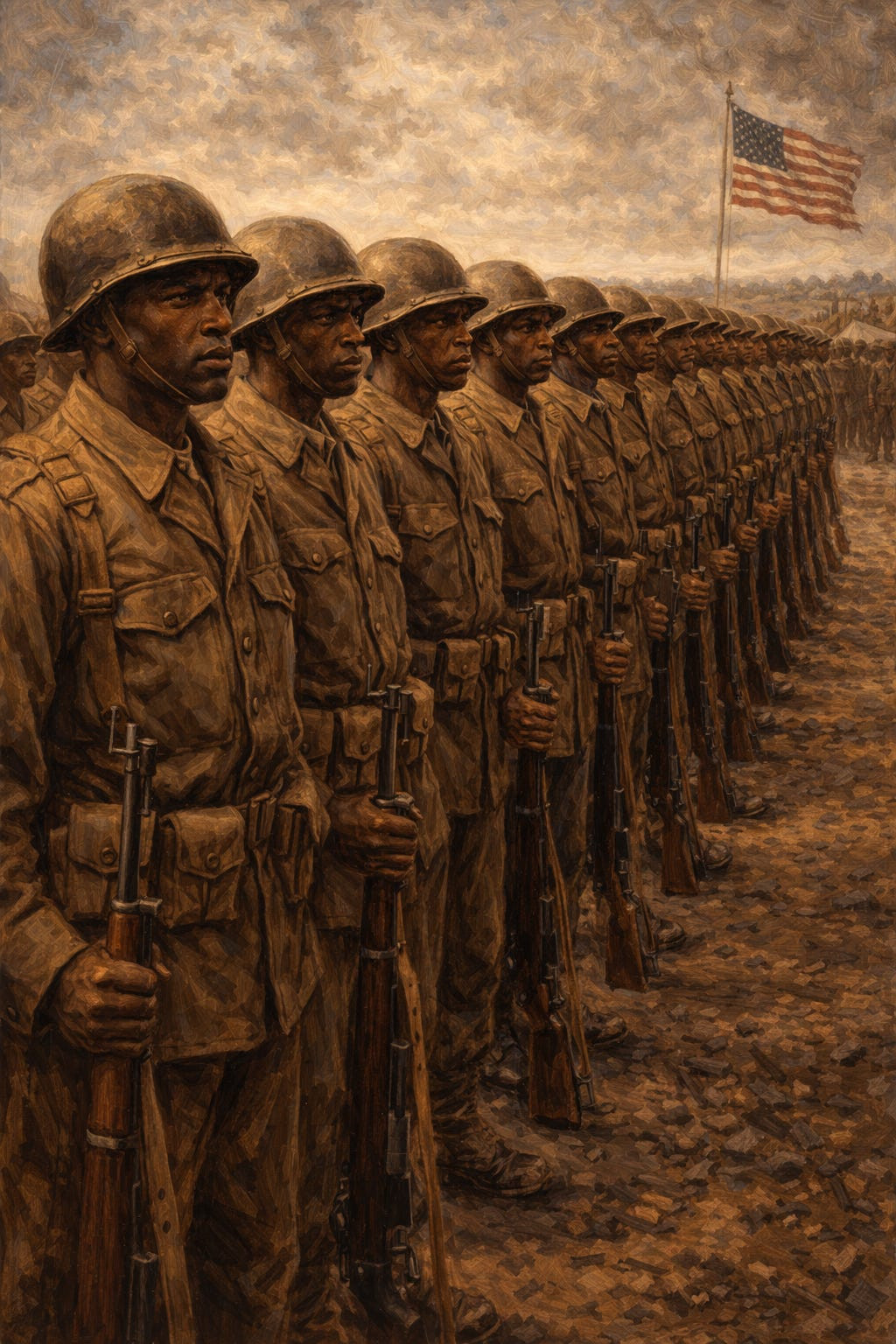
The Senate’s Church Committee, investigating in 1976, concluded that the program conducted a sophisticated vigilante operation aimed squarely at preventing the exercise of First Amendment rights.
This is the American record. It doesn’t require European analogy. It has its own names, its own statutes, its own case numbers, its own dead.
The Fugitive Slave Act required citizens to participate in the return of escaped people to their owners.
European immigrants who arrived in the 19th century, Irish, Italian, Jewish, Polish, Eastern European, themselves called the immigration problem, quota-restricted, racially classified, learned that the price of admission to whiteness was participation in the enforcement of racial hierarchy.
You caught slaves. You returned them. You proved you were white.
Whiteness was not a birthright, it was a transaction.
A social contract that said, you may have been the wretched refuse of somebody else’s shore, but if you enforce this system you become American and American means white and white means you belong.
That transaction is the foundation of the immigration enforcement apparatus that exists today.
ICE is the institutional descendant of that whiteness transfer.
Spanish speaking Hispanics, themselves often carrying European colonial lineage from the same imperial projects that disrupted the regions their targets are fleeing, are now the enforcement arm harassing and capturing people arriving from countries whose instability America had created and has never stopped creating and has never told its own people it created.
Between 1892 and 1954, approximately twelve million immigrants were processed through Ellis Island. By some estimates, as many as 100 million Americans living today are descended from people who passed through that station. The overwhelming majority were European.
They arrived into a country that had already resolved, through law and violence across three centuries, the question of who would do the foundational labor and who would not be compensated for it.
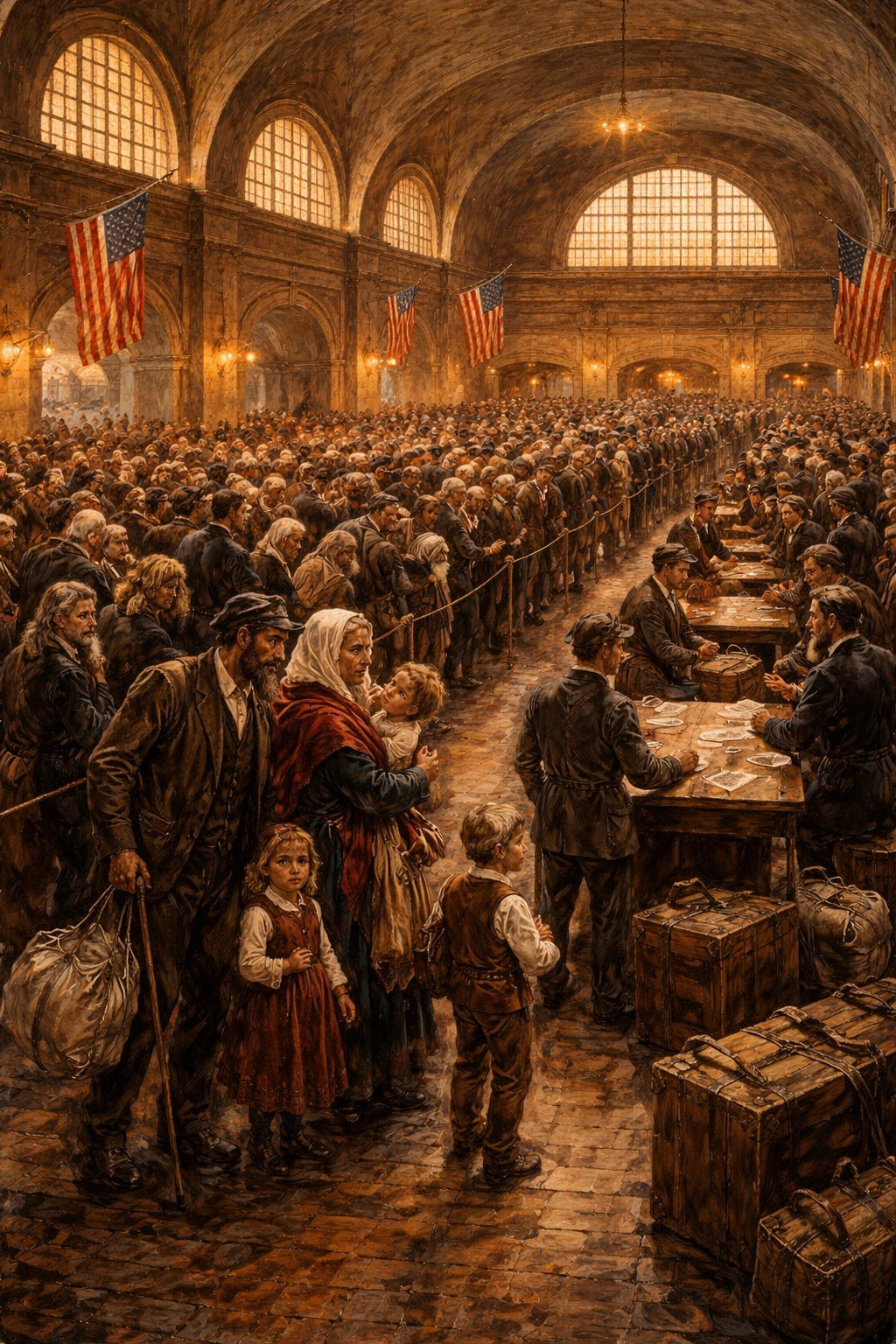
They were not asked to reckon with it as a condition of entry, they were assigned, over time and through the mechanism of ethnic assimilation, to a category called white, a legal and social designation that came with access to federal housing programs, union membership, public education, and the franchise.
The children and grandchildren of those immigrants now dominate American media. They carry inherited trauma, real, documented European trauma, from the displacement of WWI and WWII, from the pogroms, from the quotas that turned away their grandparents at the border while Europe burned.
That trauma is real, nobody disputes it.
But watch what they do with it.
They use words like Gestapo while invoking concentration camps and Hitler.
They say Nazi in reference to how the current American government is run.
They perform a cultural memory of European persecution that has been laundered through two and three generations of American assimilation into something that feels like authority, expertise and the right to define what oppression looks like.
Then, they point at the American southern border.
The Nazi and Gestapo comparisons export American horror to a European address.
They allow the domestic apparatus, its statutes, its amendments, its case law, its documented programs, to sit off the ledger while everyone reaches for a comparison that makes the problem someone else’s history.
America does not need Hitler to explain America, the record explains itself.
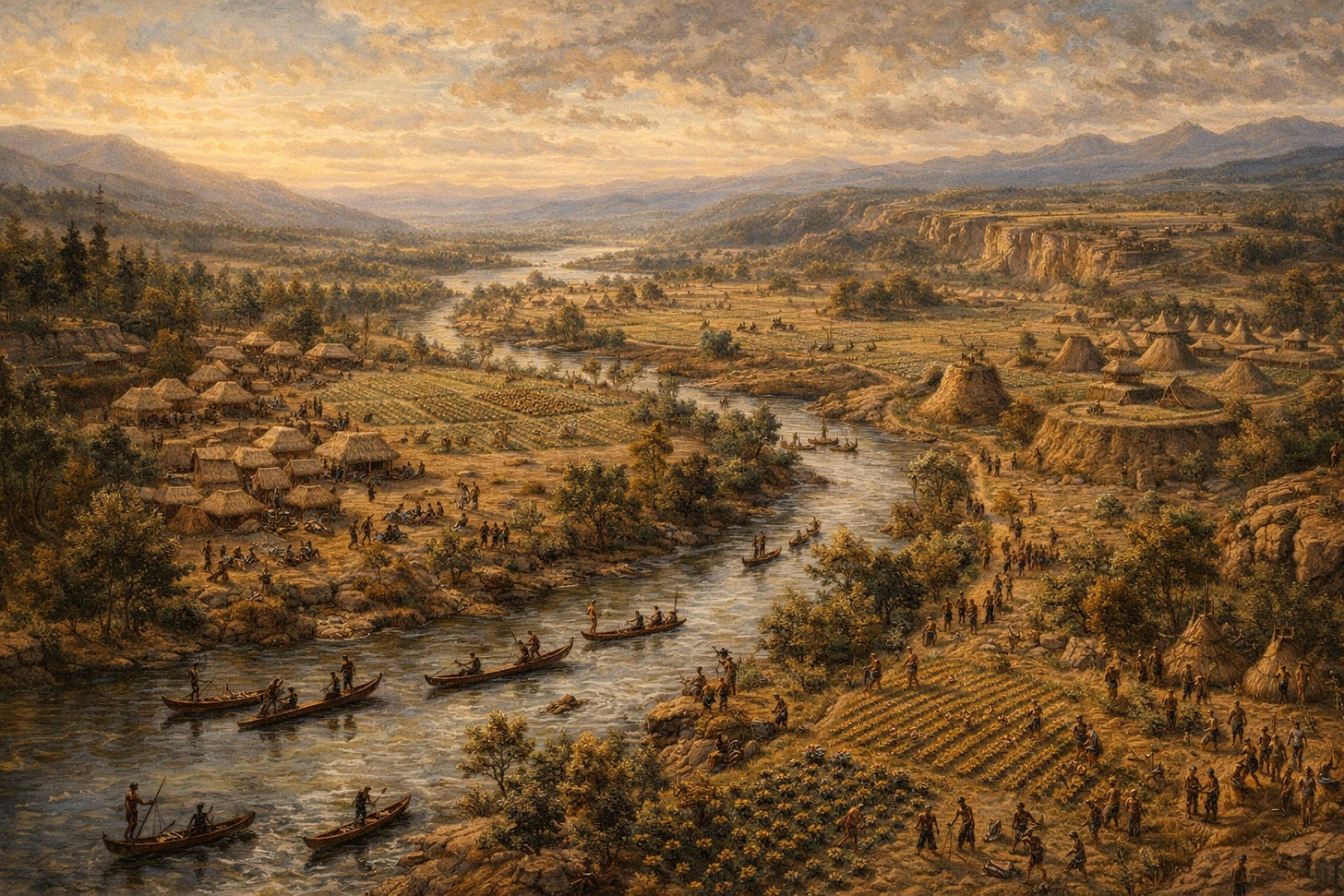
The native people of North America were here first.
The colonization that displaced them did not end, it evolved into policy, infrastructure,the Bureau of Indian Affairs and the boarding school system and the reservation and the pipeline through the sacred land and the current displacement of indigenous people by American actions funded and directed by the same political apparatus that is calling immigrants illegal.
The people arriving at the southern border are not an invasion, they are the continuation of a story America started and has been telling itself it finished.
The United States never stopped the colonization of Central and South America. It militarized it, privatized it and outsourced it to friendly governments and death squads with economic policy and the debt structures of the IMF.
It was called foreign policy, the war on drugs, free trade.
It was never called it what it was, the same project that was always the project, the extraction of labor and resources from people who are not white, for the benefit of people who are, enforced by people who proved their whiteness by participating in the enforcement.
The people being called illegal are the downstream consequence of that project. They are not coming here because America is a beacon. They are coming here because America is the reason they cannot stay there.
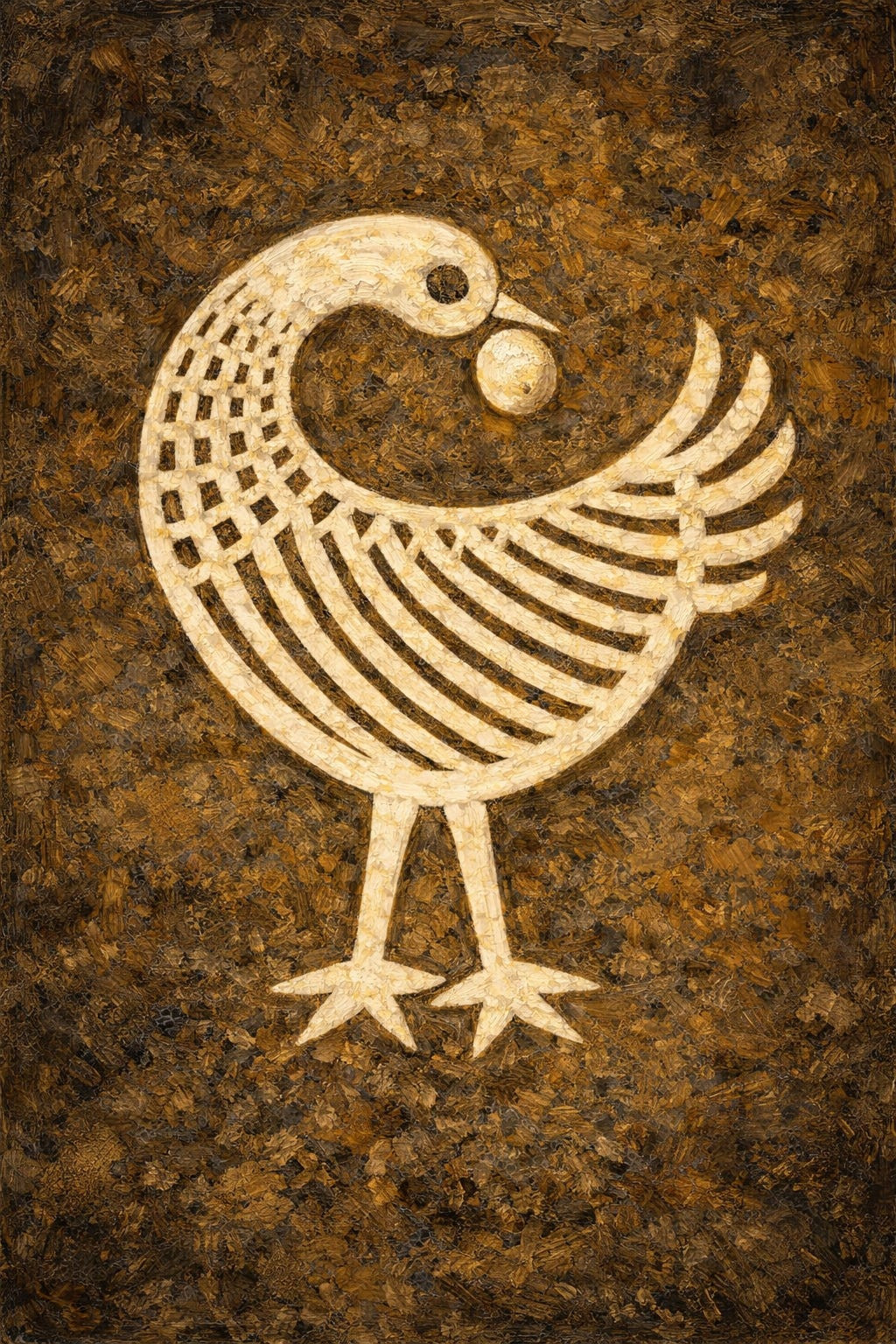
The Akan people of present day Ghana have a word, Sankofa.
In the Twi language, it is a compound, san, to return; ko, to go; fa, to fetch.
It is not a metaphor, it’s a command.
The proverb reads: Se wo were firi na wosankofa a yenkyi, it is not wrong to go back and get what you forgot.
The symbol depicts a bird moving forward with its head turned back, carrying an egg in its mouth. The feet face forward. The eyes look back. The retrieval and the movement are not opposed. They are the same act.
In 1991, during the excavation of a federal office building in Lower Manhattan, workers uncovered a burial ground. More than 400 sets of remains were eventually identified, free and enslaved Africans buried there between the mid-1600s and 1795, in what historians estimate may have been as many as 15,000 to 20,000 graves across what was once six and a half acres.
Nearly half of those identified were children under twelve.
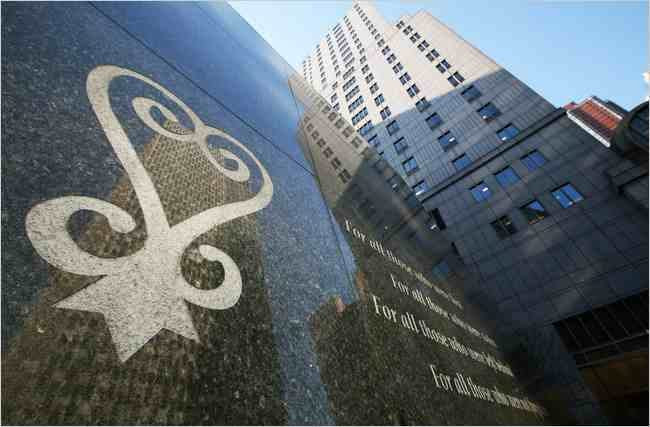
Burial 101 contained the remains of a man between 26 and 35 years old. Nailed into the lid of his larch-wood coffin were 187 cast-iron tacks, 51 of which formed a heart-shaped design approximately eighteen inches wide.
Kwaku Ofori-Ansa, an expert in African art at Howard University, identified the pattern as a Sankofa symbol. The Sankofa is now carved into the black granite memorial at the African Burial Ground National Monument.
The framework did not require European documentation to survive.
It was transmitted through communities that had everything else taken from them.
It didn’t travel through the public school, or the major newspaper, but through the Black press of the early twentieth century, gospel radio, urban radio, and now the podcast and streaming infrastructure that carries scholars trained at Howard University and other historically Black institutions, Karen Hunter, Greg Carr, Lurie Daniel Favors, transmitting frameworks that the dominant media has no incentive to circulate.
The children of European immigrants don’t remember American slavery because American slavery is not their inheritance, their inheritance is Ellis Island and the Lower East Side and the union hall and the GI Bill and the suburb.
They were handed whiteness and with it the right to forget.
The right to begin the story where their story begins and call that the whole tale.
Black people were here before those grandparents got off the boat. Indigenous people were here before Columbus convinced himself that he had found Indians.
The amendment that made Black people human was ratified in 1868. The Voting Rights Act was 1965. The Fair Housing Act was 1968. These are not ancient history. These are the parents and grandparents of living Americans.
The apparatus has a leak. It has always had a leak. The tools that the dominant culture buried are accessible to anyone willing to go find them.
Go back and get them.