

This is a summary from Marion Woodman's book, Dancing in the Flames, The Dark Goddess in the Transformation of Consciousness.
This goes very deep, you may need to read it a couple of times to really sink in (it took writing this and reading through line by line over and over to fulllllly embrace and feel these words and their meanings). But I want to share her words, these concepts with you, because it weaves so many threads together and I think it's incredibly potent.
From the black plague to the Virgin Mother, to witch hunts to WWII to quantum physics, there is a tale that is rising from the depths of our collective unconscious waiting to be told. The Goddess that lives within all of us.
____________________________________
"Even a brief look at a few of the turning points in Western culture over the last eight centuries will give us some insight into the Goddess that lies buried in our depths."
The beginning of this section briefly talks about the Crusades intention of "releasing Jerusalem (biblically imaged as the Bride) and the Holy Land from captivity of Muslims back in eleventh century."
During the crusades, the image of the Black Madonna (Isis) was brought from the East, she became "revered in an underground way, she represented fertility, life, birth, and the darker excesses of sexuality and delight in the mysteries of the body, and a wisdom that can be experienced during love making. She was the most intimate experience possible to the soul, she opened herself to the Holy Spirit and bore God a son, in her aloneness she was independent, a liberated image of the feminine."
The Black Death in the fourteenth century killed nearly half of the population of Europe. The plague was a catalyst for a major shift in human perception in many areas (*Does this sound familiar?! This book was written in 1996 btw)- in cosmology, science and medicine, in attitudes towards women, and in philosophy and religion itself. Unexplained and irrational, death was an insult thrown in the face of man's newly acquired image as the "controller." Man turned increasingly to his own rational power and began to look upon death, nature, woman, his own body and sexuality as being irrational, and therefore as something to be subdued and brought under the more rigorous control...
His dominance over nature became one expression of his power. The old science looked upon nature as God's handiwork and man's mother, the new science tends to look upon nature as an adversary to be conquered or a resource to be quarried and exploited."
Views shifted and man's focus became about the mind being distinct from the body.
"As entirely mindless, matter or body had to be controlled by mind, mind not being in matter but over matter, master ruling a slave...."
There was an increase in studying the human body during/after the plague to understand how to control disease and death. Man continued to move further away from seeing himself as part of the created order, and more they learned, the more control they felt they had over the systems (nature, bodies, etc).
"These advances in science were accompanied by a profound shift in man's perception of woman and death. It was during this period that death began to take on an erotic meaning in art and literature. Death and sex were increasingly thought of as a transgression which tears man from his daily life, from rational society, from his monotonous work, in order to make him undergo a paroxysm, plunging him into an irrational, violent, and beautiful world.
The intensified association of woman and death and erotic love greatly intensified the anxiety that man experienced. He began to project his own guilt about his sexual impulses onto woman. (Adam's blaming Eve- who was made from a 'bent, defected, rib' and was cast as inherently imperfect- for eating fruit from the tree of knowledge... that's a whole other story to get into together one day).
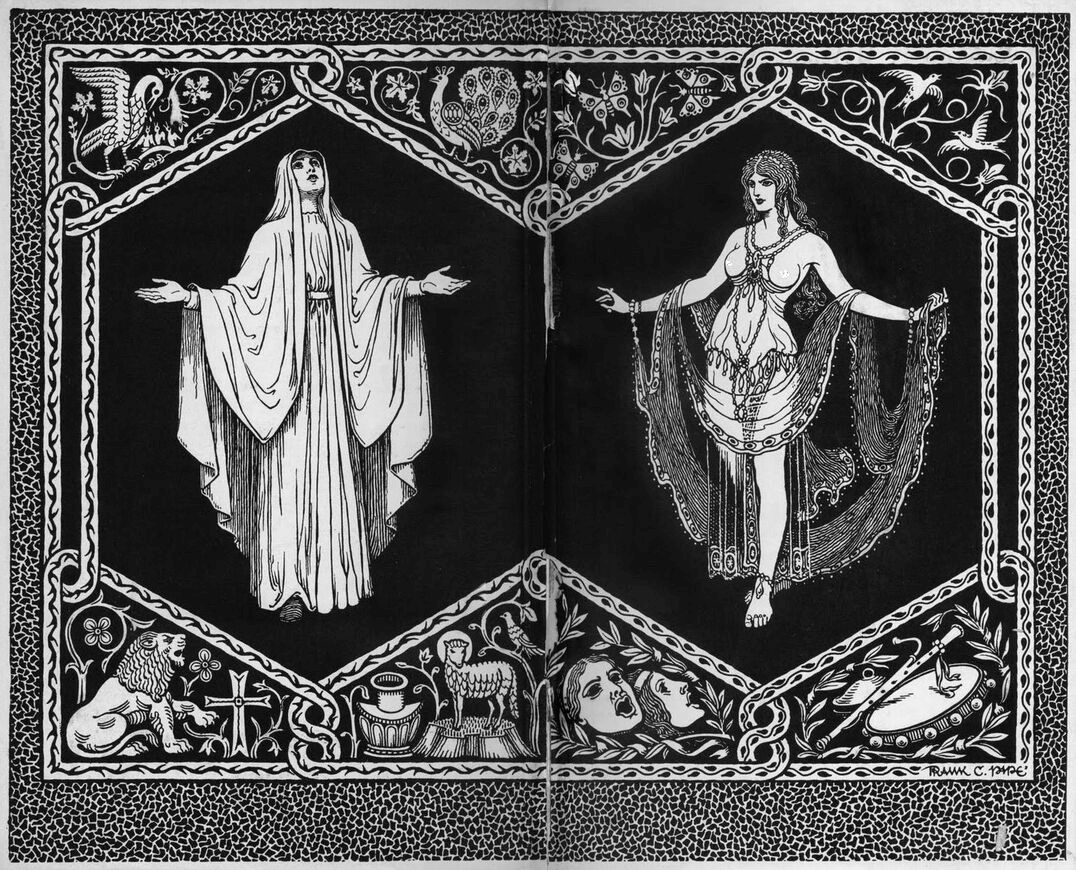
While guilt and carnality were projected onto women in general, there was also the compensating idealization through the cult of virginity, both within and without the Church. Within the church, it was placed on chastity, since death and sex were regarded as synonymous. St. John Chrysostom wrote in Della Verginita "For where there is death, there too is sexual coupling, and where there is no death, there is no sexual coupling. But virginity is not accompanied by those things."
What was occurring in man's perception of woman was a split between spiritualized feminine and carnal femaleness. A split between mind and body. The separation of man from nature.
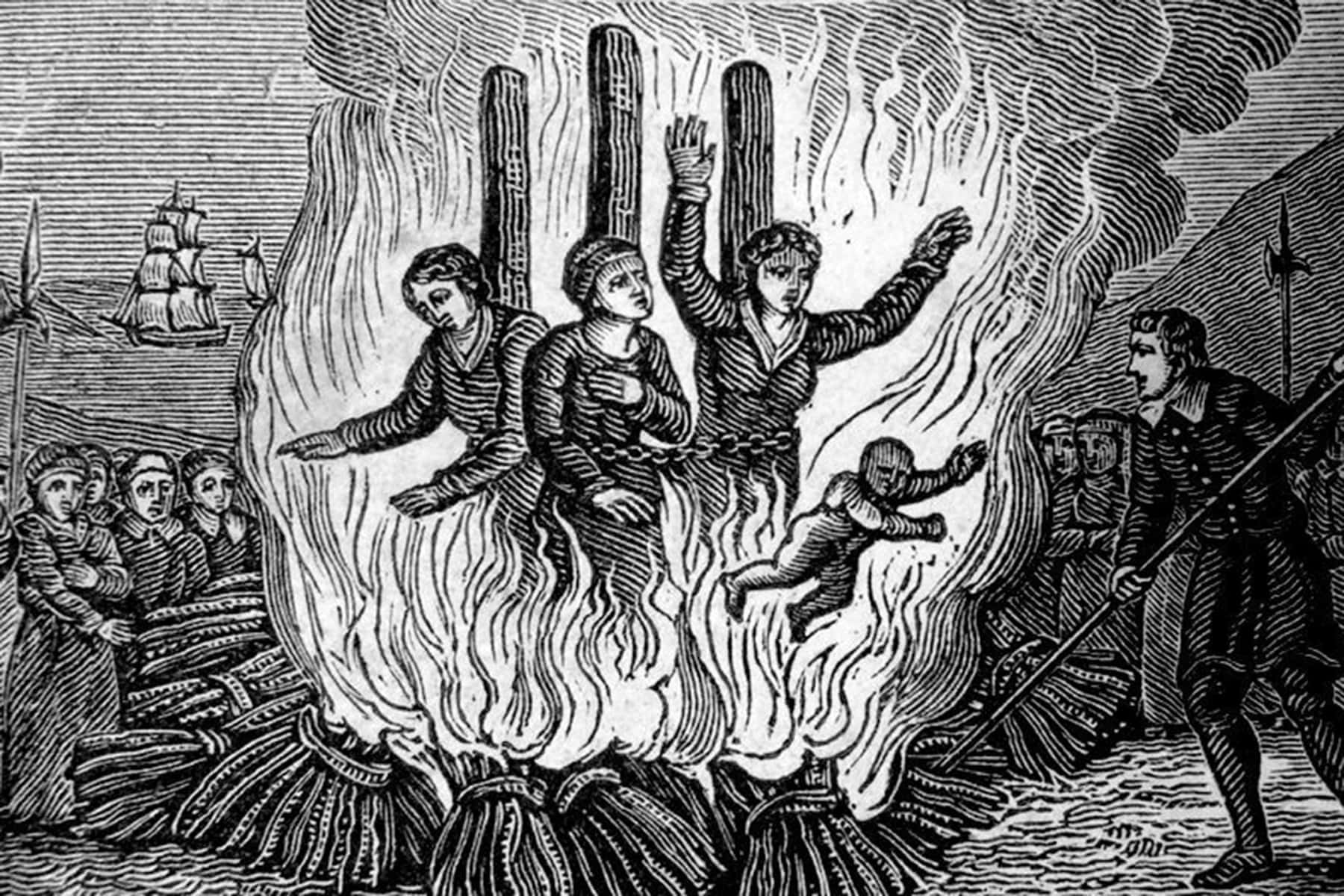
Man's split perception of women manifested most clearly in the witch hunts during the 13th-17th centuries, over one million women were killed. Not only did women carry the burden of man's guilt and response to death, but she also became the scapegoat for the economic instability that came in the wake of the plague (it was said that sterility that followed the plague was caused by witches and the devil's work).
"The split continued to grow more and more intense during the Middle Ages until it erupted in a veritable orgy of paranoia in the late medieval period [1300-1600s]. It can hardly be a coincidence that the same period that saw Mariologoy reach the greatest heights of theological definition and refinement with the triumph of the doctrine of the Immaculate Conception in nominalist theology also saw the outbreak of witch hunts that took the lives of upwards of one million women between the 14th and 17th centuries." -Rosemary Ruether
There were countless reasons why a woman (or man even) could be accused of being a witch and it was better to accuse someone else than to have it be you, there was so much betrayal and fear. There is no doubt a lingering collective wound from this period that has rippled across time and still sits within us today. This is where so much shame, blame, and fear of speaking up, have continued to live in women today.
"All witchcraft comes from the carnal lust, which is in women, insatiable."
"About this time, devotion to Mary as Universal Mother began to spread, as man started looking for a new source of security. Mary became the disembodied Mother. As Queen of Heaven, she became part of the Church's redemptive theology- not as the Black Madonna bridging sexuality and spirituality, but rather, as the obedient, chaste, the Virgin Mother.
With consciousness focused on the perfection of Mary, the dark shadow of lust constellated in the unconscious. A reflection of the mind/body dichotomy, this virgin/whore split drove the feminine soul, the receptive, unifying principle that had begun to emerge, deeper into exile. The soul became an isolated entity, the immortal and immaterial part of oneself that needed to be "saved."
Although it was women who mostly suffered during this time, man became painfully alienated from himself, torn between idealizing women (Mary/Virgin) and the need to dominate and control her.
There can be no real wholeness in heterosexual relationships until that split is healed in both man a woman.
It has only became clear in recent history that the patriarchal pathology is rooted in the dread of death.
"Not since the plague of the 14th century have human beings been so traumatized by the sudden loss of the boundaries that established their security. The holocaust, the nuclear bombings, were a nightmare that everyone has had to contend with ever since. Here was mass death on an unprecedented scale. Now the terror was not the unknown forces of nature rebelling against man, or God punishing man for his sins, now it was 'man's inhumanity to man' that was to be feared.
Inasmuch the plague had forced man to relate differently to nature, so the Second World War placed man in a new relationship to himself. Not only did men begin to fear each other, but man also began to fear himself, his own overwhelming capacity for destruction."
Following WWII, "the breakdown of the self has become evident in the predominance of the narcissistic personality. The growing prominence of character disorders seems to signify an underlying change in the organization of personality, from what has been called inner-direction to narcissism.
We have become alienated from the earth, from others, and from our own deepest feelings. In such a condition we become narcissistic. In all the mirrors that reflect reality we see only ourselves. We have become highly self-conscious, but this state is a mere parody of true self-knowledge, which comes through a relationship with and a commitment to something or someone beyond oneself, beyond the gratification of one's personal needs...
Sexual repression has given way to sexual liberation, but neither has anything to do with true passion or true self-knowledge. In the 18th and 19th centuries we denied, through the practice of puritanism, the guilt we felt towards our bodies; in the 20th century, the discomfort and guilt became too much to bear, so we abandoned it in favor of bodily gratification. We may now be a little more comfortable with the fact that we have bodies, but we have no context to give meaning to our new-found awareness."
We've swung from Puritanism to hedonism- to the pursuit of pleasure rather than the denial of it, but they are actually two sides of the same coin. Both face the body in fear, puritans fear gratification and hedonists fear the absence of it.
"Not until we recognize the Divine Immanence, the light of the Goddess in matter, can we hope to establish a balance, a reconnection with our own deepest nature that can root us in a world of meaning and imagination. Perhaps we will have to face the darkness, dive to the bottom of the sea before the old ego boundaries can be shattered to make room for the dance."
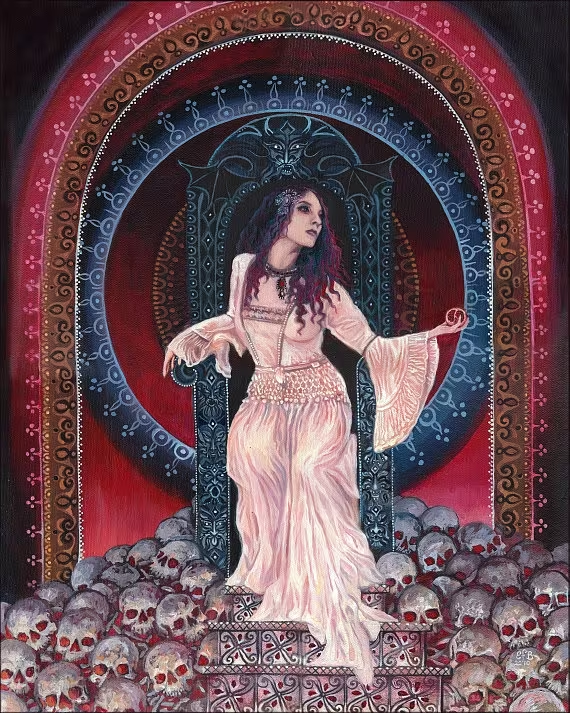
The darkness is always feared. "Beneath the mature persona of the ego lies the child's imagination, which fears being devoured by the wolf or the wicked witch. If we remain trapped in fear, we will never know the treasures of the dark."
Being thrown into the underworld is a common theme in mythology and stories across time and cultures.
"The descent is either taken voluntarily, in search of a deeper goal, or involuntarily, when the abyss unexpectedly opens. The potential in either case comes from the fact that the ordinary ego perceptions are shattered; cracks occur in the well-crafted persona. Through these cracks emerges the possibility of something new."
Descent into the underworld can happen at different stages of life, it can happen through a drastic life or traumatic event, a shakeup, something that causes you to rethink yourself, your identity, what it means to be human and alive.
Sometimes you have to hit rock bottom in a way, habits, addictions, depression, illness, death of a loved one. Something drastic needs to happen in order for the ego to feel its own despair, and until then, there is little motivation for change.
"If all we have ever known of the feminine is the old devouring Mother, we may become stuck in the black hole. If however, we are able to recognize the Great Goddess in her role as transformer of energy, then we can trust, even if we don't know where we are going, the blackness will reveal its gold. Sometimes with humor, or bluntness, or even harshness, sometimes with tenderness, she will both challenge and guide."
We must be willing to step into the darkness in order to be fueled for transformation.
In a few pages she speaks about the chaos of reality, that up until recently, chaos was seen as a bad thing, there had to be order, linear progression, rational understanding and predictability. But the more that we learn about how nature works, the more we realize with science, that the universe is so random and chaotic. The illusion of control man once had, goes out the window.
"Ancient wisdom, in which chaos was recognized and preserved (particularly in gnosticism and alchemy) as the necessary element of transformation, has finally been restored.
It is within chaos that a deeper, intrinsic order reveals itself... an order than emerges instead of being imposed. We we are connected to this emerging order we are psychically living from the incarnate feminine energy that has within it the possibility of transformation. We are in touch with the rhythms of matter and its deepest wisdom."
There is a wave of new energy rising from the Goddess, this embracing of the nature of chaos, a weaving and oneness of both the masculine and feminine- not the old devouring matriarchal energy or the tyrannical one-sided patriarchal energy.
"The evolutionary imperative within the collective unconscious is pushing us towards a new level of consciousness."
"In probing the deeper symbolism of the Goddess, we are challenged to go "inside." Evolution at this point is no longer in terms of the material body; it seems to be moving towards a greater interiority, and, paradoxically, a greater sense of all."
"In terms of our mythology, a new image of God/Goddess years to be found within ourselves. The kingdom is first within. It is manifested through body and mind. We are moving beyond an ego consciousness not only to an integration of body and mind but to a transcendence of the body/mind split to a new level of consciousness based on the dance between soul and spirit.
The soul embodied in matter, manifested in the Goddess as a container and transformer, will take us beyond dualism, beyond the defensive splits within our psyche if we open up to her energy within us. She faces us with her greatest fear and by showing us the treasure hidden away with it, she takes us to a place where love is born.
Love is the true antithesis of fear. It expands where fear contracts. It embraces where fear rebels..."
This is particularly important at this time in we are living in, with wars in countless countries, and the true fear of WWIII on the precipice, we must be able to transmute that fear into love, because fear is a much easier state to fall into for most.
"The Black Goddess, who emerged in history centuries ago, was exiled into the unconscious...
Without the recognition of the cycle of life-death-rebirth there can be no transformation, no true progression grounded in nature for the human species. In the transition from Great Mother to Great Goddess, the possibility of transformation in rebirth began to dawn.
If we enter into it, that chaos can resurrect us into a higher wisdom, rooted in the wisdom of the creative process. The chaos that we fear is the very thing that can free us.
To refuse to enter into Kali's dance of creation and destruction is to get stuck in a one- sided view of reality that can bring anarchy- destruction without creation. Armed with a new understanding of the very nature of reality itself, we may now be able to embrace the Goddess energy that is necessary if we are to move forward in our evolution."