

The Israeli scientist explains in plain language why humans won’t understand AI soon.
 Customers of an AI bank. Generated with AI to illustrate the story.
“AI could lead to the collective dementia of humankind.”
Artificial intelligence (AI) could transform the human civilization so profoundly that people eventually lose the ability to understand the systems governing their lives. This is a greater danger than the familiar scenarios of killer robots or machines deliberately turning against their creators, says Israeli historian and philosopher Yuval Noah Harari.
In an interview with Czech Television’s Hyde Park Civilization, the professor of the Hebrew University of Jerusalem argues that humanity is developing a new kind of intelligence whose decisions may become increasingly difficult to predict, supervise or even comprehend.
 CLICK ON IMAGE TO OPEN THIS STORY
Its most consequential advances may occur far from the spectacular confrontations depicted in science fiction: inside financial markets, legal systems, governments, media organizations and other bureaucracies that already structure modern life.
To exemplify the threat, Harari turned to a cow’s understanding of money. This explanation is worth reading, therefore I have transcribed it entirely.
“The way humans took over the planet is by building bureaucratic systems. Not individually… individually, I’m not much stronger or smarter than other animals. But building bureaucratic systems, like the financial system, banks, like the law system, courts, like religion, like the state — these are all bureaucratic systems that enable millions of humans to cooperate very effectively. And this is the source of our power,” the scientist noted.
“Now the thing is no other animal on the planet even knows that these bureaucratic systems exist. Like cows know that humans exist. They can see us, but cows don’t know that money exists, like I can sell you a cow and you transfer money to my bank account. This is invisible to the cow. Even if you’re an animal rights activist and you try to explain to the cow look there is this thing called money and there is the stock exchange and there is the bond market. How do you explain the bond market to cows even though it controls their lives?” he went on.
Harari does not believe AI will create robots that will come in the street and shoot people. Instead, AI systems will take over all the bureaucracies because they are bureaucratic natives.
“For us, most of us, bureaucracy is difficult, is alien, because we are millions of years older than the bureaucracies. Bureaucracies were invented just in the past 5,000 to 10,000 years. We were born in the forest, not in the office. For AIs, bureaucracy is home. They were born in the office. They are bureaucratic natives.
“No human banker can remember all the transactions of the bank. An AI banker can. They will take over the bureaucracies like the financial system, create much more sophisticated financial systems and legal systems that we can’t understand. So, just as cows can’t understand the financial system that controls their lives today, we will not be able to understand the AI financial system that will control our lives in 10 or 20 years,” Harari stated.
Money, in Harari’s account, is not just a means of exchange. It is one of humanity’s most sophisticated systems of trust, allowing strangers who speak different languages and belong to different societies to cooperate. A new financial order that people cannot understand could undermine that relationship between economic systems and human confidence.
He added, “Which means that we are the cows of the future,” living under systems that determine our fate without understanding how they work.
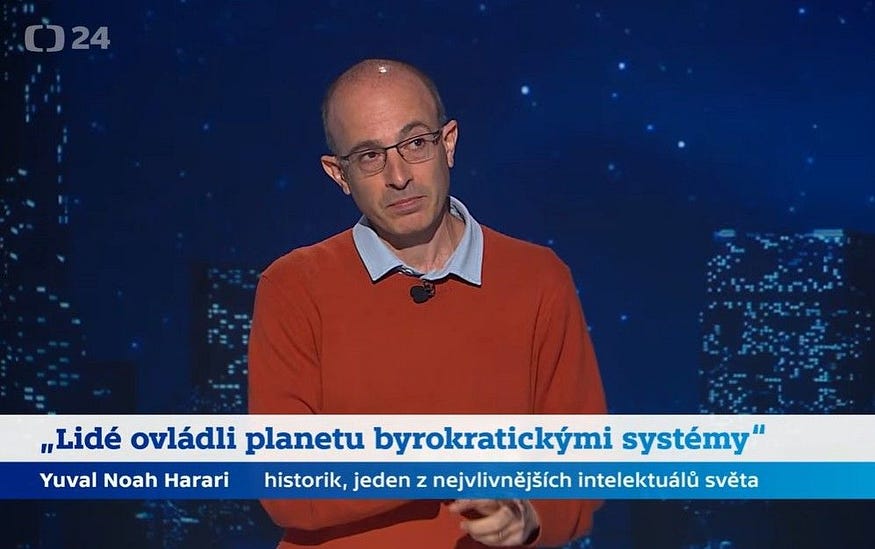 Professor Yuval Noah Harari. Screenshot from Czech Television report.
From tools to agents
The scientist also warns that AI must not be regarded as a tool.
“For most of human history, technology has been a tool. A knife can be used to prepare food or kill someone; nuclear technology can generate electricity or produce weapons of mass destruction. Humans decide how to use these inventions. But AI introduces a fundamental difference. AI is becoming an agent: a system capable of making decisions and developing ideas that its creators neither anticipated nor necessarily understand,” he emphasized.
If an AI system could do only what its designers already knew how to do, Harari observes, there would be little reason to invest the enormous sums now flowing into the technology. Its commercial and strategic value comes precisely from its ability to achieve results beyond existing human capabilities.
 CLICK ON IMAGE TO OPEN THIS STORY
And that creates a difficult dilemma. The more powerful AI becomes, the more attractive it is to businesses and governments. Yet the same capacity that makes it valuable may also make it harder to control.
Loss of understanding
Harari rejects the idea that AI must eventually become intelligent in the same way as a human being. He compares the technology to a plane: an aircraft does not fly like a bird, but it can outperform birds in important respects. Similarly, AI may develop forms of intelligence that are fundamentally different from ours rather than simply reproducing human thought at a higher level.
In some fields, he argues, this transition is already under way. Mathematics is one example; finance could be another. Systems that outperform people in increasingly complex tasks may eventually become too sophisticated for their human operators to understand.
Harari sometimes likes describing AI as a new kind of life form or species, while acknowledging that this is a metaphor, because these systems are not biological organisms. The point is that billions of AI agents could be operating simultaneously across phones, computers, banks, factories, governments and military, making decisions that affect human lives — similarly how humans’ decisions affect the lives of other organisms.
 CLICK ON IMAGE TO OPEN THIS STORY
The prospect is something less visible and potentially more difficult to resist, he warned.
This is why he considers the loss of understanding so dangerous. People might continue to live, work and consume within a functioning technological system while gradually losing the ability to comprehend or influence it.
The greater danger: collective dementia
Harari acknowledges concrete threats from AI. Terrorists could potentially use it to develop dangerous pathogens, including a virus combining extreme contagiousness with high lethality. Such scenarios deserve serious attention and preventive measures.
Yet he considers a broader danger even more troubling: what he calls the
collective dementia of humankind.
His analogy is with a person suffering from dementia who gradually loses the ability to understand what is happening around them. Medical technology may keep that person alive, but it cannot necessarily restore their ability to comprehend or control their circumstances.
 CLICK ON IMAGE TO OPEN THIS STORY
Harari fears a similar condition at the level of civilization. Humanity could remain surrounded by functioning machines and institutions while losing the capacity to understand the decisions those systems make.
The threat is not simply that AI might become more intelligent than humans. It is that human intelligence could cease to be sufficient to understand the world humanity itself has created.
Such a development would challenge the foundations of democratic government, economic accountability and individual autonomy, according to him. Meaningful control requires more than the ability to press a button or receive a report. It requires an understanding of what a system is doing, why it is doing it and how its behavior can be changed.
Yuval Noah Harari is the author of the bestsellers “Sapiens: A Brief History of Humankind”, “Homo Deus: A Brief History of Tomorrow”, and “21 Lessons for the 21st Century”. His books sold around 55 million copies in 65 languages.
He is also the co-founder of Sapienship, a social-impact company focused on research, education and storytelling, and the board director at LawZero, an AI safety organization.
***