

Ukrainian drone strikes hit Yandex data centers, cutting off three more tongues of Russia’s propaganda hydra.
 The Vladimir data center of Yandex. Screenshot from YouTube
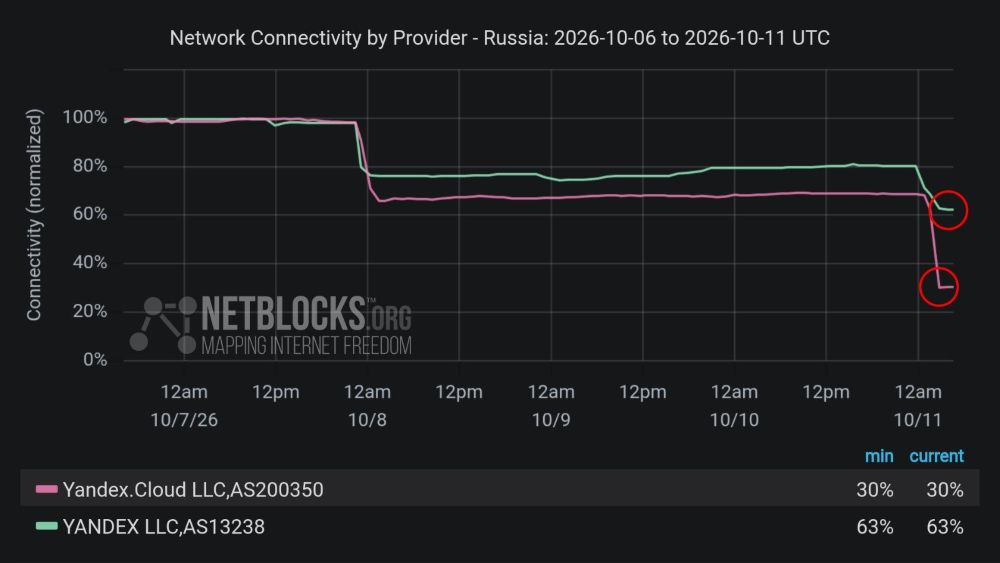
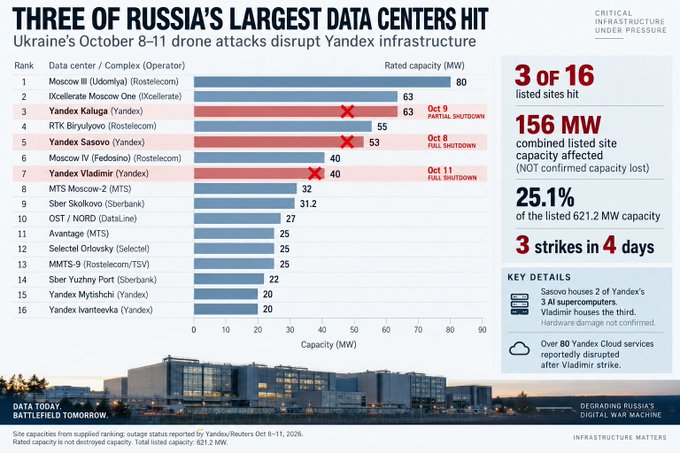
On 8, 9, and 11 October 2026, Ukraine drone strikes forced out of service three data centers run by Yandex, Russia’s largest internet company. A 53-MW facility in Sasovo and a 40-MW facility in Vladimir Region were largely destroyed and have been fully shut down, and a 63-MW one in Kaluga was heavily damaged and is in partial shutdown mode.
Sasovo housed two of the three supercomputers Yandex uses to develop its AI models. Vladimir hosted the third. The strikes appear to be part of Kyiv’s response to Russian attacks on data centres and other digital infrastructure in Ukraine.
Yandex acknowledged that some of its services could be unavailable and that its remaining infrastructure configuration was unstable.
This is not just another ordinary company in the crossfire. Like Wildberries, Russia’s major online marketplace, whose warehouses were hit by Ukrainian drone attacks last summer, Yandex is deeply embedded in everyday Russian life – from search and maps to taxis, news, payments and AI – and likewise has physical infrastructure that can be disabled by military action.
 But Yandex is more than a technology provider. Its platforms operate in a political environment where the state has sought increasing influence over the information Russians can access. Yandex has long been suspected of promoting the Kremlin’s agenda and surrendering its services to political and military objectives.
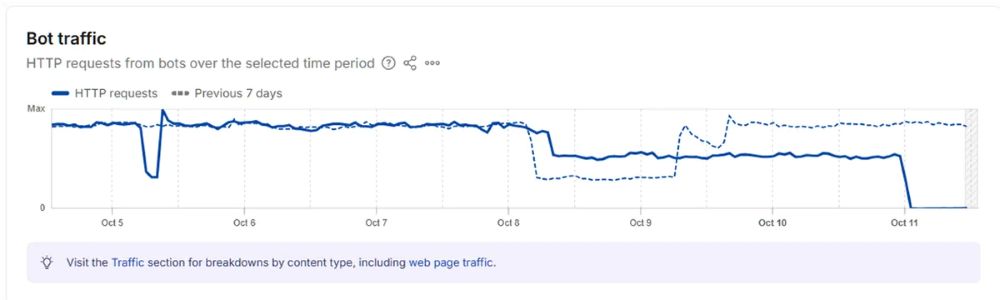
A number of internet measuring platforms noticed immediately after the strikes that the bot-generated traffic through Yandex dropped almost to zero.
After the strikes, Cloudflare Radar, for example, recorded a dramatic collapse in automated HTTP requests originating from Yandex’s network. The timing attracted attention because Russian influence operations have long relied on automated online activity. Yet the data alone does not show that propaganda bots were disabled: much of the traffic attributed to Yandex consists of legitimate search-engine crawlers.
 In social media, users pay attention to another aspect.
Suddenly, as Polish political analyst Jarosław Wolski observed, “support for [the German far right party] AfD in social media has dropped by 56%; fewer ‘Polish’ accounts inciting against Ukrainians, fewer ‘Ukrainian’ ones inciting against Poles, support for MAGA online has sharply fallen.”
Another indicator of the impact of the destruction of Yandex servers on Russian bots: the latest false narrative from the Russian operating mode Storm-1516 targeting the French presidential campaign, published on 9 October, apparently garnered only a few tens of thousands of impressions. The previous one, published on 24 September, had garnered millions in the same time frame.
Russian bots employed in Brexit and U.S. elections
Yandex servers had been reportedly used as one of the channels employed in Russian influence operations in the Brexit referendum in the United Kingdom in 2016 and in the United States presidential elections the same year, although both the company and Russian authorities denied any interference.
For the U.S. election, the US Senate Intelligence Committee concluded that the Kremlin-backed Internet Research Agency sought to influence the 2016 presidential election by damaging Hillary Clinton’s prospects and supporting Donald Trump. The committee described a broader operation that exploited divisive political and social issues.
For Brexit, researchers from Swansea University and the University of California, Berkeley analyzed 28.6 million Brexit-related tweets posted between 24 May and 17 August 2016. Their research identified bot activity on both sides of the debate and suggested that bots helped spread information and intensify divisions. Separate reporting described tens of thousands of Brexit-related messages posted by Russian-based accounts in the 48 hours around the referendum.
The fact that the propaganda-associated accounts that supported far-right parties and movements in Europe – and are the same that participated in the Brexit and U.S. electoral campaigns – stopped working as a result of Ukrainian drone strikes links Yandex directly to the Kremlin’s hybrid war against the West.
 Yandex ain’t Google
Launched in 1997 during the global dotcom boom, Yandex was immediately became the darling of Russia's internet scene, ultimately dominating Russia's online search market. It successfully completed the listing on Nasdaq and at one point reached a market capitalization of around $30 billion.
Google’s algorithms started working the same year. The two were born at the same time and yet one of them has been adopted by hundreds of millions of people around the world while the other has been trapped in politics.
For a company that presents itself as Russia’s answer to Google, any substantiated role in state-directed influence operations would carry reputational costs. International users and business partners need to trust not only a technology company’s products, but also its independence and the way it handles information.
Both grew into technology giants, developed their own algorithms and expanded far beyond web search. But their paths diverged. Google became a global ecosystem of products and services, while Yandex became increasingly dependent on its domestic market and the political system governing it.
The first obstacle for Yandex is political dependence. A search engine does more than retrieve information: it determines which sources become visible, which narratives reach audiences and which websites remain buried beneath competing results. A study published in Sage.Journals in 2023 compared Google and Yandex search results in Belarus and found that Yandex was more than twice as likely as Google to return unverified conspiracy theories in the queries examined.
“Extant research demonstrated that the algorithms of the Kremlin-controlled search engine Yandex, compared to those of its US-based counterpart Google, frequently produce results that are biased toward the interests of Russia’s ruling elites. Prior research, however, audited Yandex’s algorithms largely within Russia. In contrast, this study is the first to assess the role of Yandex’s web search algorithms as a resource for Russia’s informational influence abroad,” the authors stated in the opening abstract.
Serving a few
The researchers also found that Yandex gave greater visibility to websites connected with Russia’s ruling elites and to narratives blaming the United States for the COVID-19 pandemic. Their study did not establish that every Yandex result was politically manipulated, but it demonstrated how a search engine can become a channel for a state’s preferred interpretation of events.
The problem, however, extends beyond the accuracy of individual search results. A global technology company needs users to believe that its services are designed primarily to serve their needs, rather than the political interests of the leadership. If users suspect that search rankings, news recommendations or other services are shaped by government priorities rather than their personal preferences, the company risks losing credibility precisely where it hopes to expand.
In 2024, Yandex’s Dutch parent sold its Russian businesses to a consortium of Russian investors for approximately $5.4 billion, ending foreign ownership of its core Russian operations amid geopolitical pressure and concerns about state influence. Unlike Google, whose global ecosystem spans search, advertising, Android, YouTube and cloud computing, Yandex remains more constrained by Russia’s political environment and a limited international reach.
With the departure of foreign investors, opaque ownership, and growing political oversight, Yandex’s chances of going truly global have faded. Trust remains the one asset the Russian giant has yet to secure – even in its domestic market.
***
Hey reader, I hope you've learned something from this story. If you still care about high-quality, old-fashioned journalism, spend a minute to support the writer via this platform. It will return to you with new meaningful stories. Thanks whatever you decide!