

A Habsburg emperor’s military ambitions helped create one of history’s most flamboyant warrior cultures.
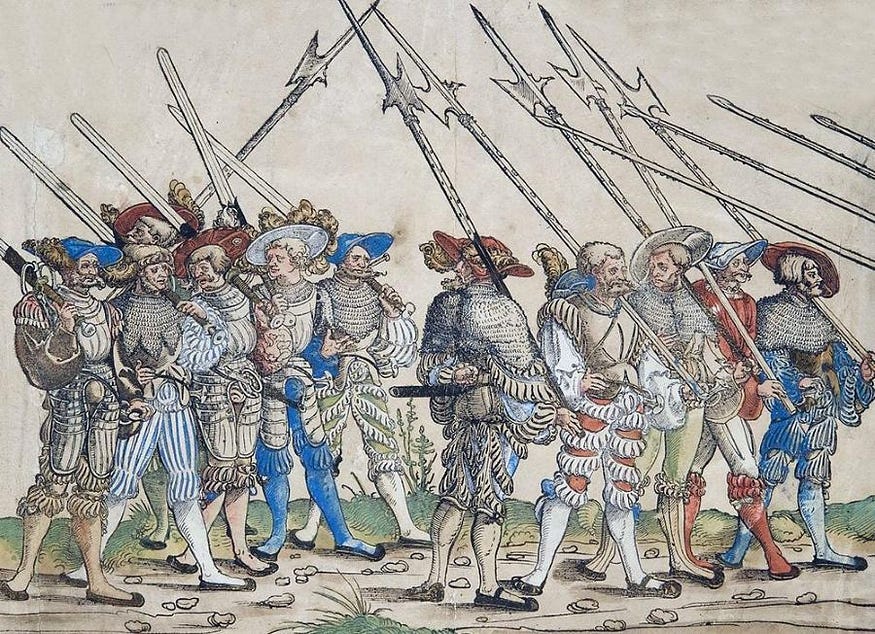 16th-century German mercenary soldiers known as Landsknechts on the march. Popular Historia
Imagine a soldier arriving in a European town around 1500. His sleeves balloon around his arms, slashed strips of fabric expose contrasting colors beneath, his trousers are puffed and uneven, and an enormous feather bobs above his hat.
His clothes look as if a tailor lost control of his scissors and a court jester took over the wardrobe. Gold chains hang from his chest.
Yet this extravagantly dressed man is not a nobleman preparing to attend a carnival. He is a Landsknecht, a professional German mercenary in the service of the Holy Roman Empire of the German Nation.
The above-described appearance — which was somewhat shocking even to contemporaries — is part of his identity. He would attract numerous glances from locals, some of whom would smile, but few — really few — would dare ask questions about the visitor’s fashion tastes.
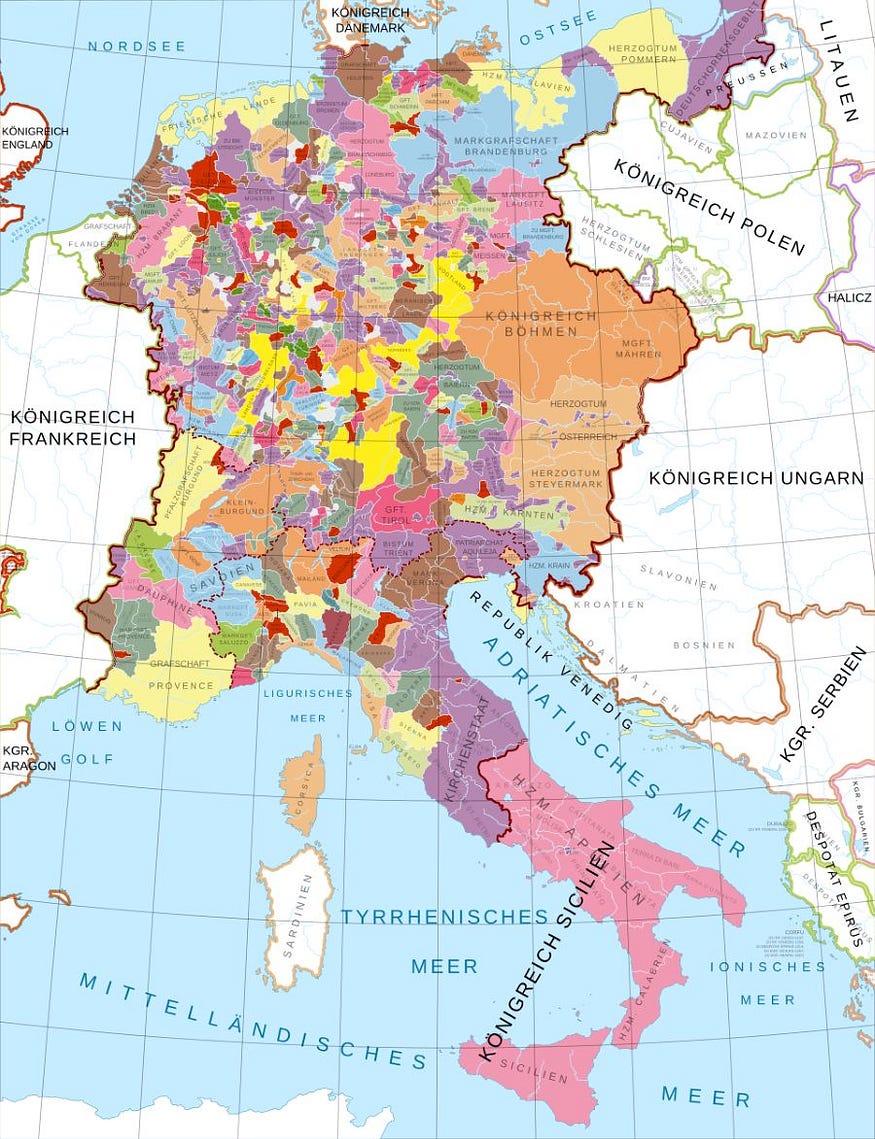 The Holy Roman Empire at its greatest extent under Emperor Frederick II. Wikipedia
The dress code
If you have not sensed the contrast yet, have a look at the year our visitor entered the city. It was a period when clothing announced a person’s place in society, his rank and wealth. In the Middle Ages, European rulers and city authorities issued sumptuary laws to prevent people from dressing above their status.
Expensive fabrics, precious metals, pearls and extravagant styles were restricted according to social position. A wealthy merchant, for example, might have the money to dress like an aristocrat, but the law could still forbid him from doing so.
The rules allowed to distinguish between an aristocrat and a farmer or a blacksmith or a clerk.
The Landsknecht seemed therefore to inhabit a different world. His profession could give him access to a degree of sartorial freedom that ordinary civilians did not enjoy. He could parade in colors, fabrics and shapes that challenged the established visual hierarchy. The more flamboyant the outfit, the harder it was to ignore the man wearing it.
Yet no one reported that dress code deviation and no Landsknecht was punished for his dressing choices.
So, why would the nobility including the emperor tolerate such a challenge to their social order?
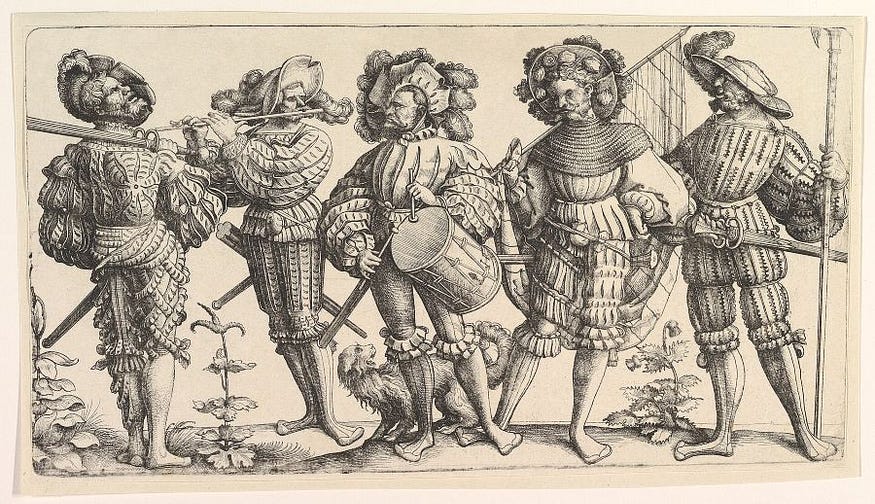 An etching titled Five German Soldiers created around 1520–1536 by German artist and armourer Daniel Hopfer.
An innovative emperor
The answer lies in a military transformation that was changing Europe. Behind the extravagant sleeves and feathered hats stood a practical problem: building a reliable infantry force in a continent where armies depended heavily on aristocratic obligations, expensive knights and mercenaries who could choose their employers.
At the end of the 15th century, Emperor Maximilian I of Habsburg needed soldiers who could fight effectively, be recruited in sufficient numbers and serve his ambitions across a sprawling, politically fragmented empire.
The Holy Roman Empire of the German Nation, which claimed its legacy from Ancient Rome, was a polity comprising much of Central and Western Europe and was characterized by a decentralized political structure. Initially, it consisted of three kingdoms — Germany, Italy, and Burgundy — which were held together by the emperor’s overlordship.
By the 15th century, imperial governance had become concentrated in and upon the Kingdom of Germany, while the effective control over Italy and Burgundy had largely disappeared.
Nicknamed “Heart of Steel” by contemporary Burgundian chronicle Olivier de la Marche and later historians for his ruthlessness, Maximilian I dreamed of recovering the territorial losses and restoring imperial sovereignty amid the growing power of the French kingdom and Italian states.
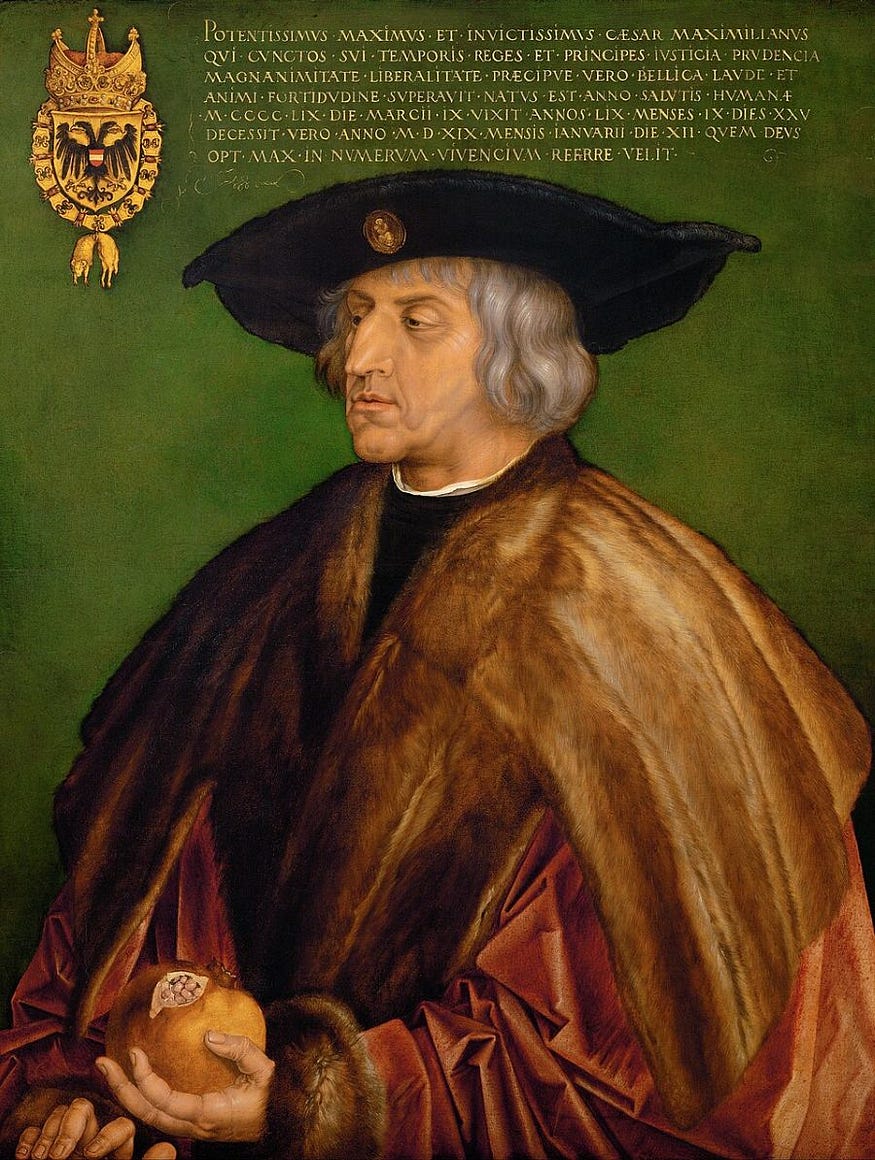 Maximilian I, emperor of the Holy Roman Empire. Wikipedia
At the same time, the monarch was a reformer who understood the need to adapt and innovate. He helped develop a new kind of infantryman, inspired in part by the formidable Swiss mercenaries who had demonstrated the power of disciplined foot soldiers armed with long pikes.
Before the Landsknechts emerged in the late fifteenth century, the Holy Roman Emperor relied on a mixture of feudal obligations, contingents supplied by territorial rulers and cities, aristocratic military households, and hired soldiers.
These arrangements had limitations. The emperor could not always obtain the number of troops he needed, in the right place, at the right time. The availability of forces depended on political agreements, financial resources and the willingness of local authorities to cooperate.
Maximilian’s response included developing a system for recruiting professional infantry under contract.
 CLICK ON IMAGE TO OPEN THIS STORY
Formed in the late 1470s and 1480s to counter the dominance of Swiss Reisläufer mercenaries, these men became known as Landsknechts or “servants of the land.” They formed the core of the Holy Roman Empire’s army, fighting across European conflicts including the Habsburg-Valois wars, Habsburg-Ottoman wars, and the European wars of religion.
Their weapons demanded discipline and their formations depended on coordination. Therefore, they fought in dense, massed formations up to 30–40 rows using pikes between 4 and 5+ meters to withstand cavalry charges and push back opposing infantry.
In some ways, this organization reminded of the Roman legions. Yet it was not a tribute to Roman military strategy, but a response to the realities of late medieval warfare. The Swiss had demonstrated that disciplined infantry armed with long pikes could challenge heavily armored cavalry and defeat armies that had traditionally relied on mounted knights.
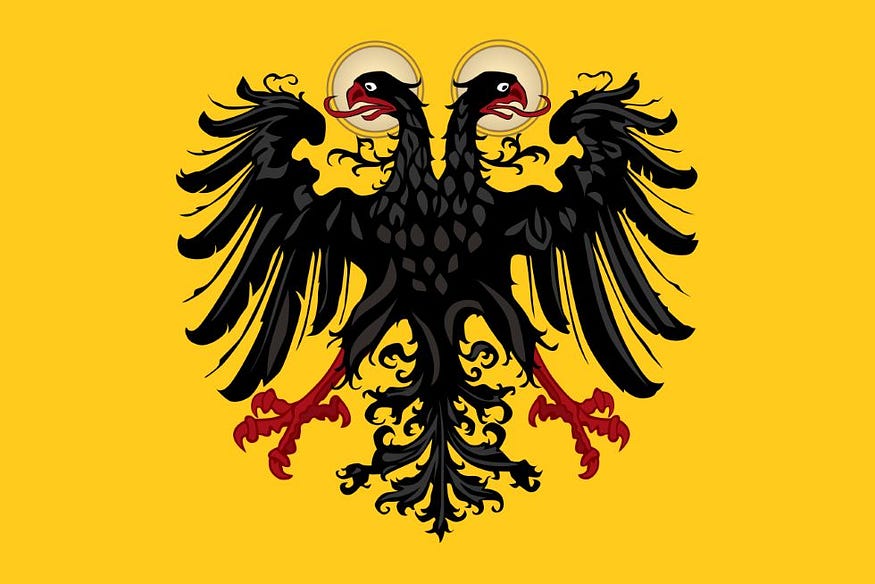 The flag of the Holy Roman Empire.
Other Landsknechts carried long, two-handed swords Zweihänder, halberds, or short, S-shaped or notched swords known as Katzbalger, depending on their specific roles in battle. When portable firearms appeared, arquebuses and muskets entered their arsenal.
Even more importantly, he helped develop a more organized system for recruiting, equipping, commanding and maintaining infantry. His reforms covered several interconnected areas: recruitment, military organization, battlefield tactics, discipline, artillery and logistics.
In general lines, this is the force Maximilian needed and personally took an active part to create.
The Landsknecht fashion
And here the story becomes particularly interesting for our subject. We covered extensively the historical background leading to the birth of the force, the context of changes in medieval European warfare. They were necessary to understand why the Landsknechts dressed the way they dressed.
So, the question remains: why?
You see, Maximilian’s reforms shaped a Landsknecht military culture that was distinct from other traditions. Although the Landsknechts were indeed similar to the Swiss pikemen in many ways, the latter did not seem concerned about visiting a tailor to order extravagant clothes.
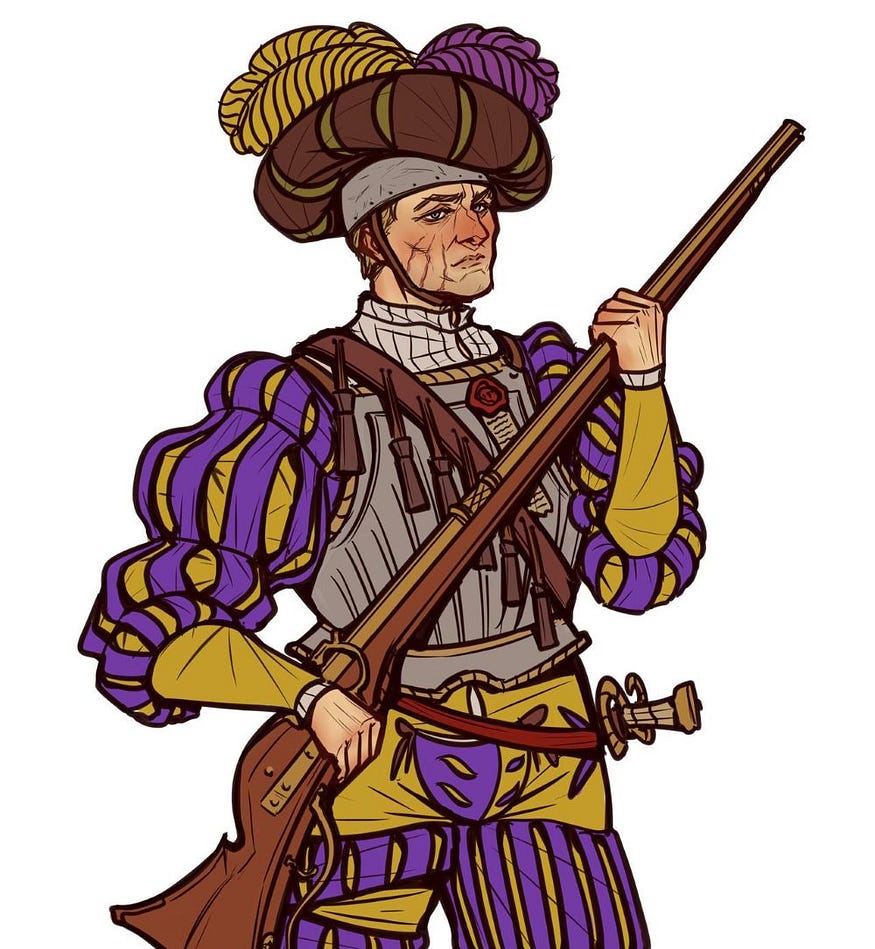 A modern depiction of a Landsknecht with an arquebuse. History.com
Unlike the Swiss, who came from a confederation increasingly renowned for exporting its military services, the Landsknechts were recruited mainly from the German-speaking lands of the Holy Roman Empire. In a conventional sense, they served their own country — although dynastic loyalties, local allegiances and the prospect of pay often mattered more than any modern idea of patriotism.
They were professional soldiers recruited and organized under contracts, usually for particular campaigns. They had ranks, commanders, rules of discipline and established military practices, but their employment was generally temporary. Regiments could be raised, disbanded and reconstituted as circumstances required.
Between campaigns, many returned to civilian life, while others sought new employers or waited for another opportunity to enlist. Yet their profession gave them a distinctive identity, reinforced by shared experiences, military customs and the reputation of their fellow soldiers.
 CLICK ON IMAGE TO OPEN THIS STORY
Clothing became one way to express that identity. Many Landsknechts adopted the rich fabrics, bold colors and extravagant silhouettes associated with elite dress, although the new designs transformed them into something quite different from mainstream aristocratic fashion. Their slashed sleeves, puffed garments and contrasting layers made them instantly recognizable — and sometimes laughable.
No one knows exactly when it started.
Authors Douglas Miller and John Richards cite a chronicle by Swiss historian Valerius Anshelm describing extravagant clothing in 1503. The account complains about the spread of colorful, slashed garments, wide sleeves, silk doublets, extravagant hats and other fashions associated with Swiss mercenaries and the broader military fashion of the period.
Yet the scale of that clothing style suggests those were outstanding cases rather than widely adopted wear.
Most likely, it began in a German city as an experiment in visual identity, a way for men of modest origins to look as striking as their social superiors. But fashion rarely stands still when others begin to imitate it. As more Landsknechts joined the trend, the question may have shifted from how to look distinctive to how to outdo one’s comrades.
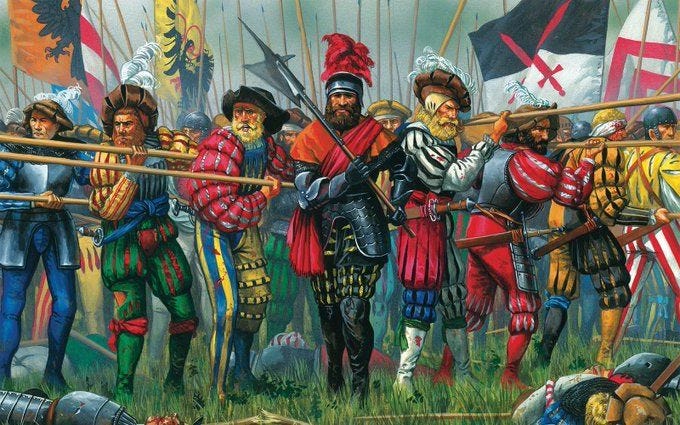 Landsknechts in formation. Warlord Community
Some Landsknechts looked like true royals, outshining nobility.
But sometimes imagination took a wild turn: shaggy hats or storm-baretts (beret); skirts and long coats with many folds and widely-cut; wide sleeves; doublets with slashes; woolen, wide decorated collars and wide breast panel; cut-outs at armpit; silver buttons around and in front; one-piece legs; divided lengthways in strips of different color, held in ribbons; widely-cut shirts; … the list design “innovations” is absurdly long.
Some Landsknechts appeared in costumes that had of different color and size for sleeves and hose — ridiculous even for their contemporaries. If seen today, they’d be mistaken for buffoons or clowns.
What began as an expression of professional pride became a competition in extravagance.
Maximilian, who needed them to die for the empire, may have let them dress whatever they liked in order to preserve their loyalty. Some historical accounts say he may have wanted to save on uniforms, which is plausible given the high cost of campaigns.
 CLICK ON IMAGE TO OPEN THIS STORY
Fashion restrictions
But not all agreed with the emperor.
A resolution passed by the Diet (council) of Constance in 1507, during Maximilian’s reign, included measures against clothing extravagance. It also addressed the pay, discipline and treatment of Landsknecht infantry.
In 1530, or 11 years after the death of Maximilian I, the Diet of Augsburg imposed dress regulations that explicitly restricted extravagant clothing according to social rank.
For example, the new code prohibited ordinary rural workers from wearing silk, gold, silver, pearls and ostrich feathers, and restricted their use of slashed or cut clothing. Urban artisans and ordinary merchants faced similar restrictions, although the precise allowances differed by social category.
 CLICK ON IMAGE TO OPEN THIS STORY
Whether the Landsknechts complied with those rules remains unclear, this aspect did not find proper coverage in medieval chronicles. The surviving sources screened for this story suggest that the flamboyant clothes disappeared gradually — along with the Landsknechts as a distinct military force.
Another unclear aspect is whether they wore the same extravagant clothes during battle or outside duty only — or in both cases.
The decline
The decline of Landsknechts began during the French Wars of Religion. A turning point is considered the Battle of Ivry in 1590, between the forces of France crown claimant Henry IV of Navarre (French mounted troops, Swiss Confederates and few English allies) and the Catholic League of France (Landsknechts and Swiss Confederates, some Walloon and Spanish allies).
The former had 12,000 infantry and 3,000 cavalry and the latter had 13,000 infantry and 4,000 cavalry, with both sides employing German-speaking Swiss Confederates.
In spite of the numerical superiority, the League lost the battle due to French cavalry’s skillful tactics. Henry’s forces eventually broke the League’s formations, killed and captured the commanding officers, sending the opposing army into retreat.
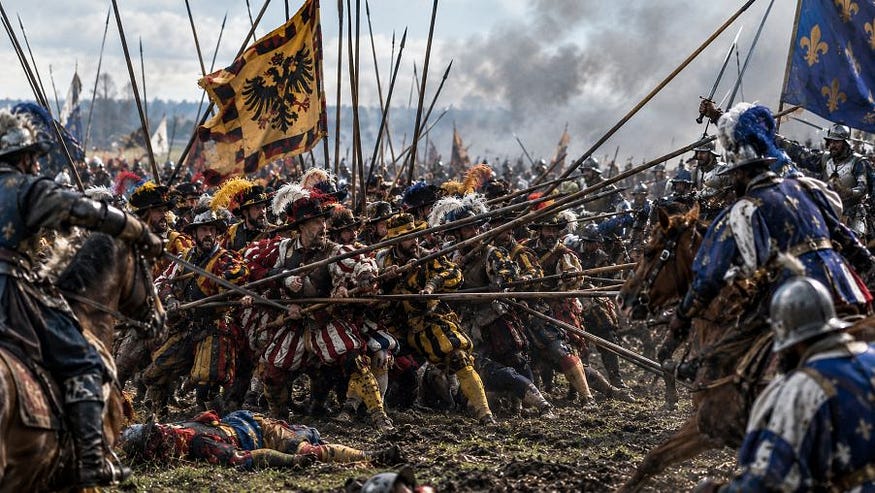 Generated with AI to illustrate the Battle of Ivry.
Yet, the League’s Landsknechts and Swiss soldiers left behind in the center stood their ground and remained isolated. The Landsknechts refused to surrender and were all killed.
The Swiss mercenaries also refused to capitulate, but were spared after their fellow Confederates from the other camp intervened for their lives. They received a certificate from Henry IV confirming that they had maintained their positions and had not laid down their weapons before he offered them mercy.
This episode offers a striking glimpse of the conflicting loyalties of mercenary life. Men hired to fight for rival rulers could still recognize ties to their compatriots — even when those ties meant sparing an enemy.
The Battle of Ivry and other battles that followed that decade exposed the weaknesses of the armies dominated by mercenary communities. European rulers increasingly showed signs of disillusionment with mercenaries especially after the Thirty Years’ War (1618–48) and began declining their services.
The late Middle Ages warfare in Europe was shifting towards regular national armies, with centralized command and mixed types of forces.
The Landsknechts, who were the response to the transition from armies of nobles to armies of mercenaries, were ultimately incorporated into permanent infantry forces and dressed in national uniforms.
 CLICK ON IMAGE TO OPEN THIS STORY
***
This story is free. If you have that crazy idea to support my writing effort, you probably have a healthy imagination. Thanks anyway.