

The Universe could be more dangerous than we think.
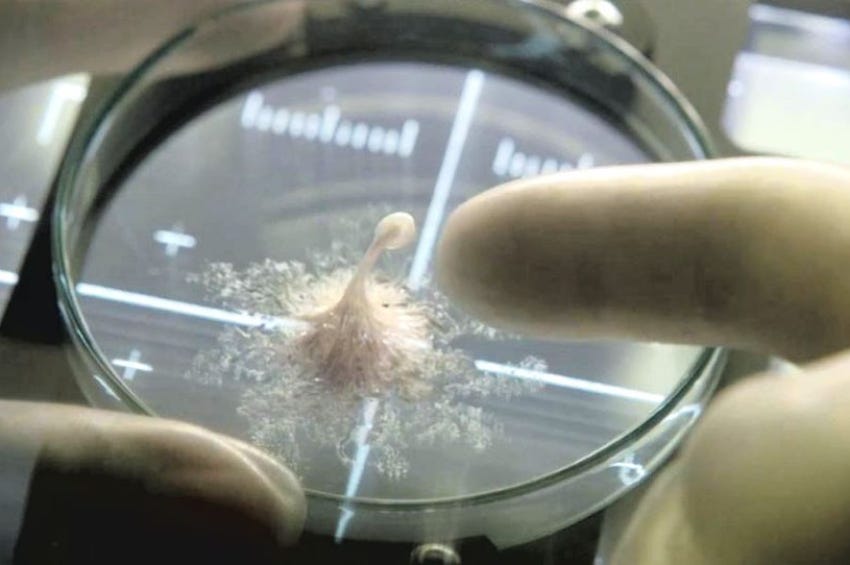 Screenshot from the sci-fi film Life.
Those who watched the 2017 science-fiction film “Life” have surely felts its grim note at the end: a tiny organism, brought back from Mars, escapes quarantine and reaches Earth, evolving and threatening humanity and life in general.
As frightening as this movie is, it may actually be over-optimistic.
This is because, in the film, the Martian creature is still built on the same basic chemistry as life on Earth. That is why humanity still has a chance to survive and contain the beast. But some scientists are worried about something even more dangerous — life based on a completely opposite form of biology, one that our immune systems might not even recognize, without mention fighting back.
That possibility gained attention after 38 researchers published a 299-page technical report called “Mirror Bacteria: Feasibility and Risks”, alongside an article in Science. Although the report focuses on synthetic biology and the dangers of creating mirror bacteria in laboratories, it also raises broader questions about what would happen if such organisms already existed elsewhere in the Universe.
Among those expanding the discussion is Harvard astronomer Professor Avi Loeb, whose career has been devoted to the search for extraterrestrial civilizations. In a blog post, he argues that mirror life could represent one of the greatest biological threats humanity has ever faced.
And he’s very serious about the issue.
The strange “handedness” of life
To understand the danger, it helps to understand one of life’s most fundamental properties: chirality.
Some molecules exist in two forms that are perfect mirror images of each other, much like your left and right hands. They look almost identical but cannot be perfectly superimposed. Scientists call this property chirality, or molecular “handedness.”
Life on Earth is remarkably consistent in the way it uses these molecules.
The sugars that make up DNA and RNA all have one handedness, while amino acids — the building blocks of proteins — all have the opposite one. This universal preference is known as homochirality, and virtually every living organism on Earth follows the same biochemical rule.
Why? Nobody knows.
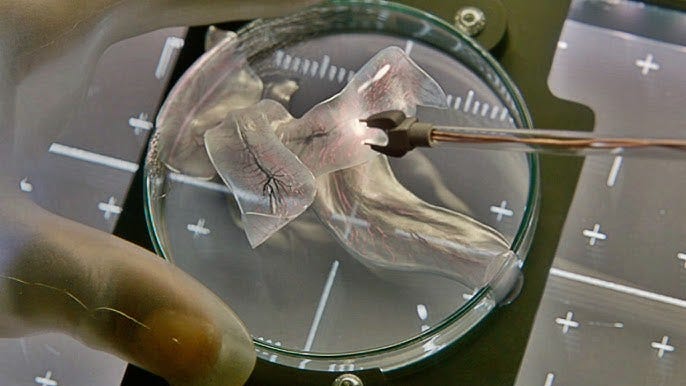 A screenshot from the sci-fi film Life.
Perhaps it was a random accident billions of years ago. Or perhaps the laws of chemistry strongly favor this arrangement everywhere in the Universe.
But there is another possibility. And this is the point this article was intended for. Life on another planet could have evolved using the exact opposite molecular handedness.
A mirror biosphere
Scientists call such hypothetical organisms mirror life.
At first glance, they might resemble familiar microbes. Underneath, however, every important biological molecule would be reversed, making them as chemically incompatible with Earth life as a left glove is with a right hand.
That incompatibility is what worries researchers.
The authors of the technical report warn that mirror bacteria could potentially evade many of the defenses that protect Earth’s plants, animals and humans. Immune systems evolved to recognize the molecular signatures of ordinary organisms known to us. Mirror organisms could, in theory, pass unnoticed while spreading through ecosystems.
The report primarily examines a future in which scientists accidentally create mirror bacteria through advances in synthetic biology. Its conclusion is stark: such organisms could pose an existential global risk, and the authors recommend that this line of research should not be pursued or halted immediately, if already started.
But what if nature got there first?
The same reasoning should also apply beyond Earth.
Mirror organisms may never have been engineered by humans, but they could have evolved naturally on another world. If this is true, then bringing them to Earth could be far more dangerous than anything created in a laboratory because they would exist entirely outside human control.
A sample returned from Mars, for example, or material carried inside a meteorite, or even a direct contact with extraterrestrial organisms could introduce mirror life into Earth’s biosphere.
If Earth’s immune systems cannot recognize such life, not only us but both sides could be vulnerable. Just as mirror microbes might devastate Earth’s ecosystems, ordinary terrestrial organisms could prove equally lethal to a mirror biosphere.
In other words, the first physical touch between two civilizations could become a biological catastrophe for both.
Why haven’t we seen aliens?
Loeb believes this possibility even offers an unusual answer to one of astronomy’s oldest questions.
For decades, people joked that touching an alien made of antimatter would trigger a spectacular explosion. Modern astronomy has shown that antimatter is extremely rare in the Universe, making that scenario highly unlikely.
Mirror life, however, may be a much more realistic concern.
If advanced civilizations discovered long ago that different forms of biology cannot safely mix, they might deliberately avoid physical contact with other inhabited worlds. Keeping their distance would simply be the safest strategy for everyone involved.
Until scientists determine whether Earth’s biochemistry is universal or merely one of two equally possible versions of life, Loeb argues that exploration should proceed with extreme caution. Missions that return samples from Mars, future human expeditions, and even long-term plans to colonize other worlds may all remain confined to science fiction.
The fact that Earth has never encountered widespread mirror life leaves scientists with two possible explanations. Either life throughout the Universe naturally converges on the same molecular handedness, or our planet has been extraordinarily fortunate for more than four billion years.
At the moment, nobody knows which explanation is correct. And nobody knows what actually happens during such an annihilation event. Before enterprising anything stupid, we must first answer a critical question: Is the rest of the Universe built the same way we are — or is it our mirror image?