

The young sultan defied Vichy government's orders during World War II.
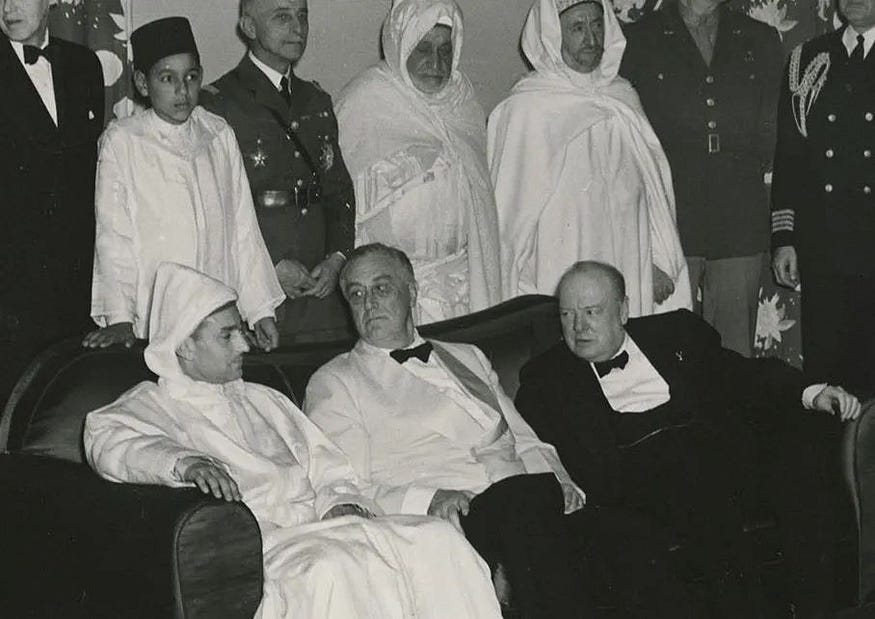 Sultan Mohammed (left) with US President Franklin D. Roosevelt and British Prime Minister Winston Churchill.
Morocco has been a rare example of a Muslim Arabic-speaking country that protected its Jewish population, with one of its rulers earning respect and gratitude from Western leaders at that time and many generations of Jews. As someone who has a second big heart for the Jewish nation, the Moroccan attitude inspires me to visit this African country someday.
This story also makes one point unmistakably clear: judging entire peoples by religion or identity is intellectually lazy and morally wrong. Muslims, like all others, are defined by their choices, not by the crimes committed by rulers who claim to speak for them. History does not indict nations or faiths — it indicts leaders who abuse power, and absolves those who choose decency.
A reasonable person does not hate Muslims because of Ayatollah Khamenei or Christians because of Pope Pius XII. Likewise, I would not hate Germans because of Hitler, Russians because of Putin, or Americans because of Trump. Period.
So, eighty-five years ago, in June, the Moroccan royal house of the Alaouite dynasty saved a quarter of million Jews from extermination, or at least three million if we count their offspring too.
In 1940, France fell and its collaborationist regime received instructions from Nazi Germany to send the Jews on its territories to death camps. When the Vichy government passed those orders to Morocco — a French protectorate — its 30-year-old nominal ruler, sultan Mohammed ben Youssef, openly defied the colonial power.
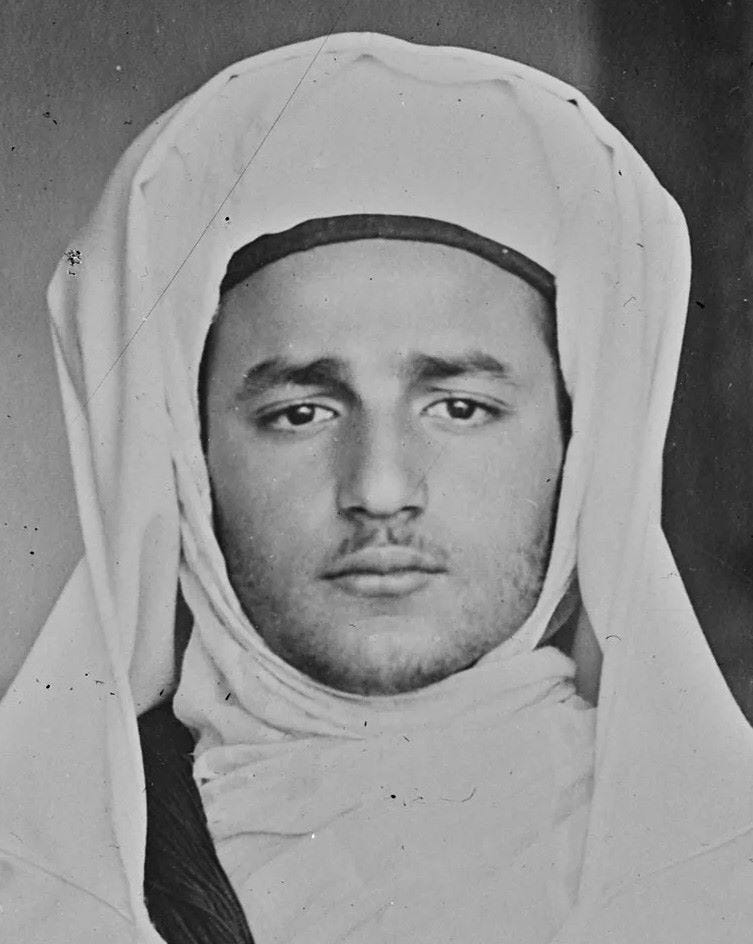 Young Mohammed, sultan turned king of Morocco. Credit: Wikicommons
Mohammed actually wasn’t supposed to sit on the Moroccan throne — his elder brother was entitled to inherit the role after the death of their father King Yusef ben Hassan in 1927. The French, however, picked up the younger brother who was only 18 in a hope that he would act as an obedient puppet, easy to manipulate.
They proved wrong.
As many as 250,000 Jews lived in Morocco at that time and most of them were integrated into the Muslim-dominated society. Though antisemitism existed, the Jewish community was not actively persecuted. It was largely allied with the ruling Alaouite dynasty and benefited from the royals’ protection.
When the Vichy government started implementing the Nazi “final solution” decrees on Jews, Morocco — along with other French colonies — received orders to deport its Jews to labor concentration camps, where they would be eventually killed.
“There are no Jews in Morocco. There are only Moroccan subjects,” Mohammed was famously quoted as saying by contemporary historians. “… it is my duty to protect them against aggression.”
The sultan secretly gathered the Jewish leaders at his palace to assure them that all Jews in his country would be treated as Moroccans, his subjects, and none would be deported or prosecuted based on race or ethnicity.
Mohammed’s daring reply and (lack of) action surprised French officials as the prince blocked the execution of criminal orders. It was only in October 1940 when the Vichy regime turned to direct implementation of orders in the colony.
In accordance with the rules of the protectorate, Mohammed was obliged to put his signature on them. As a result, many Moroccan Jews lost their jobs and had their businesses shut down. Some families were kicked out of their homes, being forced to live in squalid ghettos.
Some 2,100 Jews ended up in Vichy labor camps in the Sahara Desert as political prisoners who opposed the collaborationist regime. Although many of them died of malnutrition, disease or exhaustion, yet none was killed or deported to death camps, or imposed to severe physical violence by Moroccan law enforcements.
Sabotaging Nazi/Vichy orders
Mohammed had little incentive to oppose the Vichy government. By the end of 1940, Nazi Germany looked as if it was winning the war. Neither the United States nor the Soviet Union had entered the conflict, and Britain was the only power resisting Adolf Hitler’s armies in Europe.
However, Mohammed refused to meet with Nazi officials in Morocco. When it mattered most, he took a stand. Although he lacked true political power, the young sultan wielded significant symbolic influence.
In November 1941, during the Feast of the Throne — a holiday celebrating Mohammed’s rule — the sultan hosted a banquet following a day of pageantry. His guests of honor were rabbis and Jewish representatives. Vichy officials were outraged by the presence of Jews at the royal court, taking it as a direct challenge to their authority. Perhaps it was precisely Mohammed’s intention.
According to a report in the French state archives, Mohammed told them, “I absolutely do not approve of the new antisemitic laws, and I refuse to associate myself with a measure I disagree with. I reiterate as I did in the past that the Jews are under my protection, and I reject any distinction that should be made among my people.”
Some modern historians believe that Mohammed’s decision to defy the French was motivated by his personal desire to insult the colonial power, to show that he’s an independent sovereign, rather than truly protect the Jewish minority.
Whatever the motives behind his actions, Mohammed clearly saved hundreds of thousands of Jews, earning the respect of all citizens and — importantly — of the Allies fighting the Germans.
The sultan delayed or sabotaged the hostile operations carried out by French officials, and when 35,000 American troops landed on Moroccan seaside in November 1942, he welcomed them with open arms and even deployed Moroccan soldiers to fight the Nazis; many of them took part in the liberation of France.
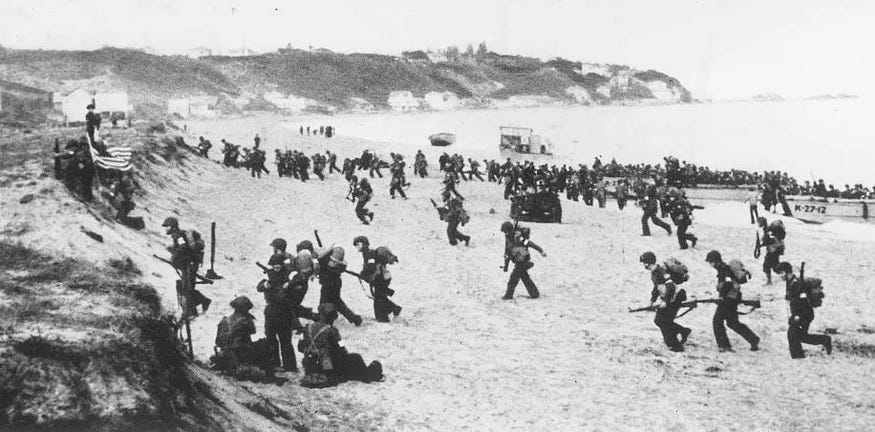 US troops landing in North Africa as part of the Torch Operations. Credit: Britannica
In 1943, Mohammed hosted the Allies’ Casablanca Conference, where he rubbed shoulders with U.S. President Franklin D. Roosevelt and British Prime Minister Winston Churchill. And in 1945, the sultan walked up the Champs-Élysées in the recently liberated city of Paris with French leader Charles de Gaulle.
Morocco’s independence
The French government nonetheless toppled Mohammed in 1953, fearing he would lead Morocco to independence. However, two years later he returned from exile and reclaimed the throne. A year later, Morocco gained independence and the new king, Mohammed V, gave Jews the same rights as Muslims, renewing his pledge of protecting them.
The Jewish community in Morocco has shrunk since then to less than 2,000 people as most Jews and their offspring emigrated to France, Canada or the U.S., or moved to the British-controlled Palestine to build a new state, Israel.
Mohammed V’s son Hassan and grandson Mohammed continued the policy of toleration towards Jews and other minorities.
The 2011 Moroccan constitution states that the country’s “indivisible national identity” has been “nourished and enriched” by “Hebraic” influence, among others.
May Lord bless Morocco.
***
This story was originally published in Medium.