

China has the world’s largest oil reserves and is best prepared for economic shocks.
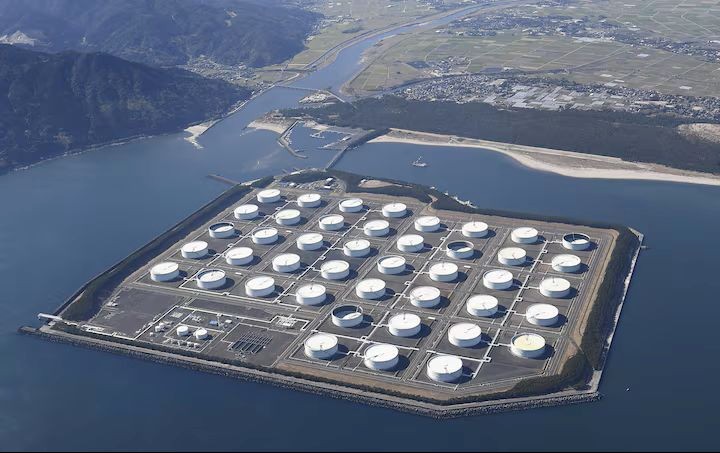 The Shibushi National Petroleum Stockpiling Base in Kagoshima, Japan. Kyodo Agency
When governments worry about an oil crisis, they do not rely only on the oil underground, but also on what has already been pumped, transported and placed into storage.
And by that measure, China stands far above the rest of the world.
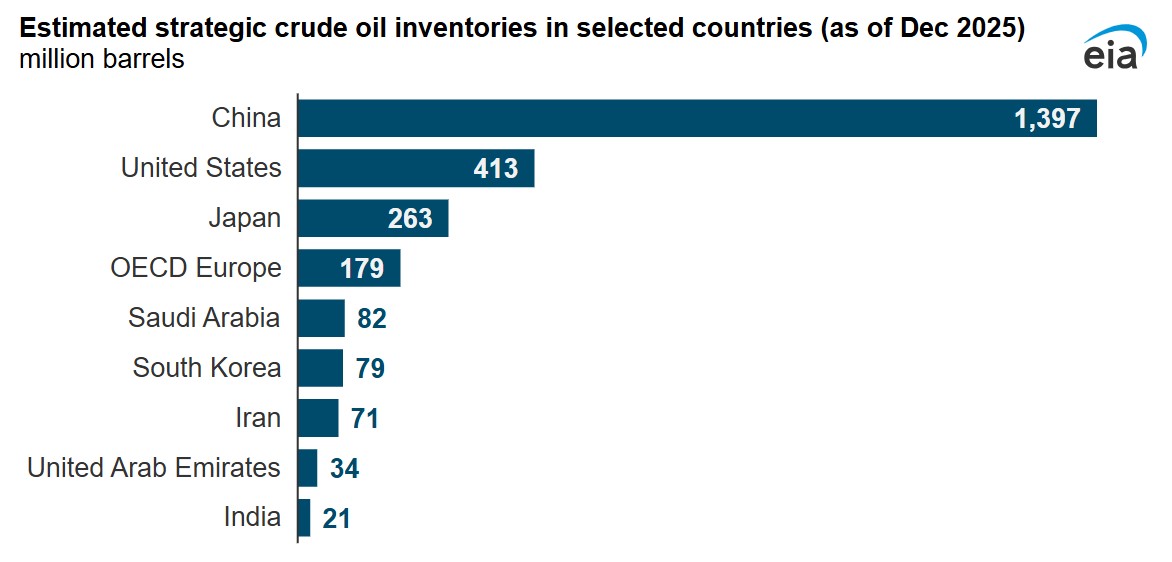
By the end of 2025, China accumulated 1.397 billion barrels of strategic crude oil, making its stockpile more than three times larger than that of the United States and larger than the combined inventories of the next several countries in the ranking.
The figures, compiled by the U.S. Energy Information Administration (EIA), estimate strategic crude inventories in on-land storage for last year. They reveal a striking feature of the global energy system: the countries with the largest oil reserves underground are not necessarily the countries holding the most oil above ground.
How Large Is China’s Reserve
China’s giant stockpile exceeds the combined stockpiles of the United States, Japan, OECD Europe, Saudi Arabia, South Korea, Iran, the United Arab Emirates and India.
China's enormous inventory is closely connected to the country's dependence on imported energy: the Beijing government is also the world's largest crude oil importer.
While other oil dependent countries are particularly exposed to disruptions along the maritime routes such as conflict, blockade, sanctions regime or major bottleneck at a strategic chokepoint such as the Strait of Hormuz, China’s large reserve of stored crude provides something perhaps more valuable than oil itself: time and domestic stability.
If imports are interrupted, oil already sitting in storage can help keep refineries operating while the government searches for alternative suppliers, reroutes shipments or waits for the disruption to end.
The latest EIA estimates indicate that China's inventory actually climbed to about 1.49 billion barrels by the second quarter of 2026, after reaching 1.541 billion barrels in the first quarter.
 America Comes Second
The United States ranked second with approximately 413 million barrels at the end of 2025.
Most of that inventory is associated with the Strategic Petroleum Reserve (SPR), created after the oil shock of the 1970s. The reserve is stored primarily in enormous underground salt caverns and was meant to protect the American economy against severe disruptions in petroleum supplies.
But the U.S. stockpile has fallen substantially over the first half of this year, down to 321 million barrels. Japan's inventory similarly declined from 263 million to 187 million barrels.
The reductions reflect the extraordinary energy disruptions of 2026 and the emergency measures taken by countries to release oil onto the market.
This is where Beijing's strategy fares better. While the U.S. has historically treated its strategic petroleum reserve as an emergency insurance policy, China has built a much larger physical buffer.
Japan's Energy Concern
Unlike China or the United States, Japan has very limited domestic oil resources. Its economy therefore depends heavily on imports, making energy security a fundamental national concern.
For Tokyo, maintaining large oil inventories is essentially an insurance policy against a country that has little control over the resources it needs to keep its economy running.
The same logic explains the presence of South Korea and India among the countries with strategic inventories.
Europe Has Oil — But Not in One Giant Tank
The European members of the Organization for Economic Cooperation and Development ranked fourth as a group, with a total of about 179 million barrels.
There is, however, an important difference between Europe and countries such as China or the U.S. Europe's strategic stocks are distributed among multiple countries rather than concentrated in a single national reserve.
This fragmentation reflects Europe's political structure: energy security is partly a national responsibility and partly coordinated through European and international institutions.
With the Iran crisis, OECD European countries had a cumulative reserve of approximately 130 million barrels in the second quarter of 2026, with France alone accounting for about 33 million barrels.
Oil Producers Also Keep Emergency Stocks
The ranking becomes particularly interesting when it reaches the oil-producing countries.
Saudi Arabia, the world's second-largest holder of proven oil reserves, had an estimated 82 million barrels of strategic inventory at the end of 2025.
Iran held approximately 71 million barrels and the United Arab Emirates had about 34 million.
At the same time, Saudi Arabia possesses roughly 267 billion barrels of proven reserves underground. Venezuela has even more – about 303 billion barrels, making it the world's largest holder of proven oil reserves.
These figures demonstrate why oil reserves and oil stockpiles should not be confused.
Venezuela's enormous geological wealth does not automatically translate into immediate energy security. Oil has to be extracted, processed, transported and sold. A barrel sitting in a storage facility can be deployed much faster than a barrel still trapped underground.
Three Rankings
The world's oil map therefore should therefore be viewed through completely different lenses, depending on what is being measured.
If the question is who owns the most oil underground, Venezuela, Saudi Arabia, Iran, Canada and Iraq dominate the ranking.
If the question is who can physically draw upon the largest strategic stockpile, China is in a category of its own.
And if the question is who produces the most oil every day, the picture changes again. The United States was the world's largest producer of petroleum and other liquids in 2025, followed by Saudi Arabia and Russia.
These three rankings — reserves, production and inventories — represent three different layers of energy power: Reserves provide long-term potential; production provides current economic power, stockpiles provide resilience during a crisis.
Which One Is Better Positioned?
A small exercise of imagination may help. Venezuela possesses more oil than anyone else. Saudi Arabia has enormous reserves and extraordinary production capacity. The United States remains the world's largest producer. China has the largest reserve.
In an oil crisis, the country with the most oil underground does not necessarily have the greatest immediate advantage – that belongs to the country that can keep the pumps running when everyone else is waiting for the next tanker to arrive.