

Alice Weidel is a typical hypocrite in German politics.
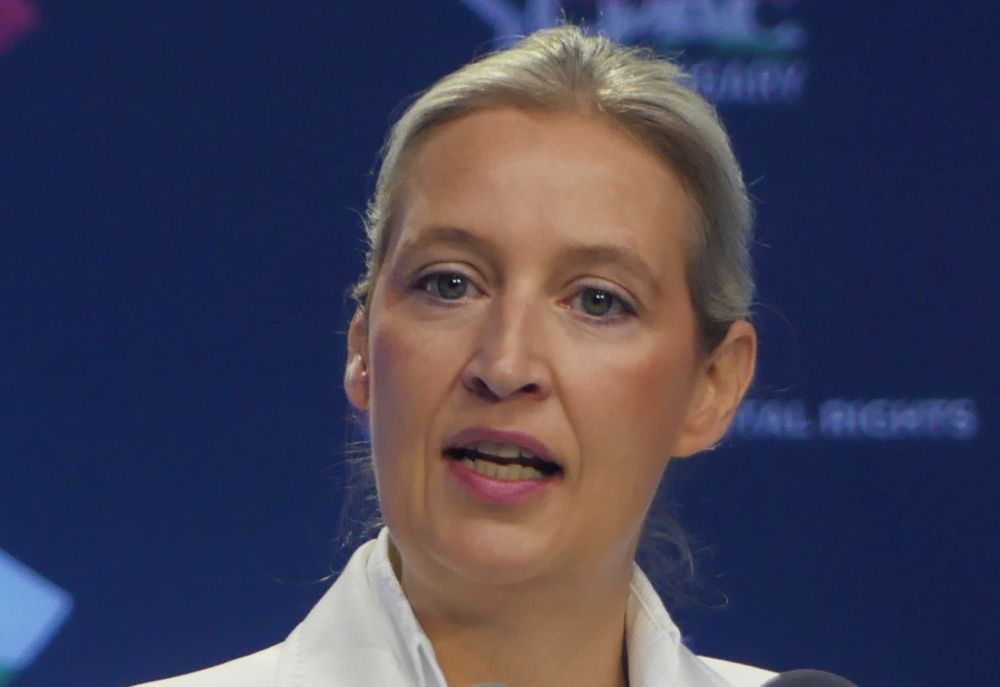 Alice Weidel. Wikipedia
Alice Weidel, co-chair of Germany’s far-right Alternative für Deutschland (AfD) and a member of the Bundestag, has built her political career around patriotism, nationalism, opposition to immigration and hostility toward what her party regards as the erosion of “traditional German values,” homosexuality included.
In the 6 September 2026 state election in Saxony-Anhalt, the AfD won 43.8% of the vote and 39 of the 83 seats in the state parliament, finishing first. The ruling CDU received 17.2% and 15 seats. U.S. President Donald Trump immediately congratulated Weidel with the victory.
It is time to know closer Miss Weidel, whose own family life sits uneasily with many of the principles she promotes for Germany.
Nazi Past
Weidel’s grandfather, Hans Weidel, served as a military judge in the Wehrmacht and as a Waffen-SS officer in Nazi-occupied Poland during World War II. A member of the National Socialist German Workers’ Party (NSDAP), he became a military judge at the Warsaw commandant’s office in July 1941. In 1944, he was promoted to Chief Staff Judge by the order of Adolf Hitler.
He was among roughly 3,000 Wehrmacht military judges who helped enforce Nazi military rule. German military courts issued an estimated 50,000 death sentences during the war, more than 20,000 of which were carried out, according to historian Claudia Bade, who found that the military courts’ record of executions far exceeded that of civilian Nazi courts.
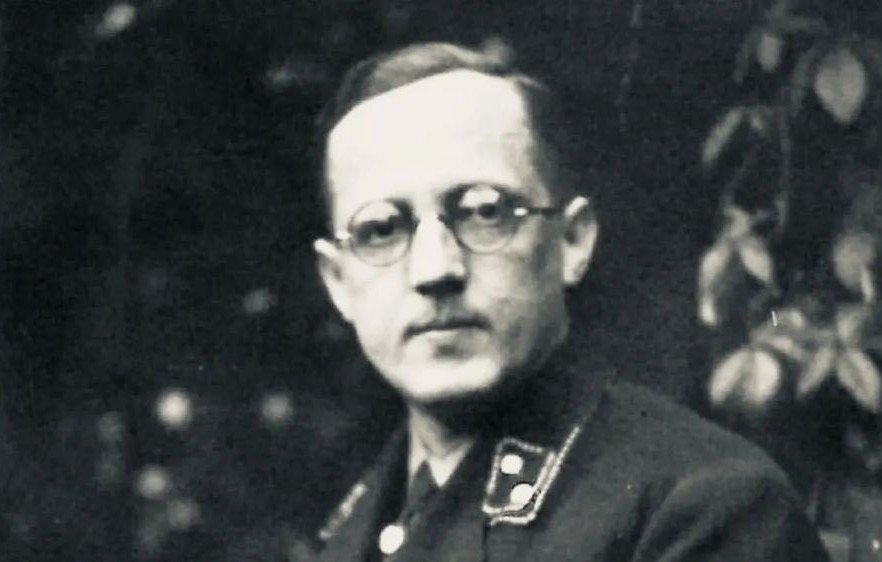 Hans Weidel. Wikipedia
Alice Weidel does not like being asked about her family’s past. She claimed she knew nothing about her grandfather’s Nazi past. According to her, there was little contact between them and the subject was never discussed in the family. She has also rejected any suggestion that she or the AfD shared Nazi values.
While Alice Weidel cannot be held responsible for the eventual wrongdoing of her grandfather, who had not been convicted after the war, her family history becomes politically relevant because she leads a party that has repeatedly challenged Germany’s approach to confronting its Nazi past.
Weidel’s Hypocrisy
But the deeper contradiction lies elsewhere: Alice Weidel's own private life is built around freedoms that the political movement she leads seeks to restrict for other Germans.
The AfD argues for stronger support for heterosexual families as its social model. In its own program, the party describes the family as consisting of father, mother and children, rejecting homosexual marriage and adoption of children by gay minorities.
Yet Weidel's own family looks very different.
She lives in a same-sex relationship with Sarah Bossard, a film producer who was born in Sri Lanka and raised in Switzerland after being adopted as an infant. The couple have two children and live in Switzerland, while Weidel maintains her political life in Germany. Her private life has repeatedly been described in the German media as being at odds with the social model promoted by the party she leads.
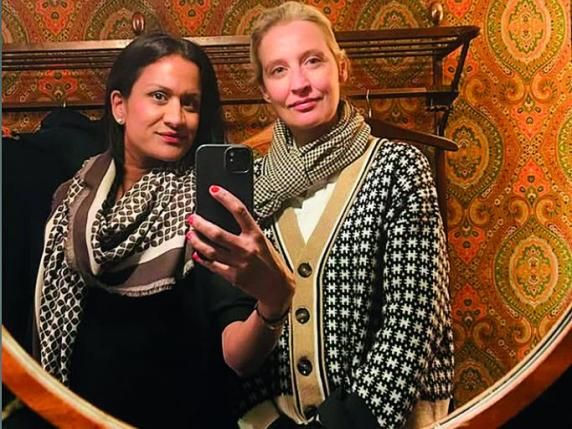 Sarah Bossard and Alice Weidel. Public domain
She admitted earlier that Switzerland was chosen as her place of residence for taxation reasons, which is an unpatriotic gesture no matter how you look at it.
On the other hand, there’s nothing illegal in Weidel's private life. Quite the opposite. In a liberal democracy, adults are free to choose whom they love, where they live and what kind of family they create, provided they respect the law and the rights of others.
And this is precisely what makes the contradiction politically interesting.
Private Life not Aligned with Her Political Program
Weidel has built her life around freedoms that her party has been trying to limit or reject as a matter of public policy. The AfD has opposed the recognition of same-sex marriage and the adoption of children by homosexual couples.
The question that begs is why the freedoms she considers acceptable for herself should not be equally available to Germans whose lives do not fit the social model promoted by her party.
If this isn’t hypocrisy, what is it then?
Weidel herself has spent substantial periods of her professional life abroad and speaks Mandarin, having previously lived in Singapore and Hong Kong. Yet she is one of the most prominent political faces insisting that Germany must reduce immigration, strengthen its national identity and put the interests of native Germans first.
The AfD advocates for restrictions on immigration and the repatriation of foreigners who are illegal in Germany. These proposals are difficult to understand at a time when the German labor force has been shrinking for years. Germany is now facing a decline in immigrant inflows and a record number of its own citizens leaving.
According to a June report released by Germany’s federal statistical office last June, immigration in Germany slowed down by 45% in 2025.
At the same time, more than 288,000 Germans left the country in 2025, the highest figure since migration records began in 1950. After accounting for returning Germans, the net outflow of German citizens was about 96,000 people.
The structure of emigration is quite interesting. According to this research, confirmed by another study, most emigrants are young adults (25–49), university graduates, skilled professionals, people with international careers, entrepreneurs and self-employed professionals.
The AfD never addressed this issue in its program and it is unclear how it’s going to maintain the labor market functional while the country is losing workers, if it ever wins the federal elections.
Anti-Ukrainian Rhetoric
Weidel’s inconsistency and contradiction become even more pronounced when she speaks about Ukraine. The AfD opposes Germany’s military and financial support for Kyiv and calls for negotiations with Russia to end the war.
In one recent public address, she portrayed the German assistance for Ukraine as money being wasted abroad while Germany itself suffers from poverty, deteriorating infrastructure and economic problems. But these are speculations – on the contrary, Germany has one of the best infrastructure in the world, a large trade surplus, and a well-paid labor.
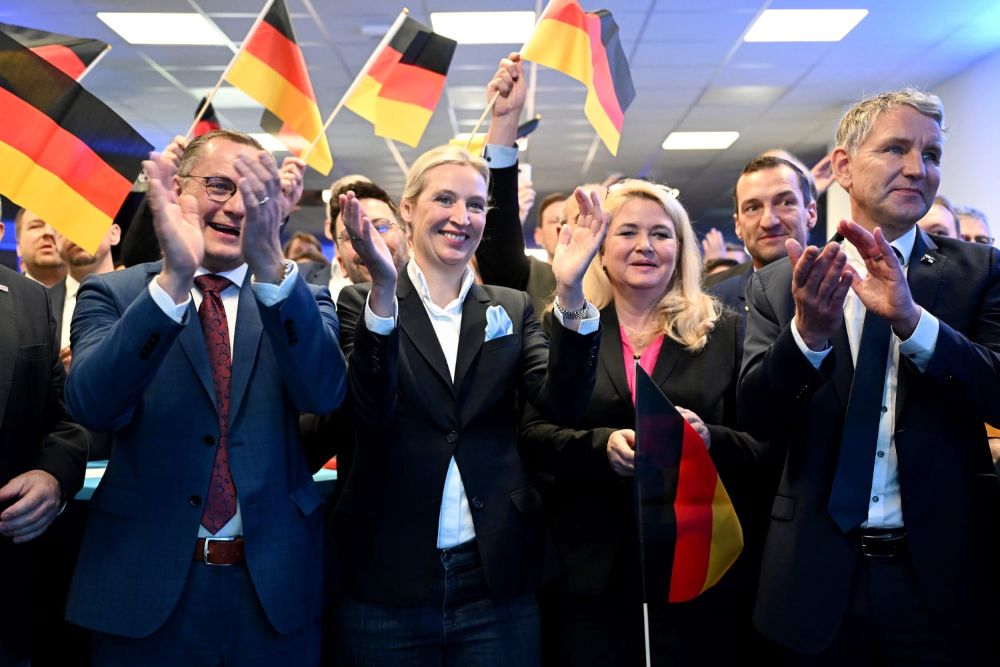 AfD leaders celebrating the election victory. Getty Images
But these claims are highly selective, if not outright misleading. Germany certainly faces economic difficulties and has significant problems with aging infrastructure. Yet it remains one of the world’s largest and wealthiest economies, with a highly productive workforce and a huge export sector. Germany recorded a goods-trade surplus of about €200.5 billion in 2025, according to the same Federal Statistical Office.
The AfD’s messages on Ukraine strikingly coincides with the Kremlin’s narratives. Weidel has been a frequent visitor to Moscow and AfD leadership has been accused of receiving Russian funding for political activity, which would be illegal under German law.
Suspicions of Russian Funding
German and international media have repeatedly reported on Russian attempts to cultivate the AfD, contacts between its politicians and Kremlin-linked figures, and allegations of Russian financial support. Yet no conclusive official finding has established that the AfD was illegally financed by Moscow.
The question, therefore, is not simply why Weidel wants Germany to spend less on Ukraine. It is why a politician who presents herself as defending German interests so consistently promotes a stance that coincides with Russia’s strategic interests?
So, Alice Weidel describes herself as a patriot of Germany, and yet she lives and pays taxes in Switzerland, seeks closer ties with Russia and the partition of Ukraine, and wants to expel the immigrants and ban homosexuals while sharing her bed with one.
The loudest patriots are often the first to exempt themselves from the rules they demand for everyone else.