

It has become a war meme that conquered the world and will last for generations.
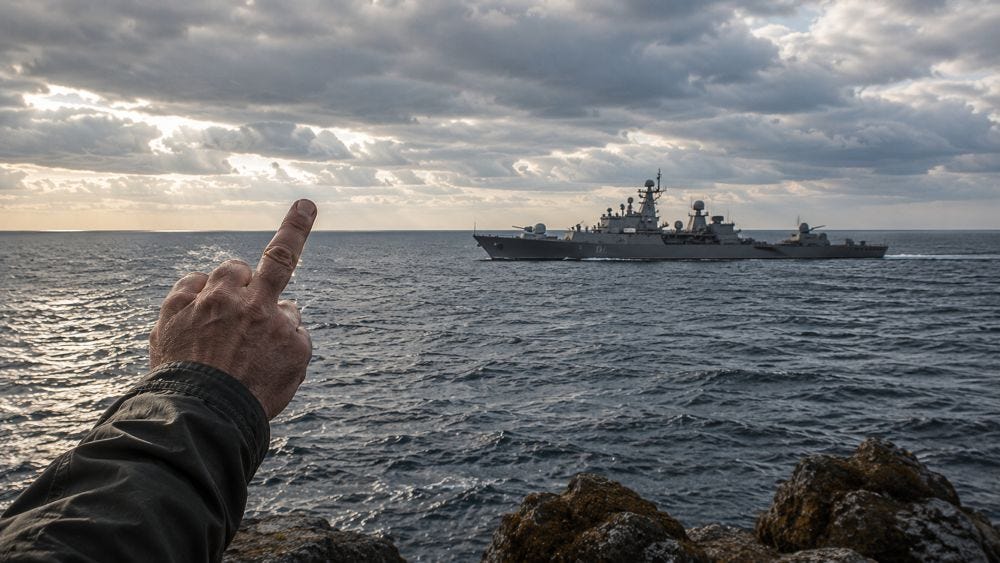 Generated with AI to illustrate the story.
Few phrases born during the war in Ukraine have traveled as far as “Русский военный корабль, иди на хуй” (“Russian warship, go f*** yourself”). It appeared in the opening days of Russia’s full-scale invasion in February 2022 and quickly became one of the most recognizable slogans of the conflict.
It was printed on T-shirts, posters and postage stamps, repeated by politicians, painted on walls, quoted in newspapers and social media, and understood by millions of people who did not speak Russian.
The story behind it made emotional headlines worldwide. On the first day of the invasion, Russian naval forces approached Ukraine’s tiny Snake Island in the Black Sea and demanded the surrender of the small Ukrainian garrison. According to the now-famous recording released by Ukrainian authorities, one of the defenders replied simply: “Russian warship, go f*** yourself.”
The island was captured shortly afterward, although the defenders, initially believed to have been killed, were later revealed to have survived and been taken prisoner before eventually being exchanged.
Russia occupied Snake Island for only a few months before withdrawing in June 2022 under sustained Ukrainian military pressure. Yet the island’s lasting significance was not strategic but symbolic. The brief encounter produced what may be the most successful meme of the war.
An effective communication tool
The slogan became an extraordinarily effective piece of wartime communication. It even has a Wikipedia page of its own.
Having worked in communications myself, I cannot help admiring its power. It encapsulated defiance, courage and national resistance in just a few words. It also turned Russian military power into an object of ridicule rather than fear. Despite being spoken in Russian — the language of the invading country — it was instantly recognizable across Europe and beyond.
It arguably did more for Ukrainian morale and international public sympathy than many carefully crafted government campaigns.
 A billboard in Dnipro, Ukraine, about the Russian warship.
Whether by design or by circumstance, the phrase perfectly matched the communication style associated with Ukrainian President Volodymyr Zelenskyi, himself a former actor and comedian who proved exceptionally skilled at turning short, emotionally powerful messages into global headlines. That does not mean the exchange was invented, but it does explain why it became such an effective symbol.
Yet behind the legend lies a surprisingly large number of questions. The last thing I want is to diminish a story that has inspired millions, but investigative curiosity in me simply wouldn’t let them pass unanswered.
Did the radio exchange really happen exactly as we know it?
There is little doubt that Russian forces demanded the surrender of Snake Island before occupying it. The uncertainty concerns the recording itself.
The famous audio released by Ukraine is only a short fragment. The public has never heard the complete exchange, making it impossible to know what preceded or followed the celebrated sentence. As a result, it is not possible to establish with certainty whether the recording is complete, edited or excerpted.
That uncertainty requires to question details that many people accepted without further thought.
The curious wording
One of the oddest features is the opening line:
“This is a Russian warship…”
To naval professionals, this sounds strangely generic.
Military vessels normally identify themselves by name, hull number, call sign or class. A commander would be expected to say something like “This is the missile cruiser Moskva” or “This is a vessel of the Russian Navy,” rather than simply “Russian warship.” No sober Russian speaks that way.
 CLICK TO READ MORE
Even the identity of the transmitting ship remains debated. Popular accounts associate the exchange with the missile cruiser Moskva, later sunk by Ukrainian missiles. However, interviews with survivors suggest the nearby patrol ship Vasily Bykov may actually have conducted the radio communications while Moskva remained farther offshore providing support.
The phrase “Russian warship” therefore appears unusually imprecise for professional naval communications.
“Russian” or “Russian Federation”?
The language raises another subtle question.
Official Russian military terminology overwhelmingly prefers российский (“of the Russian Federation”) when referring to state institutions such as the navy or armed forces. This word covers all ethnicities inside the country.
The recording instead uses русский, a more ethnic and colloquial adjective.
Russian sailors certainly use русский in everyday speech, so this alone proves nothing. But linguistically, the phrase sounds less like formal military language and more like ordinary conversational Russian — or even the wording a non-Russian speaker might instinctively choose.
Why ask for surrender at all?
Some aspects of the operation also appear counterintuitive at first glance.
The Ukrainian garrison reportedly consisted of only a handful of border guards and soldiers on an isolated rocky island. Against them stood a powerful Russian naval task force.
Why would such overwhelming force bother demanding surrender instead of simply bombing the place or landing troops?
Military logic offers a straightforward answer. The island hosted military communication, which the Russians needed for their own needs, therefore heavy artillery or missile fire was excluded. But a small garrison can still inflict casualties during an amphibious landing.
On the other hand, a radio demand costs nothing and may avoid unnecessary losses. Offering surrender is also consistent with long-established military practice and international law.
In that respect, the surrender demand itself is perhaps not unusual.
 CLICK TO READ MORE
The Georgian theory
Perhaps the most intriguing mystery concerns the slogan’s possible origin.
A persistent story claims that the expression did not originate in Ukraine at all, but during the 2008 Russo-Georgian War, when Georgian sailors supposedly responded to a Russian naval vessel with almost identical words.
The story is certainly plausible. Georgians had every reason to despise Russian forces after the war, and the phrase itself uses ordinary Russian profanity familiar throughout the former Soviet Union.
The problem is evidence.
Despite extensive searching, no contemporary newspaper article, military memoir, interview, recording or official document from 2008 has been found containing the alleged exchange.
I learned of this theory from colleagues who have visited Georgia and heard Georgians taking credit for this slogan. No official confirmation. The earliest verifiable references appear only after the Snake Island incident in 2022.
That does not necessarily mean the Georgian story is false. It may have circulated orally among veterans for years until someone published this joke and later took it down. But until pre-2022 evidence emerges, we won’t treat it as established fact.
Interestingly, two days after the Snake Island incident, a Georgian oil tanker reportedly answered a Russian request for fuel by repeating exactly the Ukrainian slogan before adding another sarcastic remark: “Use your oars.” In that documented case, however, the Georgians were clearly quoting the now-famous Ukrainian phrase rather than introducing it.
The slogan is arguably the world’s most famous sentence in Russian since the end of the Cold War. Millions of people who cannot say “good morning” in Russian know perfectly how to pronounce:
Русский военный корабль, иди на хуй.
That is extraordinary.
Normally, propaganda promotes one’s own language. Here, Ukraine managed to turn the aggressor’s language into one of its most effective psychological weapons.
 CLICK TO READ MORE
Russian silence
Another intriguing detail is the silence from the Russian side. Modern warships would normally be expected to record operational radio traffic, yet Russia has never released its own version of the exchange — not even to dispute Ukraine’s recording or use for its own propaganda.
That absence proves nothing on its own. The recording may simply confirm the published account, or operational considerations may have discouraged its release. Nevertheless, it leaves historians in the unusual position of reconstructing one of the war’s most famous conversations from a single, carefully selected excerpt.
Legend or carefully crafted symbol?
None of these questions proves that the Snake Island recording is fabricated.
It is entirely possible that the exchange occurred substantially as presented, even if the published recording is only an edited excerpt. It is equally possible that some wording was simplified or selected precisely because it would be immediately understandable to a global audience.
The remarkable success of the slogan owes less to its literal authenticity than to its symbolic power. Whether spontaneous or polished for public release, it achieved exactly what successful wartime messaging aims to achieve: it transformed a military setback — the temporary loss of a tiny island — into a lasting psychological and propaganda victory.
In April 2022, Ukraine issued a postage stamp depicting a lone border guard raising his middle finger toward the Russian missile cruiser Moskva. The stamp sold in enormous numbers, with people queuing for hours to buy it and funding this way directly the Ukrainian army. Just one day after its release, Moskva sank in the Black Sea following a Ukrainian missile strike, giving the slogan an almost mythical status.
The slogan’s success illustrates how modern wars are fought not only with missiles and drones but also with symbols. A short, emotionally charged phrase can spread across the internet in minutes, strengthen national morale, attract international support and shape how a conflict is perceived abroad.
More than four years later, “Russian warship, go f*** yourself” remains one of the defining catchphrases of the war. Like many famous wartime stories, it stands somewhere between documented history, national myth and information warfare.
The broad outline is well established, but the finer details remain open to debate. Once a story becomes a powerful national symbol, historical accuracy gradually becomes secondary to its cultural meaning. That is how legends are born.