

Researchers have observed tiny regions of complete darkness inside light waves moving faster than light itself. The discovery could help scientists explore some of nature’s fastest and most elusive processes.
 According to Einstein’s theory of relativity, nothing carrying mass or information can travel faster than light in a vacuum. However, scientists have now observed an unusual phenomenon that appears to challenge this fundamental limit: tiny points of complete darkness inside light waves that can move faster than the light surrounding them.
The observations confirmed a prediction originally proposed by British theoretical physicist Michael Berry in the 1970s. Berry had suggested that certain features of waves, including optical vortices, could move at superluminal speeds without contradicting the fundamental laws of physics.
An international team of researchers reported the discovery in a study published in the scientific journal Nature and explained by the authors in a press release for clarity among ordinary readers.
Their findings confirm a theoretical prediction made in the 1970s and offer new insights into how waves behave.
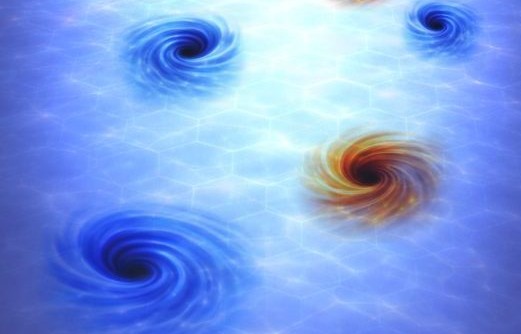
The phenomenon involves structures known as optical vortices. These are tiny regions within a light wave where the wave’s amplitude drops to zero, creating points of complete darkness. Unlike ordinary objects, these dark points have no mass and do not carry information. They can therefore move faster than light without violating Einstein’s theory of relativity.
Capturing the movement of darkness
To understand the discovery, imagine a whirlpool in a flowing river. The water continues moving in one direction, but the whirlpool itself can travel through the river at a different speed, sometimes faster than the surrounding flow.
Optical vortices behave in a somewhat similar way. They are not physical objects moving through space but specific features of a wave. Their position can change as the wave evolves, and under certain conditions, these points can move faster than the light wave itself.
The important distinction is that the movement of a feature within a wave is not the same as the movement of matter or information. The dark points can exceed the speed of light without transmitting a signal faster than light or breaking the laws of physics.
Although scientists had predicted the existence of these faster-than-light vortices decades ago, observing their movement directly was a major challenge.
To overcome it, the research team used a modified high-speed electron microscope capable of capturing extremely short-lived events. The researchers recorded changes occurring over intervals as brief as three quadrillionths of a second.
By combining hundreds of images collected during multiple experiments, they reconstructed the movement of the optical vortices. The resulting sequences revealed how the dark points interacted, collided and sometimes moved at speeds exceeding the speed of light.
Why the discovery matters
The findings may have implications far beyond the study of optical phenomena. According to the researchers, similar principles could apply to many different types of waves, including sound waves, fluid flows and complex systems such as superconductors.
The new imaging technique could also help scientists observe extremely small and delicate structures inside materials. By using electron interferometry to improve image sharpness, researchers may be able to track processes that were previously too fast or too difficult to observe directly.
This could open new possibilities in physics, chemistry and biology, where many important processes occur at extremely short timescales and are difficult to study using conventional imaging methods.
The discovery does not mean that we are closer to build spacecraft that could travel faster than light or that humanity is any closer to developing warp drives. Instead, researchers will be able to investigate some of the fastest processes in nature and improve our understanding of how waves behave across different physical systems.
The main idea that needs to be processed now by the scientific community is that certain patterns and features within waves can move faster than light without carrying matter or information at that speed.