

It had a rendez-vous with another planet.
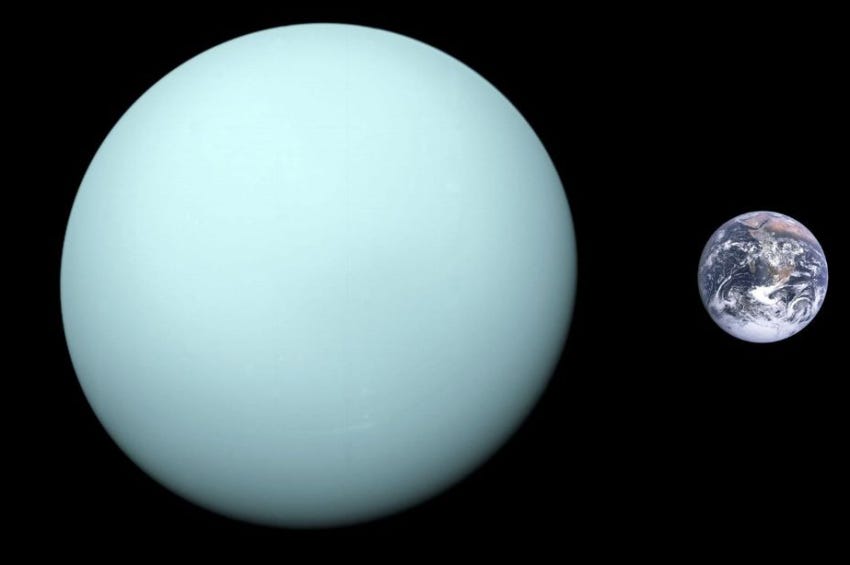 Uranus, the seventh planet from the Sun, is the oddball of the Solar System. Instead of spinning almost upright like the other planets, it rotates on its side, with its axis tilted by about 98 degrees.
For decades, astronomers have wondered how that happened. Now they think Uranus was struck by a giant object early in its history — one so large that it changed the way the entire planet spins.
A growing body of research points to this dramatic explanation: billions of years ago, young Uranus was smashed by a huge protoplanet. According to a study published in The Astrophysical Journal, the impacting object may have been twice the size of Earth.
That single collision could have rolled Uranus onto its side while astonishingly leaving its largest moons orbiting in the same tilted plane.
The crash didn’t just knock Uranus onto its side. Scientists think it also stirred up the planet’s interior, mixing its layers of ice, rock, and gas. That may explain why Uranus gives off surprisingly little internal heat compared to Neptune, which is otherwise very similar. The impact could also have changed the circulation of its atmosphere and left the planet with one of the Solar System’s strangest magnetic fields — tilted by about 59 degrees from its rotation axis and shifted far away from the planet’s center.
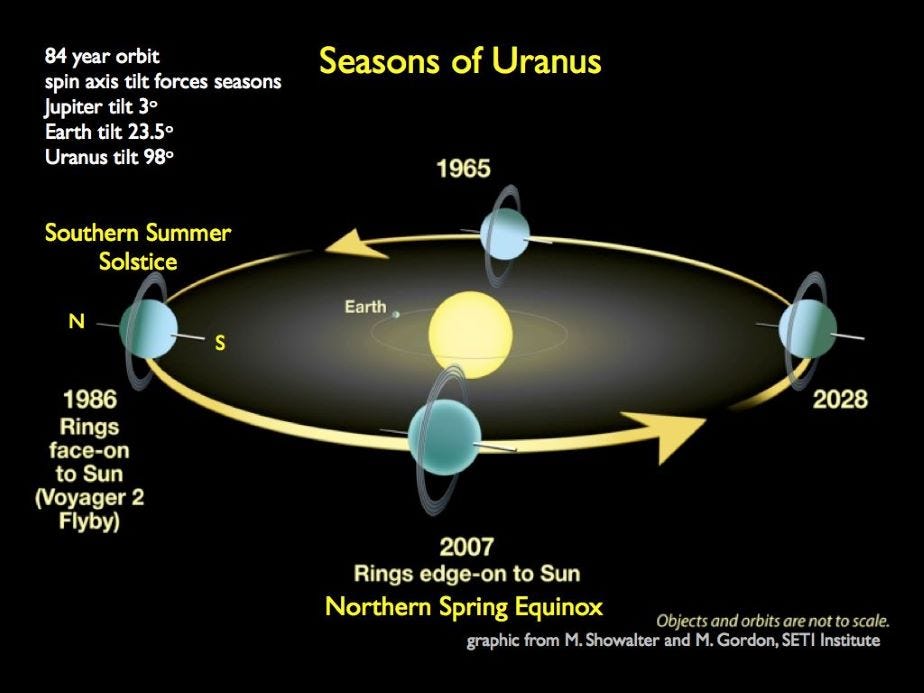 The unusual tilt also creates bizarre seasons. As Uranus travels around the Sun, each pole spends decades in almost constant daylight followed by decades of darkness. Its magnetic field is just as peculiar, with the magnetic poles sitting far away from the planet’s geographic poles.
Uranus’ 27 known moons also preserve clues to the ancient collision. Its five largest moons orbit neatly around the planet’s tilted equator, suggesting they either survived the impact or formed from debris after it. Farther out, several small irregular moons follow steeply inclined, elongated paths, hinting at a later and more chaotic history.
That single collision could have rolled Uranus onto its side while leaving its largest moons orbiting in the same tilted plane.
Despite its dramatic past, Uranus remains one of the least explored planets. It is an ice giant with a pale blue-green color caused by methane in its atmosphere. Deep inside, scientists believe it contains vast amounts of water, ammonia, and methane under enormous pressure, where these substances exist in exotic states unlike anything found on Earth.
Although people had seen Uranus with the naked eye for thousands of years, it wasn’t recognized as a planet until William Herschel discovered it in 1781. The only spacecraft to visit it was NASA’s Voyager 2, which flew past the planet in 1986 and sent back the first close-up images.
Ironically, Uranus may not be unique. Most planetary scientists think Earth also owes its existence to a giant collision. They believe a Mars-sized object slammed into the young Earth about 4.5 billion years ago, and the debris from that impact eventually came together to form the Moon.